Article: Travel Yoga Mat Dimensions: Length, Width, Thickness
Travel Yoga Mat Dimensions: Length, Width, Thickness
Most travel yoga mats run about 68 to 72 inches long and 24 inches wide, which is the same footprint as a standard mat. The big difference is thickness: travel mats are usually 1 to 2.5 mm, against 3 to 5 mm for a standard mat. That thin build is what lets them fold down to the size of a small packing cube. Below you will find the numbers, what each one means for your practice, and how to match them to your height, your luggage and your style of yoga.
TL;DR
- Typical travel mat: 68 to 72 inches long, 24 inches wide, 1 to 2.5 mm thick.
- Travel mats usually weigh under 2.5 lb and fold to roughly 12 x 6 x 2 inches, depending on the mat.
- Choose length by your height: aim for at least 6 inches more than you stand, and round up.
- Thin mats pack small. For more padding on hard floors, layer the mat over a hotel rug or towel.
- Check the folded size, not only the flat size, against the bag you actually carry.
Table of Contents
- Typical travel yoga mat dimensions at a glance
- Length: the number that decides whether your feet hang off
- Width: 24 inches is the default for a reason
- Thickness: what 1 mm, 2 mm and 3 mm feel like
- Weight: why ounces matter more than you think
- Folded size: the dimension that decides if it fits
- Travel mat versus standard mat: which dimensions change
- Packing a mat for flights
- How to choose your travel mat size in four steps
- Our perspective
- Find a travel mat that fits your bag and your practice
- FAQ
- Sources
Typical travel yoga mat dimensions at a glance
There is no single official standard for travel mats, so numbers vary a little between sources and brands. The ranges below pull together what published size guides report, and they agree on the overall picture.
| Dimension | Typical travel mat | Typical standard mat |
|---|---|---|
| Length | 68 to 72 in (173 to 183 cm) | 68 in (173 cm) |
| Width | 24 in (61 cm) | 24 in (61 cm) |
| Thickness | 1 to 2.5 mm | 3 to 5 mm |
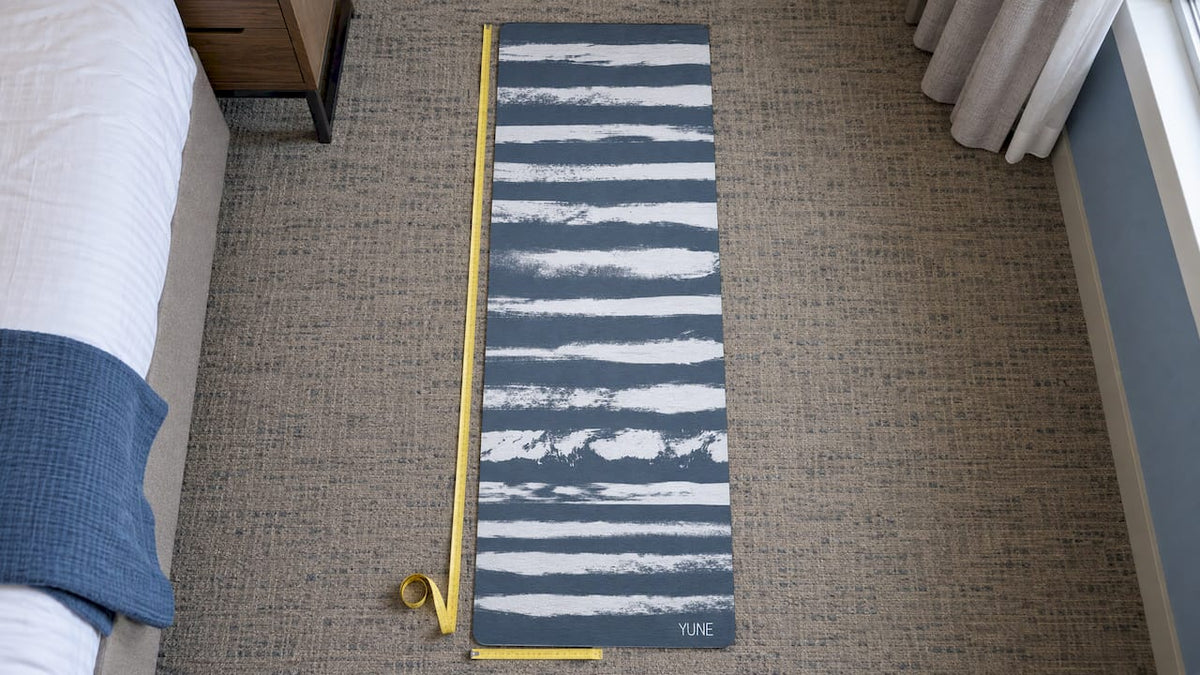
The length, width and thickness comparison comes from a yoga mat dimensions guide, which lists travel mats at 68 to 72 inches by 24 inches with 1 to 2.5 mm thickness, and standard mats at 68 by 24 inches with 3 to 5 mm. Some compact travel mats run shorter, in the 60 to 68 inch range, so always read the listing. If a mat is described only as “travel size,” look for the actual inches before you buy.
In other words, a good travel mat is not a smaller mat. It is the same mat with less material in it.
Length: the number that decides whether your feet hang off
Length is the dimension most people get wrong, because a short mat is easy to pack and tempting to choose. A mat that ends at your heels will not work in Savasana or in any pose where you lie flat.
A simple rule: take your standing height and add at least 6 inches. A size chart that covers this point says a mat should be at least 6 inches longer than your height so your whole body fits in supine poses without your feet hanging off the edge. Another guide gives the same idea in simpler words: match the mat to your height plus a few inches, and round up.
Here is how that works in practice:
| Your height | Minimum mat length | Practical pick |
|---|---|---|
| 5’2" (62 in) | 68 in | Standard 68 in |
| 5’6" (66 in) | 72 in | 68 to 72 in |
| 5’10" (70 in) | 76 in | 72 in or longer |
| 6’2" (74 in) | 80 in | Longest available |
The arithmetic is simply height plus 6 inches. If you land between sizes, go longer. A few extra inches in your bag cost you almost nothing, since thin mats fold small anyway.
If you are tall, check that a travel mat is offered in a longer length before you fall in love with a design. Many travel mats stop at 68 inches.

Width: 24 inches is the default for a reason
The usual 24 inch width fits most bodies and also matches the spacing in crowded studios. If you practice in a hotel room, a rental apartment or a park, you have no neighbor to worry about, so width becomes a matter of comfort.
A wider mat, about 26 to 30 inches, can make sense if your shoulders are broad in Savasana or if you practice restorative or prenatal yoga. The same sizing guide recommends that range for those cases.
The trade-off for travelers is straightforward: every extra inch of width adds to the folded size. For most people 24 inches is the sweet spot between space to move and a mat that fits a carry-on.
Thickness: what 1 mm, 2 mm and 3 mm feel like
Thickness is where a travel mat earns its name. Most travel mats are thinner than 3 mm. One media review of tested options says travel mats are usually 1 to 2 mm thick and typically weigh under 2.5 lb. A broader category listing puts them at 1/16 to 1/8 inch, which is about 1.5 to 3 mm.

SELF’s guide to travel mats quotes a registered yoga instructor explaining that standard mats are generally at least 3 mm thick, while something thinner is ideal for folding, rolling and squeezing into a travel bag.
Here is a practical way to think about it:
- Around 1 mm: the most compact option. It sits close to the floor, which many people like for balance poses, and it folds very small.
- Around 1.5 to 2 mm: the most popular middle ground. It still packs small, with a little more feel underfoot.
- Around 2.5 to 3 mm: more comfortable on wood or tile, with a slightly bigger folded size.
The tradeoff is padding. A guide to thickness categories says 1 to 2.5 mm mats pack small and grip well, but offer little padding on hard floors. The same guide notes that mats of 6 mm and up are kinder to sensitive knees and wrists but less stable in standing balances, because the foot sinks into the foam. So a thin mat suits standing flows and balance work especially well.
If you want extra cushioning for kneeling poses, Consumer Reports notes that layering a travel mat over a studio mat adds padding. On the road, a folded hotel towel or a yoga towel under your knees does the same job. Both are easy to bring.
Weight: why ounces matter more than you think
A mat that feels light at home can feel heavy at the end of a long travel day. The Consumer Reports testing found its four tested travel mats weighed between 2 and 5 pounds, mostly less than other types of mats. Condé Nast Traveler’s review puts the typical figure under 2.5 lb.
When you compare mats, look at weight and thickness together. A very thin mat made of dense material can still be heavier than you expect, and a slightly thicker mat in a lighter material can win on both comfort and weight.
Folded size: the dimension that decides if it fits
Flat dimensions tell you how the mat feels in use. Folded dimensions tell you whether it fits in your bag. One size chart gives an estimate of about 12 x 6 x 2 inches as the folded size of a typical travel mat. Your mat may differ, so look for the folded or packed measurements on the product page.
When you check a bag, measure three things:
- The shortest side of your packing space. A mat folded in thirds or quarters has a width of roughly 12 inches or more, so check it against the depth of your carry-on.
- The height of the folded stack. Thin mats stack neatly. A mat above 3 mm gets bulkier fast.
- Whether you prefer rolled or folded. A roll is longer but slimmer. A folded mat is squarer. The right choice depends on whether your bag has more length or more depth.
Our guide on how to fold a yoga mat for travel and storage walks through folding methods that keep creases low and the pack small.
Travel mat versus standard mat: which dimensions change
If you are deciding between a travel mat and a standard mat, here is the difference in plain terms.
| Travel mat | Standard mat | |
|---|---|---|
| Footprint | Often the same as standard | 68 x 24 in |
| Thickness | 1 to 2.5 mm | 3 to 5 mm |
| Weight | Usually under 2.5 lb | Heavier |
| Packing | Folds to fit a bag | Usually rolled, bulky |
| Best for | Trips, retreats, commutes, small spaces | Daily home practice |
You do not have to pick only one. Many people keep a thicker mat at home and a thin, foldable mat in their travel bag, so their practice follows them anywhere. For a deeper look at the full range of sizes, see our standard yoga mat guide.
Packing a mat for flights
A mat that is easy to pack is also easier to bring through the airport. Thin and foldable mats generally fit inside a carry-on or even a personal item, which saves you from strapping a roll to your backpack. For a closer look at what airlines and security expect in the United States, read our piece on carry-on yoga mats and size limits. If you want tips on keeping a mat flat and light, our guide to packing a foldable or under 2 mm mat covers the gate-side details.
A quick packing checklist:
- Measure your bag’s interior, not the outside.
- Fold the mat with the grippy side in, so it does not slide against clothes.
- Add a yoga strap to keep the fold tight and carry the mat over your shoulder.
- Wipe the mat dry before packing it after a sweaty session.
How to choose your travel mat size in four steps
- Measure your height and add at least 6 inches. That is your minimum length.
- Decide on width. Stay with 24 inches unless you want more room for shoulders or restorative work.
- Pick a thickness that fits your style: thinner for balance and flow, closer to 3 mm if you often practice on hard floors.
- Check the folded size and weight against your usual bag.
If you want a longer treatment of sizing across all mat types, our guide to choosing the right size and thickness goes through it in depth.
Our perspective
We design and curate mats for people who practice in more than one place. In our experience, the most common mistake with travel mats is choosing on weight alone and ignoring length. A mat that is light but too short ends up staying at home.
That is why we think about a travel mat as a full-size practice surface that happens to fold. Our Trekk travel mats are built for portability, and we pair that with the sustainable materials and design details that run through the whole Yune Yoga range. We want a mat you actually reach for, whether you are in a hotel room, a park or a spare corner of your apartment.
Our advice: choose the length first, then the thickness, then the folded size. If you do it in that order, the mat fits your body and your bag.
Nicholas
Find a travel mat that fits your bag and your practice
If you are ready to choose, our Trekk travel mats are made for practice on the road and at home. Compare the Fir Trekk Travel Yoga Mat, the Romeo Trekk Travel Yoga Mat and the Sagittarius Trekk Travel Yoga Mat. Each product page lists its own measurements, so you can check them against your height and your bag.

You can also browse the full range of yoga mats, towels and straps to build a travel kit in one order, or add a yoga strap and towel from our clothes and accessories collection.
FAQ
What are the dimensions of a standard yoga mat?
A standard yoga mat is typically 68 inches long and 24 inches wide, with a thickness of 3 to 5 mm. Some mats are longer, at 72 inches or more, for taller practitioners. Our standard yoga mat dimensions and buying guide covers the options in more detail.
How thick should a travel yoga mat be?
Most travel mats are 1 to 2.5 mm thick, with 1.5 to 2 mm a common middle ground. Thinner mats fold smaller, and mats closer to 3 mm give a little more feel underfoot. Choose based on how much floor padding you want and how small you need the mat to pack.
Is a 1/4 inch mat too thick for travel?
A 1/4 inch mat is about 6 mm, which is well above the usual travel range of 1 to 2.5 mm. It is comfortable for knees and wrists, but it will be bulkier and heavier to pack. If you want cushioning on the road, a thin mat layered over a rug or towel is easier to carry.
How much space do I need for a yoga mat?
Plan for the mat’s footprint plus a little room on each side, so roughly 68 to 72 inches by 24 inches of floor, and more space if you want to step out to the sides in wide-legged poses. In a hotel room, check that the mat fits between the bed and the wall before you start.
Can I fit a travel yoga mat in a carry-on?
Most foldable travel mats can, since they fold to roughly the size of a packing cube. Check the folded dimensions on the product page against your bag. Our guide on U.S. carry-on yoga mats explains how airlines set size limits.
Sources
- Yoga Mat Dimensions & Sizes: Standard Size in Inches and cm
- Yoga Mat Size Chart: Length, Width & Thickness
- The Best Travel Yoga Mats, Tested by Our Editors, Condé Nast Traveler
- Great Travel Yoga Mats, Consumer Reports
- 6 Best Travel Yoga Mats, SELF