U.S. Carry On Yoga Mats: TSA Allows Them, but Airlines Set Size Limits
Yes, TSA permits yoga mats in both carry-on and checked bags, but airline size limits and screening procedures determine how smoothly you travel with one. The TSA officer at your checkpoint makes the final call on any item, and cabin space decides whether your mat rides as your carry-on or personal item. Measure your packed mat, pick a travel-friendly style if you can, and keep any cleaning spray ready for the 3-1-1 liquids rule.
TL;DR:
- TSA officers retain discretion, and a rolled mat may prompt closer inspection, so keep it near the top of your bag for quick access.
- American Airlines lists a 22 by 14 by 9 inch cabin bag limit; measure your packed mat and check your own airline’s published dimensions.
- Foldable styles pack flat but sacrifice cushioning; mats under 2 millimeters offer little padding, while towels add grip over rented surfaces, not joint support.
- Keep cleaning spray in a container of 3.4 ounces or less inside your single clear quart bag, or pack wipes to avoid liquid restrictions.
- On regional aircraft or full flights, overhead space may run short; board early and keep your mat compact enough to fit under the seat.
Table of Contents
- TSA rules: official allowance and practical screening implications
- Airline carry-on size and how a mat fits the rules
- How to pack a yoga mat for carry-on travel
- Best mat types for travel: foldable, ultra-thin, and towel alternatives
- Cleaning sprays, liquids, and the 3-1-1 rule
- Gate-checking: when it happens and how to avoid it
- Yune Yoga travel mat options for carry-on packing
- Should you pack your own mat or use one at your destination?
- Travel-ready mats and accessories from Yune Yoga
- FAQ
- Sources
TSA rules: official allowance and practical screening implications
The TSA’s official listing for yoga mats confirms they are allowed in carry-on and checked baggage, a policy last updated September 22, 2020. That listing also makes clear that allowance is not automatic: TSA officers retain discretion over any item passing through screening, mat included.
In practice, a rolled mat often looks unusual on an X-ray image because of its dense, cylindrical shape. That can prompt an officer to pull your bag for a closer look or ask you to remove the mat for a hand inspection. None of this means your mat will be rejected. It just means you should pack it where you can access it quickly.
A few things make checkpoint screening faster:
- Keep the mat near the top of your bag rather than buried under other items.
- Remove any mat spray or cleaner before the bin reaches the scanner if an officer requests it.
- Expect that an unusual shape on the X-ray may trigger a bag check, not a confiscation.
Liquids packed alongside your mat, including sprays, follow a separate set of rules covered below.
Airline carry-on size and how a mat fits the rules
TSA clears your mat for the checkpoint, but your airline decides whether it fits in the cabin at all. Most U.S. carriers allow one carry-on bag plus one personal item per passenger. American Airlines lists carry-on dimensions up to 22 x 14 x 9 inches, and Delta applies a similar standard, requiring that carry-on items fit in the overhead bin or under the seat in front of you.
A yoga mat rarely fits inside a standard rolling suitcase without taking up most of the space, so most travelers handle it one of three ways:
- Roll or fold it small enough to slide into a carry-on bag alongside clothing.
- Strap it to the outside of a backpack or duffel that still meets size limits.
- Treat it as your personal item if it fits under the seat on its own.
Pro Tip: Before your trip, pack your mat the way you plan to travel with it, then measure the bundle against your airline’s published dimensions rather than guessing.
If your mat is borderline, most airports have a sizer box near the check-in counters where you can test your packed bag before heading to security. Calling your airline ahead of time is worth the five minutes, especially if you are flying a smaller regional jet where overhead bin space runs tight.

How to pack a yoga mat for carry-on travel
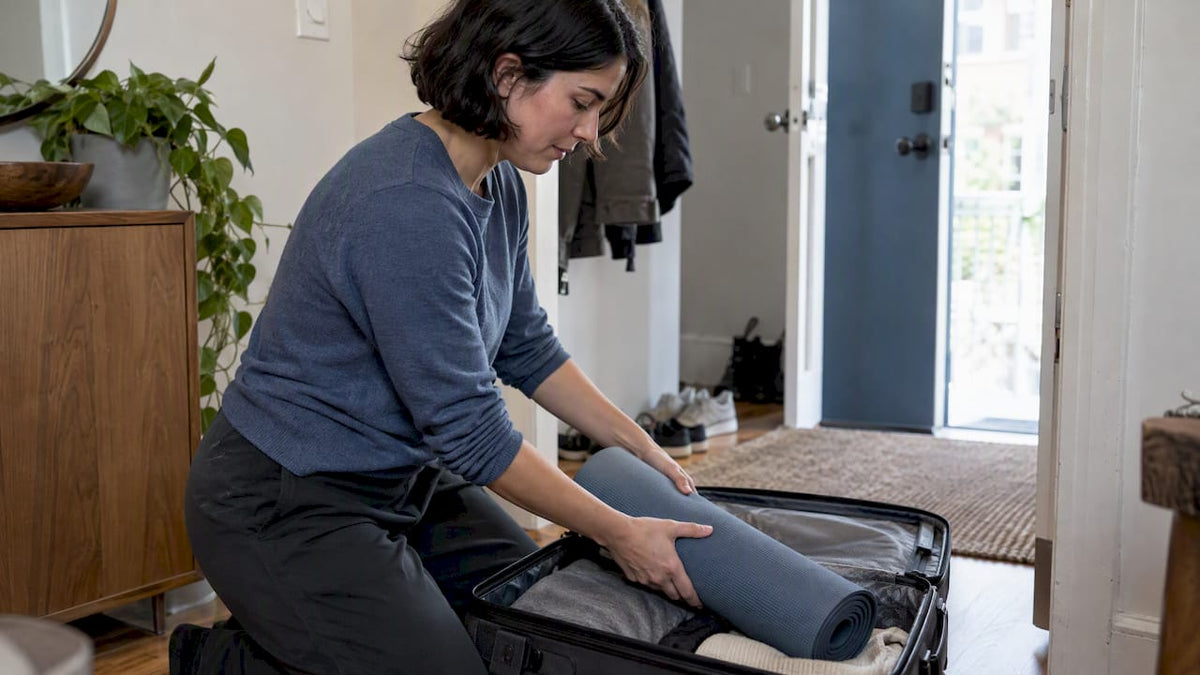
Getting a mat into a carry-on bag comes down to technique. A standard 72-inch mat rolled loosely can be nearly impossible to fit, but a tighter roll changes that.
- Lay the mat flat and fold it in half lengthwise before rolling, which cuts the roll diameter significantly.
- Roll from one end, keeping tension even so the roll stays compact instead of loosening in transit.
- Secure it with a compression strap or two rubber bands to lock in the smaller size.
Foldable mats skip this step entirely. Instead of rolling, they fold into a flat rectangle similar to a yoga block, which slides into a standard suitcase far more easily than a rolled mat. For anyone flying with limited space, a guide on packing a yoga mat walks through both rolling and folding methods in more detail.
A few packing habits help at screening:
- Use a removable mat carrier or sling so you can pull the mat out quickly if asked.
- Choose a backpack with built-in mat straps if you travel with your mat often.
- Keep the mat visible or near the top of your bag rather than wedged at the bottom.
Best mat types for travel: foldable, ultra-thin, and towel alternatives
Not every mat travels equally well. Three categories dominate the travel market, each with a different tradeoff.
- Foldable mats fold flat like a block, pack easily, and usually weigh less than a standard studio mat, though they often sacrifice some cushioning.
- Ultra-thin mats under 2mm roll into a tight, narrow cylinder that fits almost any carry-on, but offer minimal padding for joints on hard studio floors.
- Yoga towels weigh the least and pack flattest of all three, working as a grip layer over a rented or hotel mat rather than a cushioned surface of their own.
The right choice depends on your trip. A weekend studio retreat might call for a foldable mat that still offers decent cushioning, while a backpacking trip through several cities favors an ultra-thin mat or a towel that barely adds weight. For side-by-side comparisons of specific travel mats, our roundup of the best travel yoga mats breaks down weight, folded size, and material for each option. When shopping, look at folded or rolled dimensions in inches, not just overall mat size, since that number determines whether it fits your bag.
Cleaning sprays, liquids, and the 3-1-1 rule
If you pack a cleaning spray with your mat, it falls under TSA’s 3-1-1 liquids rule: containers of 3.4 ounces or less, all fitting in a single clear quart-size bag, one bag per passenger. Anything larger needs to go in checked luggage instead.
A few ways to stay compliant without leaving your mat unclean:
- Pack mat wipes instead of spray, since they skip the liquids rule entirely.
- Decant your usual cleaner into a travel-size bottle under 3.4 ounces.
- Keep your quart bag accessible in case an officer asks you to remove it for the scanner.
Packing your cleaner where you can reach it quickly saves time at the checkpoint and keeps your mat bag moving through screening without a second look.
Gate-checking: when it happens and how to avoid it
Gate-checking usually comes down to space, not your mat specifically. Delta notes that carry-on items must fit in the overhead bin or under the seat, and smaller regional aircraft simply have less of both. A full flight with limited overhead space can mean later boarders get asked to check bags at the gate, mat included.
A few tactics reduce that risk:
- Board as early as your ticket allows so you claim overhead space before bins fill up.
- Keep your mat compact enough to slide under the seat as a backup if bins are full.
- Ask the gate agent directly if cabin space looks tight before you board.
Pro Tip: If gate-checking seems likely, let the agent check your mat voluntarily rather than risk a rushed last-row scramble, and keep a luggage tag on it so it’s easy to spot at baggage claim.
Yune Yoga travel mat options for carry-on packing
Every packing strategy above points to the same conclusion: the right mat makes travel easier before you ever reach the airport. We carry foldable yoga mats built to fold flat rather than roll, which solves the bulk problem most travelers run into with standard mats. For trips where every ounce matters, our towel options, including the Jagger Yoga Towel and the Cassady Yoga Towel, work as a quick-dry, non-slip layer over a rented mat.
A few ways our product lines map to the packing tactics above:
- Foldable mats pack flat for suitcases, skipping the rolling step altogether.
- Microfiber towels add almost no weight or bulk for trips where a full mat is impractical.
- Our yoga clothes and accessories collection includes carriers and straps suited to keeping a mat compact and accessible at screening.
For more on choosing between these options, our guide to foldable yoga mats and our roundup of top travel mats cover material, weight, and folded dimensions in more depth.
Should you pack your own mat or use one at your destination?
Carrying your own mat makes sense when you practice daily, have a style of grip you rely on, or are headed somewhere with no guarantee of mat rentals, like a vacation rental or outdoor retreat. For a single class at a studio with mats included, renting usually beats hauling extra weight across an airport.
If you do travel without your own mat, pack a lightweight towel as a grip layer over whatever you’re handed. It solves the hygiene question without adding carry-on bulk, and it’s the same middle-ground approach we point travelers toward in our foldable and towel lines.
— Nicholas
Travel-ready mats and accessories from Yune Yoga
Packing for a flight gets easier when your mat is built for it from the start. Our foldable and ultra-thin mats fold or roll into a size that fits standard carry-on bags, made from eco-conscious materials that hold up to repeat travel without adding unnecessary weight.
Browse our full mat collection to compare foldable, natural rubber, and eco mat options side by side, or check out our yoga clothes and accessories for carriers and towels that round out a carry-on-ready setup. If you’re planning a trip soon, now’s a good time to measure your current mat and see whether a travel-specific option saves you space at the gate.
FAQ
Can I take a yoga mat on a plane?
Yes, TSA allows yoga mats in both carry-on and checked bags. Whether it fits in the cabin depends on your airline’s carry-on size limits and available overhead space.
How do I keep my yoga mat from smelling?
Wiping your mat down after each use with a quick-dry towel or mat wipes prevents moisture buildup that causes odor. If you pack a liquid cleaner, keep it under 3.4 ounces to meet TSA’s 3-1-1 rule for carry-on liquids.
What is not allowed in carry-on TSA?
Liquids over 3.4 ounces outside your quart bag, along with sharp or flammable items, are common carry-on restrictions, though a yoga mat itself is allowed. Check the TSA’s full prohibited items list if you’re unsure about a specific item.
What is the lightest yoga mat available?
Ultra-thin mats under 2mm and microfiber yoga towels are generally the lightest travel options, since they skip the thick cushioning of standard studio mats. Foldable mats weigh a bit more but still pack far lighter than a full-size rolled mat.
Sources
- Yoga Mat | Transportation Security Administration
- Carry-on bags and size limits | American Airlines
- Carry-On baggage | Delta Air Lines