Avoid Gate Hassles: Pack a Foldable or Under 2mm Yoga Mat
Pack your mat flat inside your suitcase or carry-on whenever the mat allows it. That single move protects it better than strapping it outside, and it sidesteps the awkward “extra item” question at the gate. If your mat won’t fold flat, a tight roll secured with a strap is the fallback. Either way, mats are fine to fly with: TSA permits yoga mats in both carry-on and checked bags. If comfort is your real worry, skip the bulky mat entirely and pack a small knee pad or a folded towel instead.
TL;DR:
- Pack foldable or thin rollable mats under 2mm in thickness for easier storage and less bulk in your luggage, avoiding stiff, bulky models.
- Always dry and clean your mat thoroughly before packing to prevent mildew and damage, and avoid packing damp or wet mats.
- Roll your mat tightly from the short end and secure with a strap or sleeve, using a cross-body strap for better weight distribution during carry.
- Store foldable mats flat, not folded long-term, especially natural rubber types, to prevent permanent creases and material damage.
- TSA allows yoga mats in carry-on and checked bags, but always verify your airline’s personal item size rules to avoid gate issues.
Table of Contents
- How to Pack a Yoga Mat in a Suitcase or Carry-On
- How to Roll and Strap a Mat for Carrying
- Folding a Pack-Flat Mat Without Wrecking It
- Protecting, Cleaning, and Drying Your Mat on the Road
- Choosing a Travel Mat: Foldable vs. Rollable, and How Thick Is Too Thick
- Travel Accessories That Make Packing Easier
- TSA and Airline Rules for Flying With a Yoga Mat
- Perspectives on Travel Mat Guidance
- Balancing Portability and Practice Quality on the Road
- Yune Yoga’s Travel Mat Options
- Sources
- FAQ
How to Pack a Yoga Mat in a Suitcase or Carry-On
Pack-flat works best when your mat is a foldable travel design or a thin rollable mat under about 2mm. Anything closer to a standard 5mm studio mat is too rigid to lie flat without eating your entire suitcase, so that category is better off rolled (more on that below).
Here’s the sequence that keeps a mat both protected and out of the way:
- Clean and fully dry the mat before you pack it. Any residual moisture gets trapped for hours in a sealed suitcase.
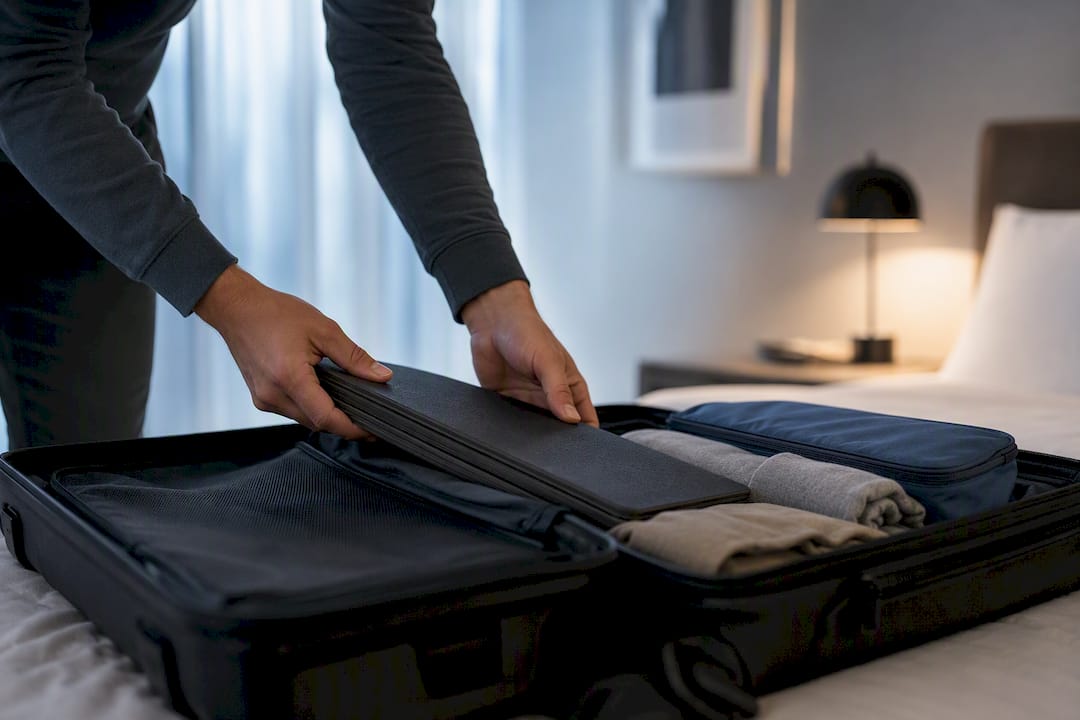
- Lay it flat against the suitcase’s back panel, the side that sits against your spine when you wear it as a backpack or the flat panel opposite the wheels in a rolling case. PackHacker’s packing guide recommends this placement specifically because it keeps the mat from bending around other items.
- Layer soft items in front of it — folded shirts, a hoodie, pajamas. These act as a buffer that stops the mat from creasing against zippers or hard edges.
- Use a packing cube to compress the soft layer and hold everything, including the mat, in place. Without that compression, the mat tends to shift and bunch during transit.
A few things to avoid:
- Don’t pack a damp mat, even for a few hours. Trapped moisture is how mildew smells start.
- Keep sharp items, like a razor or a mat scraper, in a separate pocket. A stray edge can scuff or gouge a natural rubber surface.
- Don’t force a thick mat to bend sharply just to make it fit. That’s how permanent creases start forming in the material.
Foldable mats built for this exact purpose, designed for portability, tend to handle this whole process with less fuss because the fold lines are engineered in rather than forced.
How to Roll and Strap a Mat for Carrying
Rolling makes more sense than pack-flat in three situations: road trips where trunk space isn’t tight, mats too thick to fold without cracking, and checked luggage where a rolled shape fits better around other gear than a flat rectangle does.
The technique matters more than people assume. A loose roll is bulky and prone to unraveling in your bag.
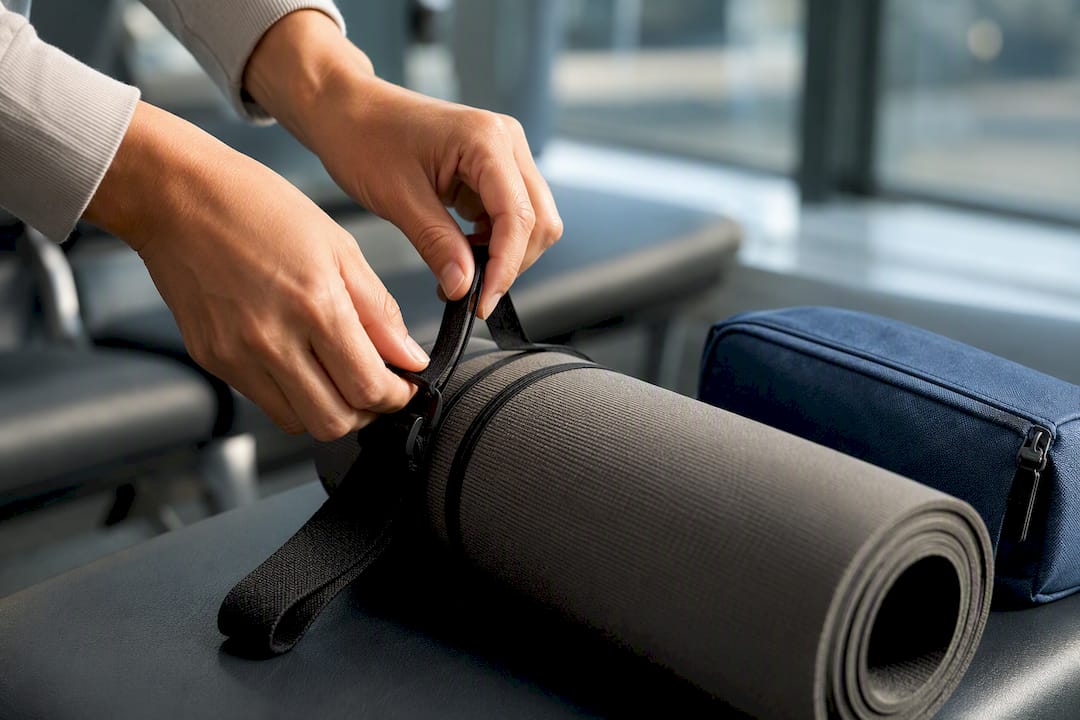
- Start from one short end and roll with even, moderate pressure the whole way. Don’t roll from a corner. That produces an oval cross section that’s harder to strap and takes up more space than a true cylinder.
- Keep the mat’s surface facing inward if it has texture on one side. This protects the grip surface from picking up dirt and grit.
- Compress as you go, rolling tighter with each turn rather than loosely coiling and hoping gravity does the work.
- Secure it with a strap or slip it into a mat sleeve immediately after rolling, before it has a chance to loosen.
For carrying, a sling-style strap that crosses the body distributes weight better than a simple loop, especially over a full day of walking between transit stops. A mat rolled and strapped this way rides securely enough to clear airport security without unraveling.
Pro Tip: Double up a rubber band or hair tie at each end of the roll before you clip on the main strap. It stops the ends from telescoping loose, which is the single most common reason a “secured” rolled mat ends up half unrolled by the time you reach your gate.
Folding a Pack-Flat Mat Without Wrecking It
Foldable mats are built to take creases without damage, but the way you fold still matters over dozens of trips.
- Fold in half, then in half again, following the mat’s built-in fold lines rather than improvising your own. Most travel mats are engineered with reinforced fold zones exactly where the manufacturer wants the crease.
- Rotate which fold lines take the load trip to trip if your mat allows more than one folding pattern. Constant pressure on the same hinge accelerates wear there.
- Unfold the mat and let it rest flat as soon as you arrive, even for just an hour before your first session. This relaxes the material back toward its original shape.
Natural rubber mats are the one category where folding tight and often is genuinely risky. WeTravelInColor’s travel guide notes that folded mats can develop permanent creases if left folded for extended periods, and rubber is more prone to this than synthetic blends. If your mat is natural rubber, roll it loosely for storage between trips rather than leaving it folded in a bag for weeks.
Protecting, Cleaning, and Drying Your Mat on the Road
Here’s the rule that matters most: never pack a mat that’s still damp, whether from sweat, a rinse, or hotel-room humidity. A sealed suitcase with a wet mat inside is close to ideal mildew conditions.
- Wipe down natural rubber mats with a diluted vinegar solution or a mat-specific cleaner. Harsh alcohol-based sprays can dry out and crack rubber over repeated use.
- TPE and PVC mats tolerate a slightly stronger cleaning wipe, but skip anything with bleach.
- Air-dry the mat over a shower curtain rod, balcony rail, or open window rather than folding it away wet.
- Pack a waterproof sleeve or a large zip-top bag for the mat if you’re traveling somewhere humid or if there’s any chance it goes into the suitcase before it’s fully dry.
- Bring a travel towel to lay over the mat during practice. It keeps sweat off the surface entirely, which cuts down how often you need a deep clean.
Pro Tip: If you’re pressed for time before a flight, roll the mat inside a dry towel for ten minutes. The towel pulls a surprising amount of residual moisture out, especially from textured rubber surfaces where water hides in the grip pattern.
Choosing a Travel Mat: Foldable vs. Rollable, and How Thick Is Too Thick

The honest answer is that the best travel mat is the thinnest one you can tolerate, with local padding added where you actually need it. That’s a different philosophy than buying one mat to do everything.
Thickness bands break down roughly like this, based on how travel-mat guides categorize the tradeoffs:
- 1 to 1.5mm: Maximizes packability and weight savings. Minimal cushioning, so your knees and wrists feel the floor directly.
- 2mm: The common travel compromise. Thin enough to fold or roll small, thick enough to blunt hard floors somewhat.
- 3mm and up: More comfortable underfoot but starts eating into the packability advantage that makes a “travel mat” worth buying in the first place.
Foldable pack-flat mats have the edge for carry-on travel because they tuck into luggage without adding bulk. Rollable thin mats give up a little of that convenience but often feel closer to a regular practice mat underfoot.
Material affects more than feel. Natural rubber grips well even when your hands or feet are damp with sweat, which matters more on a hot studio floor than people expect, but it takes longer to dry than synthetic blends. TPE dries faster and weighs less, a real advantage if you’re doing laundry sinks and hotel towel racks between sessions. If frequent flying is your pattern, Condé Nast Traveler’s roundup leans toward prioritizing weight and quick-dry material over sheer thickness, and that tracks with what most road warriors actually report liking.
Travel Accessories That Make Packing Easier
A short kit solves most of the friction points travelers run into.
Essentials worth having every trip:
- A strap or sling for carrying a rolled mat hands-free
- A slim mat bag or sleeve to keep it separate from clothes
- A travel towel that doubles as a sweat layer and a drying tool
- A micro knee pad, or a folded hand towel, for joint comfort on hard floors
Nice-to-haves that solve specific annoyances:
- A packing cube sized to compress a folded mat and soft layers together
- A waterproof sleeve for a mat that might still be slightly damp
- A small pack of disinfectant wipes for hotel-room floors or shared studio spaces
Copy this into your packing list before your next trip:
- Mat (folded or rolled, fully dry)
- Strap or mat sleeve
- Travel towel
- Knee pad or folded towel
- Packing cube
- Waterproof sleeve (optional, humid climates)
A compact accessories checklist built around exactly this kind of kit is worth keeping on hand if you travel with a mat more than a couple of times a year.
TSA and Airline Rules for Flying With a Yoga Mat
Mats clear security fine. TSA lists them as an allowed item in both carry-on and checked baggage, subject to normal screening.
Where it gets messy is the airline’s own size rules, not TSA’s. Personal-item and carry-on dimensions vary by carrier, and a mat strapped to the outside of a bag can sometimes get flagged as a second item at the gate. Airline policy summaries consistently flag this variation as the part travelers overlook, since a mat carried separately isn’t always treated the same as one packed inside your existing bag.
Practical moves that avoid the problem entirely:
- Pack the mat inside your carry-on or checked bag rather than strapping it externally.
- Check your specific airline’s personal-item policy before you fly, especially on budget carriers.
- Bring a foldable mat on flights. It removes the external-item question completely.
Perspectives on Travel Mat Guidance
Yune Yoga builds its foldable and natural rubber travel mats around exactly the packing problem this article covers: getting a real practice surface into a suitcase without the bulk of a studio mat. The foldable yoga mat line is designed to fold along reinforced lines rather than crease randomly, which is the difference between a mat that lasts one season of travel and one that lasts years.
Expect some crease lines on any foldable mat. That’s normal, not a defect. If you fly often and want the thinnest possible profile, lean rollable and thin. If you want more cushioning and pack-flat convenience matters less, a foldable mat with slightly more thickness is the better tradeoff. Natural rubber cleans up with a light, non-alcohol wipe. Neither choice is wrong. It depends on how you actually travel.
— Nicholas
Balancing Portability and Practice Quality on the Road
Portability wins on short trips and anything involving a flight. Comfort wins on retreats or stays longer than a week, where a slightly heavier mat is worth the suitcase space. For a weekend studio visit somewhere new, renting or borrowing a house mat is a perfectly reasonable call, not a compromise. What actually matters is picking one strategy per trip type and sticking with it, instead of relitigating the decision every time you pack.
Yune Yoga’s Travel Mat Options
Yune Yoga is the direct route to a travel-ready mat without piecing together a DIY solution from a studio mat, a strap, and a prayer. The Foldable Yoga Mats collection covers exactly the pack-flat need this article walks through, built from eco-conscious materials so you’re not trading sustainability for portability. If you’d rather stick with a natural rubber feel and skip the fold entirely, the Natural Rubber Mats line rolls down to a manageable size for checked luggage.
Pairing a mat with a strap, travel towel, or slim carrying bag rounds out a kit that survives repeat trips instead of falling apart after one. The Yoga Clothes and Accessories collection covers straps and towels sized for exactly this. Browse the Yune Yoga collections to match a mat to how you actually travel, whether that’s a weekend flight or a month-long retreat circuit.
Sources
For the official word on flying with a mat, see TSA’s guidance on yoga mats, and confirm your carrier’s own carry-on rules separately since those vary by airline. For more packing-focused reading, see Yune Yoga’s guide to international travel tips for yogis and its roundup of travel yoga mats.
- HTS Yoga — Best travel yoga mat: foldable, lightweight & carry-on guide
- Condé Nast Traveler — Best travel yoga mats
- PackHacker — Travel yoga mat guide
FAQ
What Is the Best Way to Roll Up a Yoga Mat?
Start from one short end and roll with steady, even pressure the entire length, rather than starting from a corner. Keep the textured or grip side facing inward to protect it from dirt, and secure the roll immediately with a strap or mat sleeve before it loosens.
What Is the Best Way to Store a Yoga Mat?
Store it rolled loosely, not folded, especially if it’s natural rubber, since permanent creases can form from long-term folded storage. Keep it somewhere dry and out of direct sunlight, which degrades both rubber and synthetic mat materials over time.
Is It Okay to Fold a Yoga Mat?
Yes, if it’s a foldable travel mat designed for it. Regular fold lines are built into these mats specifically to handle repeated folding, though letting the mat rest flat after each trip helps it hold its shape longer.
What’s the Best Way to Carry a Yoga Mat?
Inside your suitcase or carry-on, packed flat against the back panel, is the most protected option and avoids any question about it counting as an extra item at the gate. If it has to be rolled and carried externally, a cross-body strap distributes the weight better than a simple loop over one shoulder.
Can I Bring a Yoga Mat on a Plane?
Yes. TSA permits yoga mats in both carry-on and checked baggage, subject to standard screening. The one thing to check separately is your specific airline’s personal-item size policy, since that’s set by the carrier, not TSA.