Travel Yoga Accessories Checklist: Pack Light, Practice Well
A travel yoga accessories checklist is the difference between a consistent practice on the road and a week of skipped sessions. The right gear fits in a carry-on, works across climates, and covers every scenario from a beach sunrise flow to a hotel room wind-down. Yuneyoga builds its travel line around exactly this standard: lightweight, eco-conscious, and genuinely multifunctional. This guide covers every category you need, from mats and towels to clothing and optional props, so you pack only what earns its place in your bag.
1. What belongs on your travel yoga accessories checklist
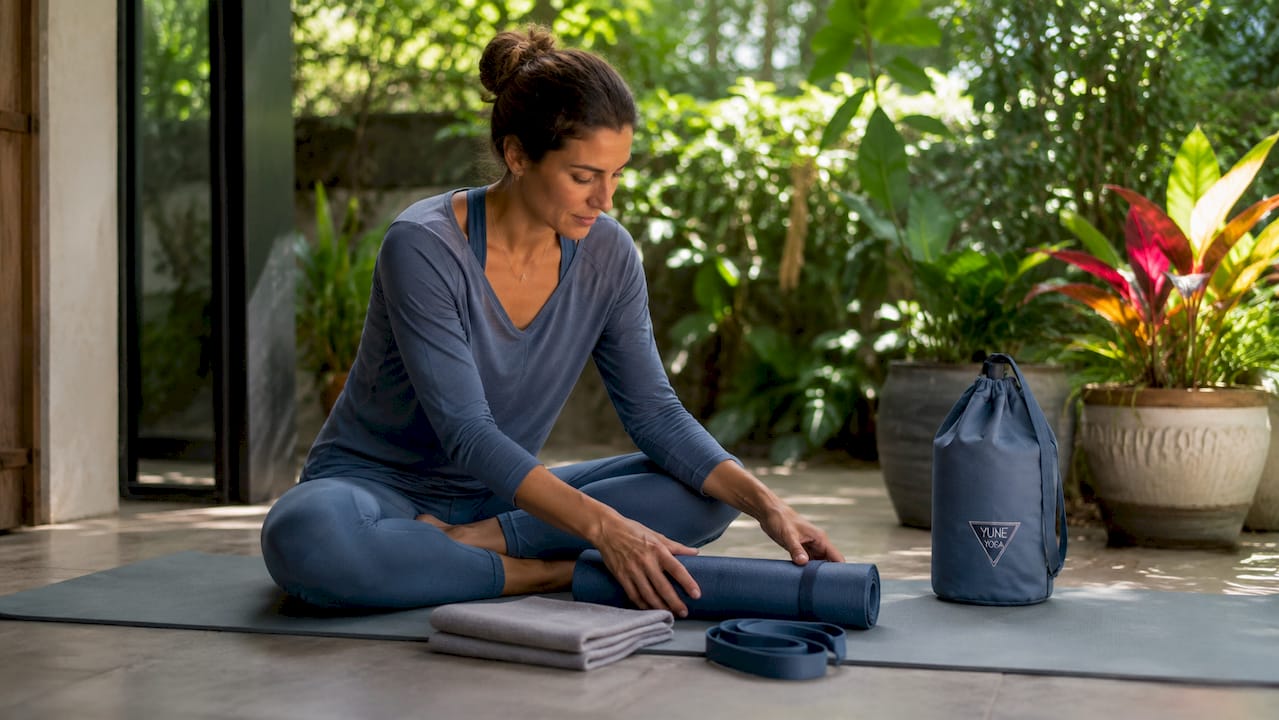
The non-negotiable core of any travel yoga kit is a compact mat, a quick-dry towel, and a strap. Everything else is situational. Getting these three right means you can practice anywhere, from a Bali retreat to a Chicago hotel room, without sacrificing grip, hygiene, or range of motion.
Compact travel yoga mat. A foldable travel mat folds flat into a bag rather than rolling into a bulky cylinder. Natural rubber mats offer superior grip and are free of PVC, which matters when you’re practicing in humid conditions. Look for mats under 2 lbs and no thicker than 2mm for true carry-on compatibility.
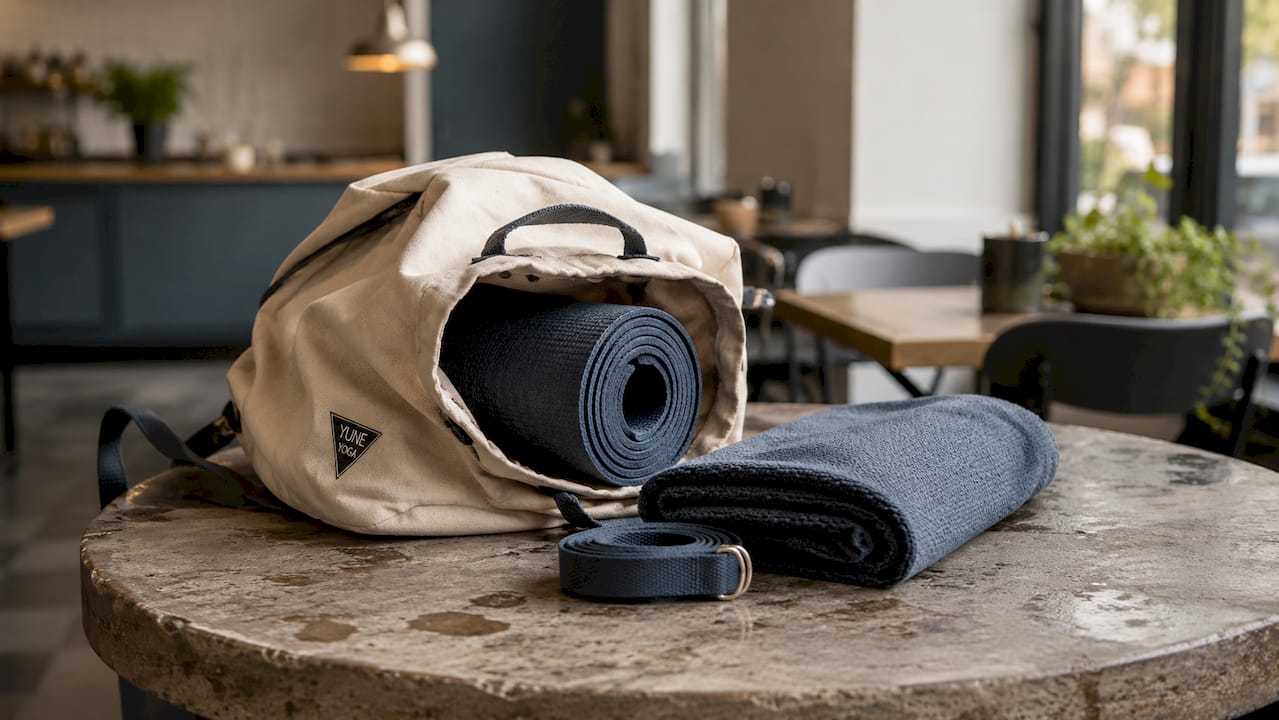
Quick-dry yoga towel. Quick-dry yoga towels prevent slipping and keep practice hygienic in travel conditions. This matters most in hot or humid climates where a standard cotton towel stays damp for hours. A microfiber mat towel also doubles as a beach layer or a makeshift bolster.
Yoga strap. The yoga strap doubles as a stretching aid and a mat carrier, making it one of the most multifunctional items in your bag. A single cotton or nylon strap weighs almost nothing and replaces the need for a dedicated mat bag. Loop it around your foldable mat and you have a shoulder carry in seconds.
Compact yoga blocks. Standard foam blocks are too bulky for travel. Cork travel blocks are denser and smaller, or you can substitute a firm paperback book or a folded blanket for most poses. Many retreats supply blocks, so verify with your organizer before adding them to your bag.
Pro Tip: Choose a mat with alignment lines printed on the surface. They eliminate the need for a separate prop to check your stance, which saves both space and time during a morning yoga routine.
2. How to choose travel yoga clothing for different climates
Clothing is the most underestimated category on any travel yoga equipment checklist. Pack too little and you’re doing laundry every night. Pack too much and your bag is full before the mat goes in.
For a 5–7 day retreat, pack 4–6 sets of breathable yoga clothing, 4 sports bras, and 2 swimsuits if you’re heading to a beach yoga destination. That recommendation accounts for humidity and slow drying times in tropical climates. A set worn in a 90-minute hot class will not be dry by the next morning without quick-dry fabric.
Fabric choices by climate
Humid and tropical destinations call for moisture-wicking synthetics like nylon or polyester blends. These fabrics pull sweat away from skin and dry in 2–4 hours. Cool or alpine destinations need a base layer of merino wool, which regulates temperature and resists odor without washing after every use.
A sarong or lightweight cover-up earns its place in both climates. It works as a yoga wrap between classes, a beach cover, and a modesty layer when visiting temples or local markets. One item, three uses. That ratio is the standard to apply to every clothing decision you make.
Pro Tip: Pack one set of yoga clothes in your personal item or day bag. If checked luggage is delayed, you can still practice on arrival day without waiting for your bag.
3. Optional props that support your travel yoga routine
Most established retreats provide full yoga props, including mats, bolsters, blocks, and straps. That fact changes the packing calculus significantly. Unless you have strong hygiene preferences or need a specific texture, leave the bulky props at home.
The optional items worth considering are:
- Meditation cushion or travel zafu. A small inflatable cushion supports seated meditation without the discomfort of a hard floor. Deflated, it takes up almost no space. If your retreat provides cushions, skip it.
- Travel journal. A small notebook for post-practice reflection reinforces mindfulness and tracks progress across a trip. This is especially useful for practitioners building a morning yoga routine from scratch.
- Resistance bands. Flat resistance bands weigh under 2 oz and add variety to stretching sequences. They work as strap substitutes and add light resistance for hip and shoulder mobility work.
- Mala beads. A 108-bead mala fits in a small pouch and supports breathwork counting and meditation focus. Wooden or seed beads are lighter than stone versions.
- Mat cleaning wipes. Individual wipes in a resealable bag keep your mat hygienic when sharing studio space or practicing on unknown surfaces.
Verify retreat provisions before packing any of these items. A quick email to the organizer saves you from carrying 3 lbs of props that sit unused in your room.
4. How to practice yoga with minimal or no equipment
Effective travel yoga requires no mat and can be done on towels, carpets, or firm surfaces with an emphasis on breath and mobility over complex poses. This is the most liberating realization for traveling practitioners. Your practice does not stop when your bag is lost or your mat is too heavy to bring.
Here are four equipment-free routines that work in any space:
- Seated spinal twist. Sit upright in a chair or on the floor. Inhale to lengthen the spine, exhale to rotate. Hold for 5 breaths per side. This targets thoracic mobility compressed by long flights.
- Legs-up-the-wall. Lie on your back and rest your legs vertically against a wall or headboard. Hold for 5–10 minutes. This pose reverses blood pooling in the legs and calms the nervous system after travel.
- Cat-cow on carpet. Place a folded hotel towel under your knees. Move through 10 rounds of cat-cow to decompress the lumbar spine. No mat needed.
- Box breathing. Inhale for 4 counts, hold for 4, exhale for 4, hold for 4. Repeat for 5 minutes. Travel yoga experts confirm that breathwork targeting cortisol reduction and melatonin regulation is the most effective tool for jet lag recovery.
Travel yoga routines should prioritize decompression and gentle circulation rather than trying to replicate studio classes on the road. A 10-minute breath-and-movement reset repeated twice through a travel day does more for your body than one intense session.
Travel yoga routines kept to 5–15 minutes and focused on breathwork, spinal mobility, and hip opening directly counteract the physical effects of sitting in transit. Short and consistent beats long and occasional every time.
5. How to pack and organize your travel yoga gear
Packing strategy determines whether your yoga gear is accessible or buried. The goal is one dedicated section of your bag for all yoga items, so you can pull out your mat and towel without unpacking everything else.
- Roll, don’t fold, your towel. A tightly rolled microfiber towel compresses to the size of a water bottle. Place it inside your mat if you’re using a foldable design.
- Use your strap as a compression tool. Loop your yoga strap around folded clothing to create a compact bundle. It replaces packing cubes for yoga-specific items.
- Keep mat wipes in a front pocket. Accessibility matters. If cleaning your mat requires digging through your bag, you won’t do it consistently.
- Pack by trip length, not by anxiety. A 3-day trip needs one mat, one towel, one strap, and 3 clothing sets. A 10-day retreat needs the same mat and towel, just more clothing.
- Weigh your yoga kit before adding anything else. Your mat, towel, and strap should total under 3 lbs. If they don’t, you’ve chosen the wrong products.
The portability of your yoga gear directly affects how often you actually practice. Heavy gear gets left in the room. Lightweight gear comes with you to the park, the beach, and the airport gate.
| Item | Packed weight target | Space-saving method |
|---|---|---|
| Foldable travel mat | Under 2 lbs | Folds flat, fits in bag sleeve |
| Microfiber yoga towel | Under 0.5 lbs | Roll tightly inside mat |
| Cotton yoga strap | Under 0.25 lbs | Doubles as mat carrier |
| Travel resistance band | Under 0.15 lbs | Flat, fits in any pocket |
| Mat cleaning wipes (5 pack) | Under 0.1 lbs | Front pocket for easy access |
Pro Tip: Place your yoga mat at the back panel of your bag, closest to your spine. This distributes weight better and keeps the mat from crushing softer items.
Key takeaways
A complete travel yoga kit weighs under 4 lbs and covers every scenario from a beach flow to a hotel room reset, provided you choose multifunctional, quick-dry, and compact gear from the start.
| Point | Details |
|---|---|
| Core kit is three items | A compact mat, quick-dry towel, and strap cover 90% of travel yoga needs. |
| Clothing quantity matters | Pack 4–6 sets for a week-long retreat to account for humidity and drying time. |
| Verify retreat provisions | Most retreats supply blocks, bolsters, and straps, so check before packing extras. |
| No mat, no problem | Towels, carpet, and breathwork routines replace a full studio setup in any space. |
| Weight is the real constraint | Keep your full yoga kit under 4 lbs so it travels with you, not against you. |
What I’ve learned about packing yoga gear the hard way
The first time I packed for a week-long retreat, I brought two mats, a bolster, three blocks, and enough clothing for two weeks. I used one mat, borrowed blocks from the studio, and wore the same two outfits on rotation. The bolster never left my room.
The lesson took one trip to learn: gear you don’t trust yourself to use is gear you shouldn’t pack. A single foldable mat from Yuneyoga and a microfiber towel now cover every trip I take, whether it’s a 3-day city stay or a 10-day retreat in the jungle. The strap comes too, because it earns its weight twice over as both a practice tool and a mat carrier.
The harder lesson was about hygiene. Shared mats at retreats are fine for most people, but if you’re practicing twice a day in humidity, your own towel is non-negotiable. It’s not about being precious. It’s about not slipping on someone else’s sweat during Warrior III.
Flexibility in practice matters as much as flexibility in the body. Some mornings the space is small, the floor is hard, and the best option is 10 minutes of breathwork in a chair. That still counts. Maintaining the habit of daily movement across a trip does more for your body than any single perfect session.
— Nicholas
Yuneyoga’s travel gear for practitioners on the move
Yuneyoga curates a focused selection of travel yoga gear built around the same priorities this article covers: low weight, natural materials, and genuine multifunctionality.
The Yuneyoga travel mat line includes natural rubber foldable mats that pack flat and grip reliably on any surface. The hot yoga accessories collection covers quick-dry towels and grip-enhancing gear suited to humid retreat conditions. Compact yoga straps for travel are available in cotton and nylon, each designed to double as a mat carrier. Browse the full travel collection at Yuneyoga to find gear that fits your bag and your practice.
FAQ
What are the must-have items for a travel yoga kit?
A foldable mat, a quick-dry microfiber towel, and a yoga strap cover the core needs of any travel practice. These three items together weigh under 3 lbs and handle every scenario from beach yoga to hotel room sessions.
Do I need to bring my own blocks and bolsters to a retreat?
Most established retreats provide mats, blocks, bolsters, and straps, so personal props are optional. Verify with your retreat organizer before packing to avoid carrying unnecessary weight.
How long should a travel yoga routine be?
Travel yoga routines work best at 5–15 minutes, focusing on breathwork, spinal mobility, and hip opening. Short, consistent sessions counteract the physical effects of sitting in transit more effectively than infrequent longer practices.
Can I practice yoga without a mat while traveling?
Yoga on towels, carpet, or firm hotel floors is fully effective when the focus is breathwork and joint mobility. Poses like seated spinal twists, legs-up-the-wall, and cat-cow require no mat and work in any confined space.
How much yoga clothing should I pack for a week-long retreat?
Pack 4–6 sets of breathable yoga clothing and 4 sports bras for a 5–7 day retreat. Humid and tropical climates slow drying times significantly, so quick-dry fabrics and enough sets to rotate daily are the standard recommendation.


