Eco-Friendly Yoga Travel Tips: Pack Light, Practice Well
The biggest eco-friendly yoga travel win is how you get there. The second is how much you carry. Choose the lowest-impact transport you can, take fewer and longer trips, and bring a small kit of reusable essentials plus one light, foldable mat. Everything else on the road, from hotel towels to water bottles, is a smaller habit that adds up.
This guide covers each step in the order you’ll make the decisions: getting there, packing, choosing a travel mat, living lightly at your destination, and caring for your gear afterward.
TL;DR
- Transport usually causes most of a trip’s emissions, so start there: trains, buses and carpools beat flying where the route allows.
- If you fly, go direct, fly economy and pack light. Every pound you leave behind helps.
- Bring reusable basics (water bottle, tote, refillable toiletries) and clothes you can re-wear and air-dry.
- Choose a thin, foldable, non-slip travel mat so you don’t need to haul a full-size one.
- At your destination, use less water and energy, support local businesses and skip single-use plastic.
Table of Contents
- Start with transport, where most of the impact sits
- Shape the trip: fewer, longer, slower
- Pack light: the yoga travel kit
- Choosing a portable, eco-friendly yoga mat
- Ready for the road: Yune Yoga travel gear
- At your destination: water, energy and waste
- Practice responsibly in the places you visit
- Caring for gear and handling it at end of life
- FAQ
- Sources
Start with transport, where most of the impact sits
If you only change one thing, change this. National Geographic says tackling transport is the single most significant way to reduce travel emissions, since it is often responsible for at least 70% of a holiday’s carbon emissions.
The United Nations puts numbers on it. A long-haul flight such as New York City to Tokyo one-way averages almost 2 tons of carbon dioxide, and even medium- and short-haul flights add 0.2 to 1.5 tons per trip. The same page says trains or electric buses can be planet-friendly alternatives. Switching from car to public transit can cut up to 2 tons of carbon emissions per person each year, and carpooling can cut up to 1 ton.
When you can avoid the flight
- Look at the train or bus first. Google’s sustainability team notes that short-haul flights are especially inefficient and suggests replacing them with a train or bus ride where possible.
- Explore closer to home. A retreat, workshop or weekend away within driving or rail distance means less time in transit and no airport at all.
- Share the ride. If you’re driving to a retreat, split the car with other guests rather than arriving separately.
- Go online for the big teachers. Yoga International points out that many renowned teachers now offer classes, trainings and conferences online, which can replace a long journey.
When you have to fly
WWF suggests the acronym NERD for choosing a flight: New aircraft, Economy class, Regular (that is, pack light) and Direct. Direct matters because planes release the most carbon during takeoff and landing, according to International Yoga Travel. The same page says business class usually carries about twice the footprint of an economy seat.

That page also makes a point yogis will like: lighten your bag by 15 pounds and you cut roughly 80 pounds of emissions on a ten-hour flight. Treat that as a company’s estimate rather than a hard rule, but the direction is clear. Lighter is better.
If you choose to offset, Yoga International suggests carbon offsets or an organizer’s offset fund. Treat offsets as an addition to cutting emissions, not a replacement for it.
Shape the trip: fewer, longer, slower
WWF recommends fewer, longer trips, less crowded destinations, and a single basecamp with day trips rather than constant moves. It also points to destinations certified to the Global Sustainable Tourism Council criteria. Green Destinations, EarthCheck and Vireo are among the accredited certification bodies.
For a yoga traveler, that translates into a few concrete choices:
- Pick one base. A week in one place with a daily practice routine beats four cities in seven days.
- Combine purposes. A retreat or training that can be paired with other travel saves a second journey.
- Stay longer when you go far. International Yoga Travel’s example is a month exploring Europe by rail instead of three separate short trips.
- Choose accommodation that shares benefits locally. Locally owned guesthouses and eco-lodges are the kind Adventure Yogi recommends for sustainable yoga travel.
If you’re coordinating dates and destinations with friends or fellow practitioners, it helps to plan trips and meetups with friends so you can spot overlapping plans and consolidate into one longer trip instead of several short ones.
Pack light: the yoga travel kit
Packing is where sustainability and convenience point the same way. Less weight means lower fuel use, less to carry up stairs and fewer things to throw away. Adventure Yogi’s Helen T notes that every extra pound on a plane increases fuel consumption, so she suggests packing only what you need.
National Geographic offers a simple filter, the three Rs of packing: reduce (what can I leave behind?), reuse (what can I use again and again?) and recycle (what can be recycled when I’m done?).
A practical checklist
| Category | What to bring | Why it works |
|---|---|---|
| Mat | One thin, foldable travel mat | Replaces a bulky full-size mat |
| Hydration | Refillable water bottle | WWF, National Geographic and Adventure Yogi all recommend it |
| Bags | Packable tote or ultralight daypack | Doubles as a studio bag and shopping bag |
| Toiletries | Refillable soft containers, shampoo bars, solid toothpaste tablets | Cuts single-use plastic and liquids |
| Clothing | Quick-dry layers in natural fibers such as organic cotton, hemp or bamboo | Lets you wash by hand and skip the dryer |
| Sun care | Reef-safe sunscreen without oxybenzone and octinoxate | Recommended by WWF for beach and ocean destinations |
| Food | Reusable utensils and a container | Avoids disposable takeout packaging |
The water bottle, refillable toiletry kit, quick-dry clothing, packable tote and reef-safe sunscreen all appear in WWF’s responsible travel tips. The zero-waste toiletries, reusable utensils and natural-fiber garments come from Adventure Yogi’s retreat guide.
Clothes you can wear twice
Pack fewer outfits and plan to wash by hand. International Yoga Travel recommends clothing that can be re-worn, hand-washed and hung to dry. Quick-dry fabrics make this realistic: wash in the evening, hang overnight, and practice in them the next morning.

Packing for a group
If you’re traveling with a yoga group or a few friends, you don’t need four of everything. Splitting shared items, such as one set of reusable containers or a single first-aid kit, is easier with a group packing list workflow that shows who is bringing what.
For more on building a kit, our own travel yoga accessories checklist and our guide to yoga props and small luggage go item by item.
Choosing a portable, eco-friendly yoga mat
A full-size mat can take up a third of a carry-on. A travel mat solves that by being thin and foldable. Here is what we’d look at when choosing one:
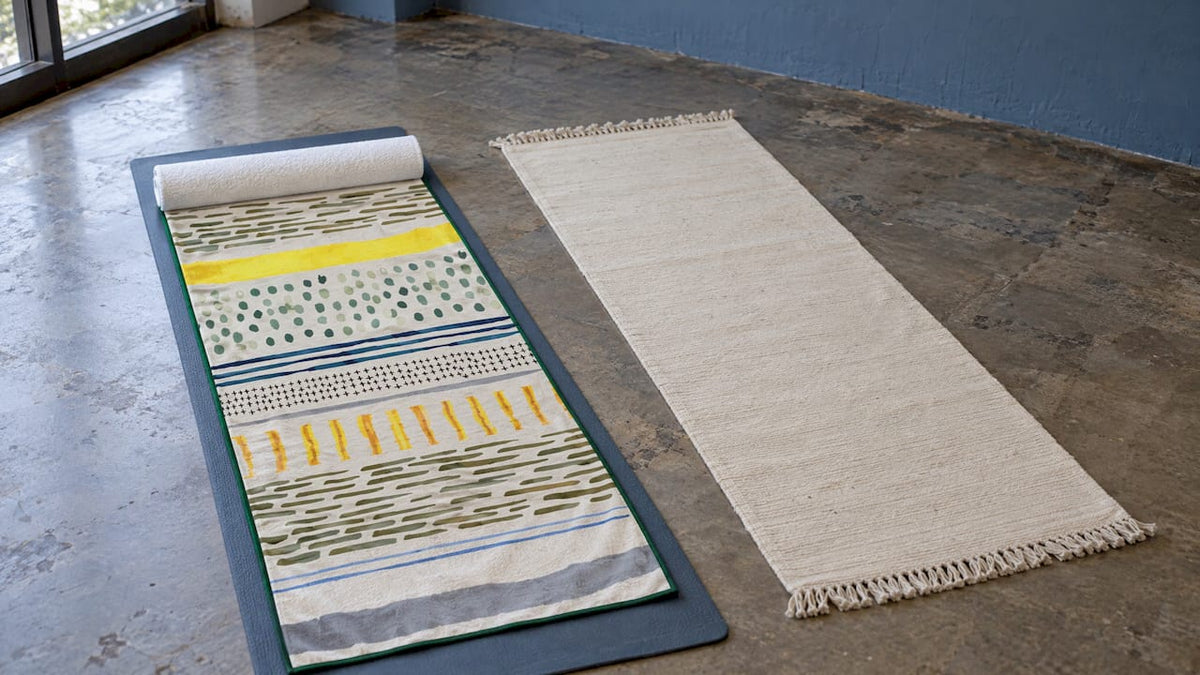
- Thickness and weight. Thin mats fold smaller and weigh less. Our foldable travel mats are 2mm and lightweight, designed to be easy to bring along.
- Foldability. A mat that folds flat fits into a suitcase, a backpack or a tote without rolling.
- Grip. A non-slip surface matters more on unfamiliar floors such as hotel carpet, tile or a rented studio.
- Materials. Natural rubber and other eco-conscious materials are the direction we favor. Check what a mat is made of before you buy.
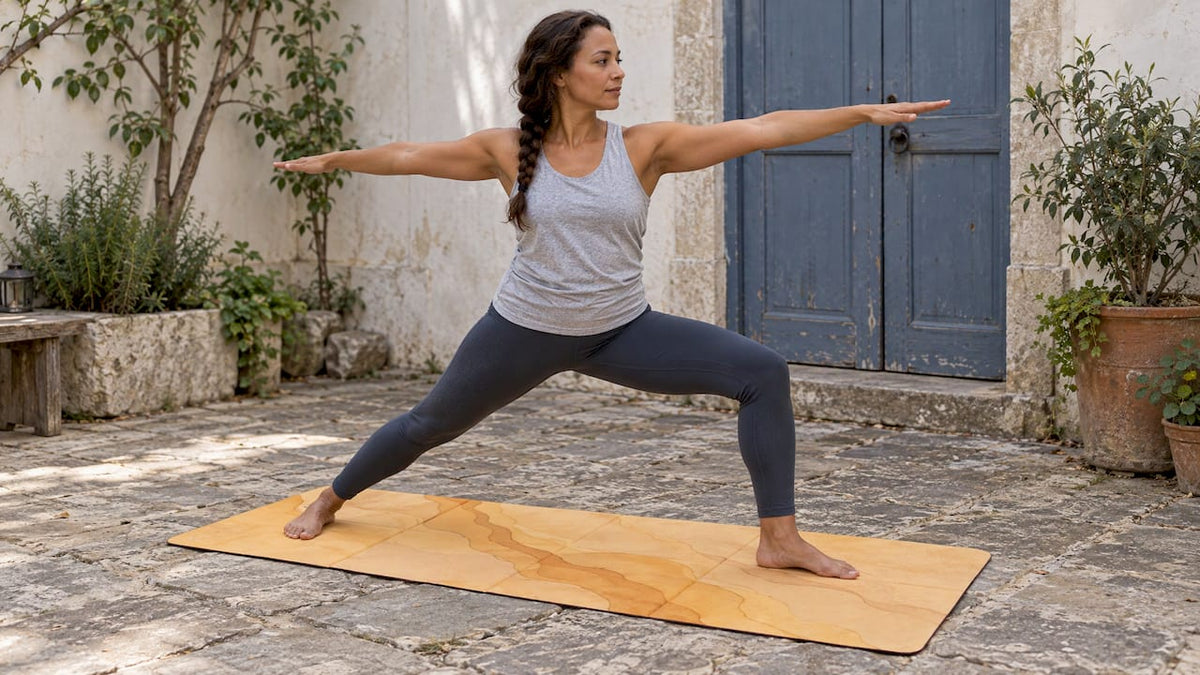
- Design you’ll actually use. A mat you like looking at is a mat you’ll unroll, or unfold, every morning.
If you’re shopping for one, these are our foldable travel mats, each 2mm, lightweight, non-slip and designed as an eco-friendly option for on-the-go practice:
- Copper River Foldable Travel Yoga Mat
- Jerome Turquoise Foldable Travel Yoga Mat
- Calacatta Foldable Travel Yoga Mat
Other travel gear follows the same rule: if it’s light, compact and made to last, it earns its place. Straps and towels from sustainable materials are easy additions. Our guide to yoga gear for international travel covers what to consider when you cross borders.
Our perspective on traveling green
We built Yune Yoga around a simple idea: the best travel mat is the one you actually bring. A heavy, awkward mat tends to stay at home, and then you either skip practice or end up on a hotel floor.
That’s why we put so much into foldable, lightweight mats alongside our natural rubber and eco mats, and why we pair them with towels and straps made from sustainable materials. Our designs aim to combine portability, sustainability and a look you enjoy.
We also believe eco-conscious travel is mostly about small, repeatable decisions. Take the train when you can. Leave the second pair of shoes. Carry a bottle. Put a thin mat in your bag and unfold it wherever you land. Done consistently, those choices matter far more than any single purchase.
If you want to go deeper, our guides to zero-waste yoga gear and sustainable practice habits are where we share how we think about it.
Nicholas
Ready for the road: Yune Yoga travel gear
If you’re putting together a travel kit, start with the mat. Our foldable travel mats are designed to be thin, light and non-slip, and our wider range includes natural rubber mats, eco mats, yoga towels and straps made from sustainable materials. You can also browse yoga clothes and accessories to round out your kit, or see the full range at Yune Yoga.

We also offer custom yoga mats if you want something personal for your practice. Visit the site to see what’s available.
At your destination: water, energy and waste
Small habits at the hotel or rental add up, and most cost nothing.
- Reuse towels and linens. WWF recommends hanging towels to dry and reducing requests for fresh linens to conserve water.
- Turn things off. Switch off lights, heating and air conditioning when you leave the room. International Yoga Travel notes that air conditioning and electricity account for the bulk of hotel energy use, and it also suggests shorter showers.
- Refill, don’t buy. Yoga Trade suggests asking juice bars to fill your own bottle rather than handing you a disposable cup.
- Bring your own container for restaurant takeout.
The last two matter because, as Yoga Trade writes, many yoga travelers use more single-use plastic on the road than at home. Keep your usual standards even when you’re away from home.
Practice responsibly in the places you visit
Good yoga travel respects the place as well as the planet. Yoga Trade’s guidance is practical:
- Favor locally owned businesses. Cafés, guesthouses, studios and guides keep money in the community.
- Eat local. It avoids imported goods and the packaging that comes with them.
- Hold providers and fellow travelers to good practice. That includes waste water treatment, solid waste management and avoiding single-use plastics. Yoga Trade’s advice is to lead by example rather than lecture locals.
- Choose certified destinations when you can. WWF points to the Global Sustainable Tourism Council criteria as a benchmark.
If you practice outdoors, leave no trace: roll up, shake out away from plants and carry out anything you brought in. Reef-safe sunscreen, as noted above, protects the water you may be practicing beside.
If green yoga travel is a new idea for you, our guide to eco choices in yoga practice and our overview of eco yoga practices and sustainable gear are good starting points.
Caring for gear and handling it at end of life
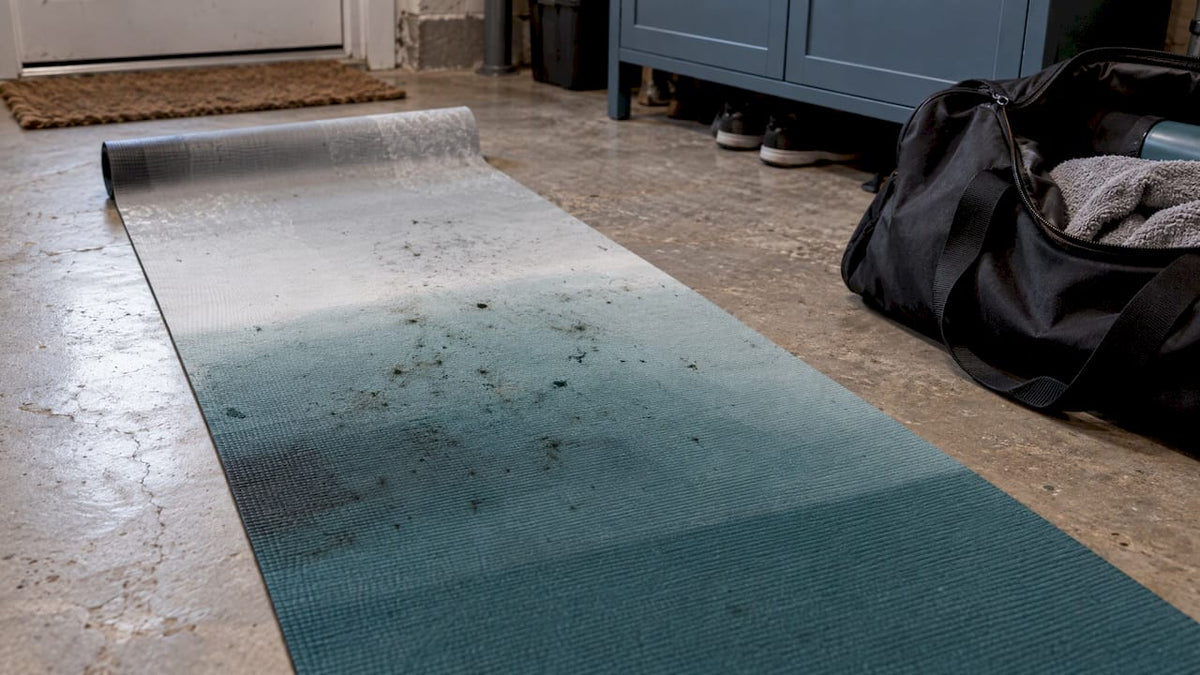
Travel is hard on equipment, so a little care extends its life. Wipe your mat, let it dry fully before folding it away, and avoid leaving it in a hot car. Longer use means less waste.
When an old mat does reach the end of its life, Earth911 reports that most popular yoga mats are made from vinyl or PVC, one of the hardest plastics to recycle. Its options for old mats are:
- Donate them to local yoga studios or community and youth centers.
- Reuse them as doormats, drawer liners or non-slip pads under area rugs.
- Call the manufacturer and ask whether it has a take-back program.
- Use a mail-in recycling box. Earth911 lists TerraCycle’s Sporting Goods Zero Waste Box at $142.00 to $290.00, as of its November 2023 article, so check the current price.
Choosing a mat made from natural materials you’ll use for years is the other half of the equation. It’s one reason we focus on natural rubber and eco-conscious mats.
FAQ
What is the most eco-friendly way to travel for a yoga retreat?
Train, bus or a shared car, where the route allows. The United Nations says trains and electric buses can be planet-friendly alternatives to flying. If you must fly, WWF advises non-stop flights, economy class and a light bag.
What should I pack for yoga while traveling?
Pack a thin foldable mat, a refillable water bottle, a packable tote, refillable toiletries and quick-dry clothing you can wash by hand. Add reef-safe sunscreen for ocean destinations. The aim is the lightest kit that lets you practice well.
Is a foldable travel mat as good as a regular mat?
It’s built for a different job. A foldable travel mat is designed to be thin, light and easy to pack, with a non-slip surface for unfamiliar floors. Many practitioners keep a travel mat for trips and a thicker one at home.
How do I dispose of an old yoga mat responsibly?
Donate it to a studio or community center, repurpose it as a doormat or drawer liner, or ask the manufacturer about a take-back program. Earth911 notes that PVC mats are hard to recycle, so reuse comes first.
Does offsetting my flight make it eco-friendly?
Offsets can help, and Yoga International and Adventure Yogi both suggest them. Cutting emissions comes first: fewer flights, direct routes and lighter luggage. Use offsets for what you can’t avoid.
Sources
- Transportation | United Nations
- Responsible travel tips | WWF
- How to travel better: a beginner’s guide to sustainable travel | National Geographic
- Working Towards Sustainable Travel | Google Sustainability
- Is Yoga Bad for the Environment? | Yoga International
- Travel sustainably and responsibly | International Yoga Travel
- Mindful Travel: Eco-Friendly Practices on Yoga Retreats | Adventure Yogi
- Sustainable Yoga Travel: It’s Our Responsibility | Yoga Trade
- Recycling Mystery: Yoga Mats | Earth911
- Group packing list workflow
- Droozi use cases for travel and meetups