Mold on Your Yoga Mat: How to Spot It, Clean It, Stop It
If you see dark spots or catch a musty smell on your yoga mat, treat it as a moisture problem. Light surface growth can often be washed off with soap and water while you protect your lungs, skin and eyes. Deep, repeated or smelly-after-cleaning mold means the mat has done its job and it is time for a new one. Below you will find how to tell mold from dirt, a safe cleaning routine, the replacement signs and the drying habits that keep it from returning.
TL;DR
- Mold looks like spots in many colors and smells musty. It grows wherever moisture lingers, and a mat rolled up damp is a perfect spot.
- For light surface mold, wear a mask, gloves and eye protection, then wash with mild soap and water. Never mix bleach with ammonia or any other cleanser.
- If the smell or spots return after cleaning, replace the mat. Porous materials can hold mold in places you cannot reach.
- Prevention is drying: let the mat dry fully, ideally within 24 to 48 hours of getting wet, and never roll it up damp.
- Check your maker’s care instructions before using any disinfectant, since some can damage certain mat materials.
Table of Contents
- How to tell if it is mold on your yoga mat
- Why mold grows on yoga mats
- Is moldy yoga mat a health concern?
- How to clean mold off a yoga mat
- When to replace a moldy yoga mat
- How to prevent mold on your yoga mat
- Quick reference: spot, clean or replace
- Our take on mold and yoga mats
- Ready for a fresh start?
- FAQ
- Sources
How to tell if it is mold on your yoga mat
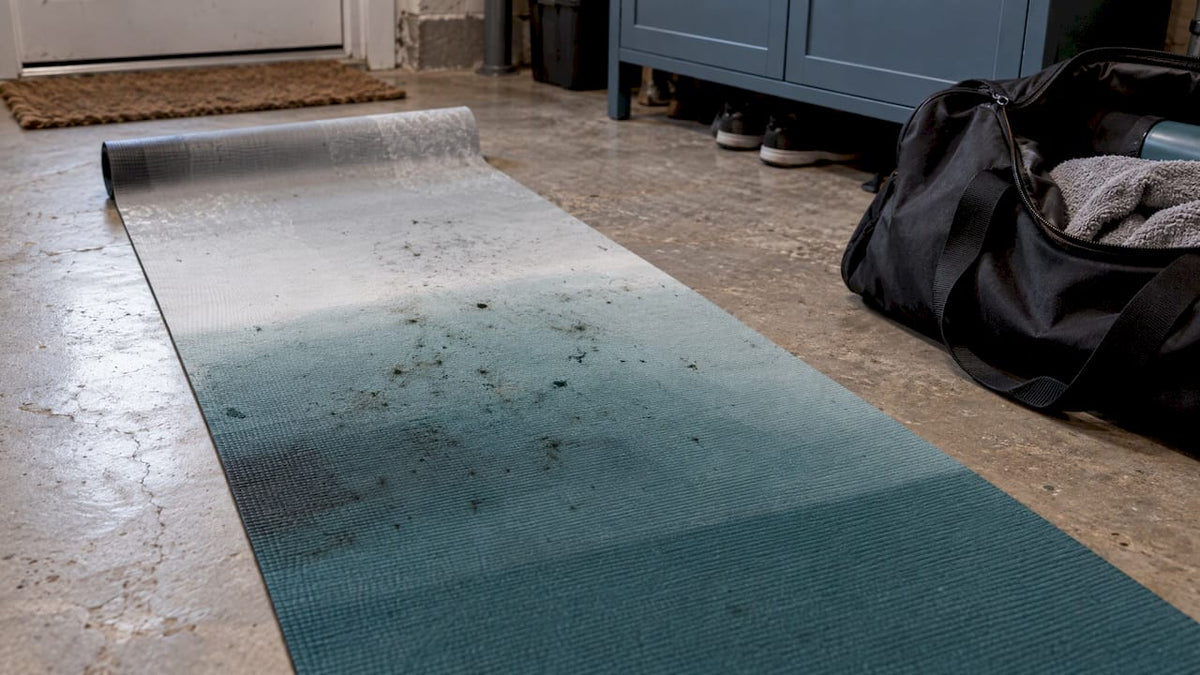
Mold does not have one signature look. The CDC notes that mold can appear as spots in many different colors and can smell musty. On a yoga mat, that usually shows up as one of these:
- Black, gray or green freckles, often along the edges, at the corners or in the center where your hands and feet land.
- A fuzzy or powdery patch on the underside, where the mat touches the floor and stays damp.
- Whitish or greenish film in the creases of a mat that has been stored folded or rolled.
- A musty, earthy smell that is stronger when you unroll the mat in a closed room.
A few things can be mistaken for mold. Floor dye can transfer to the underside of a mat and leave colored marks. Sweat and skin oils leave a yellowish, slightly sticky film. Dust and lint make gray smudges. The quick test: dirt and dye wipe away on the first pass with a damp cloth, while mold leaves a stain behind, spreads over days, and usually comes with that musty smell.
If you are not sure, the smell is often the better clue. A clean mat smells faintly of its material or of nothing at all. A mat that smells damp or sour after a day in a gym bag deserves a close look on both sides.
Why mold grows on yoga mats
Mold needs moisture, and your practice supplies plenty. Sweat soaks into the surface, a wet towel gets tossed on top, or you roll the mat up after a sticky hot class and tuck it into a closet or the trunk of your car. The CDC says mold grows where there is moisture, and the EPA adds a useful timeline: wet or damp items should be dried within 24 to 48 hours. Past that window, growth becomes likely.
The usual causes on a mat:
- Rolling it up damp. The inside of the roll stays wet for days, with no airflow.
- Storing it in a humid place. Bathrooms, basements, garages and closed gym bags hold moisture.
- Sweat that never gets wiped off. Heavy sweaters and hot-room practitioners feed the problem every session.
- Washing without drying. A deep clean that ends in a rolled-up mat swaps one problem for another.
- Leaving the mat flat on a damp floor or against a wet surface.
The EPA also gives a target for the air around your mat: keep indoor humidity below 60 percent, ideally between 30 and 50 percent. A cheap hygrometer from a hardware store will tell you where your practice room stands.
Is moldy yoga mat a health concern?
Mold is not something to scrub casually with bare hands and a lungful of spores. Because your mat touches your face, hands and breathing zone during poses like Child’s Pose and Downward Dog, you want it clean before the next practice. If you have asthma, allergies, a weakened immune system or any breathing condition, talk to your doctor before handling mold, and consider having someone else deal with it or simply replacing the mat.
For everyone else, the CDC’s cleanup guidance is the right protective baseline. It recommends at least an N95 respirator approved by NIOSH, protective gloves (non-latex, vinyl, nitrile or rubber) and goggles that give complete eye protection. Do the cleaning outdoors or in a well-ventilated space, and keep it away from the area where you do yoga until the mat is done.

How to clean mold off a yoga mat
This routine suits light surface mold on a mat that is otherwise intact. Cleaning is different from disinfecting. Cleveland Clinic, citing the CDC, explains that soap or detergent removes germs, dirt and impurities, while a disinfectant uses chemicals to kill certain germs. For a personal mat at home, the clinic’s Dr. Goldfarb says that unless you have a skin infection, soap and water will take care of the microbes you are likely to meet there.
What you need
- N95 respirator, gloves and goggles
- A tub, bathtub or large sink, or a clean hard surface outside
- Mild dish soap or a gentle mat wash
- A soft cloth or soft-bristle brush
- Clean towels and a spot with airflow
Step by step
- Suit up. Put on the respirator, gloves and goggles before you touch the mat.
- Take it outside or to a ventilated room. Unroll it fully so you can see both sides.
- Wet and wash. Use cool water and a small amount of mild soap. Wipe the whole mat in gentle strokes, paying extra attention to the spots, edges and underside. Use a soft brush on stubborn patches, and avoid abrasive scrubbing that can wear the surface.
- Rinse thoroughly. Soap residue makes a mat slippery and can trap moisture, so rinse until the water runs clear.
- Blot, then dry. Press a clean towel along the mat to remove surface water. Our towel roll method for drying a mat by material is a quick way to pull moisture out before air drying.
- Air dry completely. Hang it over a shower rod, a drying rack or a railing in a shaded, airy spot. Flip it so both sides dry. Do not roll it up until it is completely dry to the touch, on both sides and the edges.
- Wash your tools. Launder the cloth and towels in hot water if the fabric allows, and wipe down the tub.
For material-specific routines, our yoga mat care guide and the detailed guide to cleaning and caring for your mat walk through the differences.
What not to do
Do not reach for bleach by default. The CDC’s bleach guidance is written for cleaning mold in homes, and it comes with a firm rule: never mix bleach with ammonia or any other cleanser, and use no more than 1 cup of bleach per gallon of water. A yoga mat is a different kind of surface, and Cleveland Clinic’s Dr. Goldfarb warns that many cleaners are not safe, and depending on the material some disinfectants could destroy your mat. His advice when in doubt: stick with soap and water.
Other habits to skip:
- Mixing cleaning products, which can release harmful fumes.
- Soaking a mat for hours, which leaves it wet far longer than you want.
- Using a hair dryer, radiator or dryer on high heat, which can warp or harden some materials.
- Using the mat again before it is fully dry.
What about sun and vinegar?
Sunlight and vinegar come up in nearly every home-cleaning thread. Whether they help depends heavily on the mat material, and some makers advise against them. We cover this in detail in does sunlight disinfect a yoga mat. If you want a homemade option, read our DIY yoga mat cleaner recipe and check it against your mat’s care label first. For help choosing between homemade and store-bought, see DIY or buy: the best yoga mat cleaners.
When to replace a moldy yoga mat
Some mats cannot be saved. The EPA explains that porous or absorbent materials may have to be thrown away if they become moldy, because mold grows in their empty spaces and crevices and is hard or impossible to remove completely. The EPA’s examples are ceiling tiles and carpet, but the same logic applies to any mat with a soft, open structure.
Replace the mat when:
- The mold covers a large area, or it is on both sides.
- It comes back within days or weeks after a careful cleaning.
- A musty smell remains after a thorough wash and full drying.
- The surface is crumbling, sticky or peeling, which makes it hard to clean at all.
- You have a respiratory condition or allergy and you react to the mat.
There is no fixed expiration date for a yoga mat. The calendar matters less than condition: does it still grip, cushion and wash clean? If the answer to the last question is no, mold has made the decision for you.
When you buy the next one, pick a mat you will take care of. Look at the care instructions before you buy, think about where you will store it, and consider whether you practice at home, in a studio or while traveling, since a mat that goes into a bag every day needs a different drying habit than one that hangs in your spare room.
How to prevent mold on your yoga mat
The EPA is blunt about the principle: moisture control is the key to mold control. It also warns that if you clean up mold but do not fix the water problem, the mold will most likely come back. A cleaning day is only half the job, so build these habits.
After every practice
- Wipe the mat top and bottom with a dry or lightly damp cloth.
- Unroll it, or hang it, and let it air dry before you put it away. A short stretch over a chair or door works.
- Use a towel on top if you sweat heavily. A mat towel absorbs moisture before it reaches the surface, and you can toss it in the wash. Our yoga towels are made for exactly this job.
Once a week or every few sessions
- Give the mat a light wash with mild soap and water, depending on how often and how hard you practice.
- Check the underside and edges for spots, since that is where mold starts.
Storage
- Keep it in a cool, dry room, not a bathroom, a damp basement or a hot car.
- Do not store it inside a closed bag if it is not completely dry.
- If you must roll it, roll it loosely and leave it open at one end so air can move.
- Watch your humidity. Using a hygrometer to stay under the EPA’s 60 percent ceiling, and ideally between 30 and 50 percent, helps all your gear, not just the mat.
For heavy sweaters and hot yoga
If your mat is soaked after most sessions, a sweat-focused routine is worth the extra minute. Our guide to the sweat-resistant yoga mat explains what to look for, and the five proven steps to clean your mat give you a regular routine.
Shared mats
Studio mats are a separate case. Dr. Goldfarb notes in the Cleveland Clinic piece that disinfection is routine in gym settings because you do not know what could be there, and viruses and bacteria can survive on surfaces, so a chemical disinfectant makes sense on a shared mat. That is another reason many practitioners bring their own. Our studio yoga mat hygiene guide covers shared and personal mats.
Quick reference: spot, clean or replace
| What you see | What it likely means | What to do |
|---|---|---|
| Dirt, lint or dye transfer that wipes off | Surface soil, not mold | Wipe with a damp cloth and mild soap |
| A few small spots on one side, no strong smell | Light surface mold | Protective gear, soap and water wash, full air dry |
| Musty smell, no visible spots | Moisture trapped in the mat | Wash, air dry on both sides, store open and dry |
| Spots returning after cleaning | Moisture or deep growth | Fix storage and drying, then replace if it returns again |
| Large patches, both sides, or crumbling surface | Mold has settled into the material | Replace the mat |
Our take on mold and yoga mats
Most mold stories we hear are not about a bad mat. They are about a good mat rolled up wet on a busy morning. We have seen it with studio regulars and with travelers who pack a mat into a suitcase right after practice.
That is why we think about a mat as part of a routine, not a one-time purchase. At Yune Yoga, we focus on mats, towels and straps made with sustainable materials and designed for both home and travel, and we publish care guides so you can keep your gear in good condition. The most useful thing you can do is the least glamorous: dry it, then store it.
If you travel with your mat, a foldable design gives you the chance to air it out at your destination before packing it, and a towel gives you a washable layer between your sweat and the mat. If you are replacing a mat because of mold, use the moment to set up a drying spot at home. A hook or a rack beside your practice space makes the habit stick.
Nicholas
Ready for a fresh start?
If your mat has reached the end of the road, we offer natural rubber mats, eco mats, foundational mats and foldable travel mats, plus yoga towels and straps, all designed with sustainability in mind. Browse the full range on the Yune Yoga store, or look at our travel mats such as the Hoth Trekk, Hemlock Trekk and Crow Trekk if you practice on the road.

Pair a new mat with a towel and a strap from our yoga clothes and accessories collection, and you have the basics for a clean, dry routine. For more mat care reading, our blog tips and guides are a good next stop.
FAQ
Can I clean mold off a yoga mat at home?
Yes, light surface mold can usually be cleaned at home. Wear an N95 respirator, gloves and goggles, wash with mild soap and water, rinse well and dry the mat completely before rolling it. If the mold is widespread, returns, or you have asthma or allergies, replace the mat or ask someone else to handle it.
Why does my yoga mat smell musty?
A musty smell usually means moisture has been trapped in or under the mat, and mold may be starting. Mold is known for a musty odor. Wash the mat, dry both sides fully in an airy spot, and store it unrolled or loosely rolled. If the smell stays after a thorough cleaning, replace it.
Can I use bleach or disinfecting wipes on a yoga mat?
Be careful. Cleveland Clinic’s Dr. Goldfarb says some disinfectants can destroy a mat depending on its material, and soap and water is the safe default. Never mix bleach with ammonia or any other cleanser. Check your maker’s care instructions before using any disinfectant.
How long does it take for mold to grow on a yoga mat?
In damp conditions, mold can start within a day or two. The EPA recommends drying wet or damp items within 24 to 48 hours. Wiping your mat after practice and leaving it open to air dry keeps you well inside that window.
When should I throw away a moldy yoga mat?
Replace it when mold covers a large area, returns after cleaning, or a musty smell lingers after washing and full drying. The EPA notes that porous materials can be impossible to clean completely once mold has taken hold.
Sources
- Mold | CDC
- Mold Clean Up Guidelines and Recommendations | CDC
- A Brief Guide to Mold, Moisture and Your Home | US EPA
- How (and Why) You Should Clean Your Yoga Mat | Cleveland Clinic