
How Long Do Yoga Mats Last? Lifespan by Material
Most yoga mats last somewhere between one and five years. A basic foam mat may need replacing after about a year, a mid-range PVC or rubber mat often lasts three to five years, and dense, well-cared-for mats can go much longer. Your material, how often you practice and how you clean and store the mat decide where you land. This guide gives you the numbers by material, the signs that a mat is finished, and the habits that add years.
TL;DR
- Typical range: about one year for soft foam, three to five years for mid-range PVC or rubber, and close to a decade for very dense mats, at three to five practices a week.
- Daily hot yoga roughly halves those figures, and sunlight and harsh cleaners shorten them further.
- Replace your mat when it loses grip, pills or flakes, feels thin under your knees or wrists, or smells even after cleaning.
- Wipe it down every couple of uses, dry it fully before rolling, and store it away from windows and radiators.
- Using one mat for longer is also the lowest-impact choice for the planet.
Table of Contents
- How long a yoga mat lasts on average
- Lifespan by material
- How your practice changes the number
- Signs it’s time to replace your yoga mat
- How to make your yoga mat last longer
- What we think about mat lifespan
- Why a longer-lasting mat is also the greener choice
- Choosing your next mat
- Find your next mat at Yune Yoga
- FAQ
- Sources
How long a yoga mat lasts on average
A common rule of thumb is that most mats last about a year, depending on quality, frequency of use and care. That figure is a floor for many readers, not a ceiling. Better mats routinely beat it.
A yoga instructor quoted by Wirecutter says that with regular use a mat should last about three years, and the same review reports several long-term testers getting five or more years from a natural rubber mat, with a couple of mats lasting almost a decade. OutdoorGearLab’s testing notes that one tester has used a dense PVC mat for 20 years and it still looks and feels like new.
So the honest answer is a range. Material sets the ceiling, and your habits set where you land under it.
Lifespan by material
Estimates differ between testers, because mat construction differs even within a material. This table uses figures from Gold Tested, which assumes three to five sessions a week.
| Material | Typical lifespan with regular practice |
|---|---|
| PVC | 3 to 5 years |
| Natural rubber | 2 to 4 years |
| Cork | 1 to 3 years |
| Polyurethane (PU) top layer | 2 to 3 years |
| TPE | 1 to 2 years |
Other reviewers put dense PVC and well-kept natural rubber higher. Treat the table as a conservative middle, not a promise. Here is what drives the differences.
Foam and TPE mats
Soft, light foam mats are comfortable and inexpensive, but they compress and tear sooner. Expect roughly a year of regular use from a soft foam mat. TPE mats tend to land at one to two years.
PVC mats
Dense PVC is the durability benchmark. A mid-range PVC mat often gives three to five years, and the densest versions last far longer. A useful shortcut from the same source: the denser the material, the longer it lasts, so weight is a decent proxy for lifespan when you compare mats.
Natural rubber mats
Natural rubber gives excellent grip and is a renewable material, which is why many practitioners choose it. It does have one weakness: sunlight and heat. Dried on a sunny balcony, a rubber mat can degrade faster than a year of practice. Kept in the shade and cleaned gently, rubber rewards you with years of service. If you want to compare how each material is built, our guide to yoga mat materials walks through the options.
Cork and PU-topped mats
Cork and PU surfaces feel great and grip well when damp, but they sit on a base layer. Over time the top layer can separate from the base. Gold Tested lists peeling or flaking as a clear replacement signal, and once a mat delaminates it is finished.
How your practice changes the number
The ranges above assume a few sessions a week. Your own routine moves them.
Frequency. A mat that sees daily use ages faster than one unrolled twice a week. Casual practitioners can see a good mat last two years or more, while daily practitioners may need to replace sooner.
Hot yoga. Heat and sweat are hard on every material. Daily hot yoga roughly halves the figures for any material. If you practice hot, a yoga towel over your mat takes much of the sweat and friction, which helps protect the surface.
Style. Flowing, vinyasa-style practice with lots of jumping, sliding and pivoting wears the surface faster than slow restorative work. Wrists, knees and feet always land in the same places, so those spots wear first.
Travel. A mat that lives in a suitcase gets folded, squeezed, left in hot cars and used on unknown floors. Foldable travel mats are designed for that life, but the same rules apply: dry before packing, and don’t leave it in a hot trunk.
Heat and cleaning. The two things that pull a mat below its range are heat and bad cleaning, and both are avoidable.
Signs it’s time to replace your yoga mat
There is no need to replace a mat on a calendar. Replace it when it tells you to. Reviewed’s list of warning signs is a good one: the material pills or breaks down, it feels thinner in high-pressure areas, it loses grip, it smells, or it has rips and tears.
In practice, look for these:
- Lost grip. Your hands slide in downward dog even after cleaning. This is the most common reason people retire a mat.
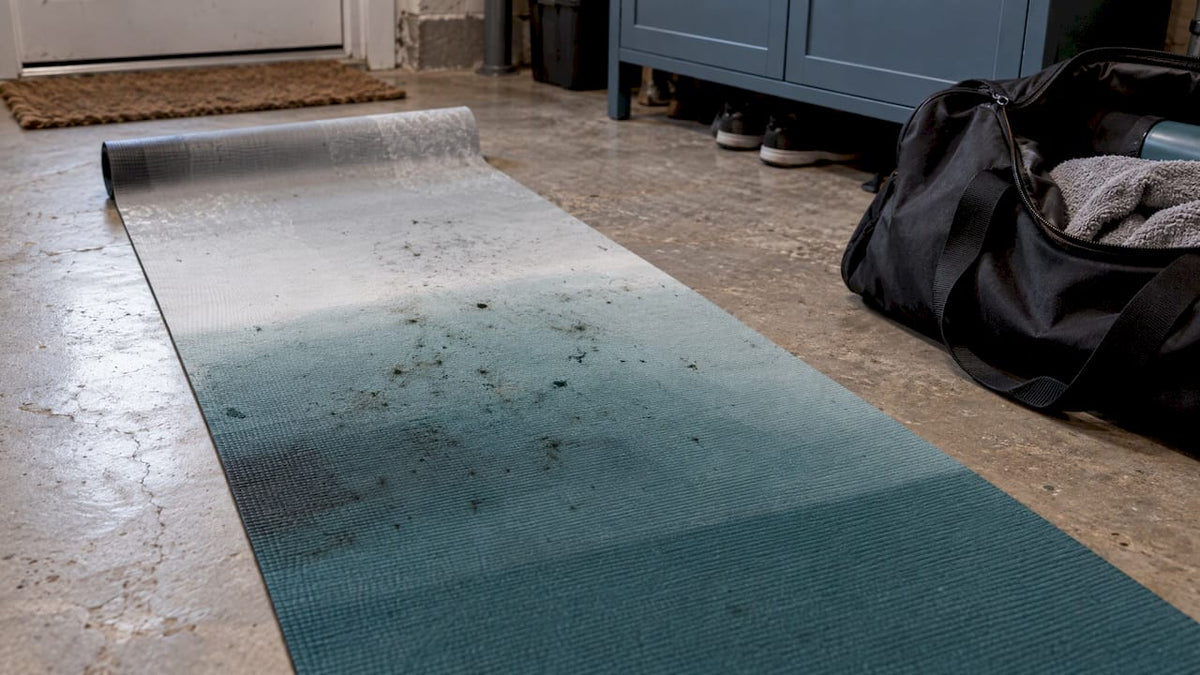
- Pilling, flaking or peeling. Little bits come off on your skin or clothes. The surface is breaking down.
- Permanent dents and thin spots. Compression works like a mattress wearing down where you sleep: less cushion under the knees, wrists and spine.
- Bald patches or holes. Organic Authority calls this a mat going bald.
- An uneven surface. If the mat curls, bubbles or no longer lies flat, it can throw off your balance.
- Pain or instability. The same source lists sore joints and struggling to hold balance poses among its signs. A mat that no longer supports you is not worth keeping. If joint pain continues after you replace the mat, see a doctor or physical therapist.
- A smell that cleaning won’t remove. Persistent odor means the material is holding moisture or bacteria.
A five-minute mat check
Once a month, unroll your mat on a bright floor and run through it:
- Press your thumb into the spots where your knees and hands go. Does it spring back?
- Rub your palm across the surface. Do you feel flaking or sticky residue?
- Lift the corners. Is there any separation between the layers?
- Wipe it, let it dry, and sniff it. Is there still a smell?
- Do a downward dog with slightly damp hands. Do you slide?
Two or more problems means it is time for a new mat.
How to make your yoga mat last longer
Good care is the cheapest way to add years, and most of it is free.
Clean it the right way, and often enough
Wirecutter advises wiping your mat down at least every couple of uses. If you sweat a lot, wiping after each practice is reasonable, and after every class if you carry your mat to a public studio, according to Consumer Reports. A quick wipe takes 10 to 15 minutes per side, including drying time. A deep clean in the tub takes 20 to 30 minutes plus up to a day to dry.
When in doubt, use mild soap and water. Avoid alcohol, vinegar and bleach, which strip natural rubber and dull PVC, and don’t soak open-cell mats, which absorb water and invite mold. We cover the step-by-step in our guides to cleaning and maintaining your mat and washing it for longevity.
If you have ever had warts, athlete’s foot or another skin infection, be meticulous: a dermatologist told Wirecutter you can reinfect yourself from a dirty mat even months after treatment. Ask your dermatologist about your specific situation.

Dry it completely
This is the habit that matters most. Consumer Reports quotes an infection-control specialist warning that a mat stored while still moist can breed microorganisms again. Let it air-dry flat or hang it in the shade, then roll it.
Keep it out of the sun and heat
Store your mat in a cool, dry spot, not on a sunny windowsill, near a radiator or in a parked car. Sunlight is hard on every material, and especially on natural rubber.
Roll it with care
Roll loosely, with the top surface facing out for most mats, or with the rubber side inward for natural rubber, as one dermatologist recommends for protecting it over time. Avoid tight bands that leave creases.
Use a towel and rotate your spots
A yoga towel soaks up sweat and cuts surface friction. Turning your mat around now and then spreads the wear across more of its length.
What we think about mat lifespan
We hear the same question again and again: how long should a mat last? Our honest view is that lifespan is a decision you make when you buy, and then a habit you keep afterward.
That is why we build our range around natural rubber, eco-friendly materials and foldable travel designs, and why we write so much about care. A mat you clean properly, dry fully and store out of the sun gets used for far longer, and every extra year of use lowers its footprint per practice.
Choose a material that suits your style, give it a gentle routine, and replace it only when it stops supporting you. Our guides on yoga mat durability and eco-friendly, durable materials show how we think about it.
Nicholas
Why a longer-lasting mat is also the greener choice
A researcher at the University of Michigan’s Center for Sustainable Systems told Wirecutter that a mat’s durability and useful life are key to its environmental impact: the longer you use it before discarding, the lower the impact per use. OutdoorGearLab’s testers reached a similar conclusion, scoring high-performing mats that last through years of practice above recyclable mats that fall apart in six months.
The greenest mat is the one you keep. When you do finally retire one, look for local textile or rubber recycling programs, or reuse the old mat as knee padding for gardening, under a plant pot or as a liner for a drawer. Our post on the benefits of an eco-friendly mat goes deeper.
Choosing your next mat
When you shop for a replacement, match the mat to the life you give it:
- Home practice, several times a week: a natural rubber or eco mat, with a regular wipe-down routine.
- Hot or sweaty practice: a grippy mat plus a yoga towel on top.
- Frequent travel: a foldable mat that packs small, so it isn’t squeezed in a way it wasn’t designed for.
- Beginners: a supportive, foundational mat that gives you cushioning while you learn.
The pattern is simple: the denser and better-made the mat, the longer it generally lasts, and the better you care for it, the more of that potential you get.
Find your next mat at Yune Yoga
If your current mat is showing its age, our yoga mat collection includes natural rubber mats, eco mats, foundational mats and foldable travel designs, plus yoga towels and straps made to go with them. We also make custom yoga mats if you want something that is yours alone.

For travelers, the Larch Trekk Travel Yoga Mat, the Fabian Trekk Travel Yoga Mat and the MN25 Trekk Travel Yoga Mat fold for packing. You can also browse yoga clothes and accessories to round out your kit.
FAQ
How often should I replace my yoga mat?
There is no fixed schedule. Replace it when it loses grip, flakes, thins out or smells despite cleaning. As a guide, a basic foam mat may last about a year, while a dense PVC or well-kept rubber mat can last three to five years or more. Daily hot yoga shortens each of those.
How often should I wipe my yoga mat?
Wirecutter suggests at least every couple of uses. If you sweat heavily or use a shared studio, wipe it after every session. Use mild soap and water and let it dry fully before rolling it up.
How long do yoga mats take to dry?
A quick wipe-down needs about 10 to 15 minutes per side to dry, according to Wirecutter. A deep clean in the tub can take up to 24 hours. Dry it in the shade, not in direct sun.
Are yoga mats worth it?
Yes, if you practice regularly. A good mat gives you grip, cushioning and stability, which helps you hold poses safely. Because a well-made mat can last years, the cost per practice drops the longer you use it.
Can I wash my yoga mat in the washing machine?
Check the care instructions for your mat first, because many materials do not tolerate machine agitation or heat. Hand washing with mild soap and water is the safer default, as covered in our complete maintenance guide.
Sources
- When should you replace your yoga mat? (Reviewed)
- How Long Does a Yoga Mat Last? (Pose & Pause)
- The Best Yoga Mats (OutdoorGearLab)
- The 3 Best Yoga Mats (Wirecutter)
- Yoga Mat Buying Guide (Gold Tested)
- 7 Signs It’s Time to Replace Your Yoga Mat (Organic Authority)
- How to Clean a Yoga Mat (Wirecutter)
- How to Clean a Yoga Mat (Consumer Reports)