Article: Yoga Towel vs Yoga Rug: Which One Belongs on Your Mat?
Yoga Towel vs Yoga Rug: Which One Belongs on Your Mat?
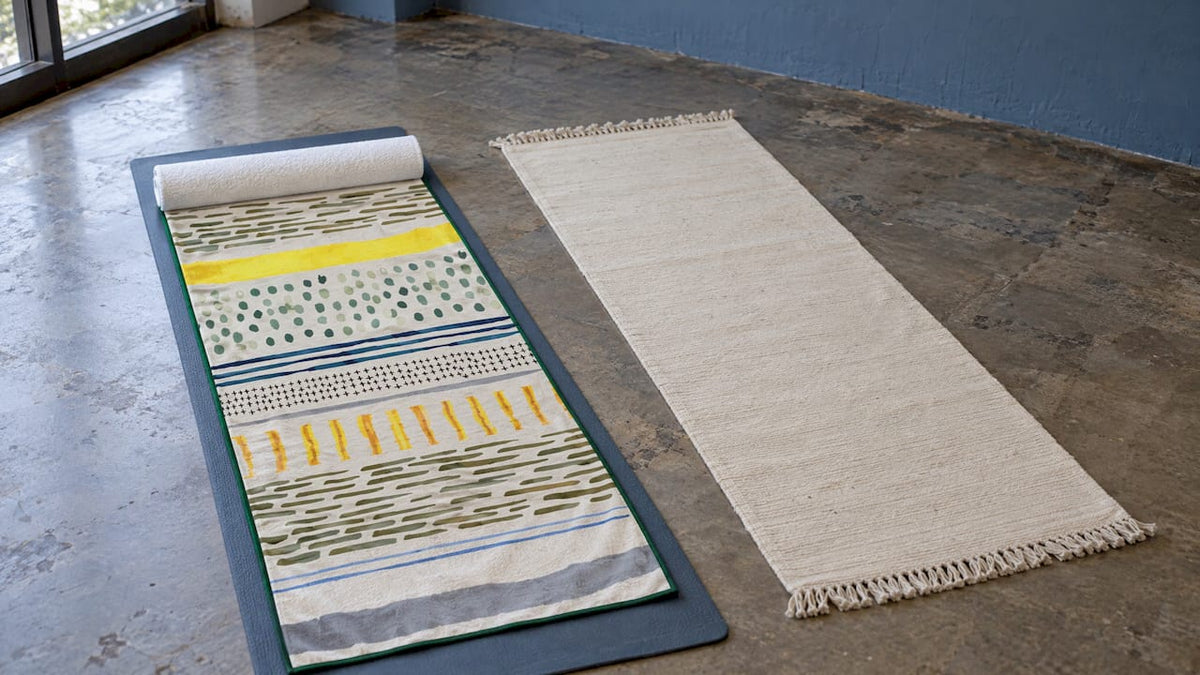
A yoga towel is a thin, grippy layer that goes on top of your mat to soak up sweat and keep your hands and feet from sliding. A yoga rug is a woven, usually cotton surface that can replace part of your mat’s job, or sit on it. If you sweat, practice in a heated room or share mats, a towel over a mat is the simpler fix. If you like a traditional, low-stick surface and a practice built on muscular control, a rug is a different philosophy of grip. Below, we compare them on grip, sweat, travel, care and style of practice.
TL;DR
- A yoga towel is an add-on: it sits over your mat and manages moisture. A rug is a surface: it replaces more of the mat’s role.
- For hot yoga and heavy sweating, a towel over a mat is the most common and easiest setup.
- Rugs suit dynamic, traditional practices such as Ashtanga and Mysore style, and they are washable. On smooth floors they usually need a rubber mat underneath.
- For slow, dry styles like yin or gentle hatha, a cushioned mat stays the primary surface, with or without a towel.
- Pairing a grippy mat with a towel gives you cushion, grip and easy washing in one setup.
Table of Contents
- What a yoga towel actually does
- What a yoga rug actually does
- Yoga towel vs yoga rug: side-by-side
- Grip and sweat: which handles a wet practice better?
- Practice style: which surface fits what you do?
- Traveling with a towel or a rug
- Care and durability
- What is a mat towel?
- How to decide in three questions
- Our perspective
- Build your setup with Yune Yoga
- FAQ
- Sources
What a yoga towel actually does
A yoga towel is not a bath towel. It is a thin, absorbent layer made to lie flat on your mat, often cut close to the mat’s dimensions. Its job is moisture management. According to Good Housekeeping’s testing roundup, yoga towels are designed to get grippier the wetter they get, which is why they hold up in the hottest classes. A regular towel does not do that: it bunches, slides and gets slick.

There is a hygiene side too. Registered dietitian and yoga teacher Eliza Whitaker told Shape that a towel absorbs sweat from your hands, feet and body for better grip, stability and safety, and that it creates a barrier between you and the mat, which can be hygienic on shared mats.
On materials, CorePower Yoga instructor Kenza Lo says in the same Shape piece that microfiber is absorbent and thinner than a normal towel, not too plush or thick, and that soft suede is another smart option. Thin matters: a thick towel shifts underfoot, while a thin one stays put.
If you want a closer look at how to choose one, our guide on how to choose and use yoga towels for mats walks through size, texture and setup.
What a yoga rug actually does
A yoga rug is a woven surface, traditionally cotton. Yoga Journal describes it as the pick if you want a washable, absorbent woven surface, and notes that rugs have a different grip from traditional mats. That is the key point. A rug does not grab your skin the way a sticky mat does. It offers texture and absorbency instead.
That difference is deliberate for some people. Drawing on yoga-rug practitioners, Yoga Journal explains that less stickiness can shift your reliance from adhesive grip to muscular control. This is why some advanced practitioners prefer rugs, while beginners may find them less immediately secure.
If you want to understand the stickiness side of that trade, see what mat stickiness means and why it matters.
Yoga towel vs yoga rug: side-by-side
| Factor | Yoga towel | Yoga rug |
|---|---|---|
| Main role | Moisture layer over a mat | Woven practice surface, alone or over a mat |
| Typical material | Microfiber, sometimes suede-like finishes | Cotton, traditionally |
| Grip when wet | Designed to get grippier as it gets wetter | Absorbs sweat, but grip feels different from a sticky mat |
| Cushion | None of its own, relies on your mat | Thin, so many rugs go over a mat on hard floors |
| Best for | Hot yoga, heavy sweaters, shared mats | Ashtanga, Mysore style, muscular-control focus |
| Washing | Machine wash is typical, check the label | Woven rugs can be washed by hand or in a machine |
| Travel | Light and compact | Folds flat |
Grip and sweat: which handles a wet practice better?
For sweat, the towel is built for it. Its whole design goal is to turn moisture into traction. If you drip in a heated studio, a towel over your mat addresses the problem directly.
A rug also absorbs sweat, and many practitioners like it for that. The difference is feel. On a rug, grip comes from the weave and from you. On a mat plus towel, grip comes from the towel’s texture, backed by the mat’s cushioning and anchoring on the floor.

The International Yoga Conference notes that a rug layered over a mat works like an integrated yoga towel for hot yoga, and that most hot yoga students put the rug on top of a regular mat. So even in the rug world, the layered setup is the usual hot yoga answer. That points back to the same conclusion: for heat, you want a mat underneath and an absorbent layer on top.
Hot yoga setups that work
- Start with a mat that grips when dry, so the towel has a stable base.
- Lay a towel that covers your mat’s full length, so hands and feet never touch bare mat.
- Mist or dampen the towel lightly if you like extra grip at the start. Many people find this helps in the first poses.
- Keep a small hand towel nearby for your face, so the main towel stays for grip.
- Wash after every class.
For more on this setup, see our guides to the ultimate hot yoga towel and choosing a towel for a hot yoga mat.
Practice style: which surface fits what you do?
Hot and vinyasa classes
Heat and flow mean sweat and quick transitions. A towel over a mat is the setup we would reach for. It absorbs, it grips, and you can toss it in the wash after class.
Ashtanga and Mysore style
The International Yoga Conference says cotton rugs are traditional in Ashtanga and Mysore-style practice, absorb sweat, wash in a machine and last for years. The same page adds that on smooth floors they need a rubber mat underneath to stop sliding. In other words, even here the rug often works as a layer on a mat, not a replacement.
Yin, restorative and gentle hatha
Slow, dry styles ask for cushion and stable contact with the floor. The same source says that for yin or gentle hatha, a rug alone will probably feel slippery and is not the right primary surface. A cushioned mat is the better foundation. Add a towel only if you run warm.
Home practice on carpet or hard floors
Floor type changes everything. On hardwood, tile or laminate, a mat gives the anchor and cushion. On carpet, a mat gives a firmer, more even platform. The Yoga Sensei guide cautions that some rugs work alone while others require a mat, so follow the manufacturer’s guidance for the floor you have. A towel is simpler in this respect: it is always meant to go on a mat.
Traveling with a towel or a rug
Both pack down. The International Yoga Conference points out that a cotton rug folds flat into a suitcase, unlike a 5 mm foam mat, which needs dedicated luggage space. A towel is lighter still and dries quickly, so it works well on a hotel floor, a beach or a studio mat you do not want to touch.
For a traveler, the best compact kit is a foldable mat and a towel. The mat gives the base wherever you land, and the towel handles sweat and hygiene on borrowed or unfamiliar surfaces. Our foldable yoga mats are made for exactly this home-and-travel use.
Care and durability
Woven rugs can be washed by hand or in a washing machine, according to Yoga Journal. That ease of washing is a real strength, and the International Yoga Conference argues cotton rugs arguably have the lowest lifetime impact because they last many years and go in the machine.
Towels share the washing advantage. A few habits keep either one working:
- Rinse or wash after every sweaty session so salt and oils do not build up.
- Follow the care label on temperature and drying. Heat can affect some synthetic fabrics.
- Skip fabric softener on towels. It can coat fibers and reduce absorbency and grip.
- Dry fully before folding into a bag to avoid odor.
If you keep a wider practice space with natural objects, you may enjoy our partner-free note on incorporating crystals into a yoga routine, which also covers keeping your practice area tidy and your mat surface clean.
What is a mat towel?
“Mat towel” is simply another name for a yoga towel: a towel sized to cover a yoga mat. It is not a rug. A rug is a heavier woven surface that can stand in for part of the mat, while a mat towel is a thin absorbent layer that needs a mat beneath it. If you see “hot yoga mat towel” in a product name, it means the same thing as a yoga towel. We cover the details in our hot yoga mat towel guide.
How to decide in three questions
- Do you sweat heavily or practice in heat? Choose a towel over a mat.
- Do you want a traditional, low-stick feel and train muscular control? A rug is worth exploring, and it often goes over a mat anyway.
- Do you practice slow, dry styles on hard floors? Keep a cushioned mat as your base, and add a towel if you get warm.
If you are still unsure, the mat-plus-towel pairing covers the most situations: cushion and anchoring from the mat, absorbency and wet grip from the towel. Our longer comparison, Yoga Rug vs Mat, goes deeper on surfaces, and our list of non-slip mats for every practice helps you choose the base.
Our perspective
We built Yune Yoga around the idea that the surface under your hands should fit the practice you actually do, not the one on a product label.
In our view, the towel-and-mat pairing is the most useful setup for most people. A mat gives you cushion, a stable base and an anchor on the floor. A towel adds the one thing a mat cannot: a washable layer that handles sweat and shared-studio hygiene. You can wash the towel after every class without washing the mat.
That is why we focus on natural rubber, eco-friendly and foldable travel mats, together with yoga towels and straps made from durable, sustainable materials. One kit works at home, in a studio and in a suitcase.
Rugs have a real tradition, and we respect it. But for most practitioners, a good mat with a towel on top is the clearest, simplest route to a practice that feels secure.
Nicholas
Build your setup with Yune Yoga
If you want the pairing we describe, start with a mat for your floor and practice, then add a towel. We offer natural rubber mats, eco mats, foundational mats and foldable travel mats, plus yoga towels and straps.

Browse the towels: Yoga Towel Reed, Yoga Towel Rowan and Yoga Towel Spruce. For mats and everything else, visit Yune Yoga, or see our yoga clothes and accessories.
FAQ
Can I use a yoga towel without a mat?
A yoga towel is made to go over a mat, so it works best that way. On a hard floor it gives no cushioning and may slide without a mat underneath. Use a mat as the base and the towel as the top layer.
Is a yoga rug better than a towel for hot yoga?
Neither is better for everyone. A rug absorbs sweat and is washable, but most hot yoga students place the rug on a regular mat, according to the International Yoga Conference. A towel is the lighter, simpler layer for that same job.
Can I wash a yoga rug in the washing machine?
Yes, in most cases. Yoga Journal says woven yoga rugs can be washed by hand or in a machine. Check the care label for temperature and drying guidance.
Can a regular bath towel replace a yoga towel?
Not for grip. Good Housekeeping notes that a regular towel will not gain grip with sweat the way a yoga towel does. A bath towel is for drying off after class.
Sources
- Good Housekeeping: 7 Best Yoga Towels
- Shape: The 8 Best Yoga Towels
- Yoga Journal: 4 Yoga Rugs That Might Make You Ditch Your Mat
- International Yoga Conference: Yoga Rug vs Yoga Mat
- International Yoga Conference: What Are Yoga Mats Made Of?
- The Yoga Sensei: 8 Yoga Mat Alternatives