Yoga Props Small Luggage Tips for Traveling Yogis
The single most effective strategy for packing yoga props into small luggage is to choose travel-specific gear, roll everything tight, and keep your mat inside your bag rather than strapped to the outside. That one decision alone changes how manageable your kit feels at the airport. Whether you’re heading to a week-long retreat or squeezing in a hotel room flow, these tips will get your practice on the road without blowing your baggage allowance.
Essential yoga props small luggage tips you need right now
Getting your gear into a carry-on or small suitcase comes down to three things: what you bring, how you fold it, and where you place it. Most travelers overpack props they never use and underpack the ones that actually help. Start with a ruthless edit.
Quick-start packing checklist:
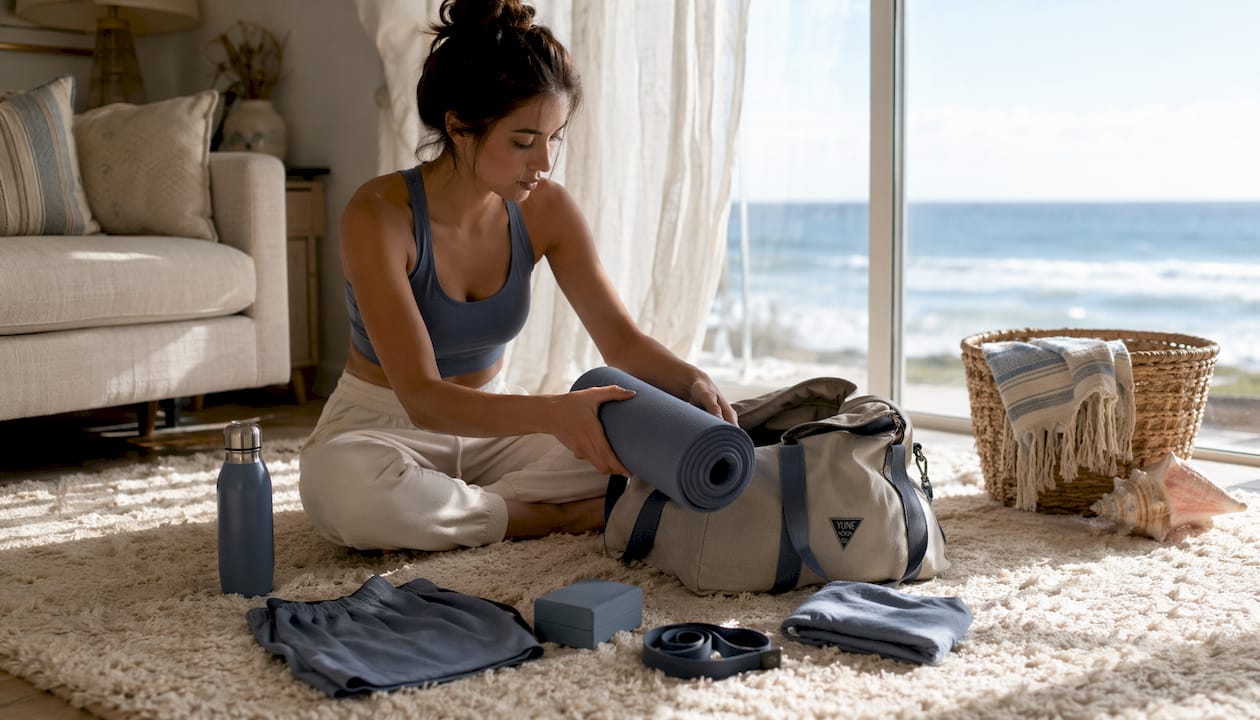
- Roll your yoga mat as tightly as possible, then fold it in half before placing it flat along the bottom of your suitcase
- Pack straps, balls, and resistance bands inside your rolled mat or shoes to reclaim dead space
- Use packing cubes to compress soft props like towels and bolster covers
- Place the heaviest items (blocks, sandbags) near the wheels of a rolling suitcase to keep the bag balanced
- Weigh your bag before leaving home. Budget carriers like Ryanair and Spirit impose strict weight limits on carry-ons, typically capping bags at 10 kg (22 lbs), and they do check
- Choose props that serve more than one purpose: a strap doubles as a luggage tie; a tennis ball works for myofascial release and fits in a jacket pocket
- Skip the bolster entirely. Hotel pillows and folded blankets do the same job
The goal is a kit that fits inside your bag, not hanging off it. Every prop you attach to the outside of your luggage adds friction, bulk, and the real risk of something snagging on a conveyor belt.
How to pack your yoga mat: carry-on versus checked luggage
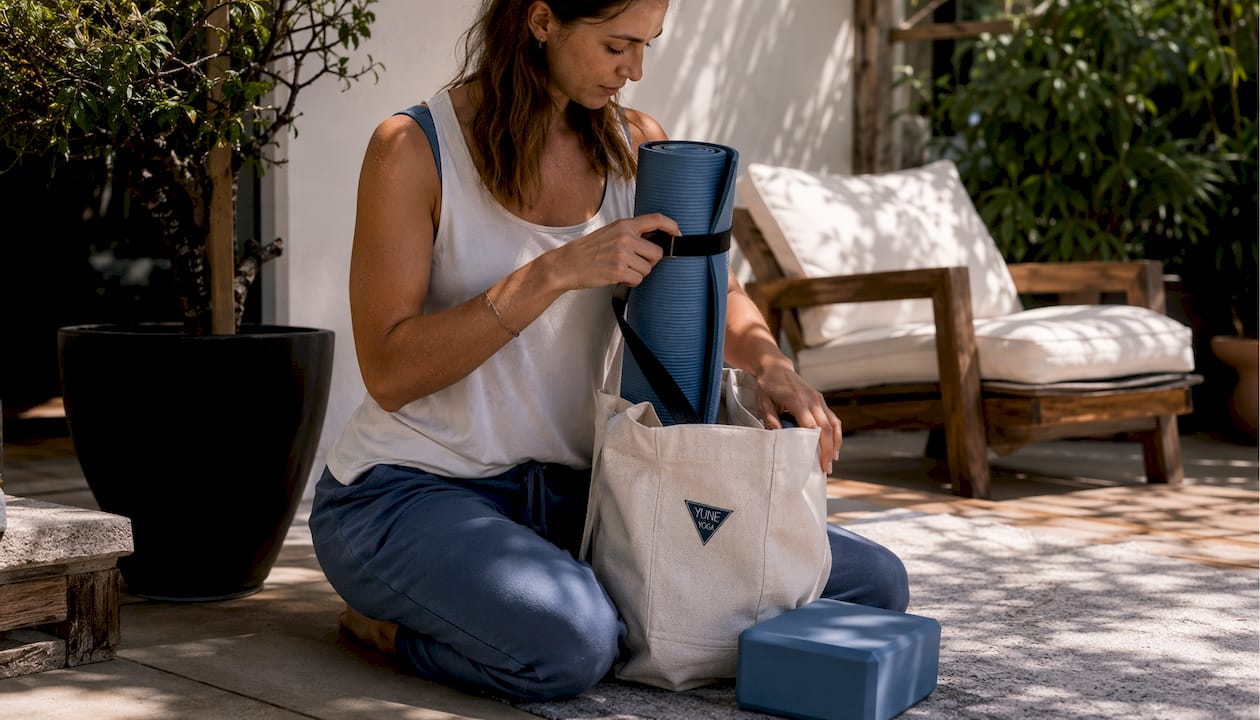
Your mat is the biggest space challenge, and the right approach depends entirely on whether you’re checking a bag.
Packing your mat in checked luggage
Checked luggage gives you the most flexibility. A standard yoga mat measures 68 by 24 inches. Fold it correctly and you can bring it down to roughly 22 x 14 x 9 inches, which fits inside most carry-ons per airline limits. Lay it flat along the bottom or top of your suitcase, then pack clothes and softer items on top to fill the remaining space. A mat that’s 4mm thick or less folds cleanly without cracking.
For checked bags:
- Fold the mat in thirds lengthwise, then roll or fold again to match your suitcase dimensions
- Place it along the spine of the suitcase, not across the middle, so it doesn’t create a ridge that prevents the bag from closing
- Wrap the mat in a reusable bag or a thin towel to protect it from scuffs and dirt
Fitting your mat in a carry-on
Carry-ons are tighter. Most airlines enforce a 22 x 14 x 9 inch size limit, and weight is often the harder constraint. A standard 4mm mat folded to meet carry-on limits can technically fit, but it leaves little room for anything else.
Travel mats solve this. They run 1.5–2mm thick, fold smaller, and weigh noticeably less. The trade-off is real: on a hard floor, that thinness shows up in your knees and wrists. Test a travel mat at home before committing to it on a trip where you’ll be practicing daily.
For carry-ons:
- Roll the mat as tightly as possible, then stand it upright in the corner of the suitcase
- If the mat won’t fit inside, fold it and slide it into a backpack with a mat strap attachment rather than dangling it loose
- Avoid attaching the mat to the outside of your carry-on bag. It creates awkward bulk and catches on other luggage
Pro Tip: If you’re flying a budget airline with strict weight limits, consider shipping your mat ahead to your hotel or retreat center. Many studios at popular yoga destinations also rent mats, which removes the problem entirely.
Which travel yoga props are actually worth packing?
Not every prop earns its spot in a small bag. The ones worth bringing are light, compact, and genuinely versatile.
Props that travel well:
- Yoga strap (8 or 10 feet, metal D-ring): A strap with a metal D-ring weighs almost nothing and rolls up to the size of a thick sock. Go for 8 or 10 feet rather than 6; the shorter length limits what you can do in seated and supine stretches. Plastic buckles break; metal holds.
- Lacrosse or tennis ball: This is the most underrated travel prop. One ball handles foot rolling, hip release, thoracic spine work, and shoulder mobility. It fits in a jacket pocket and weighs under half a pound.
- Travel yoga mat: A foldable mat in the 1.5–2mm range packs flat and keeps your practice grounded. Pair it with a hotel towel for extra cushioning on hard floors.
- Inflatable yoga block: Inflatable blocks weigh as little as 0.2–0.5 lbs when deflated and pack into a small stuff sack. They take 30–60 seconds to inflate and offer adjustable firmness. The downside is stability: they shift more than solid blocks, especially in balancing poses. For restorative work, they’re fine.
- Travel sandbag: Modern travel yoga sandbags compress to under 12 x 6 x 2 inches and weigh 3–5 pounds when filled, with double-sealed closures that prevent fill from leaking during pressurized flights. They’re TSA-friendly when filled with synthetic materials like glass microbeads rather than organic fills like rice or sand.
- Microfiber yoga towel: Doubles as a mat cover for grip and hygiene, and as a light blanket on cold flights. Folds to the size of a paperback book.
- Resistance band: Weighs under a quarter pound and replaces a strap for many stretching applications. Useful for travel-specific mobility work like hip flexor and shoulder openers after long flights.
Props to leave home:
Bolsters, foam rollers, and wooden blocks are the main offenders. A bolster is essentially a pillow with a yoga tax. Foam rollers are large, light, and impossible to compress. Wooden blocks are dense enough to push a carry-on over weight limits on their own. All three have workable substitutes at any hotel.
Pro Tip: Nest small props inside your rolled or folded mat before placing it in your bag. A strap, a ball, and a resistance band can all tuck inside the mat’s hollow center, turning dead space into storage.
How to keep your yoga practice going when you’re traveling light
Traveling with minimal gear forces you to get creative, and that creativity often improves your practice more than any prop would.
The most practical shift is moving toward floor-based and bodyweight sequences that need nothing but a mat or a patch of carpet. Yin yoga, restorative sequences, and mobility flows work beautifully with just a strap and a ball. If you practice vinyasa, a condensed 20-minute version keeps the habit alive without requiring a full studio setup.
Practical tips for yoga on the go:
- Practice in the morning before your schedule fills up. A 15-minute seated routine on a carpeted floor counts.
- Use hotel furniture creatively: a chair back works for standing balance poses; a wall replaces a block for supported inversions.
- Download a yoga app or save a few YouTube sequences offline before you leave. Connectivity at retreats and rural destinations is unpredictable.
- Check whether your destination has a local studio. A drop-in class solves the gear problem entirely and connects you with the local community.
- Pack your mat and props in a way that makes them easy to access, not buried under clothes. If getting to your gear feels like a project, you won’t do it.
For a complete travel yoga accessories checklist that covers everything from mats to towels, Yuneyoga’s guide breaks down exactly what to bring and what to skip.
Pro Tip: Build a simple seated routine you can do anywhere, even on a carpeted hotel floor with no props at all. Joanna Dunn keeps one specifically for travel days when unpacking feels like too much effort.
The nomad packing philosophy of bringing only what you’ll genuinely use applies directly to yoga gear. Every prop you pack but don’t use is weight you carried for nothing.
What yoga instructor Joanna Dunn recommends for packing props
Joanna Dunn has traveled extensively with her yoga practice and has developed a clear, practical system for keeping props manageable without sacrificing the quality of her sessions.
Her most direct piece of advice concerns the mat:
Beyond the mat, Dunn keeps her travel prop kit to two items: an 8- or 10-foot strap with a metal D-ring, and a lacrosse or tennis ball. She specifically calls out the metal D-ring because plastic buckles fail under repeated use. The ball handles the kind of deep tissue and myofascial work that becomes especially useful after hours of sitting on planes and in cars.
On weight distribution, the practical approach is to place heavy props near the wheels of a rolling suitcase. This lowers the
and keeps the bag from tipping when you let go of the handle. For backpacks, heavy items go against the back panel, closest to your spine.
Dunn also notes that creativity matters more than gear. A stable chair, a few couch cushions, and a folded blanket can stand in for blocks, bolsters, and extra padding. The practice adapts; the props are just tools. For travelers who want a deeper look at lightweight travel mats that fold small enough to fit Dunn’s inside-the-bag method, Yuneyoga’s selection covers both foldable and natural rubber options built for exactly this kind of travel.
Key Takeaways
Packing yoga props into small luggage works best when you choose travel-specific gear, keep your mat inside the bag, and limit props to the few that genuinely earn their weight.
| Point | Details |
|---|---|
| Keep your mat inside the bag | Fold or roll your mat to fit inside your suitcase rather than attaching it externally to avoid bulk and damage. |
| Weight limits are the real constraint | Budget carriers cap carry-ons at 10kg (22 lbs), making weight a stricter limit than bag dimensions. |
| Two props cover most needs | A metal D-ring strap and a lacrosse ball handle the majority of travel yoga needs at minimal weight and size. |
| Heavy props go near the wheels | Placing blocks or sandbags at the bottom of a rolling suitcase near the wheels keeps the bag balanced and easier to maneuver. |
| Travel mats trade padding for packability | At 1.5–2mm thick, travel mats fold small but may need a folded towel for cushioning on hard surfaces. |