Yoga Belt vs. Strap: Are They the Same Thing?
A yoga belt and a yoga strap are the same prop: a long, non-stretch band with an adjustable buckle that extends your reach and helps you hold a pose. “Belt” is the older, traditional word, and “strap” is what US stores and most websites print on the label. The real choice is not belt or strap. It is a strap versus a resistance band, and then length, width and buckle. We cover all of that below, with the safe way to use one.
TL;DR
- A yoga belt and a yoga strap are two names for one tool. “Belt” comes from the Iyengar tradition, and “strap” is the common retail term.
- A strap does not stretch. A resistance band does. They do different jobs and are not interchangeable.
- For most people, a strap of about 6 to 8 feet and 1 to 1.5 inches wide with a metal buckle covers nearly every pose.
- Use the strap as scaffolding, not as a winch: mild sensation, slow breath, no pulling or jerking.
- Our strap range is in the Yune Yoga collection, and the sizing guides on our blog help you pick a length.
Table of Contents
- Yoga belt vs. strap: same tool, two names
- Strap vs. resistance band: the difference that matters
- What a strap actually does for your practice
- How to choose: length, width and buckle
- What about using a towel instead?
- How to use a strap safely
- Two more ways people use a strap
- Our perspective
- Find a strap that fits your practice
- FAQ
- Sources
Yoga belt vs. strap: same tool, two names
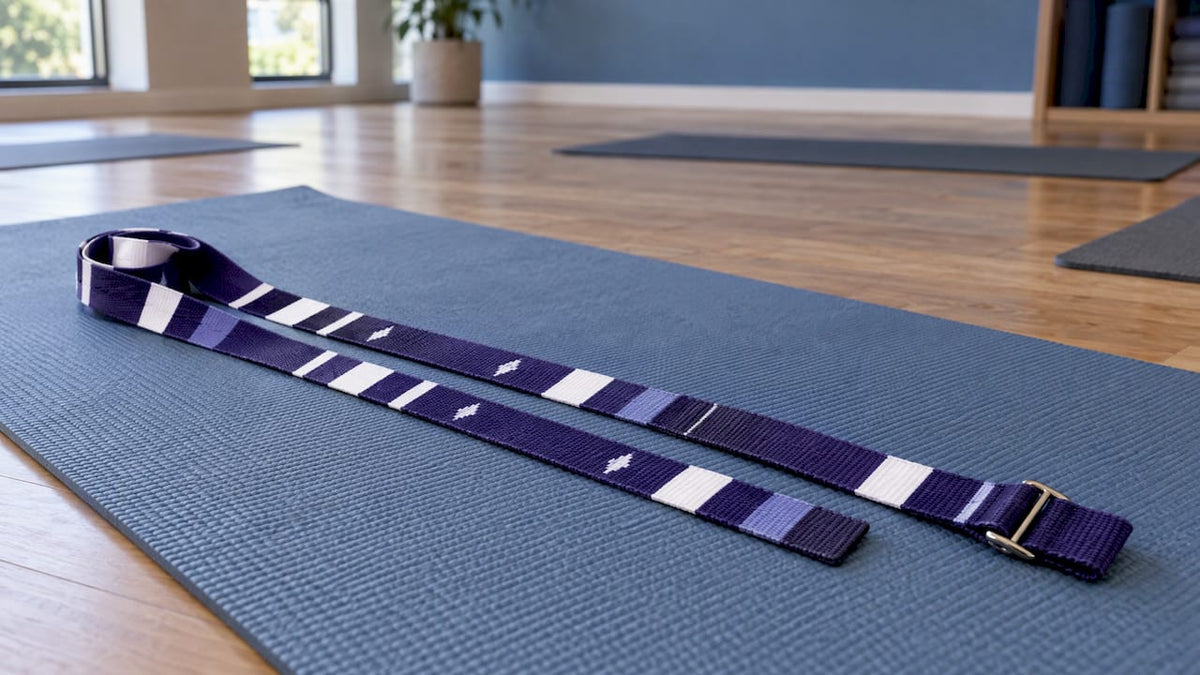
The two terms describe one object. A yoga belt, also called a yoga strap, is a long woven band, usually 6 to 10 feet of cotton or nylon with a buckle. “Belt” is the traditional term in Iyengar yoga, the style known for using props to make poses accessible. “Strap” is the word retailers settled on. If a studio teacher asks you to grab your belt, they mean the same thing you bought online as a strap.
There is one wrinkle worth knowing. Some listings use “yoga belt” for a wider, stiffer band meant for wrapping around the body in long restorative holds, while a standard strap is narrower and made for gripping with your hands. That is a difference in width, not a different category of prop, so check the dimensions in the product description rather than relying on the name.
One more near-namesake: a yoga mat strap or carrier is a sling for carrying a rolled mat. Some yoga straps can double as a belt to secure a rolled mat after practice, which is handy when you travel.

Strap vs. resistance band: the difference that matters
This is the comparison that actually changes what you buy.
| Yoga strap (belt) | Resistance band | |
|---|---|---|
| Stretch | None. Fixed length | Elastic, pushes back progressively |
| Main job | Holds a position, extends reach, cues alignment | Adds load to strengthen muscles |
| Adjustment | Buckle or D-ring sets the length | Chosen by resistance level |
| Typical use | Hamstring, shoulder and hip stretches, restorative holds | Strength and rehab-style exercises |
A strap is non-elastic, so it holds a static position while you relax into the stretch. A band stretches with your weight and movement, which is exactly what you want for strengthening and exactly what you do not want when you are trying to stay still in a hamstring stretch. If you are curious about the strengthening side, this explainer on resistance bands for strengthening shows why that tool is built for load rather than for holding a pose.
The practical rule: if your goal is to hold a shape, reach your foot or bring your hands closer together in a bind, you want a strap. If your goal is to make muscles work harder, you want a band.
What a strap actually does for your practice
The strap works as an extension of your limbs. Cleveland Clinic explains that straps make stretching more accessible by lengthening your reach, which helps most when stiffness limits your range of motion. Its example is a seated forward fold: with a strap around the balls of your feet, you can keep a long back and relaxed shoulders instead of rounding forward to grab your toes.
That points to three jobs a strap does:
- Alignment. It lets you feel the correct shape of a pose before your body can reach it unaided.
- Reach. It bridges the gap between your hand and your foot, or between your two hands behind the back.
- Duration. It lets you stay in a position long enough for your body to adapt, which is the point of restorative and long-held poses.
Common strap poses include reclining hand-to-big-toe pose (Supta Padangusthasana), seated forward fold (Paschimottanasana), cow face arms (Gomukhasana), and bound poses where your hands cannot yet meet. Yogapedia lists these and others among the popular strap poses. Yoga International also shows strap-supported reclined variations that stretch tight hamstrings and inner thighs while keeping the back from rounding.
If you want pose-by-pose walkthroughs, our guides to yoga strap poses and yoga strap leg stretches start from the beginner version of each.
How to choose: length, width and buckle
Length
Length is the decision most people get wrong. A strap that is too short forces you to hunch or lets go of the pose. Too long, and you wrestle with excess webbing.
- 6 feet suits most people under about 5’8" for standard stretches.
- 8 feet is the safe default if you are unsure, and works for nearly every use.
- 10 feet helps taller practitioners and full-body binds.
These figures come from a length and buckle guide that treats 8 feet as the all-purpose size. Yoga International adds that a fully relaxed Head Hammock, a restorative pose, needs at least an eight-foot strap, and up to ten feet if you are over six feet tall.
We wrote several guides to sizing, including how to choose the right length of yoga strap and a complete buying guide on length. Read one before you order if you are between sizes.
Width
About 1.5 inches suits most uses. A 2-inch width spreads pressure across a larger area, which is more comfortable in restorative holds where the strap rests against your body. A narrower strap is easier to grip in the hands.
Buckle
The buckle is what makes a strap a strap. A D-ring or metal buckle lets you build an adjustable loop in seconds and lock it where you want it. Loops sewn into the webbing add grip points, but a buckle is what gives you a fixed, secure circle for your foot. Our Horatio and Gemini straps both come with metal buckles: see the Horatio blue stretching strap and the Gemini white stretching strap.

Material and portability
Straps are usually cotton or nylon. Cotton feels softer in the hand and is the usual choice for eco-minded buyers, with organic cotton as an option. A strap is also one of the lightest props you can pack. It folds flat, fits in a carry-on, and takes up less room than a block. For travelers who already carry a foldable mat, a strap is the easiest addition.
What about using a towel instead?
If you are mid-practice with nothing else at hand, a rolled towel can act as a makeshift stand-in. It works for a quick home drill. But it has no buckle, so you cannot lock a fixed loop around your foot, and it slips in poses that need a steady hold. A purpose-made strap with a buckle stays where you set it, which is why it is worth owning if you stretch regularly.
How to use a strap safely
A strap should make a stretch calmer, not more aggressive. The best description we have seen calls it scaffolding, not a winch. Here is a simple routine, using the classic reclining hamstring stretch as the example.
- Set the length. Make a loop with the buckle and adjust it so you can hold the strap comfortably with your elbows soft. If you are straining to reach, lengthen the strap rather than lifting your head.
- Lie on your back. The floor supports your spine. For anyone with low-back sensitivity, the reclined setup is the gentler default compared with seated folds.
- Place the loop across the ball of the foot. Not around the ankle. Tighten it only enough to stop it slipping.
- Lift the leg slowly. Keep a small bend in the knee if locking it is uncomfortable.
- Breathe and hold. Relax your hands, jaw and shoulders. A common range is 30 to 45 seconds, building toward 60 to 90 seconds as you get comfortable, though 5 to 10 slow breaths is an easy way to count.
- Come out slowly. Release the tension before lowering the leg.
A few rules keep this safe:
- Stretch to a mild or moderate sensation, never sharp pain.
- Do not jerk, pulse or yank the strap. If the strap is doing most of the work, ease off and let your muscles take part.
- Never cinch the strap tightly around a joint such as the ankle or wrist, which can press on nerves.
- Stop and release if you feel numbness, tingling, dizziness, sudden weakness, joint pain, or pain that is sharp, electric or travels down the leg.
If you are pregnant, recovering from an injury, or managing a condition such as sciatica, check with your doctor or physical therapist before adding strap stretches. For general principles of stretching gently through a tender area without pushing into pain, this piece on gentle stretches for round ligament pain illustrates the same slow, no-forcing approach.
For a longer beginner walkthrough, see our guides on how to use a yoga strap for flexibility and alignment and how to use a yoga stretch strap.
Two more ways people use a strap
Shoulder flossing. Hold the strap wider than your shoulders, then sweep it overhead and behind your back, keeping your arms straight. Widen your grip if it feels tight. This is a common warm-up for desk-bound shoulders, and a step-by-step version is here.
Alignment feedback in strong poses. Looping a strap around the upper arms can help you keep them hugged in during arm balances. A strap used for alignment lets you check the right muscles are working first, and many practitioners eventually drop the strap once the shape is familiar.
Our perspective
We think the belt-versus-strap debate is a naming quirk, and the choice that really shapes your practice is a buckle you trust and a length that fits your body.
A strap earns its place by doing one thing well: it holds still so you can relax. That is why we stock straps with metal buckles, and why our blog covers sizing in so much detail. A strap that fits your height and your poses gets used. One that does not ends up in a drawer.
We also like that a strap travels so easily. Alongside a foldable mat, it gives you a full stretching practice in a bag, which fits the home-and-travel yoga we build our range around.
Nicholas
Find a strap that fits your practice
Our range includes the Dark Suzy stretching strap, the Horatio in blue and the Gemini in white, the last two with metal buckles. They sit alongside our mats, towels and other accessories, so you can build a home or travel kit in one order. If you want to see everything we offer, browse the Yune Yoga store or the yoga clothes and accessories collection.

Not sure which length to pick? Our guide, what size yoga strap do I need, walks through it by height and pose.
FAQ
Is a yoga belt the same as a yoga strap?
Yes. “Belt” is the traditional term from Iyengar yoga, and “strap” is the name most US retailers use. Both describe a long, non-stretch band with an adjustable buckle. If a listing calls a product a belt, check the width and length, since some wider belts are made for restorative wrapping rather than hand-gripping.
What is a yoga strap used for?
It extends your reach and helps you hold poses you cannot yet complete on your own, such as a seated forward fold or a bound pose. It also gives alignment feedback and supports long restorative holds. Cleveland Clinic notes it is especially helpful if stiffness limits your range of motion.
Can a resistance band replace a yoga strap?
Not well. A band stretches and pushes back, so it adds load rather than holding you steady. A strap is fixed in length and keeps a position still while you relax into it. Pick the strap for flexibility and alignment work and a band for strengthening.
What length of yoga strap should I buy?
Six feet works for many people under about 5’8" and eight feet is the safest all-round size. Choose ten feet if you are tall or want to do full-body binds. If you plan to do restorative poses that wrap around the body, go longer.
How do I wear or carry a yoga strap with a mat?
Some straps double as a belt that secures a rolled mat. Roll the mat, loop the strap around the middle, and tighten the buckle until it is snug but not crushing the roll. You can then carry it by the strap or over your shoulder.
Sources
- Best yoga straps to deepen your flexibility and mobility
- Yoga Belt Guide: Length, Material, Buckle & Uses
- Yoga Strap Stretches: 8 Essential Poses + Setup
- Essential Yoga Props To Elevate Your Practice
- What is a Yoga Strap? Definition from Yogapedia
- 5 New Ways to Use a Yoga Strap
- What Is A Yoga Strap & Should You Use One?
- Yoga Strap Stretches: 8 Poses to Deepen Flexibility & Reach
- How to Use a Yoga Strap by Amber Connors
- Resistance Bands for Osteoporosis: A Safe Way to Start
- Clinician Vetted Stretches for Round Ligament Pain