

Yoga strap leg stretches: A beginner-friendly guide to deeper flexibility and better mobility
Key Takeaways
A yoga strap can make leg stretches more comfortable by extending your reach and helping you stay steady. The aim is not to pull harder, but to practice with patience and control.
- Choose a strap that feels secure and gives you enough length to reach your feet comfortably.
- Warm up gently before working on deeper hamstring, hip, calf, or inner-thigh stretches.
- Keep your knees, hips, and spine aligned rather than chasing a dramatic range of motion.
- Use breath, props, and bent-knee variations to match your current flexibility.
- Stop for sharp pain, numbness, or joint discomfort and seek professional guidance when needed.
Choose the right yoga strap and prepare your body
The right strap should help you reach without making you grip or strain. A calm setup matters just as much: a clear floor, a stable mat, and a few minutes to transition into movement can change how the stretches feel. Start with the goal of steady practice rather than maximum depth.
Selecting a strap length, material, and loop style
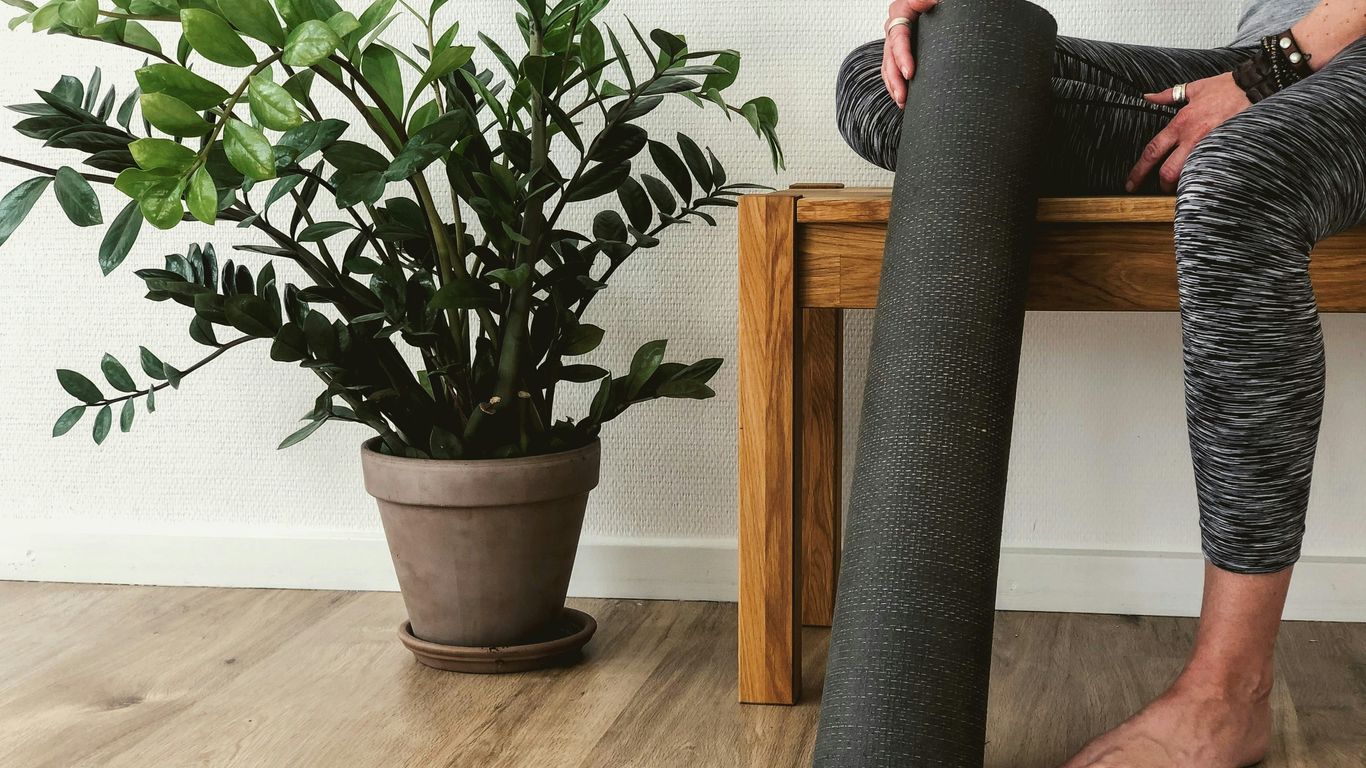
Most beginners do well with a medium or long strap that can wrap around the ball of the foot while leaving room to hold both ends. A firm, non-stretchy fabric gives clear feedback, while a buckle or D-ring makes it easier to adjust the loop. For a portable option, the Horatio Yoga Strap is documented as an 8-foot organic cotton strap with metal D-ring buckles that functions as both a mat carrier and stretching tool.
A strap should feel comfortable in your hands and easy to thread. If you practice in small spaces or while traveling, choose something that packs simply and does not require complicated setup.
Warming up your hips, hamstrings, and calves
Cold muscles often feel resistant, so begin with easy movement rather than a long, intense hold. Walk around the room, circle your ankles, bend and straighten the knees gently, or move through a few slow hip hinges. The purpose is to make the first strap stretch feel familiar, not to exhaust yourself.
Spend a minute or two on each area that will do the work. If your calves feel especially restricted, ankle circles and slow heel raises can make the later foot loop more comfortable.
Setting up a stable and comfortable practice space
Place your mat on a level surface and keep the strap free of twists before you begin. A wall, folded blanket, or block can be useful nearby, even if you do not need it right away. This practical preparation is especially helpful when practicing in a hotel room, park, or other temporary space.
Keep enough room around your arms and legs to move without bumping furniture. If you are also planning home projects, separate your movement area from tasks such as reviewing brick bungalow gutter methods; a clear practice space is easier to use consistently.
Learn the fundamentals of using a yoga strap
A strap is a guide, not a tool for forcing your body into a pose. It can extend your reach and offer a steadier connection to the foot, but your muscles still need room to respond. Move slowly enough that you can notice where the stretch begins and where compensation starts.
Creating gentle tension without forcing a stretch
Loop the strap around the ball of the foot rather than the toes, then hold the ends with relaxed hands. Apply only enough pressure to keep the strap from slipping. Steady tension beats force because it lets you stay in the position long enough to observe small changes.
If your shoulders creep toward your ears or your grip becomes rigid, ease off. The strap should make the position more accessible, not turn it into a tug-of-war.
Keeping your joints aligned during each movement
In most leg stretches, keep the working knee pointed in the same general direction as the toes. Avoid letting the hip roll backward or allowing the ankle to collapse inward simply to gain a few extra inches. Alignment is not about looking perfect; it is a way to distribute effort more evenly.
Use a mirror only if it helps you observe without interrupting your breathing. Otherwise, simple cues such as “soft knee,” “heavy hips,” and “long spine” are usually enough.
Using your breath to improve relaxation and range of motion
Breathe smoothly through the nose or mouth, whichever feels natural. On an exhale, let the muscles soften slightly without pulling deeper; on an inhale, maintain the shape and create space through the spine. This rhythm keeps the stretch active and attentive rather than passive and abrupt.
Try counting four slow breaths instead of watching the clock. When the breath becomes choppy, that is useful information that the position may be too demanding.
Knowing the difference between productive tension and pain
A mild pulling sensation in the belly of a muscle can be normal, especially in the hamstrings or calves. Sharp, pinching, burning, electric, or joint-centered pain is different and deserves immediate attention. Tingling or numbness is also a reason to release the strap and reassess.
A simple check is to loosen the strap slightly and see whether the sensation settles. If it does not, leave the pose and choose an easier variation rather than trying to breathe through it.
Practice yoga strap leg stretches while lying down
Supine stretches are a friendly starting point because the floor supports your back and reduces the balance demands. They also make it easier to compare the two sides without rushing. Keep the non-working leg relaxed and notice whether your pelvis stays level.
Reclining hand-to-big-toe stretch for the hamstrings
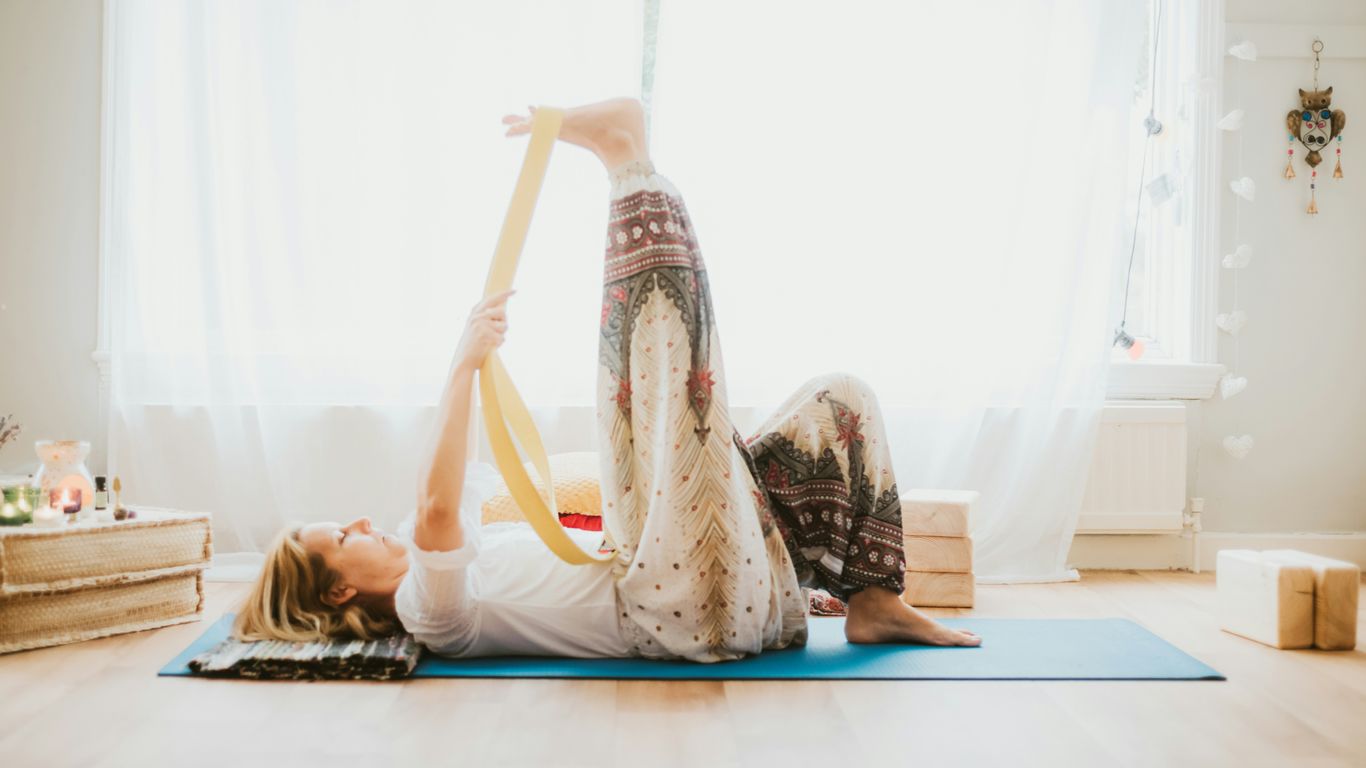
Lie on your back with both legs long, then draw one knee toward your chest. Place the strap around the ball of that foot and gradually extend the leg upward, keeping the opposite leg grounded or softly bent. The leg does not need to become vertical; a lower angle can still provide a useful stretch.
Hold both sides of the strap and let the shoulders rest on the floor. If the pelvis tucks or the back arches sharply, reduce the angle or bend the raised knee.
Strap-assisted inner-thigh stretch for the adductors
From the same position, guide the strapped leg slowly outward while keeping the opposite hip heavy. Move only as far as you can without twisting your torso. The inner thigh should lengthen gradually rather than feeling yanked toward the floor.
Return to center before switching sides. A smaller range with a quiet pelvis is more useful than a wide range that turns the movement into a rotation.
Reclining figure-four stretch for the hips and glutes
Bend both knees and place one ankle across the opposite thigh. You can loop the strap around the supporting foot if reaching the leg feels difficult, or hold behind the supporting thigh instead. Keep the crossed foot active and let the outer hip soften as you breathe.
The strap is there to bring the legs closer without pulling on the knee. If the crossed knee feels pressured, lower the legs and make the shape smaller.
Supine calf stretch for the ankles and lower legs
Extend one leg upward with the strap around the ball of the foot. Slowly point and flex the ankle, then settle into a gentle flex with the heel reaching away. Keep the knee soft rather than aggressively locked.
Small ankle movements can reveal a lot about comfort and control. Repeat on the other side, using less tension if the calf feels cramped.
Explore seated and standing strap-assisted stretches
Seated and standing variations ask for more control because the floor no longer supports every part of your body. Begin with the seated options, then try standing only when you can maintain a steady breath and stable foot placement. A wall is a sensible companion for balance, not a sign that you are doing less.
Seated forward fold with support for tight hamstrings
Sit with your legs extended and loop the strap around both feet, holding one end in each hand. Sit tall first, then hinge forward from the hips while keeping the spine as long as is comfortable. Let the strap bridge the gap between your hands and feet rather than pulling your chest toward your knees.
If your pelvis rolls backward immediately, sit on a folded blanket. The seated forward fold guidance also reflects the practical use of a strap when the feet are difficult to reach.
Standing hamstring stretch with the strap around the foot
Stand near a wall and shift your weight into one foot. Loop the strap around the other foot, extend that leg forward or slightly upward, and keep the standing knee softly bent. Hold the strap close enough to keep your shoulders relaxed.
You can keep the lifted heel low and the leg only partly straight. Stability comes first; the stretch can become more spacious with practice.
Strap-assisted quadriceps stretch for the front thighs
Lie on your side or stand with one hand on a wall, then loop the strap around the ankle of the top or lifted leg. Use the strap to guide the heel gently toward the seat while keeping the knees relatively close. Avoid pulling the foot sharply backward.
A side-lying version usually requires less balance. Keep the pelvis stacked and stop if the front of the knee feels compressed.
Wide-leg seated stretch for the inner thighs
Sit with the legs open to a comfortable width and place the strap around one foot. Hold the strap as you angle your torso toward that leg, keeping the opposite sit bone grounded. Repeat toward the center and the other side without trying to reach the floor.
Choose a width that allows you to sit upright at the beginning. Over time, the legs may open farther, but the quality of the hinge matters more than the shape.
Modify stretches for different flexibility levels
Flexibility changes from day to day, and one side may behave differently from the other. A useful modification keeps the intended area involved while reducing unnecessary effort elsewhere. Adjust the strap, bend a knee, or add support before deciding that a pose is not for you.
Adjusting strap placement for beginners
Start with the loop around the ball of the foot and keep plenty of strap between your hands and the leg. If reaching the foot is easy, shorten the strap gradually; if you are straining, lengthen it. Avoid wrapping directly across sensitive toes or placing the strap where it may slide toward a joint.
Beginners often benefit from holding the strap near the ends, which creates more space and reduces the urge to pull. This simple adjustment can make the movement feel calmer immediately.
Using a bent knee to reduce hamstring strain
A bent knee is not a failure to stretch; it changes the angle and can reduce the sensation behind the knee. Keep the thigh supported by your hands or the strap, then slowly straighten only until the stretch feels moderate. You can revisit the position later without forcing a final range.
Try alternating between a slightly bent and slightly straighter knee with each breath. Stop before the movement becomes jerky.
Adding a folded blanket, block, or wall for support
Support can help you keep your pelvis and spine in a more useful position. Sit on a folded blanket for forward folds, place a block under a hand in standing work, or practice near a wall when balance is uncertain. The Gemini Yoga Strap is documented as an 8-foot organic cotton strap with D-ring buckles that supports flexibility and alignment, but any secure strap can be adjusted to suit your setup.
Use the prop to reduce effort, not to push yourself farther. If support makes breathing easier, it is probably serving its purpose.
Progressing from static holds to active mobility work
Once a static stretch feels familiar, add small controlled movements. In a supine hamstring stretch, for example, gently bend and straighten the knee while maintaining light strap tension. In a calf stretch, alternate between a relaxed ankle and a soft flex.
Keep the movement slow and limited. The goal is to explore control around your available range, not to bounce past it.
Build a yoga strap leg stretching routine
A routine works best when it is short enough to repeat and varied enough to address more than one area. You do not need every stretch in one session. Choose a few positions that fit the time you have, then leave enough energy to finish feeling better than when you started.
A five-minute routine for daily mobility
For a quick daily sequence, begin on your back and move through one hamstring stretch per side, an inner-thigh opening, and a calf stretch. Finish with a few relaxed knee bends before sitting up. Keep the pace easy and use the strap mainly to maintain reach.
A simple order helps remove decision-making from busy mornings:
- One minute of easy walking or joint movement.
- Forty-five seconds per side for the reclining hamstring stretch.
- Thirty seconds per side for the calf stretch.
- One minute for the reclining figure-four, switching sides halfway.
- One minute of quiet breathing and gentle movement to finish.
This sequence is deliberately modest. Consistency matters more than making the five minutes feel intense.
A pre-workout sequence for better movement
Before exercise, use shorter holds and more movement. Try ankle circles, a standing strap-assisted hamstring stretch, a few gentle knee bends, and controlled leg swings without forcing height. Keep your body warm and alert rather than sinking into long passive stretches.
The strap can provide a clear target for the foot while you practice control. If the sequence makes you feel sleepy or unstable, save it for after training.
A post-workout routine for easing muscle tightness
After training, let your breathing slow before stretching. Use the reclining hamstring, figure-four, calf, and inner-thigh variations, holding each at an easy intensity. Support the head or knees with a blanket if the floor feels uncomfortable.
This is a good moment to notice asymmetry without trying to correct it aggressively. Finish with a few minutes of relaxed movement so you do not stand up abruptly.
How long to hold each stretch and how often to practice
Start with 20 to 30 seconds per side and repeat once if the sensation remains comfortable. Three or four short sessions each week can be more manageable than one demanding session. During active mobility work, use several slow repetitions rather than a long hold.
There is no need to stretch to the point of shaking. A gentle routine that you can repeat is usually easier to build into real life, whether you practice at home or travel with a compact setup.
Avoid common mistakes and practice safely
Most strap problems come from trying to get too much from the prop too quickly. The strap can make a position feel accessible, but it cannot replace awareness of your joints and spine. Keep the session simple enough that you can adjust at any moment.
Pulling too hard or bouncing into the stretch
Strong pulling often recruits the shoulders and arms while the target muscle resists. Bouncing adds speed when you need control. Instead, create light tension, pause, and let the next breath guide a small adjustment.
If the strap slips, stop and reset the loop rather than catching it with a sudden tug. Smooth setup is part of safe practice.
Locking the knees or rounding the lower back
A completely rigid knee can make the back of the leg feel sharper, while a rounded lower back can hide the true limit of the hips and hamstrings. Keep a small amount of softness in the knee and hinge from the pelvis when folding forward. The exact shape will vary between people.
Use a blanket under the hips or bend the knees when needed. The Bear Creek Yoga Strap is documented as an 8-foot, 1.5-inch-wide organic cotton strap with metal D-ring buckles, but the same alignment principles apply to any strap that fits securely.
Ignoring hip, knee, or lower-back discomfort
Muscle tension may feel broad and gradual; joint discomfort often feels more focused or pinching. Do not treat pain as proof that the stretch is working. Release the strap, change position, and reassess the area before continuing.
If one side repeatedly feels different, reduce the range and make a note of it. You may also find a practical local SEO guide useful for a separate project, but movement concerns should be addressed through appropriate health guidance rather than online comparisons.
When to stop and consult a qualified professional
Stop the session for sharp pain, numbness, unusual weakness, dizziness, or symptoms that linger after releasing the stretch. Extra care is sensible if you are recovering from an injury, managing a medical condition, or returning to movement after surgery. A qualified clinician or physical therapist can help determine which positions are appropriate.
Avoid using a generic stretching routine to assess a new injury. Likewise, questions about thigh lift scar care, hotel savings, or hospitality consultants belong to their own professional contexts and should not be mixed with advice about your body.
Conclusion
Yoga strap leg stretches become more useful when they are patient, adjustable, and easy to repeat. Choose a stable setup, use the strap to extend reach rather than force range, and let alignment and breathing guide each variation. With a few well-chosen stretches, a short routine can fit comfortably into home practice, travel, warm-ups, or cooldowns.
Frequently Asked Questions
Are yoga strap leg stretches suitable for beginners?
Yes. Lying-down variations and bent-knee options are often approachable starting points because they reduce balance demands. Begin with light tension and a short hold.
Should my knee be completely straight during a strap stretch?
Not necessarily. A softly bent knee can reduce strain and help you keep the pelvis and spine in a better position. Straighten only as far as you can without discomfort.
How tight should the strap feel?
It should be secure enough to maintain contact with the foot but loose enough that you can breathe and relax your shoulders. If your grip becomes tense, reduce the tension.
Can I use a yoga strap for tight calves?
Yes. Loop it around the ball of the foot while lying down and gently draw the toes toward you. Keep the knee soft and stop if the calf cramps or the ankle feels pinched.
How often should I do yoga strap leg stretches?
Short sessions several times per week are a practical starting point. Daily gentle mobility can also work if the stretches remain comfortable and do not leave you sore.
Is it better to stretch before or after a workout?
Use brief, controlled movements before exercise and easier longer holds after the body is warm. Avoid forcing deep static stretches on cold muscles.
When should I avoid stretching with a strap?
Avoid it when you have sharp pain, numbness, unexplained weakness, or a recent injury that has not been assessed. Seek advice from a qualified professional when symptoms persist or you are unsure how to proceed.

