
Article: Match Yoga Mat Certificates to the Exact SKU Before You Buy
Match Yoga Mat Certificates to the Exact SKU Before You Buy
Look for three names before you trust any “eco-friendly” claim: OEKO-TEX Standard 100, UL GREENGUARD, and GOTS, GOLS, or GRS depending on whether the mat claims organic fiber, organic latex, or recycled content. Everything else, from Cradle to Cradle to niche latex marks, is either narrower in scope or rarer in this category. Before you buy, ask the seller for the certificate or lab report tied to that exact mat’s SKU, not a generic brand badge.
TL;DR:
- Only certificates from OEKO-TEX Standard 100, UL GREENGUARD, GOTS, GOLS, or GRS provide genuine proof and should be verified using the issuer’s official database.
- Marketing words like “natural” or “eco-friendly” on packaging lack legal standards unless backed by a verifiable third-party certificate or lab report.
- GREENGUARD certification is crucial if you are sensitive to room air VOC emissions or practice in poorly ventilated spaces, as it measures finished product off-gassing.
- Always confirm that certificates or lab reports specify the exact SKU, are current, produced by accredited labs, and match the specific product before purchase.
- Certifications for textile components do not verify the safety of the base materials like rubber, foam, or PVC, which have their own chemical safety concerns.
Table of Contents
- Why “Green” and “Natural” Labels Can Be Misleading
- Certifications That Matter for Yoga Mats: What Each One Tests
- VOCs and Emissions: When GREENGUARD Actually Matters
- How to Verify a Certificate or Lab Report Before You Buy
- Final Thoughts: A Quick Checklist Before You Buy
- Beyond Textiles: Certifications for PVC, TPE, and Natural Rubber
- Antimicrobial and Hygiene Claims: What’s Actually Tested
- Environmental Impact: Manufacturing and End-of-Life Certifications
- Safety and Durability: Grip, Thickness, and Wear Testing
- A Publisher’s Note on Certification Transparency
- Shop Documented Mats Without the Guesswork
- Where to Verify Certificates and Standards Yourself
- Sources
- FAQ
Why “Green” and “Natural” Labels Can Be Misleading
Nothing stops a manufacturer from printing “natural,” “eco-friendly,” or “non-toxic” on packaging. Those words carry no legal definition and no third-party check, which means a mat blending recycled fiber with untested foam can wear the same label as one that passed real chamber testing. LeafScore has flagged this exact problem, noting that marketing language routinely outruns what the materials can back up.
A few claims worth treating with suspicion until proven otherwise include:
- “Eco-friendly materials” without specifying which material or citing a standard that tested it
- “Non-toxic” with no lab report, SKU reference, or issuing body attached
- “Natural rubber” on a mat that also lists synthetic foam layers with no breakdown
Third-party certification and a matching lab report are the only real evidence here. A logo without a verifiable certificate number is just decoration.
Certifications That Matter for Yoga Mats: What Each One Tests
Not every certification tests the same thing, and that’s the part most shoppers miss. Some check for harmful substances in the fabric touching your skin. Others measure what a finished product releases into your living room air. A few verify supply-chain claims about organic fiber or recycled plastic. Knowing which one answers which question saves you from being impressed by the wrong badge.
OEKO-TEX Standard 100 screens textile components, things like microfiber tops, cotton, or jute layers, for a defined list of harmful substances. It’s the right certification when a mat has a fabric top layer glued to a rubber or foam base, but it says nothing about what the base itself off-gasses.
UL GREENGUARD and GREENGUARD Gold work differently. These are chamber-based tests on the finished product, measuring actual VOC emissions rather than screening raw material content. GREENGUARD is widely recognized by building and purchasing programs as a credible low-emission mark, and Gold sets tighter limits aimed at protecting sensitive individuals.
GOTS (Global Organic Textile Standard) only applies when a textile is at least 70% certified organic natural fiber. The GOTS 7.0 standard document makes clear this is a supply-chain and processing standard, not a rubber or foam certification, so it’s relevant to organic cotton mat covers or towels, never to a PVC or TPE mat body.
GOLS (Global Organic Latex Standard) is the latex equivalent, used when a premium natural rubber mat claims organic-certified latex rather than conventional rubber.
GRS (Global Recycled Standard) verifies recycled content through transaction certificates that trace material batch by batch. A “made from recycled materials” claim with no GRS transaction certificate behind it is unverified.
Cradle to Cradle and QUL are legitimate but underused in this market. Cradle to Cradle evaluates products across multiple sustainability categories but has not gained broad traction among yoga mat makers. QUL focuses specifically on natural latex, testing for VOCs, heavy metals, pesticides, nitrosamines, and pentachlorophenol. The Fair Rubber Association addresses labor and trade fairness in rubber sourcing rather than chemical safety, which matters if your concern extends beyond your own health to how the rubber was harvested.
Buyer reference point: A practical baseline for North American and European buyers is OEKO-TEX Standard 100 for skin-contact safety, a current REACH test report for the EU, a Prop 65 assessment for the US, and ISO 9001 at the factory level, adding GRS or GOTS/GOLS only when recycled or organic claims are made.
On the regulatory side, REACH governs chemical substances sold in the EU, Prop 65 requires California-specific warnings on products containing listed chemicals above certain thresholds, and CPSIA governs children’s products in the US. None of these are voluntary quality marks, they’re legal requirements, and they matter most if you’re shopping across borders or buying a mat marketed to kids.
VOCs and Emissions: When GREENGUARD Actually Matters
New mats can smell strongly of rubber or plastic right out of the packaging, and that smell is often volatile organic compounds off-gassing into your air. Chamber-based VOC testing, the method behind GREENGUARD certification, places a finished product in a sealed chamber and measures what it releases over time, referencing methods like the CDPH emission testing protocol.
This is a different question than what OEKO-TEX answers. OEKO-TEX checks substance content in textile materials; GREENGUARD checks what the assembled product emits into a room. These two credentials address complementary buyer concerns rather than duplicating each other.
Here’s where it gets practical:
- If you practice in a small, poorly ventilated room, or you’re sensitive to chemical smells, GREENGUARD Gold matters more than a textile-only certification
- Component testing (just the rubber, just the foam) is not the same as finished-product testing, always check which one you’re looking at
- A mat that smells strong for the first week but tests clean on a finished-product emissions report is a different situation than one with no report at all
Pro Tip: Unroll a new mat in a well-ventilated room for 24 to 48 hours before your first practice, regardless of certification. Off-gassing drops fastest in the initial airing period, and this costs nothing while you wait on any documentation you’ve requested.
How to Verify a Certificate or Lab Report Before You Buy
Seeing a logo on a product page tells you almost nothing on its own. Verification takes four short steps.
- Look up the certificate in the issuer’s own database. OEKO-TEX runs a label check tool, GREENGUARD maintains a certified product guide, and GOTS/GOLS certifiers publish scope certificates. A claim that can’t be found in the issuing body’s own system isn’t verified.
- Confirm the certificate names the exact SKU, or for recycled claims, that a transaction certificate documents that specific batch. A useful VOC or emissions report identifies the tested specimen precisely, not just a generic “our mats” statement.
- Check the date, the lab’s accreditation, and the test method used. Ask what specimen was tested, when, and by which lab, a report from three years ago on a discontinued formula tells you nothing about the mat on the shelf now.
- Reject anything vague. A blurry PDF with no lab name, an expired certificate still displayed as current, or a “certificate” the brand issued to itself are all red flags worth walking away from.
Final Thoughts: A Quick Checklist Before You Buy
Match the certification to the concern: OEKO-TEX for skin-contact textile safety, GREENGUARD for indoor air emissions, and GOTS, GOLS, or GRS depending on whether the organic or recycled claim applies to fiber, latex, or plastic content. Then confirm it against the actual SKU you’re buying, not a brand-wide claim.
- Ask what’s certified: the raw material, a component, or the finished mat
- Confirm the certificate or report names your specific model
- Weigh certification alongside grip, thickness, and price, a certified mat that slides during a sweaty vinyasa class still fails you in practice
- When documentation isn’t posted, request it directly before you order
| Certification | What it verifies | When it applies |
|---|---|---|
| OEKO-TEX Standard 100 | Harmful substances in textile components | Fabric tops, towels, sewn layers |
| UL GREENGUARD / Gold | Finished-product VOC emissions | Indoor air quality, sensitive users |
| GOTS | Organic fiber supply chain (70%+ threshold) | Organic cotton or jute covers |
| GOLS | Organic natural latex | Premium organic rubber mats |
| GRS | Recycled content, batch-verified | Recycled plastic or foam claims |
Beyond Textiles: Certifications for PVC, TPE, and Natural Rubber
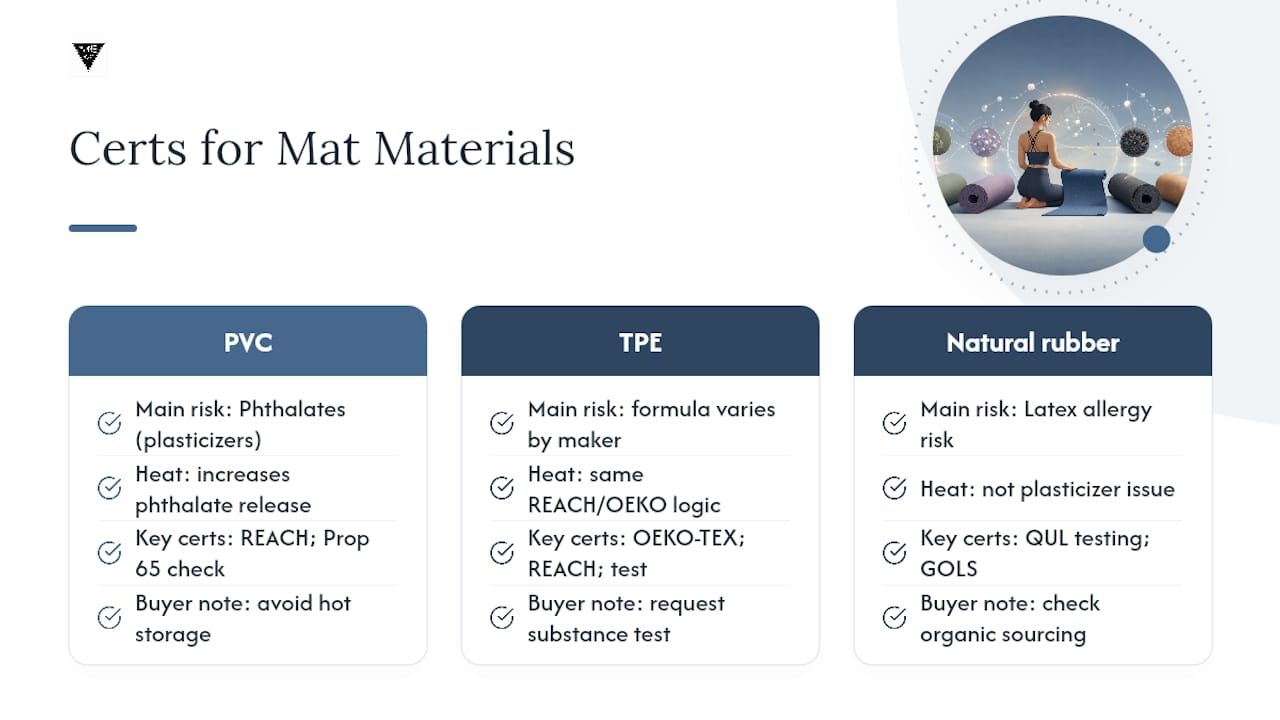
Yoga mats aren’t just fabric, most of the mat body is PVC, TPE, or natural rubber, and each material carries its own safety questions that textile certifications don’t touch.
PVC mats raise the most scrutiny because of phthalates, plasticizers added to keep PVC flexible. Heat exposure can increase phthalate release substantially, which is why a mat left in a hot car or a sun-drenched yoga studio window deserves more caution than one stored at room temperature. Our own breakdown of PVC yoga mat safety under heat covers this in more depth. REACH restricts certain phthalates in the EU, and Prop 65 requires warning labels in California when listed chemicals exceed set thresholds, so a Prop 65 label check is worth doing before you buy a PVC mat sold into the US.
TPE (thermoplastic elastomer) mats are generally marketed as a lower-toxicity alternative to PVC, but “TPE” itself isn’t a certification, it’s a material category, and blends vary by manufacturer. The same OEKO-TEX and REACH logic applies: ask for a substance test on the specific formula, not just the material name.
Natural rubber mats avoid PVC’s plasticizer question entirely but introduce latex allergy risk for a meaningful share of users. QUL testing and GOLS certification are the two credentials that speak directly to natural rubber safety and organic sourcing. Our rubber yoga mat buyer’s guide walks through what to check before choosing latex.
Antimicrobial and Hygiene Claims: What’s Actually Tested
“Antimicrobial” is one of the most loosely used words in yoga mat marketing, and it’s worth understanding what sits behind it before you pay a premium for the claim.
Some brands treat mat surfaces with silver-ion or other antimicrobial agents and reference standards like ISO 20743 or AATCC 100, textile industry test methods that measure bacterial reduction on treated fabric. These aren’t yoga-specific certifications, they’re general textile antimicrobial test protocols borrowed from apparel and medical textile industries. A brand citing one of these standards by name and number is giving you something checkable; a brand simply printing “antimicrobial” with no standard referenced is not.
It’s worth separating antimicrobial treatment from closed-cell material design. Many rubber and TPE mats resist moisture absorption simply because of their cell structure, which limits bacterial growth without any added chemical treatment. That’s a material property, not a certified claim, and it’s often the more honest hygiene story for a mat you’ll sweat on regularly.
If hygiene is your priority, the practical move is a mat surface that’s easy to wipe down and a yoga towel layered on top for hot or sweaty practices, rather than relying on an antimicrobial coating that wears off with washing and friction over the mat’s lifespan.
Environmental Impact: Manufacturing and End-of-Life Certifications
Non-toxic and sustainable aren’t the same question, and this is where a lot of otherwise careful shoppers get tripped up. A mat can pass every emissions and substance test and still be manufactured with a heavy carbon footprint, or built in a way that makes it impossible to recycle at the end of its life.
Look for these credentials when the environmental footprint is your concern:
- GRS, again, but here specifically for tracing recycled input material through manufacturing, not just declaring a product “contains recycled content”
- Fair Rubber Association membership, which addresses fair pricing and labor conditions in natural rubber sourcing, a supply-chain issue separate from chemical safety
- ISO 14001, a factory-level environmental management certification some manufacturers hold, indicating a formal system for tracking and reducing manufacturing impact
End-of-life disposal remains the industry’s weakest point. Closed-loop rubber recycling programs exist but are limited, and most PVC and TPE mats still end up in landfill once worn out, since curbside recycling programs rarely accept them. Our piece on the rise of the eco yoga mat covers where manufacturing adoption of these standards stands today. Until take-back and recycling programs become more common, buying a mat built to last several years is itself a meaningful environmental choice, longevity beats a recycling promise that may not be honored.
Safety and Durability: Grip, Thickness, and Wear Testing
Certifications answer the toxicity question. They don’t answer whether a mat will hold up under three sweaty vinyasa classes a week or keep you from sliding out of downward dog.
Slip resistance has no single universal yoga-specific certification, but manufacturers sometimes reference coefficient-of-friction testing, a physical measurement of how much a surface resists sliding under load, both dry and wet. If a brand cites a specific friction test result rather than just claiming “superior grip,” that’s a stronger signal than marketing copy alone.
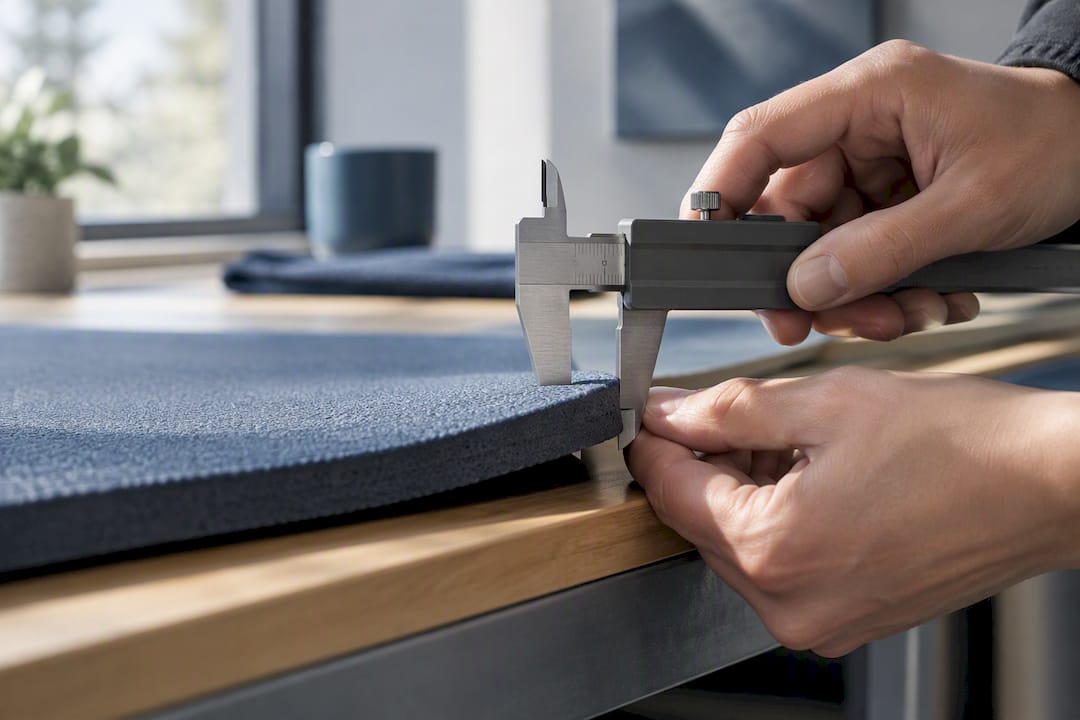
Thickness tolerance matters more than most buyers realize. A mat advertised at 6mm should measure close to that consistently across its surface, not just at the point sampled for the product photo. Manufacturing tolerance claims (usually a small percentage variance) are worth asking about directly if you’re buying for joint support during kneeling poses.
Durability testing typically covers tensile strength (resistance to tearing) and abrasion resistance (how the surface holds up under repeated friction). Neither has a single dominant third-party certification the way OEKO-TEX does for substances, so durability claims rely more heavily on manufacturer-reported testing than independent verification. That’s not a reason to dismiss them, but it’s a reason to weigh a durability claim differently than a GREENGUARD certificate. Our guide to choosing the right mat for your practice breaks down how thickness and density affect real-world performance across different styles of practice.
A Publisher’s Note on Certification Transparency
We think a mat’s paperwork should be as easy to find as its price. Yune Yoga is committed to keeping third-party documentation available for the products we sell, and we’d rather you ask a hard question before checkout than wonder after. If you want the specific report or scope certificate for any SKU, reach out to customer support directly and ask for it by model name.
— Nicholas
Shop Documented Mats Without the Guesswork
You’ve just read what separates a real certificate from a marketing sticker. Yune Yoga sells exactly the categories that let you apply that checklist directly: natural rubber mats, eco mats, and foldable travel mats built around sustainable materials rather than vague eco language.

Every product line, from Natural Rubber Mats to Foldable Yoga Mats, is built around the same sourcing philosophy: functional, stylish gear that doesn’t hide behind unverifiable claims. If you’re weighing a specific model against the checklist above, ask customer support for the SKU-level documentation before you order, and if you’re building out a full practice kit, the yoga clothes and accessories collection rounds out mats, towels, and straps in one place. Browse the current lineup and request documentation for any mat you’re considering before it ships.
Where to Verify Certificates and Standards Yourself
- OEKO-TEX label check confirms textile substance screening scope
- UL GREENGUARD product guide verifies emissions certification status
- Prop 65 guidance covers California’s chemical warning regime for US buyers
Sources
- Want a Non-Toxic Yoga Mat? Look for These Certifications (LeafScore)
- UL GREENGUARD Certification (UL Solutions)
- Yoga mat certifications: complete guide for brand buyers (Ming Yoga Mat)
FAQ
How Do I Verify a Yoga Mat Certification Is Real?
Look up the certificate number in the issuing body’s own database, OEKO-TEX’s label check or GREENGUARD’s certified product guide, and confirm it names the exact model you’re buying. If the certificate can’t be found in that system or doesn’t reference your SKU, treat the claim as unverified.
What Is the Highest Quality Yoga Mat Certification?
There isn’t one single “highest” mark because each certification tests something different. OEKO-TEX Standard 100 covers harmful substances in textiles, GREENGUARD covers finished-product emissions, and GOTS or GOLS cover organic fiber and latex claims, so the right one depends on what you’re worried about.
Is a Yoga Certification the Same as a Yoga Mat Certification?
No. A yoga certification refers to instructor training programs, while a yoga mat certification is a third-party test verifying material safety or sustainability claims on equipment. If you’re researching how to certify yourself as an instructor, that’s a separate credentialing path unrelated to product testing.
Is It Worth Paying More for a Certified Yoga Mat?
Certification adds real value when it comes with a verifiable report matching your specific mat, since it replaces a marketing claim with third-party evidence. It’s worth less if the seller can’t produce documentation on request, in which case you’re paying for a logo rather than proof.
Does Yune Yoga Provide Documentation for Its Mats?
Third-party documentation may be available upon request for some types of yoga mats; interested customers should contact customer support with the specific product name to inquire about certificates or lab reports before ordering.

