

How to Read Yoga Product Labels: Eco-Shopper's Guide
Before you buy another yoga mat or accessory, you can decode its label in under a minute. Check six things: the exact material name and any percent breakdown, third-party certifications (OEKO-TEX, GOTS, FSC), any California Proposition 65 or chemical warning, the INCI ingredient list on cleaners, country of origin, and whether the seller will hand over SKU-level test reports or a Safety Data Sheet (SDS). That’s the whole framework. Everything below shows you how to act on each item.
Quick checklist before you buy:
- Material line: Look for exact polymer or fiber names — natural rubber, PVC, TPE, NBR, cork, jute, organic cotton. “Eco polymer” or “green resin” with no chemical name is a red flag.
- Percent breakdown: A label that says “cork top / natural rubber base” without percentages tells you almost nothing about what you’re actually touching.
- Certifications: OEKO-TEX, GOTS, FSC, Global Recycled Standard, or GREENGUARD. Verify the certificate number independently.
- Prop 65 warning: Note it, then ask the seller which specific chemical triggered the warning and whether it appeared before checkout.
- Cleaner INCI list: Surfactants and preservatives must be named. “Natural” with no INCI is unverifiable.
- Country of origin + documentation: Confirm per component in bundled kits. Ask for SKU-level test reports or an SDS before purchasing anything with vague materials.
Table of Contents
- What does each label line actually tell you?
- Which certifications actually mean something?
- Common yoga mat materials: what the label tells you and what to ask
- What does a Proposition 65 warning actually mean?
- How to read labels on yoga mat cleaners and sprays
- Exact questions to ask sellers and the red flags that should stop you
- What transparent sellers actually provide
- Key Takeaways
- The label is a starting point, not the whole story
- Yuneyoga’s curated mats, with the documentation to back them up
- Primary sources and certifiers to verify label claims
What does each label line actually tell you?
Most labels pack a lot into a small space, and the gaps are just as informative as the text.
Material line. The difference between “natural rubber” and “eco polymer” is the difference between a verifiable substance and a marketing phrase. Exact polymer or fiber names — TPE, PVC, NBR, natural rubber, organic cotton — can be cross-referenced against safety databases. Shorthand like “green resin” cannot. When a label uses a trade name or vague descriptor, that’s your cue to request a material specification sheet from the seller.
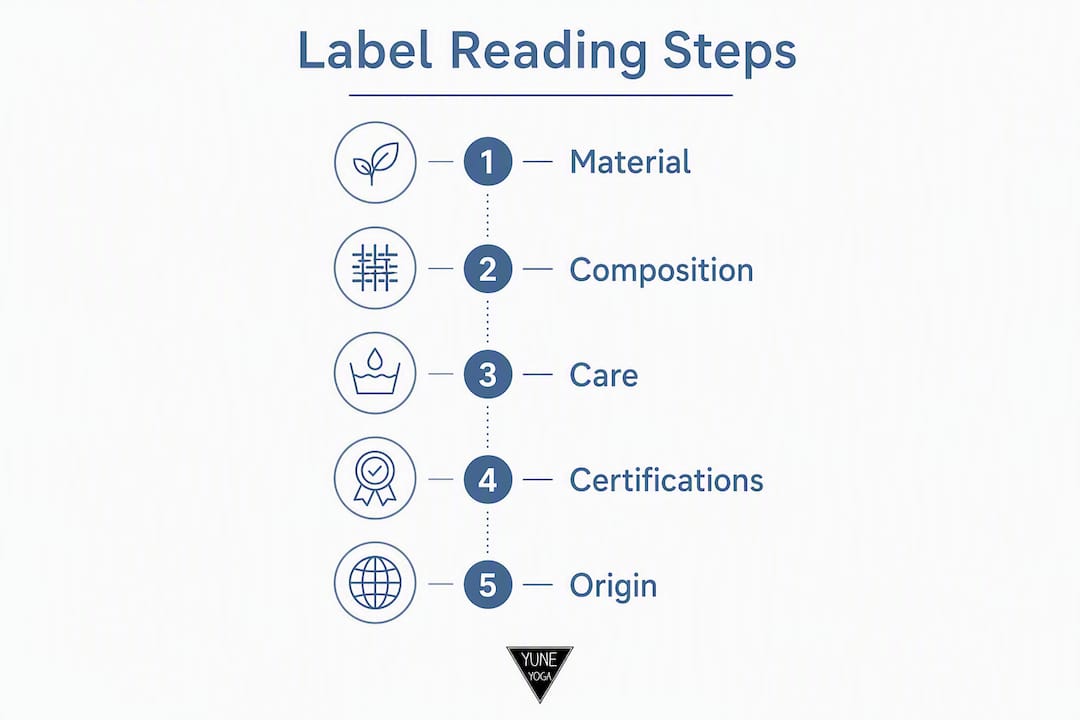
Percentages and layer composition. A cork-top mat with a synthetic polymer base is a layered construction. The surface you touch is cork; the base you compress is something else entirely. Without a percent breakdown or layer-stack disclosure, you can’t know what proportion of the mat is the material being marketed. Ask for a bill of materials.
Care and durability cues. “Hand wash only” or “avoid direct sunlight” aren’t just maintenance tips. They signal material sensitivity. A mat that degrades with mild detergent or UV exposure has a shorter lifecycle, which matters for sustainability. How you store and clean a mat directly affects how long it lasts.
Size, weight, and thickness. A 1mm travel mat and a 6mm studio mat have different material volumes and different environmental footprints. Thickness also affects cushioning and joint support. These numbers are usually accurate on labels, but confirm units (mm vs. cm) and check whether the listed weight includes packaging.
Country of origin in bundled kits. The outer box of a mat-strap-block bundle may say “Made in [country],” but each component can come from a different producer. Component-level sourcing must be verified separately — the outer-box label can be misleading.
Pro Tip: Ask the seller for a layer-stack document, not just the top-surface material name. A cork surface on a synthetic base is still mostly synthetic.
Which certifications actually mean something?
Greenwashing is common in the yoga product industry. Third-party seals are more reliable than self-declared claims, but each certification covers a specific scope — none of them guarantees sustainability across every dimension.
| Certification | What it covers | What it does NOT cover |
|---|---|---|
| OEKO-TEX Standard 100 | Harmful substance limits in finished textiles | Manufacturing environmental impact |
| GOTS | Organic fiber sourcing + processing standards | Non-textile components (e.g., rubber base) |
| FSC | Forest chain of custody for cork and wood | Chemical content of adhesives or binders |
| Global Recycled Standard | Recycled content percentage and chain of custody | End-of-life recyclability |
| GREENGUARD | Low chemical emissions for indoor air quality | Material sourcing or labor practices |
Unregulated terms to treat skeptically: “non-toxic,” “eco-friendly,” “biodegradable,” “natural,” and “plant-based” are self-declared. Any brand can print them. They require substantiation you have to request.
Verification steps:
- Find the certificate number on the label or product page.
- Go directly to the certifier’s public database (OEKO-TEX, GOTS, FSC each have one) and enter the number.
- Confirm the scope covers the finished product, not just a component or raw material.
- Check the issue date and whether it matches the SKU you’re buying.
- For restricted substances, ask for third-party test reports covering phthalates, heavy metals, and REACH/SVHC declarations. An SDS confirms chemical hazard data but is not a substitute for restricted substance test results.
Pro Tip: A certificate that covers yarn but not the finished mat is not a finished-product certification. Always confirm scope.
Common yoga mat materials: what the label tells you and what to ask
Understanding yoga product ingredients starts with knowing what each material name signals.

PVC and PVC blends. PVC is durable and inexpensive, but it often contains phthalate plasticizers. Phthalate concentrations can increase at hot yoga temperatures, and the health impact varies by product quality. PVC is also difficult to recycle. If a label says PVC, ask for restricted substance test results covering phthalates specifically.
TPE and EVA foams. These are often marketed as PVC alternatives. TPE chemistry varies significantly between manufacturers, so “TPE” alone tells you little about what additives are present. Ask for a material declaration and recycled content verification if the label claims recycled TPE.
Natural rubber and latex. Natural rubber is biodegradable and has strong grip, but it contains latex proteins. Labels should disclose latex content for allergen safety. Layered constructions (cork top, natural rubber base) need a layer-stack document to confirm the full construction. Yuneyoga’s non-allergenic mat guide explains what allergen disclosures to look for.
Cork, jute, and organic cotton. Look for FSC certification on cork and GOTS on organic cotton or jute. Percent cork content matters because some “cork” mats are mostly synthetic with a thin cork veneer. Ask about binders and backing materials — they may be synthetic even when the surface is natural.
PU, microfiber, and printed surfaces. Polyurethane coatings and printed designs involve solvents, inks, and adhesives. Ask for restricted substance testing that covers the inks and adhesives specifically, not just the base material.
Blocks, straps, and bundled props. Read the component label for each item in a kit. A foam block and a cotton strap have entirely different material concerns, and the kit’s outer box won’t cover both.
Pro Tip: For any mat with a surface material different from its base, request a layer-stack disclosure before buying. The marketing name is usually the top layer.
What does a Proposition 65 warning actually mean?
A Prop 65 warning on a yoga product is not a ban or a safety verdict. It’s a manufacturer’s decision to warn consumers about exposure to a chemical listed under California’s Proposition 65 framework. Many sellers apply the warning broadly across all states as a single-label strategy, which means a warning on a product sold in Ohio carries the same text as one sold in California.
What to do when you see one:
- Identify the specific chemical named in the warning text. Generic warnings that don’t name the chemical are less informative.
- Ask the seller which chemical triggered the warning and what the exposure pathway is.
- For online purchases in California, the warning must appear on the product display page before checkout — not just in the box after delivery.
- Request the test report tied to that SKU. A Prop 65 warning without supporting documentation is a starting point for questions, not an endpoint.
- If a mat has a strong chemical odor or noticeable off-gassing, treat that as a separate concern. Off-gassing at room temperature warrants a return or additional verification regardless of any label.
How to read labels on yoga mat cleaners and sprays
Cleaner labels deserve the same scrutiny as mat labels. The INCI (International Nomenclature of Cosmetic Ingredients) system gives every ingredient a standardized name, which lets you look it up independently. A cleaner without an INCI list is giving you marketing copy, not ingredient disclosure.
Red flags on cleaner labels:
- “Natural” or “plant-based” with no INCI ingredient list
- “Fragrance” or “parfum” listed as a single ingredient (it can contain dozens of undisclosed compounds)
- Preservatives like methylisothiazolinone or parabens without disclosure of concentration
- No biodegradability claim or no test evidence supporting one
Positive cues to look for:
- Full INCI list with named surfactants (e.g., coco-glucoside, decyl glucoside)
- EWG Verified status or equivalent independent verification
- Explicit biodegradability claim with a timeframe and test basis
- Surface compatibility statement confirming safe use on rubber, cork, microfiber, or PU
Cleaners and mat wipes that list INCI ingredients and carry EWG Verified status give you the most to work with. If you prefer to avoid commercial cleaners entirely, Yuneyoga’s DIY cleaner guide covers ingredient transparency for homemade formulas.
Pro Tip: Check that the cleaner label specifies compatibility with your mat material. A formula safe for PVC may degrade natural rubber.
Exact questions to ask sellers and the red flags that should stop you
You don’t need to be a chemist to get useful answers. These questions work in product chat, email, or in-store.
- “Can you provide the SKU-level restricted substance test report for this mat, covering phthalates and heavy metals?”
- “What specific chemical triggered the Prop 65 warning on this product, and what is the exposure pathway?”
- “Can you share the layer-stack or material specification sheet showing all components and their percentages?”
- “Is the OEKO-TEX / GOTS / FSC certificate number available, and does it cover the finished product or only a component?”
- “Can you provide the SDS for this product?”
Red flags that should pause or stop a purchase:
- Material described only with marketing terms, no chemical or fiber names
- Missing country of origin for individual components in a bundled kit
- No INCI list on a cleaner marketed as “natural”
- Prop 65 warning that appeared only after delivery, not on the product page
- Seller unable or unwilling to provide any documentation on request
Pro Tip: A seller who can’t answer question 1 or 3 above is telling you something. Reputable brands keep these documents ready.
What transparent sellers actually provide
A trustworthy product page does more than list materials. It shows you the evidence. Credible sellers provide SKU-matched test reports or material specification sheets on request rather than relying solely on badge claims.
Transparency checklist for evaluating a seller:
- Full material breakdown with percentages, not just surface material
- Accessible certification numbers that you can verify in the certifier’s database
- Per-SKU restricted substance reports available on request
- SDS available for any product with chemical content
- Care instructions that match the disclosed materials
- Consistent information between the product page and physical packaging
Yuneyoga prioritizes this kind of disclosure on its product pages. If you need SKU-level documentation for a specific mat or accessory, you can request it directly through the site before purchasing.
Transparency isn’t a bonus feature — it’s the baseline. If a seller can’t tell you what’s in their product at the component level, that gap is the answer.
Key Takeaways
Knowing how to read yoga product labels protects your health, your mat investment, and the environment — and it takes less than two minutes per product once you know what to check.
| Point | Details |
|---|---|
| Material names over marketing terms | Exact names (natural rubber, TPE, PVC) can be verified; “eco polymer” cannot. |
| Certifications have limited scope | OEKO-TEX, GOTS, FSC each cover specific hazards — verify the certificate number and scope for the finished product. |
| Prop 65 is a prompt, not a verdict | Ask the seller which chemical triggered the warning and request the supporting test report for that SKU. |
| INCI lists are non-negotiable for cleaners | No INCI list means no real ingredient transparency, regardless of “natural” claims. |
| Yuneyoga | Provides material breakdowns and certification info on product pages, with documentation available on request. |
The label is a starting point, not the whole story
The yoga industry has a greenwashing problem, and it’s not subtle. Brands slap “eco-friendly” on PVC mats, call synthetic foam “natural,” and print Prop 65 warnings in fine text that most shoppers never read. The certification system helps, but only if you actually verify the certificate number instead of trusting the badge.
What most guides miss is that the label is a starting point for a conversation, not a final answer. The brands worth buying from treat documentation requests as routine. They have the layer-stack sheet ready. They know which chemical triggered their Prop 65 warning. They can tell you whether the OEKO-TEX certificate covers the finished mat or just the fabric used in the strap.
The eco-conscious shopper’s real advantage isn’t knowing every chemical name. It’s knowing which questions to ask and being willing to walk away when a seller can’t answer them. That’s a higher standard than most buyers apply, and it’s exactly the pressure that pushes brands toward genuine transparency.
Yuneyoga’s curated mats, with the documentation to back them up
Choosing a yoga mat shouldn’t require a chemistry degree, but it does require a seller who takes material transparency seriously. Yuneyoga’s product pages lead with full material breakdowns, care guidance, and certification details — so you’re not hunting for information that should be front and center.
If you need SKU-level documentation, a restricted substance report, or just want to confirm what’s in a specific mat before you buy, Yuneyoga’s team can help. Browse the full collection and reach out directly with any documentation request. The information should be easy to get — and at Yuneyoga, it is.
Primary sources and certifiers to verify label claims
Use these directly to confirm what a label claims before you buy.
- OEKO-TEX: oeko-tex.com — search certificate numbers in the public database for Standard 100 and Standard 1000.
- GOTS: global-standard.org — verify organic textile certifications by company or certificate number.
- FSC: fsc.org — confirm forest chain-of-custody certificates for cork and wood products.
- California Prop 65 / OEHHA: oehha.ca.gov/proposition-65 — check the official list of chemicals requiring disclosure and the exposure thresholds.
- REACH/SVHC (EU): echa.europa.eu — look up substances of very high concern relevant to yoga mat materials.
- EWG Verified: ewg.org/ewgverified — confirm cleaner and personal care product verification status.
Verification steps:
- Take the certificate number from the label or product page.
- Go to the certifier’s database and search by number or brand name.
- Confirm the scope statement covers the finished product you’re buying.
- Check the expiration date — an expired certificate is not a current certification.
- For chemicals, cross-reference the named substance against the OEHHA Prop 65 list or ECHA’s SVHC candidate list to understand why it’s flagged.