

U.S. Buyers: Read Prop 65 Yoga Mat Labels, Ask for SKU Tests
A Prop 65 warning on a yoga mat is an exposure notice, not a safety verdict. It doesn’t mean the mat is dangerous, and it doesn’t mean it’s clean. Your move: find the specific chemical named on the warning, then check whether the seller offers a SKU-level lab report for that exact mat. If they don’t, lean toward a natural rubber or cork mat with full material disclosure instead.
TL;DR:
- Prop 65 warnings on yoga mats indicate legal disclosure of chemical presence but do not confirm actual safety or contamination levels.
- PVC, TPE, and EVA foam mats are the most common sources of chemicals like phthalates and flame retardants that trigger warnings.
- Sellers often display warnings nationwide to avoid legal risk, even if no California-specific law applies, leading to widespread labeling confusion.
- Verifying a safe, low-chemical yoga mat involves checking for SKU-specific lab reports, full layer disclosure, and consistent warning presence online and offline.
- Natural rubber and cork mats typically carry fewer additive risks, but proper documentation remains essential regardless of material choice.
Table of Contents
- Why Does California’s Prop 65 Show Up on Mats Sold Nationwide?
- Why Yoga Mats Commonly Trigger Prop 65 Warnings
- How to Read a Prop 65 Label and Verify a Mat Before You Buy
- Building Your Non-Toxic Yoga Mat Checklist
- Airing, Cleaning, and Knowing When to Replace Your Mat
- The Yune Yoga Approach to Sourcing Safer Mats
- Where Buyers Get This Wrong
- Ready to Shop Mats Built on Material Transparency?
- Sources
Why Does California’s Prop 65 Show Up on Mats Sold Nationwide?
Proposition 65 requires California businesses to warn consumers before exposing them to any of the more than 900 chemicals the state has linked to cancer or reproductive harm, but only when that exposure could realistically exceed a “safe harbor” threshold. It’s a disclosure law, not a chemical ban. A company can legally sell a product containing a listed substance in California as long as it warns people first.
That single fact explains a lot of confusion at checkout. Manufacturers who ship nationwide often just print the California warning on every unit rather than run two separate production and labeling lines, one for California and one for everywhere else. It’s cheaper and lower-risk to over-warn than to accidentally under-warn a customer in Sacramento. So a mat bought in Ohio or Texas can carry a Prop 65 label even though neither state has an equivalent law.
OEHHA, the California agency that administers Prop 65, updated its short-form warning rules to cut down on vague, catch-all language that told consumers nothing useful. The changes push sellers toward naming the actual chemical of concern rather than hiding behind generic boilerplate. For online sellers, the rule that matters most to you as a shopper is this:
- California-bound purchases must display the warning before checkout, not buried in a package insert that arrives after you’ve already paid.
- If a listing shows no warning anywhere on the product page, that’s a data point, though not proof the mat is chemical-free.
- A warning that only appears on the physical mat, never online, suggests inconsistent compliance and is worth a direct question to the seller.
None of this tells you the actual concentration of anything. It tells you the seller decided a warning was the safer legal move.
Why Yoga Mats Commonly Trigger Prop 65 Warnings
Most warnings trace back to the base material and what got mixed into it during manufacturing, not the finished mat as a whole. PVC (vinyl) cores are the biggest culprit, followed by TPE and EVA foams, then natural rubber, cork, and jute composite mats sitting at the lower-risk end of the spectrum.
The additives are where things get specific:
- Phthalates and phthalate substitutes like DOTP and DEHT, used to keep PVC flexible.
- Phosphorus flame retardants (PFRs), sometimes added for fire-safety compliance in foam layers.
- Polycyclic aromatic hydrocarbons (PAHs), which usually show up as contaminants in carbon black or the extender oils used in rubber processing, rather than as an intentional ingredient.
- Azodicarbonamide, a foaming agent used to give some mats their spongy texture.
- Carbon black and titanium dioxide, common pigments and fillers that can carry trace impurities depending on their source.
Ecology Center’s Healthy Stuff Lab tested 11 mats and found something buyers should sit with: several mats marketed with vague terms like “PER” or natural-fiber branding actually had PVC cores underneath a jute or cork top layer. The lab also found DOTP and DEHT in PVC samples in place of older phthalates, and detected phthalate contamination in a mat made from recycled wetsuit material, a supply chain that seems eco-friendly on paper but carries its own contamination risk.
Ecology Center’s testing is a rare example of independent, product-level verification in a category that runs almost entirely on marketing language. That’s the gap this whole buying decision revolves around: label claims versus what a lab actually finds in the material.
Exposure happens through three realistic pathways. Skin contact is constant during practice, especially with sweaty palms and bare feet pressed against the surface for an hour at a time. Inhalation matters more than people assume, particularly in heated studios, where warmth accelerates off-gassing from PVC and foam mats. Dust from a degrading mat surface is a smaller but real third pathway. Combustion exposure (mats catching fire) is rare enough that it shouldn’t drive your buying decision, but flame retardants get added to some foam mats specifically to address that risk, which is its own trade-off.
The CDC’s phthalate research documents these compounds as a chemical class with genuinely varied toxicology. Some phthalates carry more regulatory concern than others, and biomonitoring data shows most Americans already carry measurable levels from multiple everyday sources, not just yoga mats. That context matters: a mat is one exposure source among many, not the sole variable.
How to Read a Prop 65 Label and Verify a Mat Before You Buy
Short-form warnings are the compressed version you’ll see most often. They typically read something like “Cancer and Reproductive Harm” with a link or QR code to more detail. Long-form warnings name the specific chemical outright, which is more useful to you as a shopper. If a listing only shows the short-form version, that’s your cue to dig further before assuming the worst or dismissing it entirely.
Here’s the verification sequence worth running before you buy:
- Find the named chemical. If the warning doesn’t name one, check the linked detail page or contact the seller directly and ask which substance triggered it.
- Search the product page for a SKU-specific test report or certificate of analysis. A generic “our mats are tested” claim on a category page doesn’t count. You want a report tied to that exact color, thickness, and batch.
- Check whether the warning appears consistently. If it’s on the packaging but absent from the online listing, or vice versa, that inconsistency is worth a direct question before checkout.
- Read the material description for layer-level detail. A mat described only as “eco resin” or “PER material” without naming the actual polymer underneath is a red flag worth pushing back on.
Pro Tip: A missing warning doesn’t mean a mat is free of listed chemicals, and a warning doesn’t tell you the actual exposure level. Third-party, SKU-matched lab data is the only piece of evidence that actually answers the question you’re asking.
Watch for sellers who respond to a direct question about materials with marketing language instead of a spec sheet. “Non-toxic” and “premium eco material” aren’t answers. A supplier who can immediately point you to a dated test report for the specific SKU you’re looking at is telling you something real about how they run their supply chain.
Building Your Non-Toxic Yoga Mat Checklist
Prioritize construction transparency over marketing copy. A mat description that names the actual core material, every layer, and the adhesive used between them is worth more than five bullet points of “eco-friendly” language with nothing underneath.
If you’re leaning natural: natural rubber and cork mats generally carry a lower baseline chemical-additive risk than PVC or foam blends, but natural rubber isn’t automatically risk-free for everyone. It’s a known allergen for people with latex sensitivity, so allergen disclosure on the product page matters as much as the sustainability pitch.
If you’re considering a synthetic mat anyway, ask specifically for analyte tables covering phthalates, PAHs, and PFRs, matched to the layer that actually touches your skin. A test report needs to name the analyte and the unit measured, not just declare a pass or fail with no data behind it. A supplier who can’t produce that level of detail probably hasn’t tested at that level either.
| Priority | What to check | Why it matters |
|---|---|---|
| 1 | Full layer disclosure (core, adhesive, surface) | Marketing terms like “eco-friendly” don’t reveal hidden PVC cores |
| 2 | SKU-matched third-party test report | Generic category-level testing doesn’t cover your exact color/batch |
| 3 | Odor at unboxing | Strong persistent chemical smell is a valid screening signal |
| 4 | Allergen disclosure (natural latex) | Natural rubber is a known allergen for sensitive users |
| 5 | Change-control commitment from supplier | A changed pigment or compound supplier can invalidate an old test |
Walk away from listings that lean entirely on adjectives. “Premium,” “eco resin,” and “advanced material” tell you nothing about what’s actually in the mat. A seller confident in their sourcing will show you the layer breakdown without you having to ask twice.
Airing, Cleaning, and Knowing When to Replace Your Mat
New-mat odor is common and doesn’t automatically signal danger, but it’s a legitimate first screening tool. A strong, persistent chemical smell that doesn’t fade after a few days of airing out is worth paying attention to, especially if you plan to use the mat in a heated room where warmth speeds up off-gassing.
- Air it out before first use. Unroll the mat in a ventilated space, ideally outdoors or near an open window, for several days before your first session.
- Clean with mild soap and water. Solvent-based cleaners can react with mat surfaces and introduce chemicals you were trying to avoid in the first place.
- Never leave your mat in a hot car. Heat accelerates off-gassing and can degrade adhesive layers faster than normal use ever would.
- Store it away from direct flame or high heat sources, which applies to synthetic and rubber mats alike.
- Replace it when you notice flaking, delamination, or a chemical odor that returns after cleaning. A degrading surface exposes inner layers you were never meant to touch directly.
Pro Tip: If a mat still smells strongly chemical after a week of airing in a well-ventilated space, that’s a reasonable point to request a refund or exchange rather than push through it.
The Yune Yoga Approach to Sourcing Safer Mats
We build our mat lineup around natural rubber and cork first, precisely because those materials carry fewer of the additive risks that drive most Prop 65 warnings in this category. We apply this sourcing standard before a mat ever gets listed.
We ask suppliers for documentation such as SKU-level test reports, full layer disclosure down to the adhesive, and clear allergen statements for anything containing natural latex. If a supplier can’t produce that paperwork for a specific product, it doesn’t make it onto shelves.
I’m Nicholas, and I cover yoga equipment and wellness practices for the Yune Yoga blog. If you want to go deeper on reading labels or spotting vague marketing language before you buy, the product label guide on our blog walks through it in more detail than we have room for here.
Where Buyers Get This Wrong
The biggest mistake I see is treating “no Prop 65 warning” as proof of safety, and “has a Prop 65 warning” as proof of danger. Neither holds up. The absence of a warning tells you the seller made a legal judgment call about exposure thresholds, not that a lab verified the mat is clean.
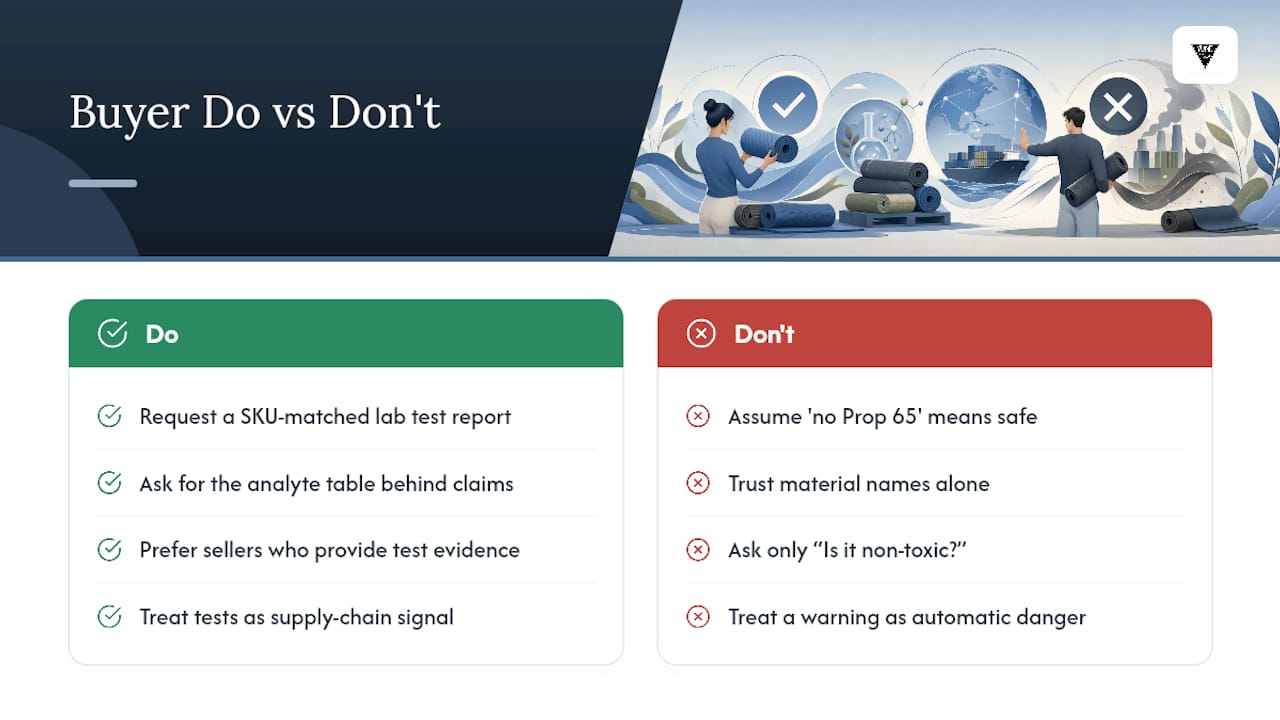
The second mistake is trusting the material name on its own. “Natural fiber,” “eco resin,” and “PER” sound reassuring, but Ecology Center’s testing found PVC cores hiding under exactly that kind of language more than once. A name on a label is a claim. A SKU-matched test report is evidence.
If I had to boil this down to one priority: stop asking sellers whether a mat is “non-toxic” and start asking for the analyte table behind that claim. Most won’t have one ready. The ones that do are telling you something real about how seriously they take their supply chain, and that’s the signal worth paying for.
— Nicholas
Ready to Shop Mats Built on Material Transparency?
Every mat we curate starts with the same question this article just walked you through: what’s actually in the layers, and can we show you proof? We favor natural rubber and cork construction with clear material disclosure, and we push suppliers for SKU-level documentation wherever it’s available, so you’re not stuck decoding vague “eco-friendly” language on your own.

Before you check out anywhere, get in the habit of scanning the product page for layer detail and test documentation, the same four checks covered above. When you’re ready to browse mats built around that standard from the start, visit the Yune Yoga shop to see the current lineup of natural rubber, cork, and eco-conscious travel mats.


