
OEKO-TEX Yoga Certification: What It Means for Safe Gear
OEKO-TEX STANDARD 100 is an independent, third-party certification that verifies every component of a textile product has been tested and found free of harmful substances at levels that could affect human health. For yoga practitioners, that means your mat, towel, or leggings have passed laboratory screening before they ever touch your skin.
Three facts worth knowing before you buy:
- Certificates are valid for one year. Brands must renew annually, so a label on last year’s product may no longer be current.
- Every component is covered. STANDARD 100 tests the finished product and each part: threads, dyes, buttons, adhesives, coatings.
- You can verify any certificate online. The OEKO-TEX Buying Guide lets you enter a certificate ID or scan a QR code to confirm status and scope.
MADE IN GREEN, a separate OEKO-TEX label, adds audited sustainable production and supply-chain traceability on top of STANDARD 100 testing. In the U.S., neither label replaces California Prop 65 or CPSIA compliance, but both are strong signals of chemical safety. Yuneyoga vets products against these standards before listing them.
Table of Contents
- What is OEKO-TEX STANDARD 100, and how does it differ from other labels?
- Which hazardous substances does STANDARD 100 screen for?
- How do the four OEKO-TEX product classes map to yoga items?
- How does OEKO-TEX testing, certification, and label verification work?
- What OEKO-TEX does not guarantee, and how U.S. regulations interact
- How does OEKO-TEX compare to GOTS, MADE IN GREEN, and Cradle to Cradle?
- A practical checklist for buying certified yoga gear in the U.S.
- Why OEKO-TEX certification matters more for yoga than for most other activities
- Key Takeaways
- The label gap most buyers miss
- Yuneyoga’s curated selection of vetted yoga gear
- Useful sources for further verification
What is OEKO-TEX STANDARD 100, and how does it differ from other labels?
OEKO-TEX STANDARD 100 is an independent textile safety testing and certification system run by the OEKO-TEX Association, a consortium of research and testing institutes. A product earns the label only when an accredited laboratory confirms that every component meets defined limits for harmful substances. It is one of the most widely recognized textile safety benchmarks globally, and U.S. retailers and consumers increasingly treat it as a baseline expectation for health-conscious gear.

The scope is broader than most people assume. A yoga mat does not pass as a whole unit if its adhesive layer or foam backing fails. Every part in scope must clear the criteria.
STANDARD 100 vs. MADE IN GREEN at a glance:
STANDARD 100 focuses exclusively on chemical safety. It tells you the product is free of harmful substances at tested levels. MADE IN GREEN layers two additional requirements on top: audited, sustainable, and socially responsible production conditions, plus item-level traceability via a unique product ID. Scan a MADE IN GREEN tag and you can trace the product back through its supply chain. STANDARD 100 alone does not offer that.
For a U.S. buyer whose primary concern is skin safety, STANDARD 100 is the core credential. If you also care about where and how the product was made, MADE IN GREEN is the upgrade worth seeking.
Which hazardous substances does STANDARD 100 screen for?
The substance list is extensive. STANDARD 100 evaluates products against criteria covering well over 100 parameters and hundreds of individual substances. The main chemical groups screened include:
- Per- and polyfluorinated substances (PFAS): — Used in water-repellent coatings; persistent in the body and environment.
Why does this matter specifically for yoga gear? During a 60-minute practice, your skin is in direct, sustained contact with your mat. Sweat opens pores and can increase the rate at which chemicals absorb through the skin. Heat, whether from a warm studio or a hot yoga class, raises the volatility of certain compounds, meaning some substances that sit inert at room temperature become more active at 95°F. Testing for these groups is not a formality for yoga gear. It is the relevant safety check for the actual conditions of use.
Lab testing for STANDARD 100 is analytical, not visual. Samples go through extraction and instrumental analysis (gas chromatography, mass spectrometry, and similar methods) at accredited facilities. No amount of looking at a product tells you whether its dye contains banned azo compounds.
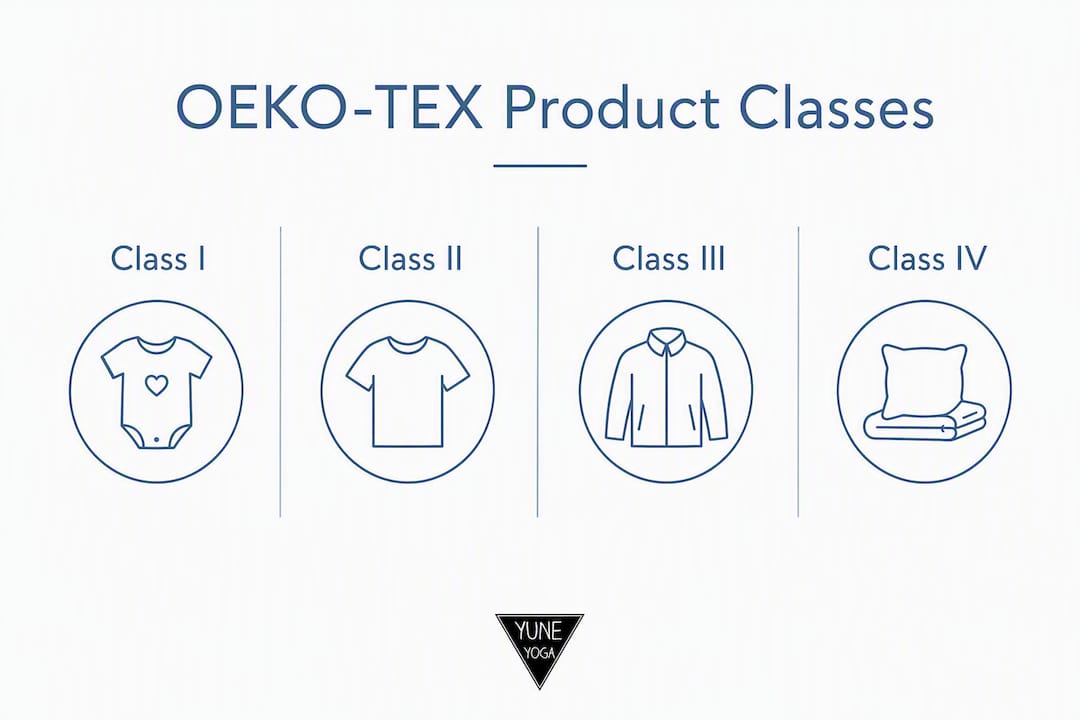
How do the four OEKO-TEX product classes map to yoga items?
STANDARD 100 assigns products to one of four classes based on the intensity of skin contact and the vulnerability of the end user. Stricter limits apply to higher-contact and more sensitive-use categories.

| Product class | Typical use case | Key yoga products | Why it matters |
|---|---|---|---|
| Class I | Products for babies and toddlers (up to 3 years) | Children’s yoga mats, infant play mats | Most stringent limits; relevant if buying for young children |
| Class II | Direct skin contact for adults | Yoga leggings, sports bras, yoga towels, yoga socks | The standard class for most adult yoga apparel |
| Class III | No direct skin contact (outer layer, decorative) | Yoga bags, mat carriers, bolster covers | Less strict; not the right class for items touching skin |
| Class IV | Decoration and furnishing materials | Studio props, wall hangings | Least strict; not applicable to personal yoga gear |
Most yoga clothing falls into Class II, since it sits directly against skin for extended periods. Yoga mats occupy an interesting middle ground: the top surface is in direct skin contact, which pushes toward Class II, while some manufacturers pursue Class I certification to signal the highest safety standard. Yoga towels used on top of mats during hot practice are Class II items.
Pro Tip: If you have sensitive skin or are buying a mat for a child, look specifically for Class I certification. For standard adult practice gear, Class II is the appropriate and sufficient benchmark. A product labeled only as “OEKO-TEX tested” without a class designation is worth a closer look.
How does OEKO-TEX testing, certification, and label verification work?
The path from raw textile to certified product follows a defined sequence. Manufacturers submit samples to an accredited testing institute, which runs the full analytical battery. If every component clears the criteria for the relevant product class, the institute issues a certificate. That certificate carries a unique ID, the covered product scope, the product class, and an expiry date exactly 12 months from issuance.
To verify a certificate as a consumer, follow these steps:
- Find the certificate ID or QR code on the product tag, packaging, or brand website.
- Go to the OEKO-TEX Buying Guide and enter the certificate number or scan the QR code.
- Confirm the certificate is active (not expired).
- Check which specific products and components are covered under that certificate.
- Verify the product class matches the item you are buying (Class II for adult apparel and mats).
Watch for these red flags:
- A brand claims “OEKO-TEX tested” but cannot supply a certificate ID.
- The certificate is expired (more than 12 months old).
- The certificate covers only the fabric but not coatings, adhesives, or accessories.
- The label appears on a product not listed in the certificate’s scope.
Marketing language like “eco-safe” or “non-toxic” without a verifiable certificate number is not the same as STANDARD 100 certification. The certificate ID is the only claim you can actually check.
What OEKO-TEX does not guarantee, and how U.S. regulations interact
STANDARD 100 is a chemical safety credential. It is not a sustainability certificate, a durability rating, or a lifecycle assessment. Knowing this prevents a common misreading of the label.
What STANDARD 100 does not cover:
- Environmental footprint: — Carbon emissions, water use, and manufacturing waste are outside its scope unless the product also carries MADE IN GREEN.
- Full sustainability: OEKO-TEX focuses on chemical safety; broader sustainability claims require additional credentials.
U.S. regulatory context: OEKO-TEX is a voluntary, internationally recognized standard. It does not replace U.S. legal obligations. California’s Prop 65 requires businesses to warn consumers about exposure to chemicals on the state’s list of known carcinogens and reproductive toxins. CPSIA sets mandatory lead and phthalate limits for children’s products sold in the U.S. A product can hold a valid STANDARD 100 certificate and still require separate Prop 65 labeling or CPSIA third-party testing if it is marketed to children. For adult yoga gear, STANDARD 100 aligns well with the spirit of Prop 65 limits, but brands operating in California should confirm compliance independently.
How does OEKO-TEX compare to GOTS, MADE IN GREEN, and Cradle to Cradle?
Each label answers a different question. Choosing the right one depends on what you actually want to know about a product.
| Certification | Primary focus | Covers production/social? | Traceability? | Best for |
|---|---|---|---|---|
| STANDARD 100 | Chemical safety of finished product | No | No | Health-first buyers |
| MADE IN GREEN | Chemical safety + audited production | Yes | Yes (item-level QR) | Safety + sustainability |
| GOTS | Organic fiber origin + social criteria | Yes | Yes (supply chain) | Organic fiber priority |
| Cradle to Cradle | Material health + circularity | Partially | No | End-of-life and circular design |
STANDARD 100 is the right starting point when your primary concern is what the product might do to your body. MADE IN GREEN is the logical next step when you also want to know how and where it was made. GOTS matters most when organic fiber sourcing is the priority, particularly for cotton-based yoga apparel. Cradle to Cradle addresses a different question entirely: what happens to the product after you are done with it.
For most U.S. yoga practitioners, STANDARD 100 or MADE IN GREEN covers the core health and safety concern. The labels are complementary, not competing.
A practical checklist for buying certified yoga gear in the U.S.
Before you add a mat or pair of leggings to your cart, run through this:
- Find the label. Look for the STANDARD 100 or MADE IN GREEN logo on the product tag, packaging, or product page.
- Get the certificate ID. It should be printed on the label or listed in the product description. No ID means no verifiable claim.
- Verify it. Enter the ID at the OEKO-TEX Buying Guide. Confirm the certificate is active and covers the specific product you are buying.
- Check the product class. Class II is the minimum for adult skin-contact items. Class I is better for sensitive skin.
- Confirm component coverage. Ask whether coatings, adhesives, and foam layers are included in the certificate scope, not just the outer fabric.
- Check the expiry date. A certificate issued more than 12 months ago is no longer valid.
- If the brand cannot provide a certificate number, treat the claim as unverified.
Pro Tip: When contacting customer service, ask specifically: “Can you provide the OEKO-TEX certificate number for this product, and does it cover the mat’s adhesive layer and any surface coating?” A brand with a real certificate will answer that in one reply. Vague responses about “meeting safety standards” are not the same thing.
Why OEKO-TEX certification matters more for yoga than for most other activities
Yoga creates specific exposure conditions that most clothing and fitness gear categories do not. Consider a 75-minute hot yoga class at 95°F. Your leggings and mat are in unbroken skin contact the entire time. You are sweating heavily, which increases skin permeability. The heat raises the volatility of any residual chemicals in the textile, meaning compounds that might stay bound at room temperature can become more mobile.
This is not a hypothetical concern. Heat and sweat can increase chemical absorption through the skin, making the chemical profile of your gear more consequential than it would be during, say, a 20-minute walk in a cotton t-shirt. A mat used in a heated studio is a different exposure scenario than the same mat sitting in a cool gym bag.
Practical steps that reduce exposure regardless of certification status:
- Air new mats and apparel for 24–48 hours before first use. Off-gassing is highest when a product is new.
- Wash new yoga clothing before wearing it. This removes surface residues from manufacturing and shipping.
- For mats, wipe down with a damp cloth and let dry fully before the first session.
Pro Tip: Even with a certified mat, the first few uses carry the highest residual chemical load from manufacturing. Airing and wiping down a new mat is a low-effort step that applies regardless of what label it carries.
For non-toxic yoga mat shoppers, STANDARD 100 or MADE IN GREEN certification is the most reliable signal available. No other widely available consumer label tests the same range of substances with the same lab-based rigor.
Key Takeaways
OEKO-TEX STANDARD 100 is a rigorous, independently verified chemical safety label available for yoga mats and apparel, covering every product component and requiring renewal to maintain validity.
| Point | Details |
|---|---|
| What STANDARD 100 certifies | Independent lab testing confirms the product and all components are free of harmful substances at defined limits. |
| Certificate validity | Certificates expire after 12 months; always verify the current status via the OEKO-TEX Buying Guide before buying. |
| Product class for yoga gear | Most adult yoga apparel and mats fall under Class II; Class I applies to children’s items and is the strictest option. |
| What it does not cover | Chemical safety only; no sustainability, durability, recyclability, or social compliance claims attach to STANDARD 100 alone. |
| Yuneyoga’s approach | Yuneyoga vets mats and apparel against OEKO-TEX criteria, including component-level certificate checks, before listing products. |
The label gap most buyers miss
The most common mistake health-conscious yoga practitioners make is treating “OEKO-TEX” as a single, uniform claim. It is not. A product tagged STANDARD 100 and one tagged MADE IN GREEN are not equivalent, and a product with an expired certificate is not certified at all. The label is only as good as the verification behind it.
What I find underappreciated is how much the product class matters. Most buyers see the OEKO-TEX logo and stop there. But a yoga mat certified at Class III (no direct skin contact) is certified for the wrong use case. The class tells you whether the testing thresholds were calibrated for your actual exposure scenario. A Class II or Class I certification on a mat means the limits were set for skin contact. That distinction is not a technicality.
The other thing worth saying plainly: OEKO-TEX is a chemical safety credential, not a sustainability badge. Brands sometimes lean on the label to imply broader environmental virtue, and that is a stretch the label does not support on its own. If sustainability matters to you alongside safety, MADE IN GREEN or GOTS is the combination worth looking for. Treating STANDARD 100 as proof of eco-responsibility is a misread of what the testing actually covers.
For eco-friendly yoga mat buyers, the honest answer is that chemical safety and environmental sustainability are related but separate questions. The best-certified products address both. The label tells you which question has been answered.
Yuneyoga’s curated selection of vetted yoga gear
Knowing what to look for is one thing. Finding gear that actually meets the standard is another.

Yuneyoga curates mats, towels, and straps with chemical safety in mind, checking supplier certificates before any product goes live on the site. That means verifying the certificate ID, confirming the product class, and asking whether coatings and adhesives are included in scope, not just the outer fabric. If you have questions about a specific product’s certification status, the customer service team can pull that detail directly.
Browse eco-friendly yoga mats and the full Yuneyoga collection to find gear that has been vetted for the conditions you actually practice in.
Useful sources for further verification
- OEKO-TEX STANDARD 100 official overview — the primary source for testing criteria, accredited institutes, and the modular certification approach
- U.S. Consumer Product Safety Improvement Act (CPSIA) — federal law governing lead and phthalate limits in children’s products sold in the U.S.


