

How to Spot Greenwashing in Yoga Brands: A Shopper's Checklist
You can reliably spot greenwashing in yoga and activewear by checking three things: whether the brand names specific certifications with verifiable IDs, whether it discloses full material composition by percentage, and whether it can explain what happens to the product at end of life. If any of those three answers is vague, you’re likely looking at marketing, not sustainability.
Quick red flags to scan in 10 seconds:
- The word “eco,” “natural,” or “green” appears in the product name with no certification listed
- The materials section says something like “eco-friendly fabric” without naming the fiber
- A certification logo appears on the page but no certificate number is visible
- “Recycled” content is mentioned without stating the percentage
- “Biodegradable” appears with no mention of composting conditions required
- The brand’s sustainability page is one paragraph of values with no supplier or factory information
The single best action right now: email the brand and ask, “Can you share the full fiber composition by percentage and the certificate ID for any certifications listed on this product?” A brand with nothing to hide answers that in one reply.
Pro Tip: Frame your email as a purchase decision question: “I’m about to buy this mat and want to confirm the certifications before I do.” Brands that are genuinely certified respond fast with specifics. Brands that are not tend to reply with mission statements.
Key Takeaways
The most reliable way to spot greenwashing in yoga and activewear is to ask for a specific certification ID and full material composition by percentage: brands that can’t provide both are almost certainly relying on marketing language rather than verified claims.
| Point | Details |
|---|---|
| Three core checks | Verify certification ID, full material composition by %, and end-of-life options before buying. |
| “PER” is a red flag | The Ecology Center found PER-labeled mats were often PVC-based with plasticizers; always ask for the recognized polymer name. |
| Certifications have scope limits | OEKO-TEX STANDARD 100 covers chemical safety; GOTS covers organic fibers; GRS covers recycled content. No single label covers everything. |
| Verification takes five minutes | Look up the certificate ID on the issuing body’s official database; a logo without a traceable number is unverified. |
| Yuneyoga’s approach | Yuneyoga curates mats with material breakdowns and certification information, applying the same checklist criteria described here. |
Table of Contents
- What does greenwashing actually mean for yoga and activewear shoppers?
- 10 questions to ask any yoga or activewear brand before you buy
- Common greenwashing tactics and buzzwords used in yoga marketing
- How to read and verify the certifications that actually matter
- Product-specific red flags for yoga mats and activewear
- How to verify sustainability claims step by step
- What scientists say about ambiguous terms like “PER”
- What to do if you suspect greenwashing
- Why the certification checklist is only half the answer
- Yuneyoga curates mats with material transparency you can verify
- Sources
What does greenwashing actually mean for yoga and activewear shoppers?
Greenwashing, in the context of yoga and activewear products, is the practice of making environmental claims that are technically defensible but practically misleading. It’s not always outright lying.
Yoga and activewear shoppers are unusually exposed to this. The wellness community places high value on clean materials and ethical sourcing, which gives brands a strong commercial incentive to signal those values whether or not the products back them up. Add to that the genuine complexity of activewear materials (multi-fiber blends, chemical finishes, dyes, elastic components) and it becomes easy for brands to obscure what’s actually in the product.
The FTC Green Guides set the U.S. standard for environmental marketing claims, requiring that claims be specific, substantiated, and not misleading. Vague terms like “eco-friendly” or “sustainable” without qualification are exactly the kind of claims the Guides flag as potentially deceptive. Knowing that standard exists gives you a baseline: if a brand’s claim wouldn’t survive FTC scrutiny, treat it with skepticism.
10 questions to ask any yoga or activewear brand before you buy
This checklist is designed for conscious shoppers evaluating brands in-store, on product pages, or via email. Copy and adapt as needed.
- What is the full fiber or material composition, listed by percentage?
- Which certifications does this product carry, and what is the certificate ID number?
- Is the certification for this specific product, or for the brand/factory overall?
- What percentage of the material is recycled, and is it pre- or post-consumer recycled content?
- Where is the product manufactured, and can you share a supplier or factory list?
- What dyes and chemical finishes are used, and have they been tested for harmful substances?
- Does “biodegradable” or “compostable” require industrial composting, or does it work in home conditions?
- What is the recommended end-of-life option: take-back program, recycling, or landfill?
- Are the trims, elastic, and hardware (zippers, labels) included in the certification scope?
- Has the product been independently tested by a third-party lab, and can you share the report?
What a strong answer looks like: The brand names a specific certification (e.g., GOTS, OEKO-TEX STANDARD 100), gives you the certificate number, and points you to a verification database. On recycled content, it states the exact percentage and whether it’s post-consumer. On end of life, it describes a real take-back or recycling program with instructions.
What a greenwash answer looks like: Vague language about “commitment to sustainability,” a link to a values page, or a claim that the product is “made with eco-friendly materials” without naming them.
Pro Tip: Questions 2 and 7 are the single best predictors of authenticity. A brand that can hand you a certificate ID and explain composting conditions in plain terms has done the work. A brand that can’t answer either is almost certainly relying on marketing language alone.
Common greenwashing tactics and buzzwords used in yoga marketing
The vocabulary of greenwashing in yoga and activewear has become fairly predictable once you know what to look for. Here are the terms that carry the most risk of misleading you, and what they usually hide.
- “Eco” / “eco-friendly”: No legal definition in the U.S. Any brand can use it. Means nothing without a certification or material breakdown.
- “Natural”: Often applied to products that contain a small percentage of natural material (rubber, cotton, bamboo) alongside a majority of synthetic content.
- “Plant-based”: Technically accurate for materials like Tencel or bamboo viscose, but the processing can be chemically intensive. The fiber origin doesn’t tell you about the manufacturing footprint.
- “Biodegradable”: Frequently requires industrial composting at specific temperatures. A mat labeled biodegradable that ends up in a landfill will not degrade meaningfully.
- “Carbon neutral”: Often achieved through offset purchases rather than actual emissions reductions, and the scope (Scope 1, 2, or 3) is rarely disclosed.
- “Recycled”: Recycled-content claims often involve small percentages or conditions not disclosed on packaging. A legging that’s “made with recycled materials” might be 10% recycled polyester.
The single-attribute trap is worth calling out separately. A brand might launch a small “sustainable collection” using one certified material while the rest of its line remains unchanged. That collection gets featured in marketing as evidence of the brand’s environmental commitment, even though it represents a fraction of total production. Fewer than 20% of fashion companies have full raw-material-level transparency, which means most “sustainable” claims are built on partial data.
When you see a sustainability claim, the skeptical question is always: What specifically does this cover, and what does it leave out?
How to read and verify the certifications that actually matter
Not all certification logos carry the same weight. Here’s what each major label actually verifies, and how to confirm it’s real.
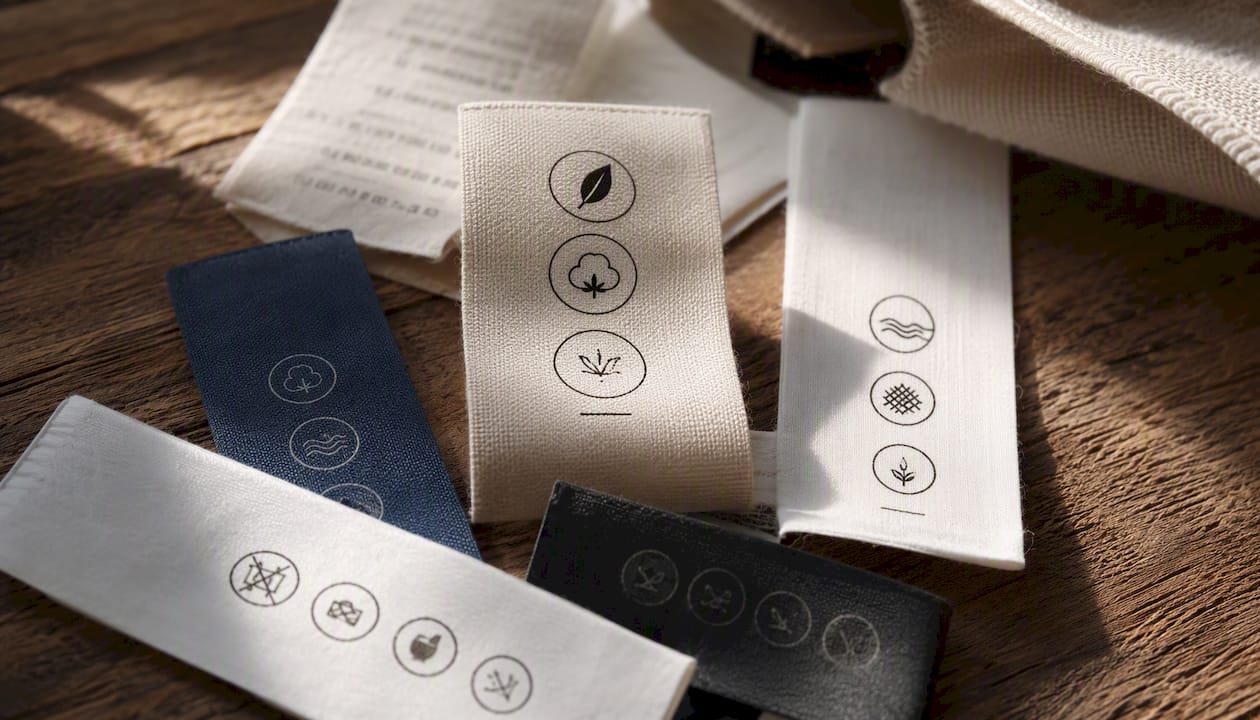
| Certification | What it tests | What it does NOT cover | How to verify |
|---|---|---|---|
| OEKO-TEX STANDARD 100 | Harmful substances in the finished product (dyes, heavy metals, formaldehyde) | Supply chain, labor conditions, environmental production practices | Search certificate ID at oeko-tex.com |
| MADE IN GREEN by OEKO-TEX | Chemical testing + facility environmental and social audits + traceability | Does not cover raw material extraction upstream of certified facilities | Scan QR code or enter product ID at oeko-tex.com |
| GOTS (Global Organic Textile Standard) | Organic fiber content, chemical processing, social criteria | Synthetic fibers, non-textile components (foam, rubber) | Search at global-standard.org |
| Global Recycled Standard (GRS) | Recycled content percentage, chain of custody | Chemical safety of the recycled material itself | Search at textileexchange.org |
| Bluesign | Chemical inputs in manufacturing, resource efficiency, worker safety | Fiber origin, end-of-life | Check brand’s bluesign partner status at bluesign.com |
| FSC (Forest Stewardship Council) | Responsible forest management for wood/cork/natural rubber sources | Processing, chemical finishing, labor in manufacturing | Search certificate at info.fsc.org |
OEKO-TEX issues certificate numbers and MADE IN GREEN offers traceable product IDs; both are searchable on the official OEKO-TEX database. MADE IN GREEN goes further by bundling product-level testing with facility audits and a unique QR code that traces the product’s journey through certified facilities.
A few practical notes on scope. GOTS is the gold standard for organic cotton activewear, but it doesn’t apply to foam yoga mats. For mats, OEKO-TEX STANDARD 100 is the most relevant chemical-safety check. For recycled-content claims, GRS is the certification to ask for. For cork or natural rubber sourcing, FSC matters.
When a certification matters for mats vs. clothing:
- Yoga mats: OEKO-TEX STANDARD 100, FSC (for cork/rubber), GRS (for recycled content)
- Activewear: GOTS (organic fibers), OEKO-TEX STANDARD 100, Bluesign (manufacturing process), GRS (recycled synthetics)
- Accessories (straps, towels): GOTS, OEKO-TEX STANDARD 100
You can learn more about how certifications apply to specific mat materials and what each label means in practice before you shop.
Product-specific red flags for yoga mats and activewear
Yoga mat red flags
The mat category has some of the most persistent greenwashing in the yoga space, partly because the materials are complex and partly because most shoppers don’t know what to look for.
- “PER” listed as the material: PER (Polymer Environmental Resin) is a marketing term, not a recognized material category. Lab testing by the Ecology Center found mats labeled PER were often PVC-based and sometimes contained plasticizers. It sounds eco-conscious; it frequently isn’t.
- “TPE” without further detail: TPE (Thermoplastic Elastomer) is a broad category. Some TPE formulations are cleaner than others, but the label alone tells you nothing about chemical additives.
- “Recycled” without a GRS certificate: A mat described as made from recycled materials without a Global Recycled Standard certificate has no independent verification of that claim.
- “Biodegradable” with no conditions stated: If the brand doesn’t specify industrial vs. home composting, the claim is incomplete and likely misleading.
- No phthalate or heavy metal testing disclosed: PVC-based mats can contain phthalate plasticizers. Without a test report or OEKO-TEX certification, there’s no way to know.
For a deeper look at how mat materials compare on health and environmental grounds, Yuneyoga’s guide to eco-friendly mat materials and trade-offs covers the specifics.
Activewear red flags
- Undisclosed elastane percentage: Most activewear contains spandex or elastane for stretch. Brands that list “recycled polyester” without disclosing the elastane content are giving you an incomplete picture, since elastane is rarely recycled and affects the garment’s end-of-life options.
- “Natural” applied to recycled synthetics: Recycled polyester is not natural. Some brands use “natural feel” or “natural performance” language on synthetic garments in ways that blur the line.
- No mention of microplastic shedding: Synthetic activewear sheds microplastics in the wash. A brand that markets itself as sustainable without addressing this is ignoring one of the most documented environmental impacts of synthetic textiles.
- Dyes and trims excluded from certification scope: A garment certified for its main fabric but not its dyes, elastic, or hardware is only partially certified. Ask specifically whether trims are in scope.
Pro Tip: Ask the brand for a third-party lab test report (sometimes called a test certificate or chemical compliance report). Legitimate brands that have done the testing will share it. A brand that responds with “our products meet all safety standards” without providing the actual report is giving you a claim, not evidence.
How to verify sustainability claims step by step
Verification takes about five minutes per product once you know where to look.
- Start on the product page. Look for a certification name (not just a logo), a certificate ID number, and a full material breakdown by percentage. If any of those three are missing, note it.
- Look up the certificate ID. For OEKO-TEX, go to oeko-tex.com and enter the number. For GOTS, use global-standard.org. For GRS, use textileexchange.org. If the ID doesn’t appear in the database, the claim is unverified.
- Scan the MADE IN GREEN QR code if one is present. It should take you to a page showing which certified facilities handled the product and what tests were run.
- Email the brand using the question from the opening of this article. Request the certificate ID and full fiber composition. Give them 48 hours to respond.
- Evaluate the response. Valid proof is a traceable certificate ID, a public test report, or a facility-level social audit from a recognized body (SA8000, Fair Trade, amfori BSCI). A values statement, a press release, or a link to the brand’s sustainability page is not proof.
What counts as a red flag during verification: a logo without a number, a certificate that expired more than a year ago, a certificate issued to the factory rather than the specific product (which means the product itself may not have been tested), or a brand that refuses to share documentation.
Pro Tip: Some brands display certification logos that belong to their supplier, not to the finished product. A fabric mill might be GOTS-certified, but if the brand doesn’t hold its own certificate for the final garment, the claim doesn’t transfer. Always ask: “Is this certificate for the finished product or for a component?”
For practical label-reading guidance you can apply immediately, Yuneyoga’s yoga product label guide walks through what each label element means.
- Authorities to bookmark: OEKO-TEX database, GOTS at global-standard.org, GRS at textileexchange.org, FTC Green Guides
What scientists say about ambiguous terms like “PER”
The Ecology Center’s Healthy Stuff Lab tested eleven yoga mats and found that several marketed as eco-friendly were actually PVC-based, with the material labeled as “PER” (Polymer Environmental Resin). Lab analysis found plasticizers including DOTP and phthalates in some samples.
The practical implication: “PER” is not a material you can look up in a safety database, because it’s a brand-created term rather than a recognized polymer category. When a mat is labeled PER, you have no way to know what you’re actually buying without independent testing. The Ecology Center’s findings suggest the term is used specifically because it obscures PVC content while sounding environmentally responsible.
Questions to ask any brand using ambiguous polymer names:
- “What is the chemical composition of this material? Is it PVC, TPE, EVA, or another polymer?”
- “Has this mat been tested for phthalates or other plasticizers? Can you share the test report?”
- “Is ‘PER’ a proprietary term? What does it stand for chemically?”
If a brand can’t answer the first question with a recognized polymer name, treat the material claim as unverified. The Ecology Center’s full report is publicly available and worth reading if you’re comparing mat materials.
What to do if you suspect greenwashing
Suspecting greenwashing and doing something about it are two different things. Here’s a short action sequence that works.
- Step 1: Ask for the certificate ID. Give the brand one clear opportunity to substantiate the claim. Document the exchange.
- Step 2: Request a refund if the claim is unsubstantiated. In the U.S., a product that doesn’t match its described material composition may qualify for a return under consumer protection law. Contact the retailer first; if that fails, dispute the charge with your credit card issuer.
- Step 3: Leave a factual review. Describe what the brand claimed, what you asked, and what they couldn’t provide. Factual reviews based on documented exchanges are protected speech and genuinely useful to other shoppers.
- Step 4: Report to the FTC. The FTC’s complaint portal at Reportfraud accepts complaints about deceptive advertising, including environmental claims. Your state Attorney General’s office may also have a consumer protection division that handles this.
- Step 5: Report to your state AG or a consumer NGO. Organizations like the Consumer Federation of America track deceptive marketing patterns.
Formal investigations do happen. Regulators and NGOs have pursued cases when environmental claims are demonstrably false or misleading, and high-profile investigations into activewear brands have been covered by major outlets. Individual complaints contribute to the pattern recognition that triggers those investigations.
Why the certification checklist is only half the answer
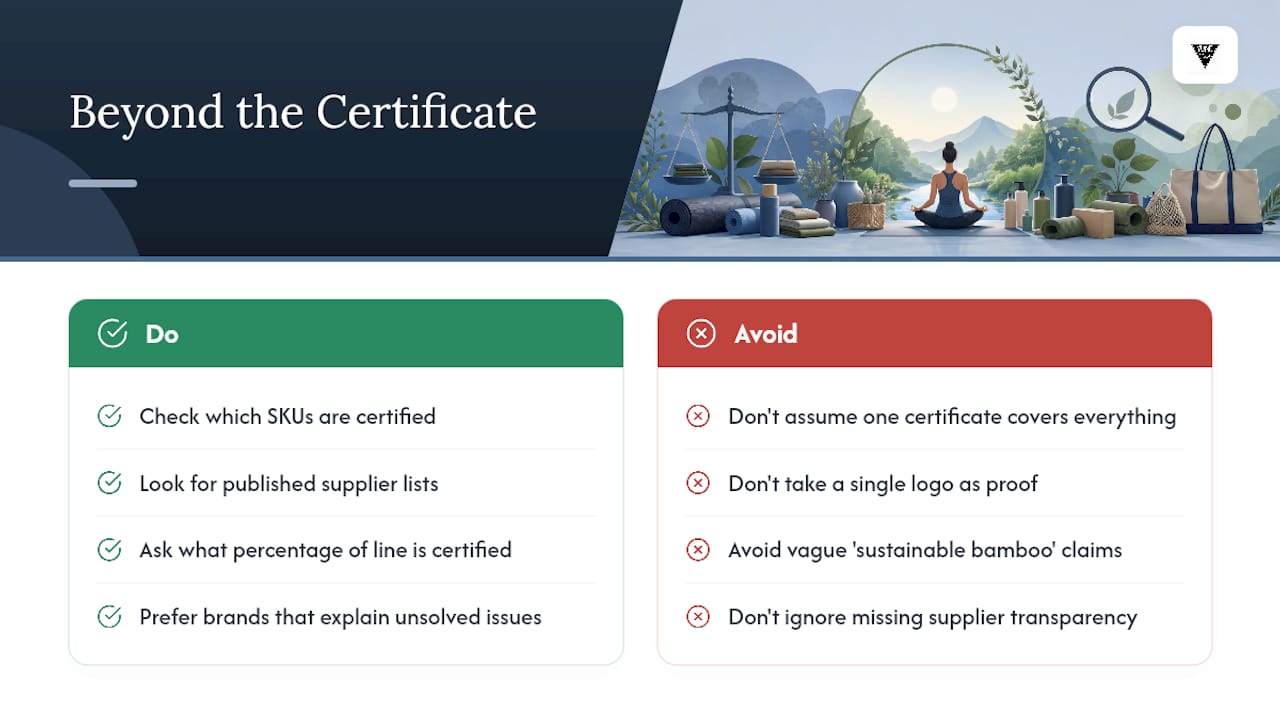
The verification framework in this article is sound, and using it will protect you from most greenwashing. But there’s a gap worth naming: certifications test what a brand submits for testing. They don’t test the full product line, and they don’t test every production run. A brand can hold a valid OEKO-TEX certificate for one SKU while the rest of its catalog is uncertified. GOTS certification for a fabric mill doesn’t mean the finished garment was made under GOTS conditions.
The brands that are genuinely doing the work tend to show it in ways that go beyond a single certification logo. They publish supplier lists. They disclose the percentage of their line that’s certified, not just the fact that some products are. They explain what they haven’t solved yet. That last one is the tell most shoppers miss: a brand that acknowledges its own limitations is almost always more trustworthy than one whose sustainability page reads like a press release.
For what it’s worth, the bamboo supply chain transparency question is a useful proxy for this. Bamboo is widely marketed as sustainable, but the processing from raw bamboo to fabric is chemically intensive. A brand that can explain its bamboo supply chain in detail, including the processing method and any certifications for that step, has thought through the problem. One that just says “made from sustainable bamboo” hasn’t.
The checklist in this article is a floor, not a ceiling. Use it to filter out the obvious greenwashing. Then look for the brands that go further.
Yuneyoga curates mats with material transparency you can verify
Sorting through sustainability claims on your own takes time. Yuneyoga does that work upfront, curating yoga mats selected for material safety and clear labeling, so you’re not starting from scratch every time you shop.

Every mat in the Yuneyoga collection comes with a material breakdown you can read, not a vague “eco-friendly” label. The focus is on natural rubber, tested materials, and products where the sustainability claims hold up to the questions in this checklist. Transparency promises you should expect when you shop there: material composition listed by component, certification information where applicable, and end-of-life guidance for each product.
If you want a starting point for vetted, transparent yoga mats, the Yuneyoga shop is built around exactly the criteria this article describes. Browse the eco-friendly mat collection to see how those standards apply to specific products.
Sources
- Yoga Mats Testing Reveals Greenwashing | Ecology Center
- Eco-friendly yoga mats: choose sustainable options (2026) – Mats4U USA
- How to Spot Greenwashing in Yoga and Activewear: 10 Questions Every Conscious Shopper Should Ask
- Sustainable Yoga Clothes: Fabric and Ethics Guide 2026


