Article: Business Travel Yoga Mat: How to Pick One That Packs Well
Business Travel Yoga Mat: How to Pick One That Packs Well
The best business travel yoga mat is a foldable or ultra-thin mat that weighs roughly 1.5 to 2.5 pounds, folds small enough to live inside your carry-on, and still grips a hotel carpet or a bare floor. Everything else, from color to brand, comes second. A mat you will actually unpack on a Tuesday night in a Chicago hotel beats a better mat left at home.
This guide covers what to look for, what the airport rules actually say, how to get a decent practice out of a thin mat, and how to pack so you never have to fight with a gate agent over it.
TL;DR
- Choose a mat that folds or rolls small and weighs about 1.5 to 2.5 lbs. Travel mats are usually 1 mm to 2 mm thick, against 3 mm to 5 mm for studio mats.
- TSA has no special restriction on yoga mats in carry-on or checked bags. The real limit is your airline’s carry-on size and weight allowance.
- Pack the mat inside your bag, not strapped to the outside, so you can pull it out if your carry-on is gate-checked.
- Thin means little cushioning. A folded hotel towel under the mat fixes most knee and wrist complaints.
- Air out a new mat for a few days before the trip, and check the material if you have a latex allergy.
Table of Contents
- What makes a mat right for business travel
- Airport and airline rules for yoga mats
- Foldable, thin roll, or standard: how they compare
- Materials: grip, weight and what is in the mat
- Making a thin mat comfortable in a hotel room
- A packing routine that works on a tight schedule
- Our perspective: what a travel mat should do for you
- Shop travel mats at Yune Yoga
- Cleaning and caring for your mat on the road
- When a travel mat is not the right call
- FAQ
- Sources
What makes a mat right for business travel
A business trip is not a vacation. You carry a laptop bag, maybe a garment bag, and you have a tight schedule and a hotel room of unknown size. That changes what a good mat is.
Packed size matters more than rolled length. A full-size studio mat is a long roll that will not fit in most roller bags. A foldable mat collapses into a flat rectangle that slides next to a laptop sleeve or lies along the back wall of a suitcase.
Weight adds up. Review testing of travel mats puts foldable options at about 700 g to 1.15 kg (1.5 to 2.5 lbs), with 1 mm to 2 mm of thickness. That is the range to shop in. Anything heavier starts to compete with your shoes and your charger for bag space.
Grip beats cushioning. On a hotel floor, the danger is not sore knees. It is a mat that slides on polished tile or bunches on thick carpet. A non-slip base and a surface that holds when your hands get warm are the priorities.
It has to be easy to deal with. If it is hard to clean, you will not want to pack it damp or put it back in your bag after a sweaty session. Surface and care routine count as much as thickness.
Airport and airline rules for yoga mats
People often assume a yoga mat is a security problem. It is not. The TSA’s sporting and camping list does not restrict yoga mats in carry-on or checked bags. As with anything, an officer can still ask to inspect an item at the checkpoint.
The constraint comes from the airline. A rolled mat strapped to a backpack counts as part of that bag, so it has to meet the airline’s carry-on size and weight limits like everything else. On a full flight, or on a small regional aircraft, bags that do not fit may get checked at the gate.
That is where business travelers get caught. The Department of Transportation’s Fly Rights guide is a good reminder to leave extra leeway when the trip matters, such as a deal to close or a speech to give. Treat your mat the same way: assume the bag might be taken from you at the jet bridge.
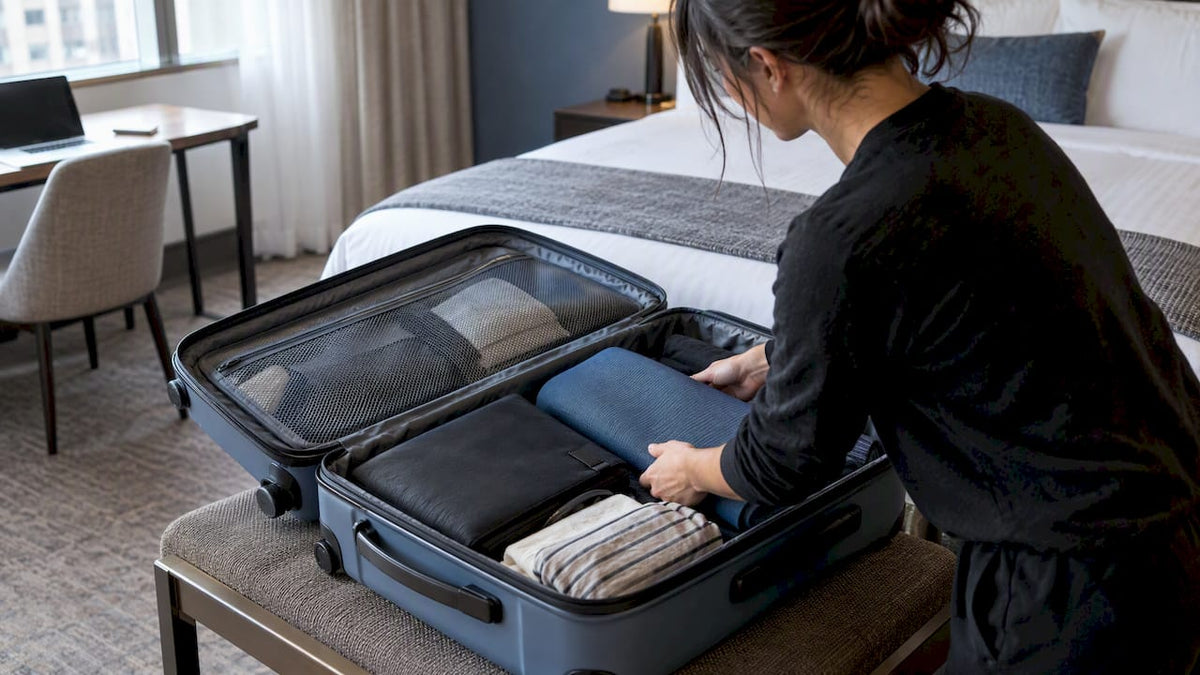
So pack the mat inside your carry-on or inside a personal item that fits under the seat. If the roller bag gets gate-checked, you pull the mat and your essentials out first. A mat tied to the outside of a backpack can be separated from you or damaged in the hold.
We go into more detail in our guides on what TSA allows and what airlines limit and on packing a foldable or under 2 mm mat to avoid gate hassles.

Keep the rest of your kit airport-friendly
A yoga mat is only part of the carry-on puzzle. Toiletries are the other. If you are trimming your bag to one item per category, a short routine of travel skincare that fits TSA 3-1-1 keeps the liquids bag small and leaves room for the mat.
Foldable, thin roll, or standard: how they compare
| Type | Typical thickness | Packs into | Best for | Trade-off |
|---|---|---|---|---|
| Foldable travel mat | 1 mm to 2 mm | Flat rectangle in a carry-on | Frequent flyers, tight bags | Little cushioning |
| Thin rolled travel mat | About 1 mm to 2 mm | Narrow roll, fits some bags | Drivers, checked-bag travelers | Roll can be awkward in a carry-on |
| Standard studio mat | 3 mm to 5 mm | Long, bulky roll | Home practice, road trips by car | Often too big for a carry-on |
The thickness numbers come from the same travel mat testing above, which notes that travel mats run noticeably thinner than 3 mm to 5 mm studio mats.
If you fly more than a few times a year, foldable usually wins. It is the one format that reliably fits in a carry-on without taking over the bag. For a full breakdown, see our guide to choosing a folding yoga mat for every kind of trip.
Materials: grip, weight and what is in the mat
The surface decides how a mat feels at 6 a.m. in a hotel room with the heat turned up.
Natural rubber
Pure natural rubber gives strong baseline traction, but it tends to be heavier and needs a regular cleaning routine to keep its stickiness. It is also renewable and biodegradable, where PVC is cheap but hard to recycle. If you have a latex allergy, read the composition carefully, because some natural rubber mats can trigger reactions.
Microfiber and polyurethane tops
Microfiber-topped mats often grip better as they get damp, which suits hot yoga or a humid hotel gym. The same review notes that a rubber base underneath keeps the mat from skating on the floor. If you want to compare the two surface types side by side, we wrote up PU versus natural rubber.

Chemicals and labels
Price swings widely, from roughly $45 to over $600, and consumer testing links that spread to material quality, durability and additives such as phthalates. For perspective, a 2025 US EPA assessment of DEHP in consumer products measured yoga mats at a very low weight fraction compared with other plastic goods. Still, if you are sensitive to smells or chemicals, ask what a mat is made of before you buy.
Durability is the greener choice
According to Gregory Keoleian of the University of Michigan, as reported by Wirecutter, the footprint of a mat depends mostly on how long you keep using it, not only on the material. For a traveler, that means a mat that survives repeated folding and the occasional suitcase squeeze is the sustainable one.
Making a thin mat comfortable in a hotel room
The cost of portability is cushioning. A 1 mm to 2 mm mat gives almost no joint support. The fix is cheap and already in your room.
- Fold a hotel towel under the mat. Wirecutter’s testing notes that travelers do this to make a thin mat a usable floor surface. A folded blanket from the closet works too.
- Clear a rectangle. Push the luggage rack and desk chair aside. Most hotel rooms have a spot between the bed and the window that fits a 24 by 72 inch mat.
- Test the floor. On thick carpet, put the mat on the firmest area. On tile or wood, check that the base does not slide before you move into standing poses.
- Choose poses to match the surface. Seated work, floor stretches and standing sequences suit a thin mat. Long kneeling holds are where a towel pad earns its place.
- Wipe and air it out. Let the mat dry flat before folding it back into your bag.
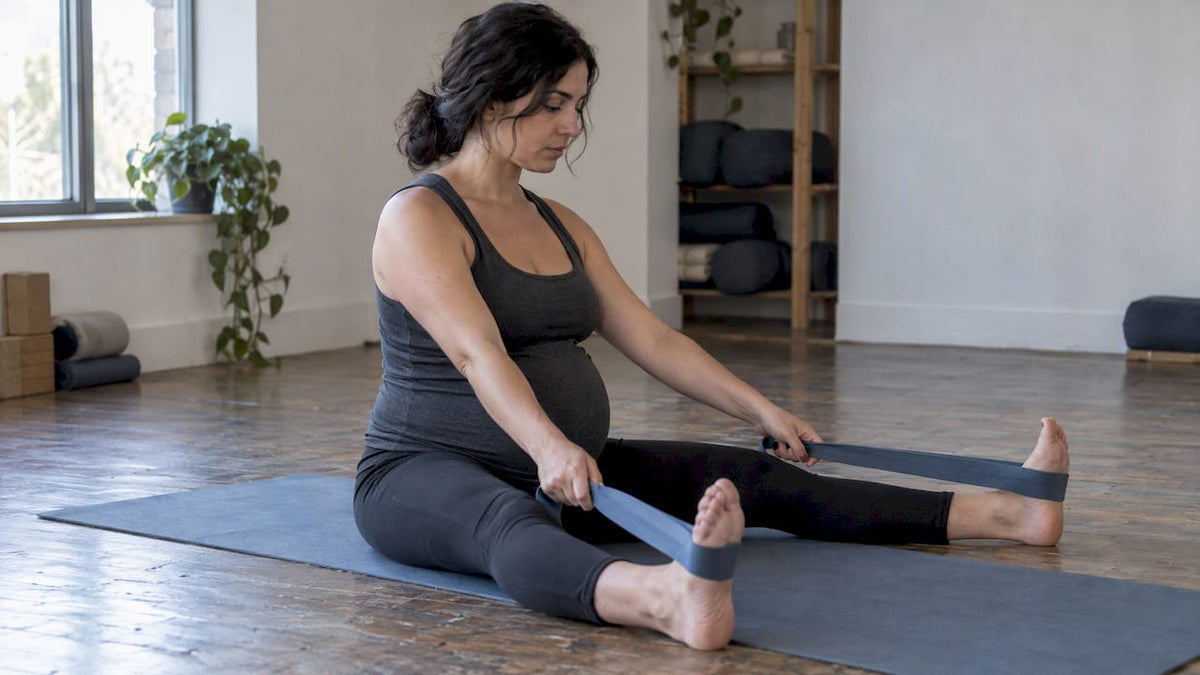
A yoga strap helps when the floor space is small, because it lets you work on hamstring and shoulder flexibility without needing to reach far. It weighs next to nothing and fits in a laptop bag pocket.
A packing routine that works on a tight schedule
Before the trip:
- Air out a new mat. New natural rubber or foam mats can give off a smell that is unpleasant in a small room. Practitioners suggest letting it breathe in a ventilated space for several days before you travel.
- Check your airline’s carry-on dimensions and weight limit. Weigh your packed bag with the mat inside.
- Decide where the mat lives. A flat foldable goes against the back panel of a roller bag or in a briefcase sleeve.
At the airport:
- Keep the mat in the bag, not on it.
- If you hear a gate-check announcement, take out the mat, laptop and anything fragile first.
At the hotel:
- Unpack the mat right away so it is not forgotten at the bottom of the bag.
- Hang a damp towel or mat over the bathtub edge to dry, not on the carpet.
Our perspective: what a travel mat should do for you
We sell yoga gear, and we have seen the same mistake from both sides of the checkout. People buy the most cushioned mat they can find, then discover it will not fit in their carry-on. Or they buy the thinnest mat available and find it slips on their hotel floor.
The right balance, in our view, is a mat you can fold small, with a surface that grips and a material you can keep clean. That is why our range centers on natural rubber, eco-conscious materials and foldable designs, with travel in mind as much as home practice. Durability is also part of the sustainability story for us: a mat that stays in use for years does more good than a short-lived mat made from a greener-sounding material.
For business travelers specifically, we would put portability first, grip second and cushioning third. You can add cushioning with a hotel towel. You cannot add portability to a mat that does not fit in your bag.
— Nicholas
Shop travel mats at Yune Yoga
If you are ready to pick one, start with our Trekk travel mat collection, which includes the Fir Trekk Travel Mat and the Oak Trekk Travel Mat. The Airstream collection is built for travel comfort and daily practice. If you prefer a natural rubber surface for home use and the occasional trip by car, browse our natural rubber yoga mats. A yoga towel or a yoga strap rounds out a kit that still fits in a carry-on.
For more help comparing options, our guides on the best travel yoga mats and foldable mats for travel and home walk through the choices in more depth.
Cleaning and caring for your mat on the road
A travel mat gets more wear than a home mat. It is folded, squeezed, carried through airports and laid on floors you did not choose. A few habits keep it usable.
- Wipe after each session. A damp cloth with mild soap is enough for most surfaces. Let it dry fully before it goes back in the bag.
- Do not leave it in a hot car or a sealed suitcase for days. Heat and trapped moisture are hard on rubber and foam.
- Re-clean natural rubber regularly. Rubber loses its tack when oils and dust build up. Our guide on cleaning a natural rubber mat without ruining it covers the safe methods.
- Check the folds. If a crease starts cracking, retire that fold line and re-fold in a different place.
When a travel mat is not the right call
A travel mat is a compromise, and it is fair to say when it is the wrong tool. If you drive to most of your trips, a standard mat in the trunk is simpler. If you have sore knees, hips or wrists and your practice is mostly kneeling or seated, a thicker, softer mat suits you better, as the Consumer Council of Hong Kong notes: thicker mats suit beginners, seated poses and achy joints. In that case, consider checking a bag, or use the towel trick and keep sessions short. If you are managing an injury or a medical condition, ask your physician or physical therapist what floor surface is safe for you before you pick a mat.
FAQ
Can I bring a yoga mat on a plane?
Yes. The TSA does not list yoga mats as restricted in carry-on or checked bags. Your airline decides whether it fits as part of your carry-on, so check its size and weight limits before you go.
What thickness is best for a business travel yoga mat?
Most travel mats are 1 mm to 2 mm thick, which keeps them light and foldable. That is thin for joints, so many travelers add a folded hotel towel underneath. If you need more cushioning, accept a bulkier mat and plan to check a bag.
Is a natural rubber mat a good choice for travel?
It gives excellent traction and is a renewable material, but it can be heavier than other travel options. It also needs regular cleaning to stay grippy, and it is not suitable if you have a latex allergy. Check the product composition before you buy.
Should I strap my mat to the outside of my bag?
It is better not to. If your carry-on is gate-checked, a mat on the outside can be separated from you or damaged. Pack it inside your carry-on or a personal item that fits under the seat.
Sources
- TSA: Sporting and Camping, What Can I Bring?
- US Department of Transportation: Fly Rights
- Advnture: Yogamatters Eco Travel Yoga Mat review
- Advnture: Mikkoa Travel Yoga Mat review
- Wirecutter: The Best Yoga Mats
- Consumer Council: The Selection and Use of Yoga Mats
- US EPA: Consumer and Indoor Exposure Assessment for DEHP