Article: Prenatal Yoga With a Strap: Safe Poses and Setup
Prenatal Yoga With a Strap: Safe Poses and Setup
A yoga strap is one of the most useful props in a prenatal practice. It extends your reach when your belly gets in the way, steadies you when your balance shifts, and keeps you from stretching further than your joints can safely handle. This guide covers how to use one, which poses it helps, what to avoid, and when to stop. Check with your OB-GYN or midwife before you start, especially if your pregnancy has complications.
TL;DR
- Healthy people with uncomplicated pregnancies can generally start or continue yoga. ACOG says regular physical activity is safe when your pregnancy is normal, and your provider should confirm that for you.
- A strap is a safety tool, not a beginner’s crutch. It adds length where your belly shortens your reach, and it limits how far you can overstretch.
- Skip deep twists that compress the abdomen, long stretches flat on your back after the first trimester, and hot yoga.
- Aim for active, stable positions, not deep passive stretching. Pregnancy hormones loosen your joints.
- Stop and call your provider if you have vaginal bleeding, regular painful contractions, or dizziness.
Table of Contents
- Why a strap matters more when you’re pregnant
- What the research says about prenatal yoga
- Choosing and setting up your strap
- Poses and positions to avoid
- Eight strap-assisted poses, by purpose
- A short routine for each trimester
- When to stop and call your provider
- Our perspective: treat the strap as a guardrail
- Build your setup
- FAQ
- Sources
Why a strap matters more when you’re pregnant
Before pregnancy, a strap often means “help me get deeper.” During pregnancy, the job changes. You use it to keep a long, neutral spine when your belly blocks the usual path to your feet, and to make room for the baby instead of folding over them.
Three things change in your body, and the strap answers each one.
Your reach shrinks. As your belly grows, a forward fold toward your toes gets harder. A strap looped around your foot lets you hold the pose with a tall chest instead of rounding your back to reach.
Your center of gravity moves. Balance gets harder in the second and third trimesters. Holding a strap anchored to a leg, a wall or a doorframe gives your hands something to work with in standing poses.
Your joints loosen. Pregnancy hormones, relaxin in particular, increase joint laxity. Guidance from the Australian government’s Pregnancy, Birth and Baby service on yoga and Pilates during pregnancy is a good place to read about why gentle, controlled movement is the goal. A strap helps because you can hold your range of motion at the edge of what feels stable, not push past it.

The American Heart Association quotes yoga instructor Dina Pinelli on the same point: props such as straps and blocks are not only for beginners during pregnancy. They help with balance, alignment and space for the belly.
What the research says about prenatal yoga
Yoga is not just pleasant. A 2022 systematic review and meta-analysis in BMC Pregnancy and Childbirth pooled 29 studies with 2,217 pregnant women. It found that yoga interventions reduced anxiety, depression and perceived stress. The authors also reported that programs of 12 or more sessions lasting 60 minutes or longer were linked to shorter labor and a higher likelihood of normal vaginal birth (odds ratio 2.58, 95% CI 1.46 to 4.56).
Two cautions. These are associations pooled from trials of varying quality, not a promise about your own labor. And none of those studies tested straps specifically. What they support is regular, well-guided prenatal yoga, and the strap is how you make that practice fit your body.
On how much to do, MotherToBaby’s summary of ACOG guidance says people with uncomplicated pregnancies should aim for 150 minutes of moderate-intensity exercise per week. That can be split into 30-minute sessions on five days or shorter bouts. If you’re new to exercise, start slowly and build up. Yoga can count toward that total, and ACOG’s talk test applies: if you can’t speak normally while exercising, you’re likely pushing too hard.
Choosing and setting up your strap
You don’t need anything fancy, but a few details make a big difference when your body is changing.
- Length. Pick a longer strap if you can. At six feet or more you have room to loop it around a foot with your knees bent wide, or around your back and feet in a seated pose. Eight to ten feet gives more flexibility.
- Buckle type. A D-ring or cinch buckle lets you adjust the loop quickly and hold it securely. You’ll adjust more often than you expect as your body changes week to week.
- Material. Cotton and similar natural fibers grip well and don’t slip on sweaty hands. A soft strap is more comfortable against your lower back and belly.
- Placement. Keep the strap and a couple of blocks within arm’s reach of your mat, even for floor sessions. If you feel a wave of dizziness or fatigue, you can move into a supported pose instead of risking a fall by getting up fast.
A non-slip mat matters too, because wet or slick surfaces are a bigger risk when your balance is off. If you’re comparing, look at natural rubber yoga mats with a firm grip, and keep a yoga strap beside it. Our guide on how to use yoga straps to improve your practice walks through basic loops and holds if you haven’t used one before.
Poses and positions to avoid
Know the limits first, so you can see why the strap variations below look the way they do.
The Mayo Clinic News Network recommends avoiding several things during pregnancy:
- lying flat on your back for long periods after the first trimester, because it can restrict blood flow to the uterus
- hot yoga or hot Pilates, which risk overheating
- deep forward or backward bends
- full twists that put pressure on the abdomen
Instead, bend from the hips rather than the back, and keep twists to the upper back, shoulders and rib cage. The strap helps with both: it lets you hinge from the hips with a long spine, and it keeps your chest open in a twist so your belly isn’t compressed.
Some other points a provider will likely reinforce: avoid inversions unless your provider has cleared them, skip anything that makes you hold your breath, and avoid positions where a fall is possible. If a pose feels unsteady, move closer to a wall or chair.
Eight strap-assisted poses, by purpose
These are general practice ideas, not medical prescriptions. Do them slowly, breathe through the nose, and stay in a range where you could hold a conversation.
1. Seated forward fold with a wide stance
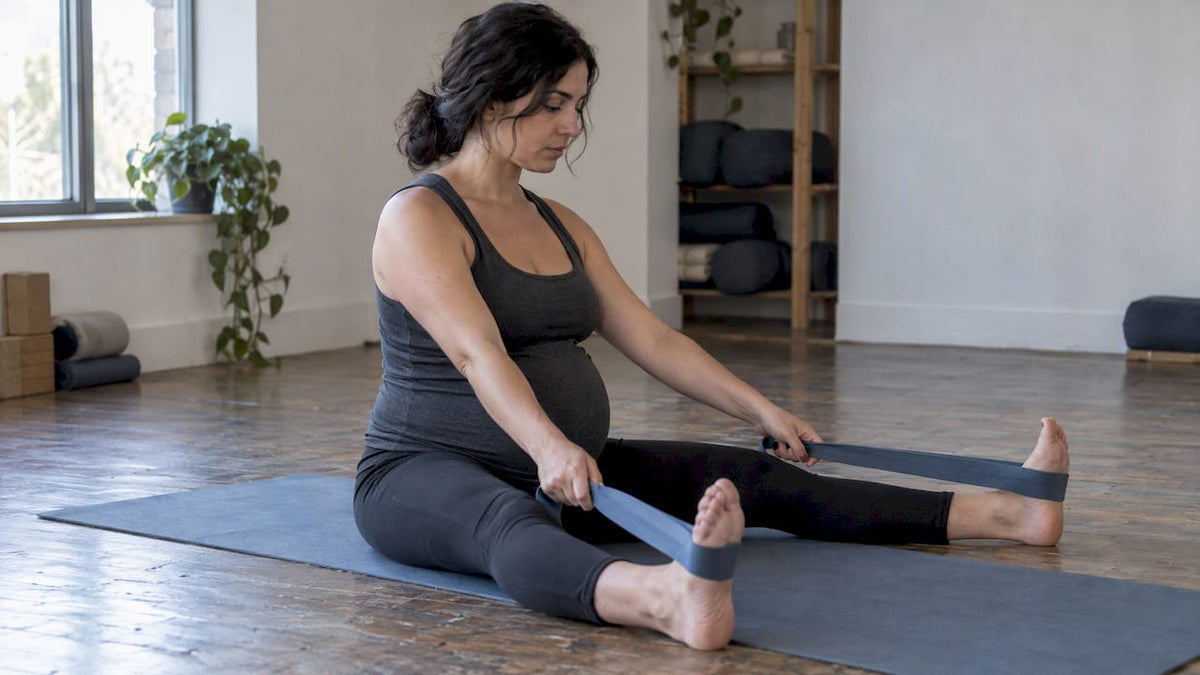
Sit with your legs comfortably wide so your belly has room. Loop the strap around the soles of both feet (or one at a time), hold an end in each hand, and walk your hands up the strap until your spine is long. Hinge forward from the hips only as far as feels comfortable and stop before your belly feels compressed. Sit on a folded blanket if your lower back rounds.
2. Supported cobbler’s pose (butterfly)
This is one of the most commonly recommended prenatal poses, and it also shows up as a question readers ask. Sit tall, bring the soles of your feet together and let your knees fall open. Loop the strap around your lower back and over your feet, then tighten it until your legs feel held, not pulled. The strap does the holding so your hips and lower back can soften. Place blocks under your knees if your inner thighs feel stretched too much. If you feel pinching in the groin or pubic bone, widen your feet away from your body or skip the pose.
3. Seated single-leg stretch
Sit with one leg extended and the other knee bent out to the side. Loop the strap around the ball of the extended foot and hold it with both hands, keeping your chest lifted. This eases the back of the leg without any bending from the spine. Keep a slight bend in your knee. Since joints are looser in pregnancy, stay below the full stretch you had before pregnancy, and do not bounce.
4. Standing hamstring stretch with the foot on a chair
Face a sturdy chair, rest one heel on the seat, and loop the strap around the ball of that foot or hold it for support with both hands. Stand tall, keep the supporting knee soft, and lean from the hips. It is a good option from the second trimester, when lying on your back becomes uncomfortable. Stand near a wall so you can steady yourself.

5. Open twist with the strap
Sit cross-legged or on a chair. Hold the strap with both hands, shoulder-width apart, and bring it in front of your chest. Turn from your upper back and ribcage toward one side, away from your belly, and keep your hips and pelvis facing forward. The strap gives your arms something to press against so you rotate through your upper spine without winding your abdomen. Switch sides and breathe slowly.
6. Shoulder and chest opener
Hold the strap wide, with arms extended in front of you, and lift it overhead if your shoulders allow it. Pull gently outward on the strap to wake up the muscles between your shoulder blades, which tire as your breasts grow and your posture changes. Stay seated or standing, whichever feels steadier.
7. Side stretch with the strap overhead
Stand or sit tall holding the strap overhead with both hands, slightly wider than your shoulders. Lean gently to one side, creating length along the ribs, without crunching your belly. This relieves the tightness many people feel at the side of the waist when the baby grows.
8. Supported squat
Wrap the strap around a sturdy, fixed anchor such as a heavy post or a secured door handle and hold both ends with your feet shoulder-width apart or wider. Lower into a squat only as far as is comfortable and keep your heels on the floor or on a folded blanket. Skip this one if the anchor isn’t completely secure, if you feel any pelvic pain, or if your provider has told you to avoid deep squats late in pregnancy.
A note on reclined poses
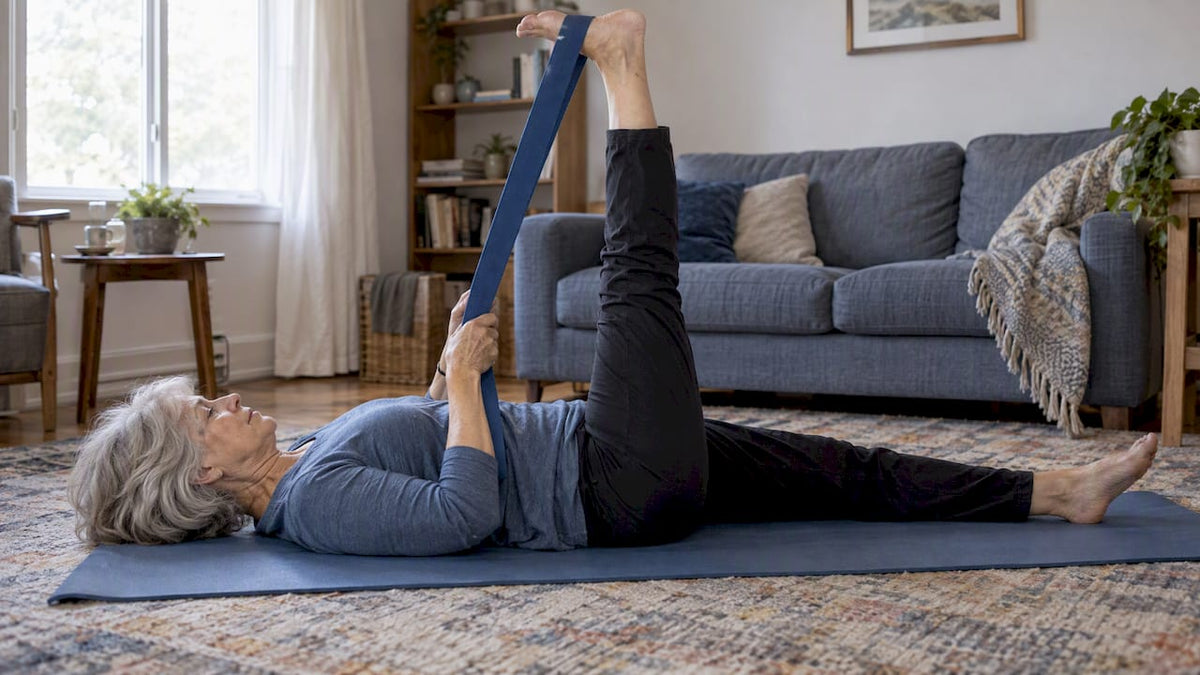
You’ll see “reclined hand-to-big-toe” in most strap tutorials. After the first trimester, don’t hold it flat on your back. If you want that stretch, sit up on a bolster or incline and work with the strap there, or choose the standing and seated versions above.
A short routine for each trimester
The guide below is a template to adapt, not a prescription. Your provider can tell you what is right for your pregnancy.
| Stage | Focus | Strap use |
|---|---|---|
| First trimester | Gentle movement, breathing, energy and nausea management | Seated forward fold, shoulder opener |
| Second trimester | Hips, back and balance as your belly grows | Standing hamstring stretch, cobbler’s pose, open twist |
| Third trimester | Comfort, pelvic space and rest | Supported cobbler’s pose, side stretch, wall-supported poses |
A 15 to 20 minute session is a good starting point. Begin with a few minutes of slow breathing, move through three or four of the poses above, and finish with a restful seated position. If you want more structure, our alignment-first strap stretch routine lays out a 15 to 20 minute sequence you can shorten and adapt, and our article on finding the best prenatal yoga classes can help you pick an instructor trained in pregnancy.
If you also deal with pain at the side of your lower belly when you stand up or turn, there is a clinician-vetted guide to stretches for round ligament pain that pairs well with a gentle strap practice.
When to stop and call your provider
Prenatal yoga is a modified practice. The “no pain, no gain” attitude doesn’t belong in it.
Stop right away and contact your OB-GYN or midwife if you notice any of the following, as listed by ACOG: vaginal bleeding, regular painful contractions, or dizziness. Call emergency services if you feel severe symptoms that don’t ease with rest.
Also tell your provider before you start if you have a pregnancy complication, a history of preterm labor, or a placenta concern. Anyone who has been told to limit activity should get specific instructions on what to do, because general advice does not cover your situation.
Our perspective: treat the strap as a guardrail
We sell yoga straps, and we get asked often whether they have a place in a pregnancy practice. Our answer: yes, but with a different mindset from the one most people bring to a strap.
Most of us pick up a strap to go deeper. In pregnancy, we would use it to stay in a range where your joints are protected. A strap with a fixed loop gives you a clear limit: you can see where you stopped yesterday and stay near it. That matters when relaxin makes everything feel easier than it is.
We also encourage keeping props close. A strap, a block and a non-slip mat set up before you start means you never have to scramble when you feel dizzy or tired. Our design thinking at Yune Yoga is about gear that is functional, durable and made from sustainable materials, and pregnancy is one of the places where those basics matter most: a mat that doesn’t slide, a strap that holds its loop, and a setup that is ready when you need it.
We are not clinicians, and nothing in this article replaces your provider’s advice. What we can say is that your practice should feel supported, not strained.
— Nicholas
Build your setup
If you’re putting together a prenatal practice at home, start with the basics: a grippy mat, a strap long enough to loop around your feet with your knees wide, and a couple of blocks or a firm cushion. Browse our yoga straps and natural rubber mats, or see everything in our full shop. If you travel during pregnancy, our travel mats fold small enough for a suitcase.
FAQ
When in pregnancy should you start prenatal yoga?
If your pregnancy is healthy, ACOG says it is safe to continue or start regular physical activity. Many people begin in the second trimester once early nausea and fatigue ease, but you can start earlier if your provider agrees. Choose a prenatal class or a gentle, low-intensity routine to begin with.
What yoga poses should you not do while pregnant?
Avoid deep forward and backward bends, full abdominal twists, hot yoga, and lying flat on your back for long periods after the first trimester, per the Mayo Clinic News Network. Skip inversions unless your provider clears them. If a position pulls on your belly or makes you dizzy, come out of it.
Why avoid twisting while pregnant?
Closed twists compress the abdomen, where the baby is growing. Open twists solve this by turning from the upper back, shoulders and ribcage, away from the belly. A strap lets you hold your chest open and forward-facing while you rotate through the upper spine.
Can I sit in butterfly pose while pregnant?
Yes, for most people it is a comfortable seated pose. Sit on a folded blanket, support your knees with blocks, and use a strap around your lower back and feet so you don’t have to hold the position with effort. If you feel pinching in your pelvis or groin, widen your feet or choose another seated pose, and mention the pain to your provider.
Sources
- Exercise During Pregnancy, ACOG
- Women’s Wellness: What you need to know about prenatal yoga, Mayo Clinic News Network
- Prenatal yoga may help ease stress, improve fitness during pregnancy, American Heart Association
- The characteristics and effectiveness of pregnancy yoga interventions: a systematic review and meta-analysis, BMC Pregnancy and Childbirth
- Yoga and Pilates during pregnancy, Pregnancy, Birth and Baby
- Exercise, MotherToBaby