Article: Yoga Strap Stretches for Seniors: 8 Gentle, Safe Moves
Yoga Strap Stretches for Seniors: 8 Gentle, Safe Moves
A yoga strap lets you stretch your legs, hips, shoulders and back without forcing your body to reach. You hold the strap, the strap holds the position, and you stay tall and in control. Below are eight strap stretches you can do in a sturdy chair or lying on your back, a simple 15-minute routine, and the safety rules that matter most after 60.
TL;DR
- A strap works as an extension of your arm, so you can keep your spine long instead of rounding forward to reach your toes.
- Start with seated or reclined stretches: hamstrings, calves, hips, shoulders and chest. Hold each for 20 to 30 seconds, two or three rounds per side.
- Stretch to mild tension, never to pain, and keep a soft bend in your knees and elbows.
- Pair stretching with strength and balance work. Flexibility alone is not enough.
- Check with your doctor or physical therapist first if you have had a joint replacement, have arthritis, osteoporosis or balance problems.
Table of Contents
- Why a strap suits older adults
- Before you start: safety first
- Choosing and setting up your strap
- Eight yoga strap stretches for seniors
- A 15-minute routine you can repeat
- Make the strap work harder: active stretching
- Common mistakes to avoid
- Our perspective: slow is the point
- Gear for a comfortable home routine
- FAQ
- Sources
Why a strap suits older adults
Most people do not get stiffer because of age alone. They get stiffer because they move through a smaller range every year. Stretching can help you take that range back, but the usual way of doing it, bending forward and grabbing your toes, asks a lot of the lower back and hamstrings at once.
A strap solves the reaching problem. If your hands cannot get to your foot, the strap closes the gap. You keep your chest open and your back straight, and the stretch lands in the muscle you meant to target instead of in your lower back. It also stops you from yanking yourself deeper to match a photo or an instructor, which is a common way people strain a muscle. MedlinePlus notes that flexibility exercises help the body stay limber, and that is the job a strap makes easier to do well.
There is also evidence that yoga is worth the time. A 2021 meta-analysis of yoga in older adults found moderate improvements in balance and in lower-body flexibility. Those are the two things that keep stairs, getting out of a car and reaching a high shelf feeling easy. Another systematic review of yoga-based exercise for people aged 60 and over looked at balance and mobility, where falls are the big concern: it points out that about one in three community-dwelling older adults falls each year.
A strap does not do the work for you, though. Used well, it gives you a stable, adjustable guide so that you can build range of motion at your own pace.

Before you start: safety first
The stretches below are gentle, but your body is not generic. Read this section before you try any of them.
Talk to a professional if any of these apply to you:
- A hip, knee or shoulder replacement, or any recent surgery. The AAOS says to check with your provider and listen to your body after joint surgery. Ask your surgeon or physical therapist which positions to avoid and where a strap can safely sit.
- Osteoporosis or low bone density. Deep forward folds and strong twists can be off limits, so ask your doctor which ranges are safe. The National Institute on Aging lists balance, strength, flexibility and endurance as the four types of exercise, and a provider can help you choose within them.
- Arthritis flares, nerve pain, dizziness or balance problems. A physical therapist can check that the strap is not pressing on a sore joint.
- Any exercise program that is new to you. MedlinePlus advises talking to your health care provider before you begin one.
Rules that apply to everyone:
- Stretch to mild tension, never to pain. A pulling sensation in the muscle is fine. Sharp, pinching or burning pain in a joint means back off.
- Keep a micro-bend. Do not lock your knees or elbows straight. A slight bend keeps the muscles working and spares the joint.
- Breathe. If you are holding your breath, you are pushing too hard.
- Move slowly in and out. Take about five seconds to bring the strap in and the same to let go. No bouncing.
- Use a sturdy chair. Pick one without wheels or arms that get in the way, and put it against a wall or on a non-slip surface. Sit toward the front edge with both feet flat.
- Stop and rest if you feel lightheaded. Stand up slowly afterward.
Choosing and setting up your strap
You do not need anything fancy. What matters is how the strap feels in your hands.
- Length. For most adults a strap around 8 feet gives enough room for foot stretches and for holding a shoulder stretch behind the back. If you are tall or very stiff, longer gives you more options.
- Material. Durable cotton or similar sturdy fabric grips well and does not slide. Avoid anything stretchy for these exercises: you want a fixed length.
- Buckle. A D-ring or cinch buckle lets you make a loop around your foot and tighten it with little hand strength. If your fingers are sore from arthritis, practice the buckle before the stretch starts.
- Grip points. Some people like knots or loops in the strap as handholds. You can tie them yourself or just move your hands up and down the strap.
If you want to see what we make, our yoga strap collection is built around durable, sustainable materials. For setup basics, our guide on how to use yoga straps walks through the buckle and loop.
Mat or no mat? For the reclined stretches you will want something cushioned and non-slip under you. A natural rubber mat grips a hard floor well, so it will not slide as you push through a foot. If you prefer a seated-only routine, you can skip the mat altogether and keep one under your feet for traction.
Eight yoga strap stretches for seniors
Do these in order. The first four are seated, the last four are reclined, which gives your back a rest and lets gravity help. Hold each side for 20 to 30 seconds and repeat two or three times, unless it says otherwise. A hold of that length is a common guideline for static stretching, but shorten it if you feel strain.
1. Seated hamstring stretch
Targets: back of the thigh.
- Sit near the front edge of the chair. Extend your right leg forward with the heel on the floor and the toes pointing up.
- Loop the strap around the ball of your right foot. Hold both ends in your hands.
- Sit tall, lengthen your spine, and keep a soft bend in the knee.
- Gently lean from the hips, not the shoulders, until you feel a mild pull behind the thigh.
Tip: If your back rounds, you have gone too far. Come up until your chest is tall again and hold there.
2. Seated foot-to-hand stretch with strap
Targets: hamstrings and calves, with extra stability work.
- From the same seated position, lift your right foot a few inches off the floor with the strap around it.
- Straighten the leg only as far as feels comfortable, keeping the micro-bend.
- Press your foot gently into the strap while your hands resist. Hold for a few breaths.
This version asks your thigh muscles to work against the strap. That helps build strength while you stretch, which fits the multicomponent approach recommended in the Physical Activity Guidelines midcourse report. If lifting the leg feels shaky, leave the heel on the floor and use stretch 1 instead.
3. Seated outer hip stretch (figure four)
Targets: outer hip and glutes.
- Sit tall and cross your right ankle over your left thigh, just above the knee.
- Place the strap around your right shin or foot, and hold it to help keep the leg in place.
- Sit up straight, then hinge forward a few inches from the hips.
Caution: If you have had a hip replacement, skip this stretch unless your surgeon or therapist has cleared it. Crossing the legs can be restricted after surgery.
4. Seated overhead and side stretch
Targets: sides of the torso, shoulders and upper back.
- Hold the strap with both hands, about shoulder-width apart, and raise it in front of you.
- Lift it overhead as far as feels comfortable. If your shoulders feel tight, stop at forehead height.
- Lean gently to the right, keeping both hips on the chair. Breathe into the left ribs. Return to center and repeat on the left.
The strap keeps your hands the same distance apart so that one shoulder is not doing more than the other. If you are working back from a shoulder injury, the AAOS offers a rotator cuff conditioning program you can review with your therapist.
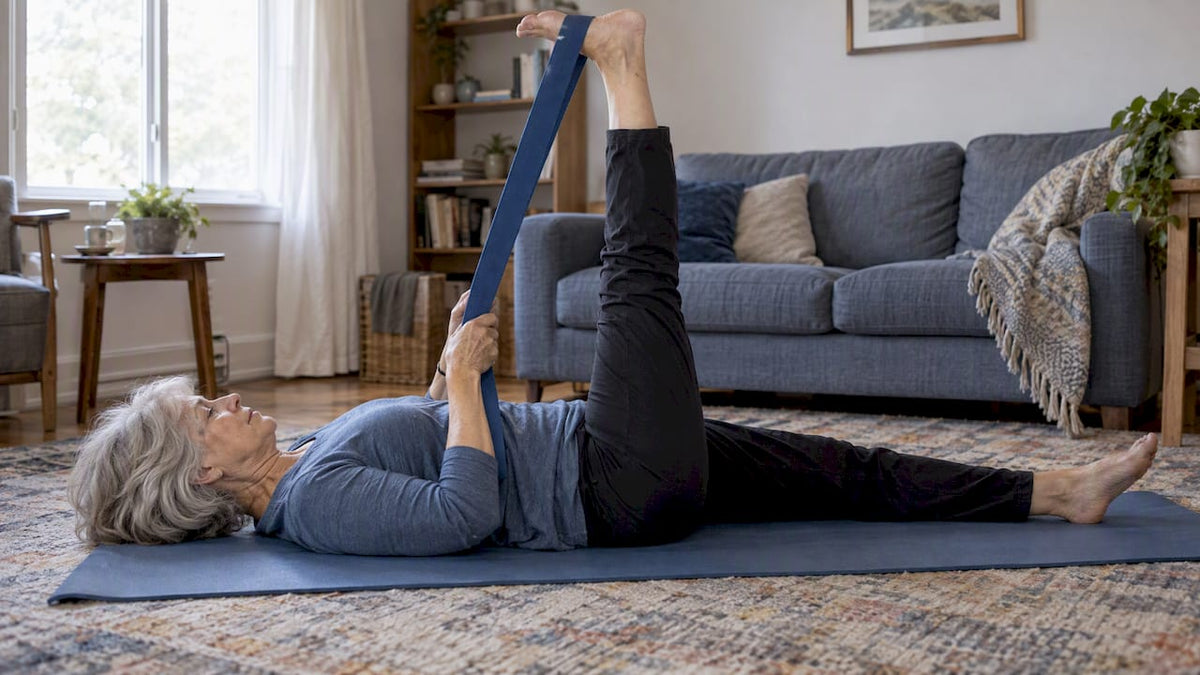
5. Reclined hamstring stretch
Targets: hamstrings, with your back fully supported.
- Lie on your back with your knees bent and feet flat. If your neck is uncomfortable, put a thin folded towel under your head.
- Bring your right knee toward your chest and place the strap over the ball of the foot.
- Extend the leg toward the ceiling as far as comfortable. A bent knee is perfectly fine.
- Keep the left foot on the floor, or extend that leg if your lower back feels good.
This is the classic strap stretch, and it is gentler than the seated one because the floor holds your spine. If getting down to the floor or back up is difficult, do the seated version instead and save floor work for when you are stronger.
6. Reclined leg to the side
Targets: inner thigh and hip.
- From the reclined position, hold the strap around your right foot with your left hand.
- Slowly let the right leg drift out to the right, keeping your left hip on the floor.
- Rest your right arm out to the side for balance.
Go only as far as you can without your hip lifting. People often rush this one. Stay shallow and breathe. Skip it if you have had a hip replacement unless your care team says otherwise.
7. Reclined knee-to-chest with strap
Targets: lower back and hips.
- Lie on your back and loop the strap around your right thigh, just behind the knee.
- Draw the knee toward your chest using the strap, with your elbows relaxed.
- Hold, then switch sides. You can also bring both knees in if that feels comfortable.
If you have knee pain, hold the strap behind the thigh rather than pulling on the shin. Pull only until you feel a gentle release in the lower back and hip.
8. Strap shoulder and chest opener
Targets: chest, front of shoulders.
- Sit or stand tall holding the strap wide, with your palms facing down.
- Slowly lift the strap overhead, then move it back behind you only as far as your shoulders allow, with elbows slightly bent.
- Pause, then return the same way.
If you cannot get the strap behind you without pain, stop earlier. A wider grip is easier on the shoulders. Move your hands closer together only when it feels comfortable.
A 15-minute routine you can repeat
| Time | Move | How to do it |
|---|---|---|
| 0:00 to 2:00 | Breathing and overhead reach | Seated, strap overhead, slow breaths |
| 2:00 to 5:00 | Seated hamstring stretch | 2 rounds per side, 20 to 30 seconds |
| 5:00 to 7:00 | Seated side stretch | 2 rounds per side |
| 7:00 to 9:00 | Shoulder and chest opener | 6 to 8 slow repetitions |
| 9:00 to 12:00 | Reclined hamstring stretch | 2 rounds per side |
| 12:00 to 14:00 | Knee-to-chest | Hold each side, then both if comfortable |
| 14:00 to 15:00 | Rest | Lie still, breathe, then rise slowly |
Some people like gentle background music to keep a steady pace. If that is you, this tempo chart for different workout types can help you pick a calm rhythm for slower sessions.
Three or four sessions a week is a realistic goal. In the 2021 review, the clearest gains for people aged 60 to 79 came from practicing consistently for roughly nine to twelve weeks, so give it a couple of months before you judge the results.
Make the strap work harder: active stretching
Passive stretching means you hold a position and wait. Active stretching means you gently push against the strap and then relax, which wakes the muscle up. For example, in the reclined hamstring stretch, press your foot lightly into the strap for five seconds, then release and ease the leg a little closer.
This matters because the point of exercise after 65 is function, not just length. The CDC’s guidance for older adults calls for aerobic, muscle-strengthening and balance activity each week. A strap routine covers part of that, and the National Institute on Aging says it is important to get all three types and not just one.
A practical weekly plan could look like this:
- Aerobic: brisk walking, swimming or dancing, building toward the 150 minutes a week of moderate activity the guidelines describe.
- Strength: two or more days, working major muscle groups. The CDC’s Growing Stronger program is a good place to start, and it advises discussing it with your provider first.
- Balance: standing near a counter, shifting weight, or heel-to-toe walking.
- Flexibility: your strap routine, on the days you feel stiff, or after a walk when muscles are warm.
For more seated ideas, see our guides to chair yoga for seniors and gentle chair yoga for flexibility and balance. When you are ready for more leg work, our 10 yoga strap leg stretches are a natural next step.
Common mistakes to avoid
- Forcing the stretch. Chasing a deeper position is how soft tissue gets hurt. The strap is there so you do not have to chase.
- Rounding the back to reach. If your spine curls, shorten your hold on the strap or bend the knee more.
- Locking joints. Keep the micro-bend in knees and elbows.
- Stretching cold. Walk around for a few minutes first, or do the stretches after a bath or a walk.
- Skipping strength. Stretching without muscle support around the joint can leave you looser but not steadier. Treat flexibility as one part of a plan.
- Ignoring one-sided pain. If one side is much tighter or sorer than the other, mention it to your doctor instead of pushing through it.
Our perspective: slow is the point
We make yoga straps, mats and towels, and we hear the same thing from people who are newer to yoga or returning to it later in life: “I’m not flexible enough.” We think that has it backwards. Props exist because bodies are different, and a strap is the simplest one.
Our view is that a good strap session should feel almost boring. You sit tall, you breathe, you find the edge where the muscle says hello, and you stop there. Over weeks, that edge moves. You do not need to hurry it, and you should not.
We also believe gear should get out of your way. A strap that slips, a mat that slides on a hardwood floor or a buckle you cannot work with stiff fingers will end a routine faster than any tight hamstring. That is why we focus on durable materials, good grip and simple design, and why we keep writing practical guides alongside the products.
If you take one thing from this article, let it be this: keep a gentle bend in the joints, stay out of pain, and show up often. The consistent person beats the ambitious one every time.
— Nicholas
Gear for a comfortable home routine
If you are setting up a spot at home, we offer yoga straps for stretching and alignment, along with natural rubber yoga mats that give you grip for the reclined work. You can browse the full range on our shop page.
FAQ
What stretches can I do with a yoga strap?
The most useful ones are hamstring stretches (seated or reclined), a figure-four hip stretch, a leg-to-the-side stretch, knee-to-chest, and overhead or chest-opening shoulder stretches. Seniors usually do best starting with the seated and reclined versions covered above. If you have had joint surgery, ask your provider which of them are safe for you.
What are some good yoga stretches for elderly people?
Gentle seated stretches are the best starting point: seated hamstring stretches, side bends, shoulder rolls and a seated twist within a comfortable range. They keep you stable and reduce fall risk. Our guide to chair yoga for elders covers a full seated routine.
How long should I hold each strap stretch?
About 20 to 30 seconds per side is a common starting point, repeated two or three times. If you feel strain, shorten the hold or ease off the strap. Breathe slowly the whole time, and stay out of pain.
Is a yoga strap safe after a hip or knee replacement?
It can be, but only with guidance from your surgeon or physical therapist. Some positions, such as crossing the legs or deep hip flexion, may be restricted for a period after surgery. Ask your care team which movements are allowed and where the strap should sit.
How often should seniors stretch with a strap?
Three or four times a week works for many people, with rest days in between. Add strength and balance work on other days to cover what the CDC recommends for adults 65 and older.
Sources
- Exercise for Older Adults, MedlinePlus
- Meta-Analysis of the Effect of Yoga Practice on Physical Fitness in the Elderly, PMC
- Yoga-based exercise improves balance and mobility in people aged 60 and over, PubMed
- Activities After Knee Replacement, AAOS OrthoInfo
- Four Types of Exercise Can Improve Your Health and Physical Ability, National Institute on Aging
- Exercise and age, MedlinePlus Medical Encyclopedia
- Physical Activity Guidelines Midcourse Report, ODPHP
- Rotator Cuff and Shoulder Conditioning Program, AAOS OrthoInfo
- Older Adult Activity: An Overview, CDC
- Three Types of Exercise Can Improve Your Health and Physical Ability, National Institute on Aging
- How Older Adults Can Get Started With Exercise, National Institute on Aging
- Growing Stronger: Strength Training for Older Adults, CDC