Article: Yoga Without a Mat: What Works, What Doesn't
Yoga Without a Mat: What Works, What Doesn't
Yes, you can do yoga without a mat. A mat gives you grip, cushioning and a defined space, but it isn’t a requirement. What matters is the surface under you: clean, level, and not slippery under bare hands and feet. Pick the right surface, choose poses that suit it, and a mat-free session can be perfectly good practice.
Below you’ll find which surfaces and substitutes work for which poses, a 20-pose beginner sequence that suits a mat-free session, how to adjust when you have no cushioning, and when a mat or travel mat is worth having after all.
TL;DR
- You don’t need a mat to practice yoga. You do need a clean, level, non-slip surface and slow, controlled movement.
- Bare floor suits standing poses. A folded blanket or firm pillow suits seated and kneeling poses. A rug gives general cushioning.
- A regular towel can slide and bunch, so keep it to slow, low-load work. A towel with a grippy underside, or a travel mat, is more dependable.
- On hard floors, step instead of jumping, and skip inversions and wrist- or knee-heavy poses.
- Going mat-free is not automatically safer. Beginners should keep sequences simple and stop at sharp pain.
Table of Contents
- Is a mat really necessary?
- Pick your surface first
- Mat substitutes, ranked by what you’re doing
- A beginner’s mat-free session of 20 poses
- Adjusting your practice when there’s no cushion
- Is mat-free yoga safer, or riskier?
- Why you might practice without a mat on purpose
- Perspective: when we’d say “just roll out of bed and practice”, and when we wouldn’t
- Travel without a mat
- When a mat starts to make sense
- Our mats, towels and travel options
- FAQ
- Sources
Is a mat really necessary?
No. NCCIH, the National Institutes of Health center for complementary health, describes yoga as generally safe for healthy people when practiced properly, and its guidance centers on starting slowly, choosing an appropriate level and not pushing past comfort. Equipment isn’t on that list of requirements. Glo’s support team makes the same point: the only essential thing you need for yoga is yourself.
What a mat does is solve three problems at once:
- Traction. Hands and feet stay where you put them.
- Cushioning. Knees, wrists, hips and spine bones get some padding.
- Boundaries and hygiene. You have a defined, clean space, which also helps you feel settled.
Without a mat, you have to solve those three problems another way. That’s the whole game.
Pick your surface first
Before you choose a substitute, look at the floor. Test it: press your palm flat and push forward. Step with a bare foot and try to slide. If either slips easily, change surface or change the pose list.
| Surface | Grip | Cushion | Best for | Watch out for |
|---|---|---|---|---|
| Hardwood, tile, laminate | Low, especially when clean and polished | None | Standing poses with weight over the feet | Sliding hands in dog poses, bony knees and hips |
| Dense carpet | Good | Moderate | Most poses, including floor work | Feet or hands catching and twisting on loops; dust and allergens |
| Thick, plush carpet | Fair | High but unstable | Gentle seated and supine work | Wobble in balance poses |
| Clean area rug | Varies with the backing | Moderate | General practice | Rugs that creep on smooth floors |
| Grass or sand | Fair | Some | Outdoor flow at an easy pace | Uneven ground, debris, hidden hazards |
Surface changes how a pose feels, so treat each as a different setting. The CDC’s school physical-activity guidance on yoga lists natural surfaces among possible places to practice, but each one changes traction, cleanliness and joint comfort. If you have carpet at home and want to use a mat on it, our guide to using a yoga mat on carpet safely covers the trade-offs. For a wider look, see our explainer on yoga practice surfaces.
Mat substitutes, ranked by what you’re doing
There’s no single best stand-in. It depends on the pose.
Folded blanket or firm pillow
For seated and kneeling poses, this is the most useful option. The CDC guidance points to a firm pillow or folded blanket as an alternative when you don’t have special equipment. Fold a thick blanket in four and kneel on it for Child’s Pose or Cat-Cow. Sit on the edge of a folded one to lift your hips in easy seated pose.

Clean rug
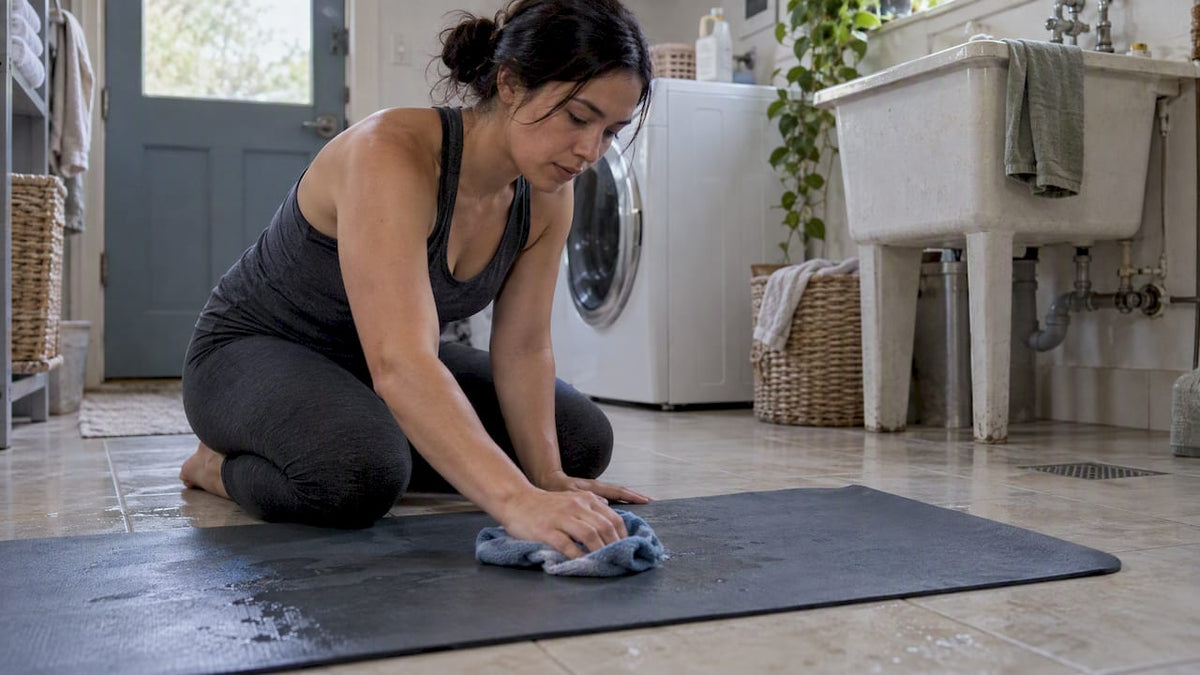
A rug gives broad cushioning and a defined practice space. Check the underside. If it slides on your floor, put it on carpet or against a wall, or do only slow, supported poses on it.
Towel or sheet
A towel works for light yoga, with caveats. Glo suggests a rug or towel for classes, alongside non-slip equipment. An ordinary bath towel has no floor-gripping backing, so it can slide or bunch under a hand or foot. Use it on a clean, non-slippery surface, keep your movements slow, and avoid fast flows, jumping, or any pose where a sliding hand could drop you.
A yoga towel is a different thing. It’s made to lie flat and is longer and thinner. Our Tiger, Leopard and Zebra yoga towels are designed for yoga rather than the bathroom, and the first two are 24x70 inches.
Bare floor
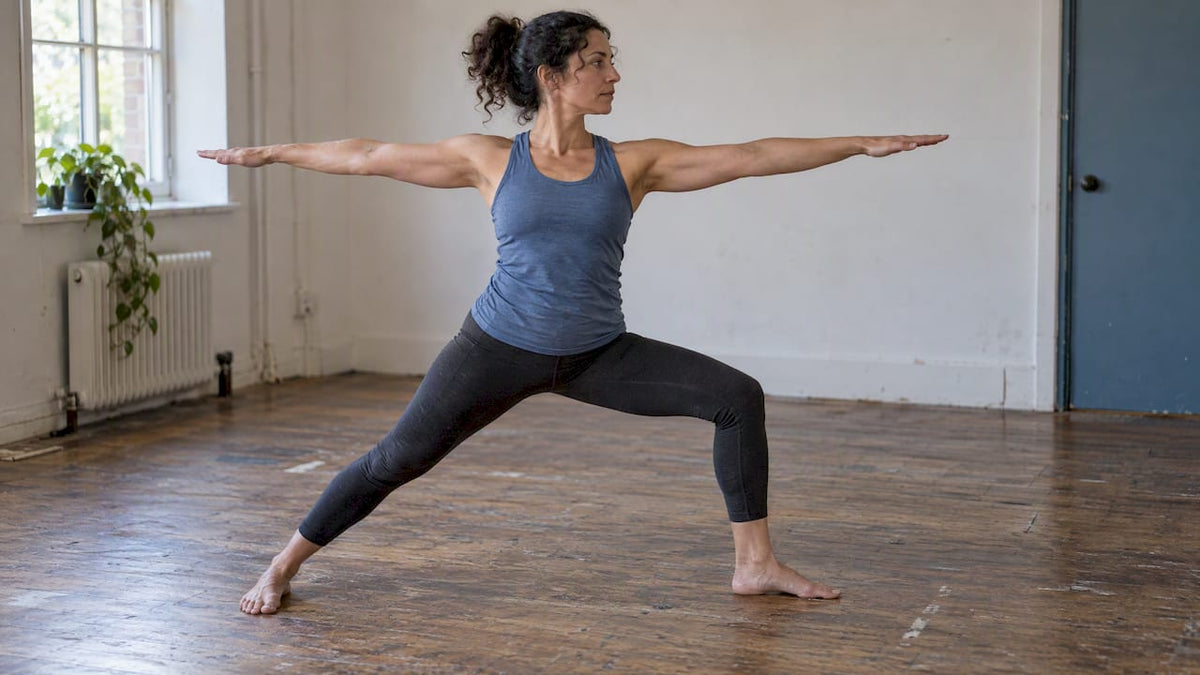
For standing practice, a bare, clean floor is often the best choice. Your feet spread and grip naturally. It works for Mountain, Warrior poses, Triangle and Tree. It’s less kind to knees and hip bones, so leave kneeling and prone poses for a padded surface.
A beginner’s mat-free session of 20 poses
If you want a ready list, these poses are low-impact and don’t depend heavily on traction or padding. They follow the CDC’s yoga guidance, which recommends a warm-up, slow movements, skipping any pose that causes sharp pain, and finishing with 5 to 10 minutes of relaxation.
Standing (bare floor or dense carpet)
- Mountain Pose
- Standing side stretch
- Chair Pose
- Warrior I
- Warrior II
- Triangle
- Extended Side Angle
- Tree Pose
- Wide-Legged Forward Fold
- Garland (a squat; hold a folded blanket under your heels if they lift)
Floor (blanket, rug or carpet)
- Cat-Cow
- Child’s Pose
- Sphinx
- Cobra
- Bridge
- Supine Figure Four
- Supine Twist
- Seated forward fold
- Easy seated pose
- Savasana
How to run it: begin with a few minutes of gentle joint circles and easy stretching. Hold each pose for a few breaths. Take your time moving between them. Finish in Savasana for 5 to 10 minutes.
What to leave out
When grip or padding is uncertain, skip jumping transitions, headstand, shoulder stand, forceful breathing practices, and variations that load the wrists or knees heavily. Those are the poses where a slipped hand or a bruised kneecap turns a good session into a bad one.
Adjusting your practice when there’s no cushion
Hard floors change which body parts carry your weight. Yoga teacher Alice Trieu, quoted by PS Fitness, suggests stepping rather than jumping into plank or chaturanga and avoiding force through the metatarsals, the long bones of the feet. Those are sensible rules for any bare floor.
In practice:
- Step back, don’t hop. Walk one foot at a time into plank.
- Move carefully between downward and upward dog. Don’t drop or whip through.
- Pad the bony spots. Fold a towel under knees, or fold a blanket under hips for seated work.
- Shorten holds on hard floors. If your wrists or kneecaps start to complain, come out.
- Shrink your range. Use a smaller stance in lunges and standing poses to keep your feet planted.
Is mat-free yoga safer, or riskier?
Neither, automatically. Don’t assume that skipping the mat makes you more natural and therefore safer. A 2024 review of yoga safety reports that adverse events can include musculoskeletal injuries, with risk influenced by duration, frequency, technique, awareness, and whether someone attempts movements beyond their preparation. An earlier systematic review of published case reports found 76 cases, 27 of them (35.5%) involving the musculoskeletal system. That’s a collection of case reports, not an injury rate for everyone who does yoga, so read it as a reminder rather than a statistic about your odds.
The practical message: keep your sequence simple, avoid advanced inversions, and don’t force a pose. NCCIH recommends starting slowly, choosing an appropriate level, and adapting practice with a qualified instructor if needed.
If you’re coming back from an injury, talk with your physician or physical therapist before you take away the cushioning and grip you’ve been relying on. Strengthening work such as Pilates exercises for injury recovery can build the support around a joint, but ask your own clinician which movements are right for your condition. Sharp or lingering pain in a wrist, knee or lower back is a reason to stop and get it checked, not to try a different towel.
Why you might practice without a mat on purpose
Some experienced practitioners do it by choice. Yoga International teacher Nina Zolotow describes the appeal: a rectangular mat can frame how you move, while a firmer or less sticky surface lets you slide, roll and move in circles. A firmer surface can also ask for more isometric control, since you have to hold yourself in place.
The point is deliberate experimentation. It isn’t a reason to add instability to advanced poses. Try it with simple movements, such as a slow lunge that lets your back foot glide, and keep complex poses for a surface you trust.
Perspective: when we’d say “just roll out of bed and practice”, and when we wouldn’t
We sell mats, so you might expect us to insist you need one. We don’t. If you’ve got ten minutes, a clean floor and a few easy standing poses, start now. A stalled practice is worse than an improvised one, and buying gear is a poor substitute for doing the thing.

What we do notice is where mat-free practice stops being convenient. Repeated floor work, holding dog poses, or sweating through a flow are the moments grip matters most. That’s why slipping is something we write about so often, in pieces like our tips to stop slipping on your yoga mat and advice on preventing injuries from slipping. A mat doesn’t make you a better yogi. It removes one variable so you can pay attention to your breath and alignment.
Our rule of thumb: improvise for standing and gentle seated practice, and get a proper surface once you’re practicing a few times a week or doing flows. And if you travel, a light foldable mat makes the “I’ll do it later” excuse disappear.
— Nicholas
Travel without a mat
Hotel rooms are the classic mat-free scenario. A practical order of preference, drawn from the CDC’s list of surface options:
- Bare floor for standing poses.
- Folded blanket or firm pillow for seated and kneeling work.
- Clean rug for general cushioning.
- A non-slip travel mat when the session includes repeated weight-bearing transitions.
A strap is optional. A towel, belt or piece of clothing can stand in, but only if it won’t stretch or release unexpectedly. Never use something that could snap back at you.
Hotel carpet deserves a word. It’s often thin and not always clean, so lay a towel or sheet over it and keep your face and hands away from it where you can. Pack a small towel for this reason alone.
When a mat starts to make sense
You’ll probably want one if:
- You practice floor-based styles, with lots of dog poses, planks or hot sessions.
- Your floor is polished hardwood or tile and your hands slide.
- Your knees, wrists or hips are sensitive to hard surfaces.
- You want a dedicated spot that makes starting easier.
- You travel and want something that packs small.
If slipping is your problem on a mat you already own, our guides on staying grounded and non-slip mat options can help.
Our mats, towels and travel options
If you decide to add something to your practice, we make yoga mats, natural rubber mats, eco mats, foldable mats, towels and straps. For daily use, the Natural Rubber Yoga Mat 3mm is a non-slip, eco-friendly option. For trips, take a look at the Fir Trekk, Sycamore Trekk or Pagoda Trekk travel mats. Straps and apparel are in our yoga clothes and accessories collection.
FAQ
Do you have to have a mat for yoga?
No. A mat is a comfort, cushioning and traction aid, not a prerequisite. You do need a clean, level surface where your hands and feet won’t slide. Standing poses are the easiest to do without one.
Can you use a towel instead of a yoga mat?
For light, slow yoga, yes. Place it on a clean, non-slippery surface and avoid fast flows and jumping, because an ordinary towel can slide or bunch. A towel with a non-slip underside, or a travel mat, is more dependable for repeated floor work.
What’s the best surface for yoga without a mat?
It depends on the pose. Bare floor works well for standing poses, a folded blanket or firm pillow for seated and kneeling poses, and a clean rug for general cushioning. Dense carpet is often a good all-rounder, while polished hardwood and tile are the slipperiest.
Is it dangerous to practice yoga without a mat?
It isn’t dangerous in itself, but it removes grip and padding, so technique matters more. Step instead of jumping, skip inversions, and stop if a pose causes sharp pain. If you have a joint injury, check with your physician or physical therapist first.
What can I do for yoga when traveling?
Use the bare floor for standing practice and a folded blanket or pillow for seated work. Lay a towel over hotel carpet. If you do repeated floor work on the road, a light foldable travel mat is easier than improvising.
Sources
- Yoga for Health, NCCIH (2024)
- CDC, BAM Physical Activity: Yoga
- What if I have no props? Glo Support Center
- A Guide to Practicing Yoga Without a Mat, PS Fitness
- The Perks of Practicing Without a Mat, Yoga International
- Safety and Prevention of Injuries in Yoga, PMC
- Adverse Events Associated with Yoga: A Systematic Review, PMC