Choose For Grip Or Green: PU Vs Natural Rubber Yoga Mat
For sweaty, hot-yoga practitioners, a PU-surfaced mat often gives superior moisture-activated grip, biting harder the more you sweat. Eco-minded practitioners usually lean toward natural rubber for its renewable, biodegradable origin. Either way, construction quality and lamination matter more than the material label printed on the box, so check specs before you check marketing copy. Some retailers stock both categories if you want a starting point for comparison.
TL;DR:
- Natural rubber mats offer consistent dry grip, are biodegradable, and provide a firmer feel suited for grounded practices, but tend to be heavier and may trigger latex allergies.
- PU mats, especially moisture-activated surfaces, excel in sweaty conditions and are often lighter and more portable, though lamination quality is crucial for durability.
- Check support specs such as density, thickness, and recovery before buying; layered PU mats require strong lamination to prevent peeling and delamination.
- Proper maintenance, like breaking in new mats and cleaning with gentle productos, extends their lifespan while excessive heat or sunlight accelerates wear.
- Eco claims on mats are often vague; consumers should verify specific material details, manufacturing quality, and end-of-life options according to standard guidelines.
Table of Contents
- Quick comparison: PU vs natural rubber at a glance
- Why two “PU” mats can perform completely differently
- How grip changes as you sweat through a session
- What fails first and how to make either mat last
- Where the eco trade-offs actually stand
- A short checklist before you buy
- How Yune Yoga approaches material selection
- What you actually pay for in each material
- Chemical exposure, allergens, and what to check before buying
- Sizing and thickness options to expect
- What I’d actually tell a friend shopping for one
- Where Yune Yoga fits into this decision
- Sources
- FAQ
Quick comparison: PU vs natural rubber at a glance
The two materials solve different problems, and your priorities should decide which one wins.
- Dry grip: natural rubber’s textured surface tends to hold steady from the first session, while PU can feel slightly slicker until it warms up.
- Sweaty or damp grip: PU surfaces are moisture-activated, meaning they often grip better as perspiration increases, whereas textured rubber relies on surface pattern rather than moisture to stay put.
- Feel and stability: rubber’s density gives a firmer, more grounded platform for standing poses; PU-topped mats vary more by their foam or rubber base layer.
- Weight and portability: natural rubber mats generally weigh more, making PU or PU-hybrid travel mats the easier pick for frequent flyers.
- Environmental profile: natural rubber is plant-based and biodegradable under the right conditions, while conventional PU is petrochemical-derived, a trade-off covered in depth further down.
If you practice in a heated room and sweat heavily, weight the PU-surface column more. If you practice at home or outdoors and care most about the mat’s end-of-life, rubber usually wins. For more background on how these materials differ structurally, see this overview of yoga mat materials.
Why two “PU” mats can perform completely differently
PU shows up in yoga mats in two different roles, and confusing them explains most of the frustration people report after buying online. In many mats, PU is just a thin top coating bonded over a rubber or foam base, meant to add moisture-wicking grip without changing the mat’s core feel. In others, PU forms a thicker functional layer that changes how the whole mat compresses and recovers. Natural rubber, by contrast, is usually the bulk material itself, providing the cushioning and the floor-side grip in one layer rather than two.
That two-layer design, PU on top, rubber or foam underneath, means lamination quality becomes the deciding factor. A mat with a weak bond between layers can start to peel, bubble, or flake at the edges after repeated rolling and sweating, a failure mode known as delamination. Signs to watch for including a top layer that feels loose when pinched, visible seams at the edges, or a faint chemical smell that gets stronger with heat.
When comparing specs, look past the word “PU” or “rubber” and check three numbers: density (how compact the material is, which affects support and durability), thickness (which affects cushioning versus stability), and compression recovery (how quickly the mat springs back after being rolled or compressed, which predicts how long it will hold its shape). Two mats listed at the same thickness can feel completely different if their density figures diverge. For a broader rundown of what these specs mean in practice, this guide to yoga mat materials is a useful reference.

How grip changes as you sweat through a session
Grip performance splits into two separate problems: how the mat’s top surface handles your hands and feet, and how the mat’s underside handles the floor. A mat can excel at one and fail at the other, which is why some practitioners slide during a sweaty vinyasa flow despite owning a mat marketed as “non-slip.”
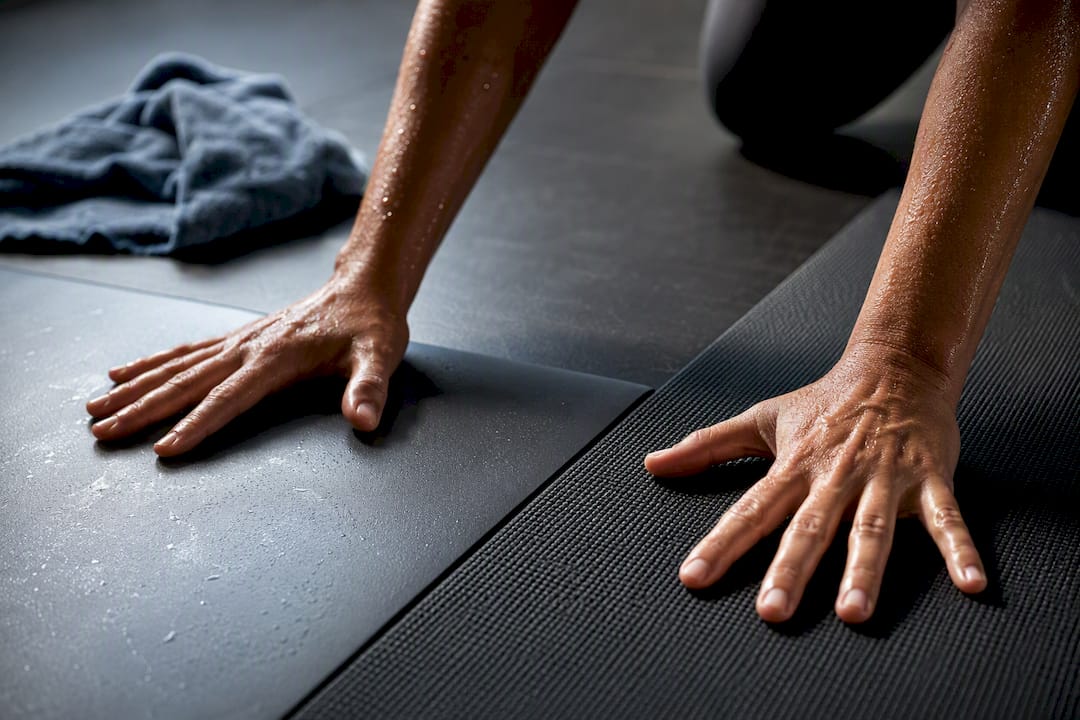
PU surfaces are moisture-activated. As you start to sweat, the surface often becomes tackier rather than slicker, which is why PU-topped mats show up so often in hot yoga recommendations. Natural rubber depends more on its molded texture, small ridges or a matte finish that physically interrupt slide, and that texture works whether the mat is dry or damp, though very heavy sweating can eventually overwhelm it.
Floor-side grip is a separate concern. Natural rubber’s density and tackiness generally keep it planted on hardwood or studio flooring, while lighter PU-foam hybrids can creep on smoother surfaces if the underside lacks its own texture or rubber backing.
A few practical steps help either material perform closer to its potential:
- Break in a new mat with a few light sessions before a sweaty class, since some surface finishes need light wear to reach full grip.
- Keep a small towel nearby for hot sessions, laid directly on the mat if sweat starts pooling rather than absorbing into the surface.
- Wipe down before class, not just after, since dust and skin oils on a “clean” mat can reduce grip on the first few minutes of practice.
Pro Tip: If a new mat feels slippery out of the box, a light rinse with water and a mild soap before first use often removes the manufacturing residue that dulls initial grip.
What fails first and how to make either mat last
Most yoga mats do not die of one dramatic failure. They wear down through a few predictable mechanisms, and knowing which one applies to your mat tells you what to watch for.
- Surface abrasion wears down PU coatings first, showing up as a dulled, less tacky top layer, especially at high-contact spots like hand and foot placement zones.
- Compression set flattens foam or rubber overtime, leaving permanent indentations where knees and palms press most often.
- Lamination failure peels layered mats apart at the edges or corners, usually starting small and spreading with continued rolling and flexing.
- UV and heat aging dries out and stiffens natural rubber, which is why storing a rubber mat near a sunny window accelerates cracking.
Cleaning routines differ by material. PU surfaces generally do best with a damp cloth and a small amount of mild, non-oil cleaner, since oil-based or harsh solvent cleaners can break down the coating and leave it sticky or cloudy. Natural rubber tolerates water-based cleaning well but should be dried fully before rolling, since trapped moisture can encourage mildew inside the roll. Storage matters just as much as cleaning: keep either mat rolled loosely rather than folded to avoid permanent creases, store it away from direct sunlight and heat sources, and give it time to air out after sweaty sessions rather than rolling it up immediately.
Replace a mat when grip no longer returns after cleaning, when you see visible flaking or peeling at the surface, or when flattened areas no longer spring back after a few minutes of rest. For a closer look at how these wear patterns play out on a specific hybrid mat, this review balancing grip, comfort, and durability walks through real wear points.

Where the eco trade-offs actually stand
Natural rubber comes from a renewable source, the rubber tree, and is biodegradable under appropriate conditions, according to a review of bio-based polyurethane applications. Traditional PU, by contrast, is petrochemical-based and does not break down readily in the same way, and recycling or recovery options for PU remain limited at the consumer level.
Chemical recycling pathways for PU, including glycolysis and aminolysis, are technically viable on an industrial scale in some sectors, but consumer-product closed-loop recycling is still limited.
That gap between industrial capability and consumer reality is worth sitting with before buying a mat marketed as “recyclable.”
Bio-based PU formulations, made with vegetable oils or lignin instead of petrochemicals, have shown potential to reduce environmental impact in some life-cycle assessments, according to research on bio-based polyurethane materials, though results vary widely depending on feedstock, formulation, and manufacturing scale. This means a “bio-based PU” label is not automatically better than conventional PU, it depends on details most product pages do not disclose.
Chemical recovery methods for PU waste, such as glycolysis and hydrolysis, can reclaim polyols for reuse according to a review of environment-friendly polyurethane recycling, but these processes remain technically complex and are not yet widely available outside industrial settings. Until that changes, most PU mats headed for disposal end up in landfill rather than a recycling stream.
If you want to evaluate green claims on a mat you are considering, the FTC’s Green Guides are a useful check: they advise caution around vague biodegradability or recyclability claims and call for real substantiation, not just a green label on the packaging. A mat that says “eco-friendly” without specifics is making a claim, not a commitment. For a deeper look at how rubber’s sustainability profile plays out in practice, see this guide to natural rubber mat benefits.
A short checklist before you buy
Match the mat to how you actually practice, not to how you wish you practiced. A dedicated hot yoga student and someone doing gentle home stretches have different priorities even if they are shopping the same category.
- Sweat level first: heavy sweaters lean PU-surfaced, occasional or light sweaters can go either way.
- Latex sensitivity: natural rubber mats can trigger latex allergies in sensitive individuals, so check for latex-free labeling if this applies to you.
- Travel needs: if you carry your mat often, weight and foldability matter more than marginal grip differences.
- Maintenance appetite: PU surfaces need gentler cleaning products, while rubber tolerates water-based cleaning but needs full drying before storage.
Three questions to ask before purchasing: What is the listed density and thickness? Is the lamination method disclosed, and does the brand mention delamination testing? What specific end-of-life claim is made, and is it substantiated? Three red flags to walk away from: vague “eco-friendly” language with no material specifics, no stated thickness or density, and reviews mentioning a chemical smell that persists after airing out.
Pro Tip: Air out any new mat, PU or rubber, for 24 to 48 hours before first use to let manufacturing odors dissipate and to get an honest read on its natural scent.
How Yune Yoga approaches material selection
Nicholas, who covers yoga equipment and materials for Yune Yoga’s blog, put this guide together to help practitioners weigh sweat performance against sustainability rather than choosing on label alone. Yune Yoga’s own catalog reflects that same split: natural rubber mats for eco-focused practitioners and other constructions for those prioritizing grip under sweat, matched to the checklist above rather than to a single “best” material.
What you actually pay for in each material
Price differences between PU and natural rubber mats usually track construction complexity rather than the raw material itself. A single-layer rubber mat with a molded texture tends to sit in a more predictable price bracket because it involves one material and one manufacturing step. A PU-topped hybrid mat, by contrast, involves two layers, a bonding process, and often a foam or rubber core, which adds cost even before you account for the moisture-activated coating itself.
Value for money depends on matching spend to actual use. A frequent, sweaty practitioner gets more return from investing in a well-laminated PU-surfaced mat, since grip performance directly affects safety and comfort during practice. An occasional or home practitioner may find that a mid-range natural rubber mat delivers everything they need without paying for moisture-activated features they rarely stress-test. Foldable travel mats, whether PU or rubber-based, often carry a premium for the folding mechanism and lighter materials, a cost worth it only if you actually travel with your mat regularly. The cheapest option in either category is rarely the best value if it delamps or flattens within a year, since replacing a mat annually costs more over time than buying one durable mat up front.
Chemical exposure, allergens, and what to check before buying
Health considerations for yoga mats mostly come down to two questions: what the mat is made of, and how it smells when new. A noticeable chemical odor that persists well beyond the first few days of airing out is generally a sign to look more closely at the product’s material disclosure, since it can indicate lower-grade manufacturing or incomplete curing.
Natural rubber comes from latex, and practitioners with latex allergies or sensitivities should check labeling carefully or choose a mat explicitly marketed as latex-free. This is one of the more overlooked practical differences between the two materials, since PU-surfaced mats built on synthetic foam cores avoid latex exposure entirely.
PU surfaces are generally considered stable once cured, but they benefit from the same common-sense precaution as any manufactured textile product: airing out a new mat before extended use, and avoiding harsh cleaning chemicals that could degrade the surface and potentially release residue. Neither material has a documented safety advantage that rises to the level of a settled consensus, so the more practical move is reading a brand’s material disclosure and choosing based on your own sensitivities rather than assuming one category is inherently the healthier option.
Sizing and thickness options to expect
Standard yoga mats in both materials typically run in a similar thickness range, with thinner mats favored for stability-focused practices like Vinyasa or Ashtanga and thicker mats favored for restorative or joint-sensitive practice. Natural rubber mats tend to cluster toward the denser, firmer end of that range because the material itself provides structural support without needing extra foam padding. PU-topped mats vary more, since the base layer beneath the PU coating can be foam, rubber, or a hybrid blend, each producing a different thickness-to-support ratio.
Foldable travel mats, in either material, generally run thinner than standard studio mats to reduce bulk and weight for transport, trading some cushioning for portability. Standard mat lengths and widths are fairly consistent across both categories, so length is rarely the deciding factor. Thickness and the resulting feel underfoot are where the real differences between a PU and a rubber option show up, more than any dimension printed on the box. If you are choosing between a standard and foldable option, the comparison of eco-friendly and durable materials covers how that trade-off plays out for different practice styles.
What I’d actually tell a friend shopping for one
If sustainability is your main filter, natural rubber remains the more defensible choice on origin and biodegradability. If you sweat heavily and grip failure is your real fear, a well-laminated PU surface usually solves that problem better. Neither claim is absolute: a poorly made mat in either material disappoints, so read the construction details and care instructions before you buy, not just the marketing headline.
— Nicholas
Where Yune Yoga fits into this decision
If the checklist above points you toward natural rubber, Yune Yoga’s Natural Rubber Mats collection is built around the same renewable, biodegradable materials covered earlier, paired with the density and floor grip that grounded practices need. For practitioners who want that eco-conscious material without sacrificing portability, the Eco Mats and Foldable Yoga Mats lines apply the same sustainability priorities to a travel-ready format.

Every mat in these collections lists its thickness, density, and construction details up front, so you can apply the same three buying questions from the checklist section rather than taking a product description at its word. Browse the full yoga mat collections to compare specs side by side and find the material that matches how and where you actually practice.
Sources
- Assessment of Bio Based Polyurethanes: Perspective on Applications and Bio-Degradation
- Bio-Based Polyurethane Materials: Technical, Environmental, and Economic Insights
- Recent Advances in Environment-Friendly Polyurethanes from Polyols Recovered from the Recycling and Renewable Resources: A Review
- Environmental claims: summary of the FTC’s ‘Green Guides’
FAQ
What is the healthiest material for a yoga mat?
There is no single material proven to be the healthiest, since health considerations depend on individual sensitivities like latex allergies and how well a specific mat is manufactured. Natural rubber suits people without latex sensitivities who want a plant-based material, while PU-topped synthetic mats avoid latex exposure entirely.
What material should I avoid in a yoga mat?
Avoid natural rubber if you have a known latex allergy or sensitivity, since the material is latex-based and can trigger reactions. Also be cautious of any mat, PU or otherwise, that retains a strong chemical odor well beyond the first few days of airing out.
What is the best material for a yoga mat?
The best material depends on your practice: PU-surfaced mats tend to perform best for sweaty, hot yoga sessions because of moisture-activated grip, while natural rubber suits eco-focused or grounded practices that prioritize renewable materials and firm floor contact. Construction quality and lamination matter as much as the material itself.
What is the most recommended yoga mat material?
Recommendations vary by practice type rather than pointing to one universally best material. Practitioners focused on sweat performance are generally steered toward PU-topped mats, while those prioritizing sustainability and biodegradability are steered toward natural rubber.