

Yoga Mat Weight Limit: What Practitioners Need to Know
Yoga mat weight limit is defined as the maximum practitioner weight a mat can safely support without losing structural integrity or stability during practice. Most standard mats support 300–500 pounds safely, though that range shifts based on material density, construction quality, and mat thickness. Choosing a mat below your weight threshold is not just a comfort issue. It directly affects balance, joint protection, and how long the mat holds up over time. Understanding yoga mat weight capacity before you buy protects both your practice and your body.
What is yoga mat weight limit and what determines it?
Yoga mat weight limit is the load threshold a mat can handle before its structure degrades or its surface becomes unreliable underfoot. Three factors drive that threshold: material type, density, and construction quality.
Material type sets the foundation. Natural rubber mats are denser and more resilient than foam or TPE (thermoplastic elastomer) mats of the same thickness. That density translates directly into higher load capacity. A natural rubber mat at 4mm can outperform a foam mat at 6mm when it comes to supporting heavier practitioners.
Density is the factor most practitioners overlook. Weight is a reliable proxy for build consistency. A mat that feels lighter than expected for its thickness likely uses less dense material, which means reduced durability and lower effective weight capacity. This is why two mats with identical dimensions can perform very differently under load.
Construction quality covers how layers bond and how uniformly the material is distributed. Poorly bonded layers delaminate under repeated pressure. Uneven material distribution creates soft spots that compress unevenly, reducing stability exactly where you need it most.
Here is a quick breakdown of how material types compare on key structural factors:
| Material | Typical density | Weight capacity range | Best use case |
|---|---|---|---|
| Natural rubber | High | 300–500 lbs | Home practice, stability |
| TPE | Medium | 250–400 lbs | General practice |
| PVC foam | Low to medium | 200–350 lbs | Light use, budget mats |
| Extra-thick foam (8mm+) | Varies | Up to 330 lbs | Pilates, joint support |
Pro Tip: Pick up a mat before buying. If it feels surprisingly light for its size, the material density is likely lower than average. That lighter weight often signals a reduced load capacity and shorter lifespan.
Key structural factors that affect weight capacity:
- Material density (higher density equals higher capacity)
- Mat thickness (affects cushioning, not always capacity)
- Layer bonding quality (prevents delamination under load)
- Surface traction (affects safety independent of weight limit)
- Manufacturing consistency (uniform density across the mat surface)
How much weight can a typical yoga mat hold safely?
Standard yoga mats support 300–500 pounds under normal practice conditions. That range covers the vast majority of practitioners. The lower end of that range applies to thinner, lighter mats made from less dense materials. The upper end applies to natural rubber or high-density TPE mats built for durability.
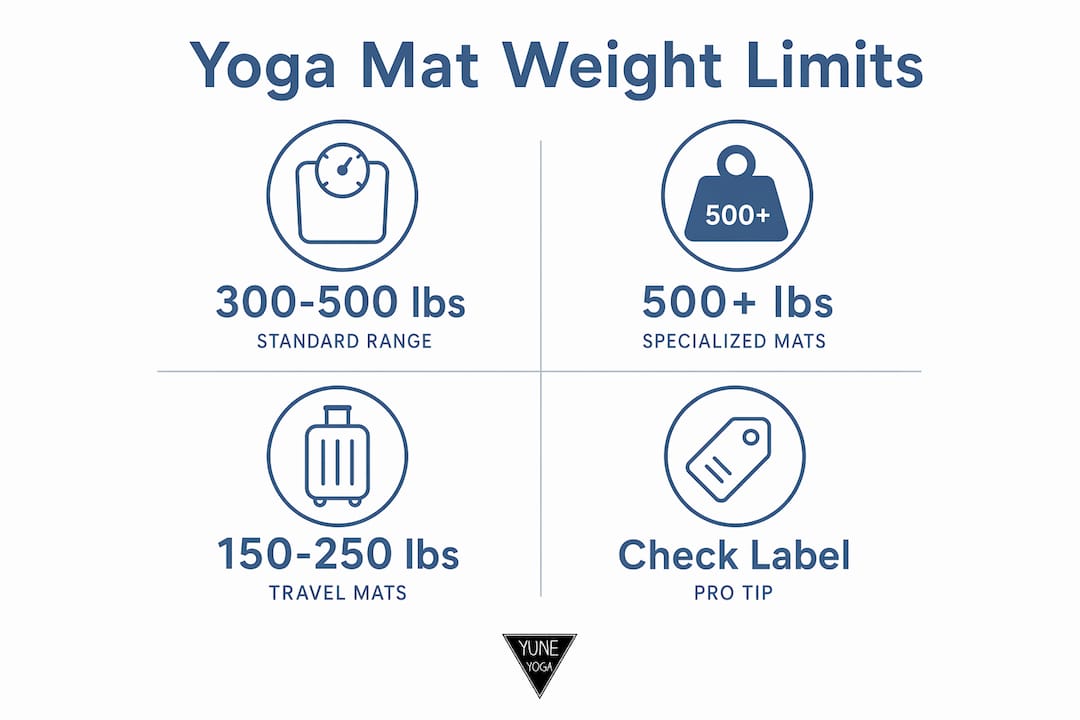
Specialized mats push those numbers further. Some extra-thick 8mm Pilates mats carry a manufacturer-tested weight capacity of 150 kg, which is approximately 330 pounds. That figure is manufacturer-verified, which matters because it gives practitioners a concrete, reliable number rather than a general estimate.
Travel mats sit at the other end of the spectrum. Lightweight travel mats weigh 0.5–1.2 kg and trade structural density for portability. That tradeoff means lower effective weight capacity. A travel mat is not the right choice for a heavier practitioner doing standing balance work or high-impact flows.
The gap between a standard mat and a travel mat is not just about physical weight. It reflects a real difference in how much load the mat can distribute across its surface. A denser mat spreads your body weight more evenly, reducing pressure points and preventing the mat from compressing unevenly under your feet.
Pro Tip: Always check the manufacturer’s listed weight capacity before purchasing. If no capacity is listed, treat the mat as suitable for average body weights only and contact the brand directly for clarification.
Does mat weight alone indicate quality or stability?
Mat weight does not equal stability. This is one of the most common misconceptions in mat selection. A heavier mat can reduce floor creep and feel more anchored during practice, but it does not fix slipping caused by poor surface traction. Those are two separate problems.
Stability in balance poses comes primarily from material density and ground feedback, not from how much the mat weighs. Dense mats provide firm footing even when thin. A thick but low-density mat feels soft and can actually destabilize you in standing poses because your foot sinks unevenly into the surface.
Thickness affects joint cushioning, not standing stability. A 6mm mat feels gentler on your knees in kneeling poses. That same thickness can create a wobbly base in Warrior III if the material is too soft. The sweet spot for most practitioners is a mat that is firm enough to feel the floor through it while still providing enough cushion for joint comfort.
What actually drives stability underfoot:
- Material density: Firm materials give consistent ground feedback.
- Surface texture: Open-cell or textured surfaces grip skin and prevent slipping.
- Mat thickness: Thicker is not always better. Firmness matters more.
- Floor grip: The underside texture determines whether the mat moves on the floor.
Pro Tip: Test stability by standing on one foot on the mat before committing to a full practice session. If your ankle wobbles more than usual, the mat is too soft for your weight or practice style.
Understanding the role of cushioning in yoga helps you separate comfort from stability. Both matter, but they come from different mat properties.
How to choose a yoga mat weight limit that fits your practice
Matching mat weight capacity to your body weight is the starting point, not the finish line. The right mat also depends on where you practice, how you practice, and how often you carry it.
Follow these steps to find the right fit:
- Identify your weight and add a margin. Choose a mat rated for at least 50 pounds above your body weight. That buffer accounts for dynamic movement, where impact forces exceed static body weight during jumps or fast transitions.
- Match the mat to your practice environment. Home practice allows heavier mats at 2.5 kg or more for maximum stability. Commuting practitioners do better with mats in the 1–2 kg range. Travel requires mats at 0.5–1.2 kg, accepting the tradeoff in density.
- Prioritize density over thickness. A 4mm natural rubber mat supports more weight reliably than a 6mm foam mat. Check material specs, not just thickness numbers.
- Verify manufacturer weight claims. Look for mats with published, tested weight capacities rather than vague durability language. Tested numbers are more reliable than marketing descriptions.
- Consider long-term durability. A mat used daily by a heavier practitioner compresses faster than one used twice a week. Higher-density mats hold their shape longer, which means the weight capacity stays consistent over time.
Pro Tip: If you practice dynamic yoga styles like vinyasa or power yoga, choose a mat rated toward the upper end of the 300–500 pound range. Fast movements create brief impact loads that exceed your static body weight.
The yoga practice surface you choose affects every aspect of your session, from grip to joint protection to how long the mat lasts. Weight capacity is one spec among several, but it is the one most practitioners skip when reading product descriptions.
Weight capacity is the spec most practitioners ignore
I have seen practitioners spend considerable time comparing mat colors and textures while completely skipping the weight capacity spec. That is a mistake I made myself early on. I bought a lightweight travel mat for daily home practice because it looked good and felt soft in the store. Within three months, the surface had compressed unevenly and my balance in standing poses had noticeably declined. The mat had not failed dramatically. It had just quietly degraded under load it was never built to handle.
The lesson was simple. A mat that does not match your weight creates a slow, invisible problem. You do not feel it fail. You just start to feel less stable, less supported, and more fatigued after practice. By the time you connect the mat to the problem, you have already lost months of quality practice.
What I tell practitioners now is this: treat weight capacity the same way you treat weight capacity on any piece of fitness equipment. You would not use a resistance band rated for 50 pounds to do 150-pound pulls. The same logic applies here. A mat rated for 250 pounds used daily by a 220-pound practitioner doing vigorous flows is operating at its limit constantly. It will degrade faster, grip less reliably, and ultimately put you at risk.
Balance matters too. The heaviest mat is not always the best mat. A 3 kg natural rubber mat is excellent for a dedicated home studio but impractical for anyone who carries their mat to class three times a week. The right answer is always the mat that meets your weight capacity needs within the constraints of your actual lifestyle.
— Nicholas
Yoga mats with verified weight capacity at Yuneyoga
Finding a mat with a published, tested weight capacity takes more effort than it should. Most product listings bury material specs or skip weight capacity entirely.

Yuneyoga carries a curated range of yoga mats and accessories built from natural rubber and eco-friendly materials, with detailed product specs so you can match the mat to your weight and practice style. Whether you need a high-density mat for daily home practice or a lighter option for travel, the product descriptions give you the material and construction details to make an informed choice. Browse the full selection at Yuneyoga to find a mat that supports your weight, your practice, and your long-term safety.
Key takeaways
Yoga mat weight capacity is the single most overlooked spec in mat selection, yet it directly determines stability, durability, and safety for every practitioner.
| Point | Details |
|---|---|
| Standard weight capacity range | Most mats safely support 300–500 lbs; choose one rated above your body weight. |
| Density beats thickness | Dense materials provide better stability and higher load capacity than thick but soft mats. |
| Weight as a quality signal | A mat lighter than expected for its size likely uses less dense, less durable material. |
| Match mat to environment | Home practice suits heavier mats; travel requires lighter mats with lower capacity. |
| Verify manufacturer claims | Look for tested, published weight capacities rather than general durability language. |
FAQ
What is the standard yoga mat weight limit?
Most standard yoga mats support between 300 and 500 pounds safely. The exact limit depends on material density, construction quality, and mat thickness.
Does a thicker yoga mat hold more weight?
Not necessarily. Thickness affects cushioning, but density determines load capacity. A thin, high-density natural rubber mat can support more weight than a thick, low-density foam mat.
Can a yoga mat break under too much weight?
A mat will not snap, but it will compress unevenly, lose surface grip, and degrade faster when used beyond its weight capacity. This reduces stability and increases injury risk over time.
How do I find the weight capacity of a yoga mat?
Check the manufacturer’s product page for a listed weight capacity. If none is published, contact the brand directly. Mats without listed capacities should be treated as suitable for average body weights only.
Are heavier yoga mats better for stability?
A heavier mat reduces floor creep but does not improve surface traction. Stability in balance poses comes from material density and surface texture, not from how much the mat weighs.


