Article: Yoga Mat Creases: 24–72 Hours to Flatten Folds, Unless Layers Split
Yoga Mat Creases: 24–72 Hours to Flatten Folds, Unless Layers Split
To prevent fold creases, we recommend rolling mats loosely for storage instead of folding them. If a crease has already set in, unroll the mat on a hard floor and weight the fold flat for 24 to 72 hours. Always clean and fully dry a mat before you put it away, since trapped moisture under a fold makes creases worse and invites mildew.
TL;DR:
- Store mats in a loose roll after drying them fully, away from heat, sunlight, and pressure; a breathable bag or shelf avoids compression.
- Flatten creases by unrolling the mat on a hard floor and applying even weight for 24 to 72 hours, checking progress daily.
- Avoid ironing, steaming, or forceful bending because heat can worsen creases or separate layers; reserve gentle warmth for rubber mats only.
- If an edge stays curled or layers separate, stop weighting the crease; the backing may have delaminated, and pressure will not restore the bond.
- Fold only mats with reinforced hinges along their marked seams; roll travel mats designed for rolling, and avoid packing pressure on hinge points.
Table of Contents
- Why mats crease: material memory and storage stress
- Rolling, tying, and storing a mat to avoid creases
- How to remove existing fold creases
- Material-specific tips for rubber, silicone, neoprene, vinyl, and fabric mats
- Travel and foldable mats: hinge-care best practices
- Maintenance routine to prevent repeat creases
- What Yune Yoga customers ask us about mat care
- Our take on crease prevention versus crease panic
- Crease-resistant mats and accessories worth considering
- FAQ
- Sources
Why mats crease: material memory and storage stress
A crease is not random damage. It is the mat’s material remembering a shape you forced onto it, usually a fold line where the top and backing layers bend in opposite directions. Repeated folding concentrates stress along the same hinge line every time, and over weeks that stress can set a permanent shape even after you try to flatten it out.
Layered mats are more vulnerable than single-material ones. A rubber or PU top bonded to a separate backing can delaminate at the fold point, where the two layers pull apart just enough to create edge curling that will not relax with weight alone. Once that separation happens, the crease is no longer just a memory line, it is a structural change.
Storage conditions decide how fast and how deep that memory sets:
- Constant pressure from a tightly rolled or folded mat pushed into a drawer or bag.
- Heat and direct sunlight, which soften some materials enough to let a fold “bake” into place.
- Humidity, which can swell certain backings and make them more prone to permanent creasing.
- A hard, uneven storage surface that presses a crease into one spot for months.
Pro Tip: Store mats somewhere temperature-stable, like a closet shelf, rather than a car trunk or sunlit windowsill, where heat accelerates creasing.
Rolling, tying, and storing a mat to avoid creases
Prevention is mostly about the habit you build every time you put the mat away, not a one-time fix.
- Lay the mat flat and roll it from one short edge, keeping the roll loose and even rather than cinched tight.
- Avoid rolling it into a small, tight diameter. A looser, wider roll spreads tension evenly instead of concentrating it at one point.
- Secure the roll with a loose strap or band, never a tight cord that bites into the surface.
- Store it in a breathable bag or upright on a shelf, not squashed under boxes or gear.
- Keep it away from direct sun, heaters, and radiators, and away from any spot where it gets pinched between shelf edges.
This same loose-roll approach lines up with guidance for other rolled materials: storage advice for biodegradable plastic mulch rolls recommends keeping rolls horizontal to reduce deformation risk, and discarding any outer layer that has already cracked from handling. The same logic applies to a mat: horizontal, unstressed storage beats anything that compresses or pinches the material.
If you are tight on space, a vertical rack works fine as long as the mat is not wedged in so tightly that it bends against neighboring mats. For shipping or travel packing, roll the mat before it goes into a bag or box rather than folding it to fit, since a fold introduced right before transit often sets faster under the pressure of a packed bag.
Pro Tip: If you store several mats together, rotate which one sits on the outside of the stack so no single mat takes on constant pressure from the others.
How to remove existing fold creases
Most creases are fixable with time, weight, and a hard surface, not with heat or force.
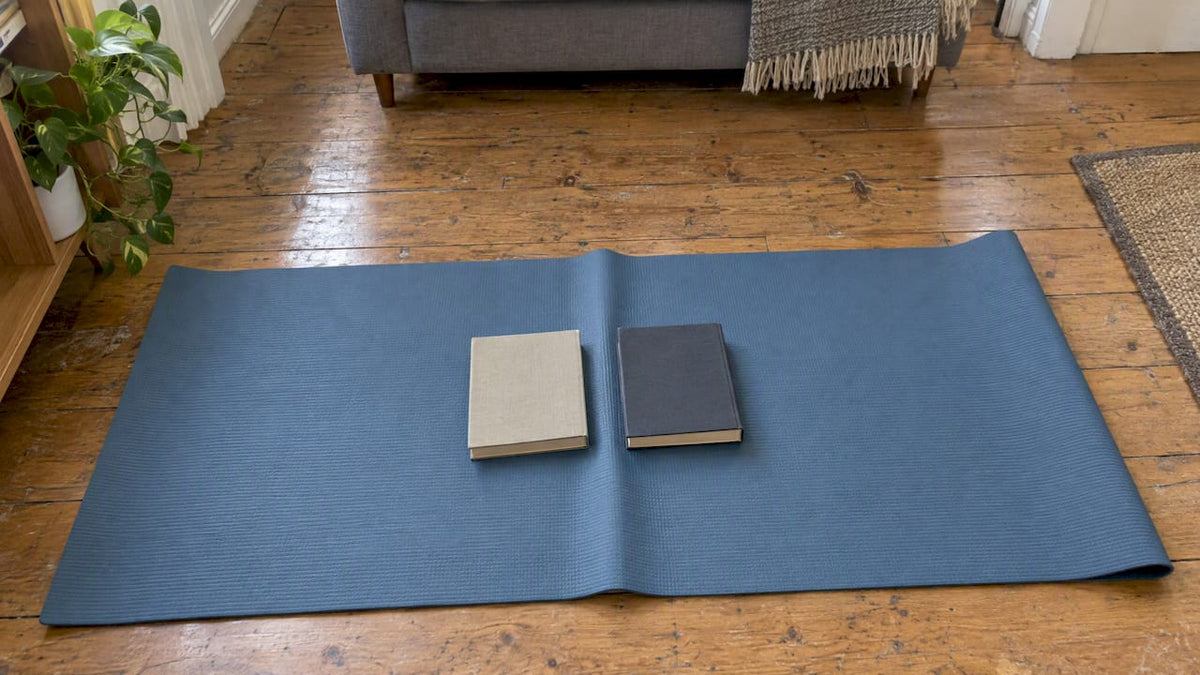
- Unroll or unfold the mat onto a hard floor immediately, smoothing the crease line by hand. Leave it flat for 24 to 72 hours before judging the result.
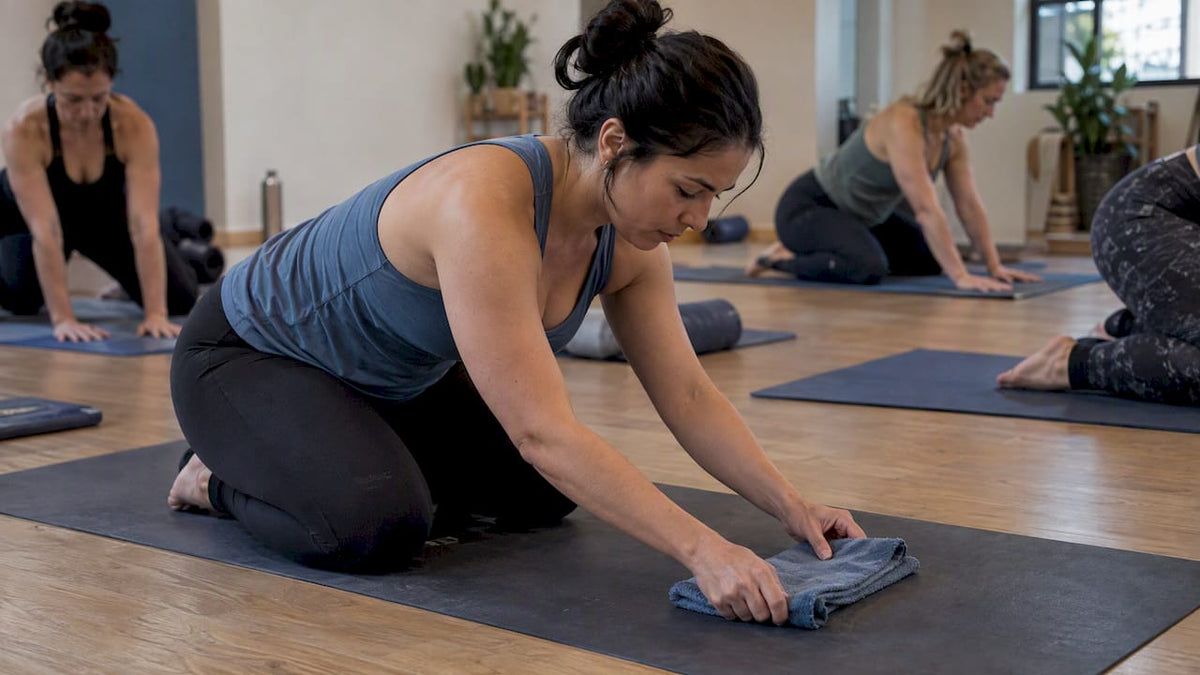
- For a stubborn line, lay a clean, slightly damp towel over the crease, then place an evenly distributed flat weight on top, such as stacked books or a flat board. Check it every 24 hours.
- Let the mat dry fully in the open air after any damp method. A mat put away even slightly damp risks trapped moisture and mildew.
A hard floor matters more than people expect. Pro Tip: Flatten creases on a hard floor rather than carpet, since carpet gives under the weight and does not press the fold flat the way a solid surface does.
Gentle heat, like a brief pass of warm (not hot) air from a safe distance, is sometimes used as a last resort on rubber-based mats, but it is material-dependent and unnecessary for most silicone or polymer mats, where weight and regular use work faster and more safely than heat ever does. Most mats relax and flatten within that first few days of unrolling and use, according to product-care observations from Studio Huske.
Watch for signs the crease is not temporary:
- The fold line shows visible separation between layers rather than just a bend.
- An edge stays curled or lifted no matter how long it sits flat under weight.
- The crease area feels thinner, stiffer, or different in texture from the rest of the mat.
If any of those show up, stop trying to flatten the mat. You are looking at structural wear, not surface memory, and further pressing will not reverse it.
Material-specific tips for rubber, silicone, neoprene, vinyl, and fabric mats
The right fix depends heavily on what the mat is made of.
- Natural rubber and TPE: Roll for storage, flatten creases with weight on a hard floor, and avoid concentrated heat or solvent-based cleaners that can dry out the surface.
- Silicone: Relaxes well with ordinary use and weight. Skip ironing or any direct heat, and avoid folding it the same way twice in a row.
- Neoprene and similar polymers: Improve gradually with regular use on a firm surface. Avoid harsh chemical cleaners, which can separate the layers over time.
- Vinyl or PU-layered mats: Treat edge curl as a caution sign rather than a quick fix. It often points to backing separation, which weight and time may not reverse.
- Fabric or linen placemats: Roll gently rather than folding sharply, or pad any necessary fold with tissue paper to soften the crease line.
Gym-flooring guidance for rubber materials backs up the role of correct sizing and installation in reducing long-term deformation, recommending a 24 to 48 hour settling period after installation before heavy use. The same patience applies at home: give a newly flattened mat time before rolling it back up for storage.
A layered mat with a separate backing is the one case where a crease can become permanent. Once the top and backing move independently at a fold line, no amount of weight fully restores the original bond.

Travel and foldable mats: hinge-care best practices
Foldable travel mats are built differently from standard rollable mats, and that difference changes how you should treat creases.
- Identify whether your mat is designed to fold (reinforced hinge lines) or simply designed to be rolled thin for travel. Folding a roll-only mat along sharp lines invites the exact damage this guide is trying to prevent.
- If the mat has true fold lines, fold along those manufacturer-marked seams only, and pad the hinge points with a cloth before compressing the mat into a bag.
- Avoid stacking heavy luggage directly on the folded hinge, and when you can, alternate which direction you fold occasionally so the same crease line is not reinforced every trip.
- When packing allows it, roll the mat instead of folding it, even a travel-specific design, since rolling puts far less concentrated stress on the material.
Foldable mats are the one category where some crease lines are expected and designed into the product. The goal with these is minimizing hinge stress over time, not eliminating the fold entirely.
Maintenance routine to prevent repeat creases
A mat that gets regular care rarely develops deep creases in the first place.
- Clean with mild soap and water, never harsh solvents, and let the mat air dry completely before rolling it for storage.
- Rotate how you roll or fold a mat over time instead of always compressing the same line, which spreads out stress rather than reinforcing one hinge point.
- Inspect periodically for delamination, backing separation, or an edge that will not lie flat. These are repair-or-replace signals, not storage problems.
- After long-term storage, unroll the mat, check for lingering creases or odor, and let it air out for a few hours before use.
Cleaning before storage does more than keep the mat looking good. A mat put away damp traps moisture under the roll, which can soften backing layers and make them more prone to permanent creasing. Our cleaning and maintenance guide and our drying techniques by material walk through safe methods for different mat types.
Pro Tip: Set a reminder to inspect your mat every few months, since catching early edge curl is far easier to manage than waiting until it spreads across the whole seam.
What Yune Yoga customers ask us about mat care
Shipping and packaging questions come up often, and most trace back to the same worry: a mat arrives rolled tightly for transit and customers wonder if that roll will leave a mark. It typically does not, since a brief transit roll is nothing like months of tight storage, but we always recommend unrolling a new mat right away and letting it rest flat for a day before first use.
Nicholas’s short takeaway after fielding these questions: weight, use, and time resolve almost every crease we hear about. A mat that gets rolled loosely, used regularly, and flattened under a book or two after unboxing settles into shape within days. For material-specific nuance, our yoga mat care guide and our materials breakdown cover the details by mat type.
Our take on crease prevention versus crease panic

The advice people repeat most often, iron it, steam it, bend it backward, is the advice most likely to make a crease worse. Heat and force treat a symptom instead of the cause, and on layered mats they can push a cosmetic line into actual delamination. The quieter fix, flat storage, a hard floor, and patience measured in days rather than minutes, works because it respects how the material actually behaves instead of fighting it.
The bigger blind spot is that most people never ask whether a crease is temporary memory or early structural wear. Those two problems look almost identical at first glance but call for opposite responses: one needs time and weight, the other needs you to stop pressing and start planning a replacement. If we had to prioritize one habit, it would be rolling loosely from the start. It is the cheapest, lowest-effort choice available, and it prevents the deep creases that no towel-and-weight method ever fully undoes.
— Nicholas
Crease-resistant mats and accessories worth considering
A mat that rolls easily instead of fighting you is the simplest long-term fix for creases, and that is exactly what we design for across our yoga mats lineup, including natural rubber constructions built to hold their shape through repeated rolling.
If you travel often, a foldable design with reinforced hinge lines handles compression far better than forcing a rollable mat into a suitcase, so match the mat to your actual habits rather than buying based on size alone. Pairing either style with a dedicated towel, like our Jagger Yoga Towel or Cassady Yoga Towel, adds a layer of protection between your mat and the floor, which cuts down on surface wear between cleanings. Browse our accessories collection to round out a setup built to stay crease-free for years of use.
FAQ
How do you get creases out of a rug that’s been folded?
Unroll or unfold the rug flat on a hard floor and let gravity and time work first, checking progress over 24 to 72 hours. For stubborn lines, place a damp towel over the crease with an even flat weight on top, then let the rug dry completely before using it again.
How to stop carpet corners from curling?
Keep corners weighted flat during the first few days after unrolling or installation, since early settling matters most. Avoid tight rolling for storage and keep the carpet away from heat sources that can bake a curl into the backing.
How to keep a yoga mat from curling?
Roll the mat loosely rather than folding it, and store it away from direct sun or heat, which can soften the backing enough to set a curl. If curling appears at an edge, weight it flat on a hard floor and check it daily, since persistent edge curl can signal backing separation rather than simple memory.
How can I flatten the curled edges of my rug?
Lay the rug flat on a hard floor and place a flat, even weight, like books or a board, directly on the curled section for 24 hours at a time, checking progress daily. If the curl persists after several days of weighting, the backing may have separated from the top layer, which weight alone cannot reverse.
How long does it take for a mat crease to disappear?
Most mats flatten noticeably within 24 to 72 hours of being unrolled and left flat under weight, with regular use speeding up the process further. A crease that has not improved after a week of consistent flattening likely points to material fatigue rather than simple memory.
Sources
- Play mat creases and curling edges — Studio Huske
- Perfect rubber mats gym flooring to upgrade
- Storing soil-biodegradable plastic mulch on-farm — WSU