How to Attach a Yoga Mat to a Suitcase
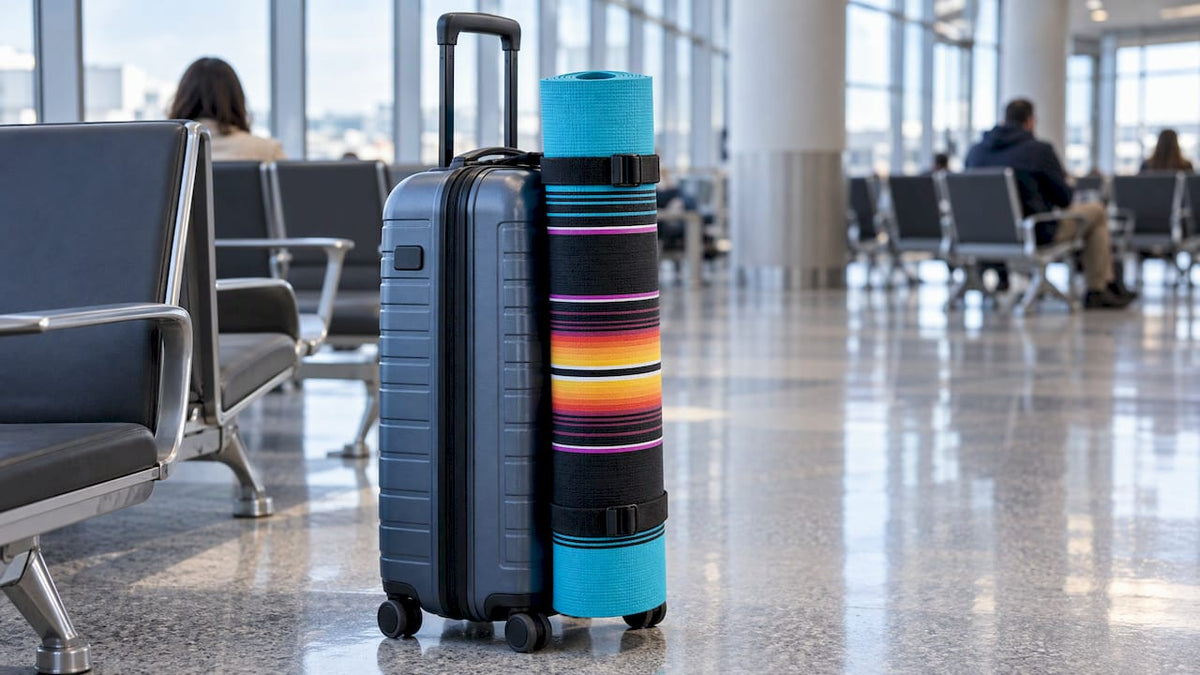
Roll the mat tight, close it with a strap at both ends, then lock the roll to the suitcase with two more straps or loops so it can’t slide, swing or snag. Do that and a standard mat rides on the outside of a roller bag from the curb to the gate. The even simpler route is a foldable travel mat that goes inside the suitcase and never needs attaching, which is why we make foldable travel mats for people who move around.
Below: the step-by-step method, the mistakes that make a mat fall off, what airlines allow, and when folding beats strapping.
TL;DR
- Roll the mat tightly and evenly first. A loose roll is what causes most slipping and unrolling.
- Use two straps on the roll itself, then at least two attachment points on the suitcase (handle plus a side or top grip).
- A mat strapped outside a bag is still baggage: airlines apply their size rules, and gate staff can ask you to check it.
- Folding a thin travel mat and packing it inside avoids every attachment problem.
- Check your airline’s published carry-on dimensions before each trip, because they differ between carriers.
Table of Contents
- What you need before you start
- Step by step: attaching a yoga mat to a suitcase
- Common mistakes that make a mat fall off
- Will an airline let you fly with it?
- When strapping isn’t the best idea
- Other ways to carry a mat with your luggage
- Choosing a mat built for travel
- A travel mat that doesn’t need attaching
- Our view: the best way to attach a mat is to not need to
- FAQ
- Sources
What you need before you start
You don’t need special gear. You need three things: something that closes the roll, something that fastens the roll to the bag, and a bag with a place to fasten to.
- A mat strap or two. A yoga strap with a buckle or cinch loop works well for closing the roll. Our yoga straps are made from durable, sustainable materials and double as your stretching strap on the mat.
- Fasteners for the suitcase. Wide hook-and-loop cinch straps, a luggage strap with a buckle, or a stretchy loop that slides over the handle. A carabiner is fine for a light mat, but it shouldn’t be the only fastener.
- A suitcase with anchor points. The telescoping handle, a side grab handle, or external compression straps. Many soft-sided bags and travel backpacks have compression straps or attachment loops designed to hold larger items like a mat, as Pacsafe’s travel blog notes.
Which suitcase is best? A larger roller bag gives the mat the most stable perch. A small carry-on is harder, because the mat can overhang the case and push it past size limits.
Step by step: attaching a yoga mat to a suitcase
1. Roll the mat tightly
Start at one short end and roll firmly, pressing out air as you go and keeping the edges lined up. A loose, wobbly roll is the root of almost every carrying problem: it sags in the middle, slides out of the straps and ends up unrolling in the airport.
Which side goes inside? Rolling with the practice surface inside keeps the side you stand on away from floors and bag exteriors. If your mat’s ends curl upward, roll it the other way so the curl presses down instead of lifting.
2. Close the roll with a strap at each end
Slide a strap or loop over each end of the roll, about a hand’s width in from the edge. Pull it snug so the loop grips the mat instead of just resting on it. Use equal tension on both ends. You want the mat held firmly, not crushed out of shape.
Quick test: lift the roll by one strap and tilt it. If the mat slips, tighten or re-roll. Thirty seconds at home beats a mat rolling across a terminal.
3. Choose where it sits on the suitcase
The best spot is flat against the back or side of the bag, parallel to the handle. That keeps the mat from catching on doors, seats and conveyor belts. Avoid dangling it off the bottom, where it drags, or across the wheels.
- Along the telescoping handle: good for a roller bag you’ll pull upright. The mat rides against the handle housing.
- Along the top or side: good if the bag has a grab handle or external straps.
- On the front pocket or panel: works on soft bags with compression straps.
4. Fasten the roll at two points, minimum
Run a luggage strap or cinch strap around the mat and the suitcase handle or frame, near the top. Run a second one near the bottom of the mat, around the mat and a solid part of the bag. Two attachments stop the roll from pivoting. One fastener turns the mat into a pendulum.

Crisscrossing a stretchy loop over the handle is a fast option too, but treat it as a helper for a short walk, not the only line of defense on a long trip.
5. Trim the loose ends
Tuck in the tails of straps, or wrap them back around themselves. Dangling strap ends snag on conveyors, escalators and other luggage. Close any buckles flat against the mat.
6. Do the tug test
Pick the suitcase up by the handle, tilt it, and wheel it over a threshold. If the mat shifts, add tension or a third strap. Then check it again after the first long walk, because soft mats compress and straps can loosen slightly.
Common mistakes that make a mat fall off
| Mistake | What happens | Fix |
|---|---|---|
| Loose roll | Mat slides inside the straps or unrolls | Re-roll tight, press out air |
| One strap only | Mat pivots and swings | Use two closures and two attachment points |
| Straps placed at the very ends | Edges flare out | Move straps about a hand’s width in |
| Long strap tails | Snag on conveyors and doors | Tuck or wrap tails |
| Mat on the wheel side | Drags and wears | Place it along the back or side |
| Overstuffed bag with a mat on top | Straps loosen as the bag shifts | Pack the bag first, then attach the mat |
Loose straps can snag and an unsecured mat can scrape other luggage, so the fastening matters for the people around you too.
Will an airline let you fly with it?
This is where attaching a mat to a suitcase gets tricky. Once the mat is strapped on, the airline may treat the combined bag as one item. If the whole package grows past the size limit, it can be sent to the hold.
The published limits differ slightly by carrier:
- United’s carry-on page lists a carry-on at 9 x 14 x 22 inches including handles and wheels, and a personal item at 9 x 10 x 17 inches that fits under the seat. Anything beyond that, or oversized, must be checked and may cost a fee.
- American Airlines’ Basic Economy guidance lists a personal item of 18 x 14 x 8 inches and a carry-on of 22 x 14 x 9 inches.
- USA Today’s July 2026 guide reports 22 x 14 x 9 inches as the standard maximum on most major US airlines, with Southwest allowing 24 x 16 x 10 inches, and advises confirming with your airline before each trip.
In plain terms: a rolled mat strapped to the outside of a 22-inch carry-on usually adds width and depth. If the case already sits at the limit, the mat pushes it over. Measure the whole package, handles and wheels included, before you leave. Airline rules change, so use the airline’s own baggage page for the current numbers.
Security is a separate question. TSA permits yoga mats in carry-on and checked bags, but the officer at the checkpoint has the final say and a rolled mat may get a closer look. We cover this in detail in our guides on TSA rules for yoga mats and carry-on yoga mats and airline size limits. Keep the strap easy to undo, so you can unroll or lift the mat quickly at screening.
Checked bag or carry-on?
If the mat is strapped outside a bag you check, protect it. Wrap it in a thin cover or a mat bag so zippers, belts and other bags don’t scuff it, and tuck the straps in so they can’t catch. Outside attachments on checked bags are more exposed than anything inside the case, so for a long trip, consider packing inside.
When strapping isn’t the best idea
A strapped mat has real costs. It adds bulk to your luggage, it can get snagged in transit, and a separate mat is easy to leave behind in an overhead bin. One yoga teacher who writes about travel props suggests asking whether you could run to make a connecting flight with your setup. If the answer is no, simplify.
The simplest way is to fold the mat and pack it. The same teacher’s guide says a standard 68" x 24" mat can be folded down to about 17" x 12" if it is no more than 4mm thick, small enough for a checked bag or a carry-on suitcase (her guide). For thicker mats, Travel + Leisure’s testing notes that you can roll the mat tightly, strap it, and place it inside a backpack, carry-on or checked bag, using a compression strap for very thick ones.

Our own step-by-step is in how to fold a yoga mat for travel and storage.
Pack it inside: a quick routine
- Fold the mat along its crease lines, or roll tightly if it’s a standard mat.
- Lay the mat flat against the back panel of the suitcase, the side that sits against your body when upright, so it forms a rigid layer.
- Pack shoes and heavy items on the wheel side, soft clothes around the mat.
- Add a strap around the folded mat to keep it from opening up as you pack.
A foldable mat is designed for exactly this. Nothing hangs off your bag, nothing gets caught, and the gate agent sees a normal suitcase.
Other ways to carry a mat with your luggage
Sometimes the suitcase isn’t the right anchor. Options by type:
- A travel backpack with compression straps. The mat rides on the outside of a bag you carry on your shoulders, so it can’t drag or tip.
- A mat bag or sling. It carries the mat on your shoulder and leaves one hand free for the suitcase handle.
- Crossbody strap carry. A yoga strap looped over your shoulder with the mat hanging at your side.
- A belt, scarf or cord loop. If you forget a strap, a belt or scarf loop, or a cord loop clipped with a carabiner, does the job for a short walk.
When you get home, a canvas weekend bag that carried a damp mat can use a wash. This guide to cleaning a canvas weekend bag covers the basics.
Choosing a mat built for travel
If you fly or commute often, the mat you choose changes everything. A standard thick mat is bulky and usually needs the outside-strap approach. A foldable travel mat packs flat. Think about these when you shop:
- Folded size. Will it fit in the suitcase you already own?
- Weight. You’ll carry it through airports, so every ounce counts.
- Grip. A mat that shifts on a hotel floor is no good, whatever its size.
- Materials. Natural rubber and other eco-conscious materials suit people who care what their gear is made of.
Our Trekk line is built around this idea: the Sagittarius Trekk Travel Yoga Mat, the Horatio Trekk Travel Yoga Mat and the SB51 Trekk Travel Yoga Mat. For a side-by-side look at how folding styles compare, see our roundup of the top foldable yoga mats for storage and travel.
We also wrote about avoiding trouble at the gate with a foldable or under 2mm mat.
A travel mat that doesn’t need attaching
If you’re tired of strapping, our foldable travel mats are made for people who practice at home and on the road. They come in natural rubber and eco-friendly options, with unique designs, and they fold to fit in a suitcase. Add a durable yoga strap and a yoga towel from the same store and you have a complete travel kit.

Browse the foldable yoga mats collection, or see the full range of mats, towels and straps on yuneyoga.com.
Our view: the best way to attach a mat is to not need to
We get why people search for this. You own a good mat, you love it, and you don’t want to leave it behind. Strapping it to a suitcase is a fair answer, and the steps above work.
But we design with travel in mind. A mat that folds and packs inside your bag means no straps to tighten, no handle to wrestle with at the gate, and no mat left in an overhead bin. It also means your suitcase looks like a suitcase, which keeps size rules simple.
We build mats from natural rubber and eco-friendly materials because we think the gear you carry should feel good to use and good to own. Add a strap and a towel made from durable, sustainable materials, and you have a practice that fits in the same bag as your clothes.
Whichever way you carry your mat, roll or fold it with care. A good habit before every trip is worth more than any gadget.
Nicholas
FAQ
Can I attach a yoga mat to my suitcase on a plane?
Yes, in most cases. TSA permits yoga mats in both carry-on and checked bags, but the airline sets size limits for the bag. Measure the suitcase with the mat on it, and check your airline’s baggage page before you travel.
What’s the best strap for carrying a yoga mat on luggage?
A wide strap with a buckle or cinch closure holds a roll best, with one at each end of the mat. Then add a luggage strap or loop to fasten the roll to the handle. Use at least two attachment points so the mat can’t swing.
How do I stop my yoga mat from unrolling?
Roll it tighter and more evenly, keeping the edges aligned, and press out air as you go. Place straps about a hand’s width in from each end and pull them snug. Lift the roll by one strap to check that it holds.
Is it better to fold a yoga mat than to attach it?
For travel, usually. A folded mat packs inside your suitcase, so there is nothing to snag, nothing to forget and no change to your bag’s size. A foldable travel mat is made for that, and our guide to folding a mat shows how.
Sources
- Pacsafe travel blog: 5 backpack hacks for travel
- United Airlines: Carry-on bags
- American Airlines: Basic Economy agency reference guide
- USA Today: Carry-on or checked luggage? Airline rules and tips
- Travel + Leisure: The 8 best travel yoga mats
- Joanna Dunn: Best yoga props for travel
- The Pair: Cleaning a canvas weekend bag