
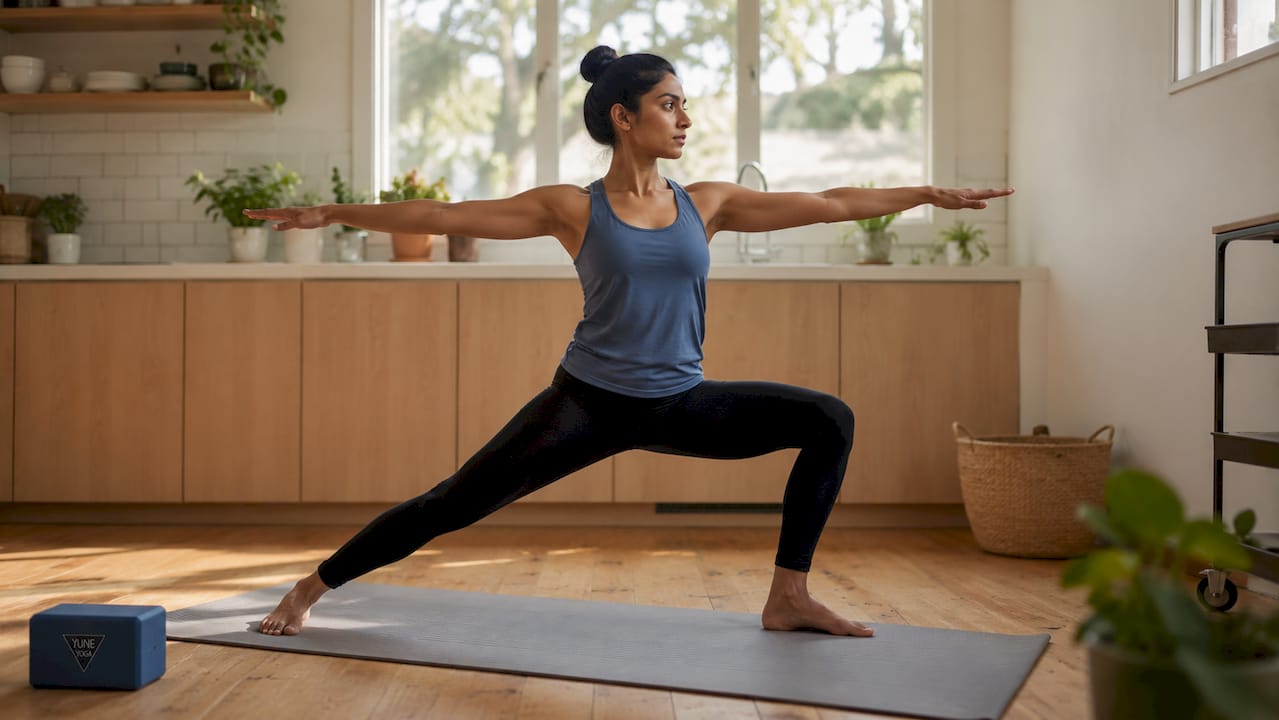
Yoga Poses for Small Spaces: Your Apartment Guide
Yoga poses for small spaces are sequences adapted to deliver full-body benefits within the footprint of a single mat, making them the most practical fitness option for apartment dwellers. You do not need a dedicated studio, a spare bedroom, or even a cleared living room. The minimum viable practice zone is one mat length by one mat width plus enough overhead clearance for a full arm extension. That standard applies whether you live in a 400-square-foot studio or a cramped city bedroom. With the right poses and a smart setup, a consistent yoga practice fits any home.
What yoga poses small spaces actually require to get started
The single biggest barrier to yoga for limited space is not the space itself. It is the belief that more room is needed before starting.
The minimum space requirement for a functional yoga practice is one mat length by one mat width, plus enough overhead clearance for your arms to extend fully above your head. A standard mat runs approximately 68 inches long and 24 inches wide. That is a footprint smaller than most apartment hallways.
When floor space drops below even that, wall support and seated sequences fill the gap. A wall substitutes for a balance partner in Tree Pose and replaces the need for wide lateral steps in Warrior variations. Chair yoga and bed-based sequences require near-zero floor space and still deliver real mobility work.
Setting up your environment matters as much as choosing the right poses. A few specific adjustments make the difference between a practice you do daily and one you skip:
- Clear a dedicated zone. Push one piece of furniture aside and identify your mat’s permanent position, even if it overlaps with your living area.
- Store your mat vertically. Storing your mat behind a door rather than under the bed keeps it visible and accessible, which directly supports daily use.
- Eliminate cable hazards. Loose phone chargers and power strips on the floor create real safety risks during standing poses.
- Use household props. Books replace yoga blocks, a belt or scarf substitutes for a strap, and a folded duvet works as a bolster. Household items substitute for standard props with full functional equivalence, so you need no dedicated storage for equipment.
Pro Tip: Roll your mat out the night before and leave it in place. Seeing it first thing in the morning removes the decision to set up, which is the most common reason people skip a session.
Which standing poses work best in tight spaces?
Standing poses are where most apartment practitioners run into trouble. Wide-legged stances, sweeping arm movements, and lateral lunges all demand more room than a small apartment offers. The solution is not to avoid standing poses. It is to select and modify them deliberately.
These six standing poses fit within a single mat footprint and deliver strong results for balance, strength, and flexibility:
- Mountain Pose (Tadasana). The foundation of all standing work. Feet together or hip-width apart, arms at your sides. This pose builds postural awareness and requires zero lateral space.
- Chair Pose (Utkatasana). Feet together, knees bent, arms raised. The vertical arm line keeps the pose compact. Hold for five breaths to build leg strength.
- Tree Pose (Vrksasana). One foot pressed to the inner calf or thigh, hands at heart center or raised. Use a wall for balance if needed. This pose fits entirely within your mat’s width.
- Eagle Pose (Garudasana). Arms and legs wrapped around each other. Eagle is one of the most space-efficient standing poses in yoga because every limb folds inward rather than extending outward.
- Crescent Moon (Anjaneyasana variation). A low lunge with arms raised straight overhead. Keep the back knee on the mat to reduce the forward stride length when space is short.
- Triangle Pose (Trikonasana). Shorten your stance by 30–40% compared to a full studio version. The alignment benefit comes from the lateral torso stretch, not the foot distance.
Alignment over intensity is the core principle for yoga in tight spaces. Dr. Goldfarb at Cleveland Clinic identifies maintaining safe joint positioning, such as ears over shoulders, as the primary goal of home yoga practice. Reducing range of motion to fit your space does not reduce the benefit. It redirects your focus to breath and form, which is where real progress happens.
Pro Tip: Face a wall during standing balance poses. The visual reference point improves stability more than gripping furniture, and it keeps your gaze fixed rather than wandering.
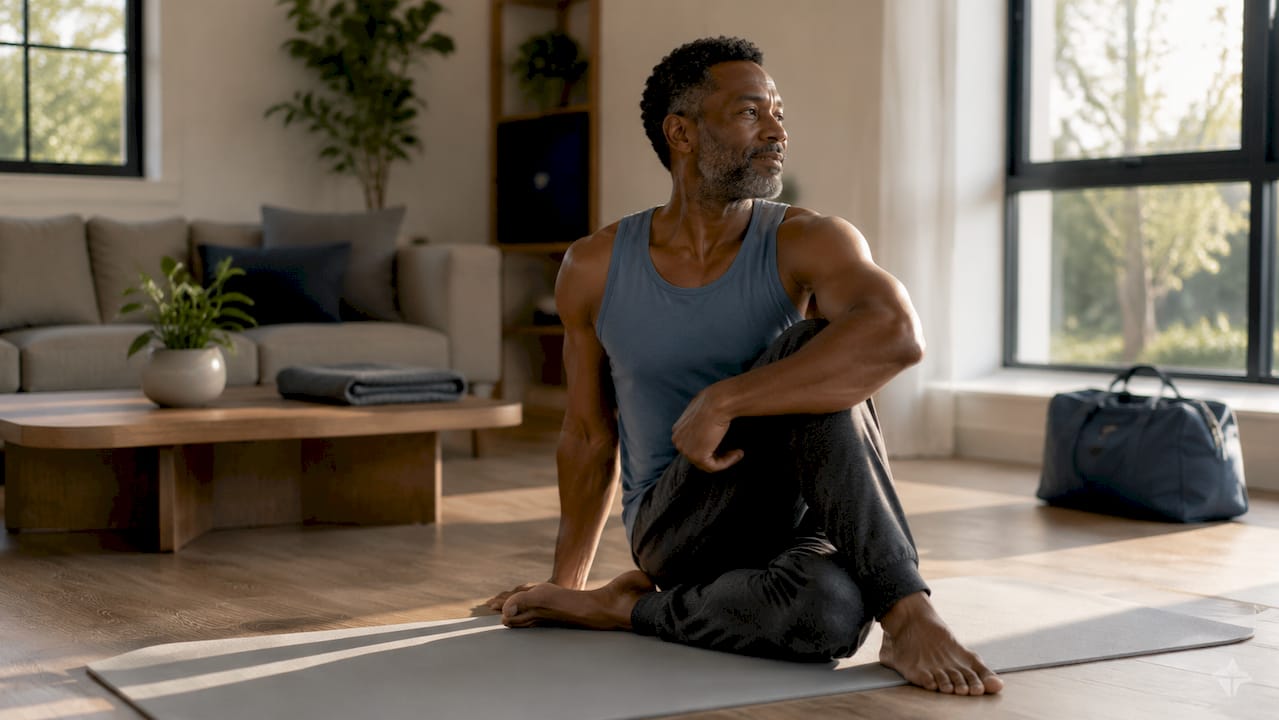
What are the best seated and floor-based poses for very limited floor space?
Seated and floor-based yoga stretches for small areas are not a compromise. They are a complete practice category with their own benefits, and they often engage muscle groups and breath awareness that standing flows skip entirely.
No-standing yoga sessions deliver full-body mobility and stress relief in 10–15 minutes. Yoga Journal documents that these sequences require near-zero floor space and produce measurable results for flexibility and tension release. That makes them the most practical option for practitioners with extremely tight apartments or physical limitations.
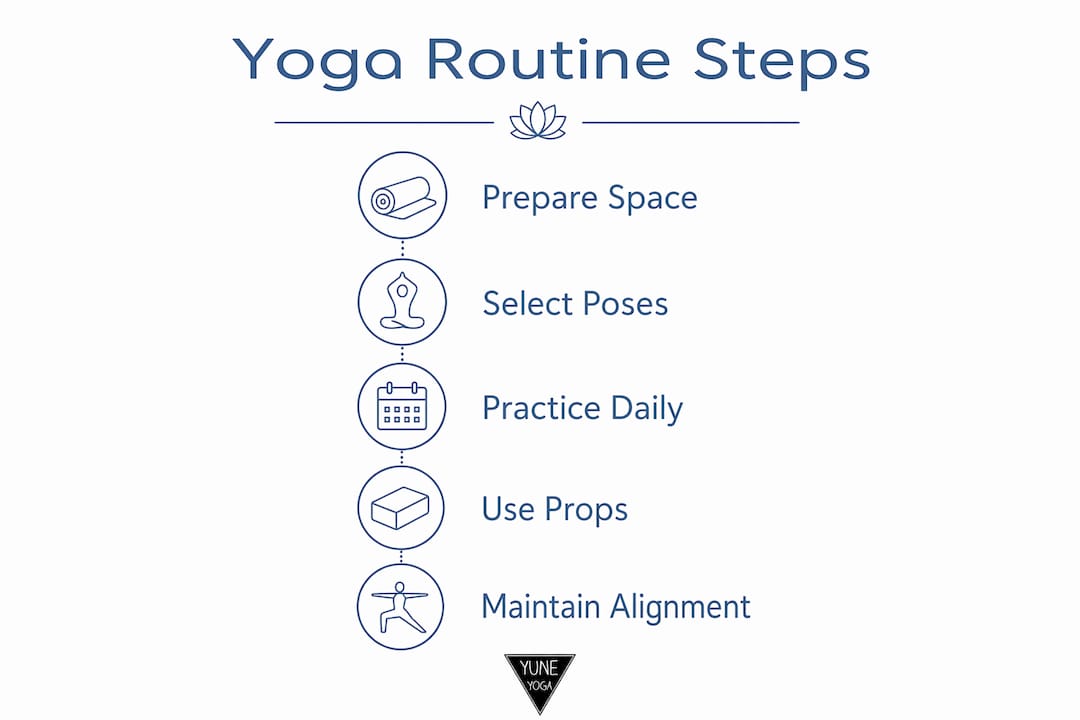
A functional 15-minute seated and floor sequence looks like this:
- Seated breathing (2 minutes). Sit cross-legged or in a chair. Inhale for four counts, exhale for six. This activates the parasympathetic nervous system and sets the tone for the session.
- Seated spinal twist (2 minutes each side). Sit tall, place one hand on the opposite knee, and rotate your torso. This pose fits entirely in a chair or on the mat with no lateral extension.
- Cat-Cow variation (3 minutes). On hands and knees, alternate between arching and rounding the spine. The entire pose stays within a 24-inch by 36-inch zone.
- Supine knee-to-chest (2 minutes). Lie on your back and draw both knees to your chest. This releases the lower back and requires only mat length, no width.
- Bridge Pose (Baddha Setu Bandhasana) (3 minutes). Feet flat on the mat, hips lifted. Bridge strengthens the glutes and opens the chest without any lateral movement.
- Savasana (3 minutes). Lie flat and breathe. This is not optional. It consolidates the session’s physical and neurological benefits.
Bed-based yoga is a legitimate option when floor space is genuinely zero. A firm mattress supports seated twists, supine stretches, and even modified Cat-Cow. Yoga instructors Kassandra and Laia Bové advocate accessibility-focused yoga as an intentional practice, not a lesser version of studio work.
Pro Tip: If you practice on a bed, place a folded blanket under your knees during Bridge Pose to compensate for mattress softness and protect your knee alignment.
How do you build a consistent yoga routine in a small apartment?
Consistency in compact yoga routines depends more on reducing friction than on motivation. Setup friction is the leading dropout factor in home yoga practice. A 30-second delay caused by moving furniture or untangling cables cuts practice consistency by 50%. That single finding reframes the entire problem. Your apartment does not need more space. It needs a smarter layout.
The concept of “usable practice mode” captures this well. Usable practice mode means your living area can transform into a practice zone in under two minutes. You do not need a permanent yoga room. You need a repeatable, frictionless transition.
These habits build that transition into your daily routine:
- Keep your mat rolled and vertical. Behind a door or leaning against a wall beats under the bed every time for accessibility.
- Use a compact yoga strap instead of blocks. A strap stores flat, weighs almost nothing, and replaces multiple props in seated and standing poses.
- Set a two-minute rule. If your space is not ready to practice in two minutes, simplify the setup further. Remove one more obstacle.
- Choose shorter sessions deliberately. A 15-minute practice done daily builds more strength and flexibility than a 60-minute session done once a week. Shorter sessions also require less mental commitment to start.
- Anchor your practice to an existing habit. Practice immediately after your morning coffee or before your evening shower. The existing habit carries the new one.
Alignment and manageable consistency matter more than space size or equipment. That principle, supported by Cleveland Clinic, is the most liberating insight for apartment practitioners. Your small space is not an obstacle. It is a constraint that sharpens your focus on what actually produces results.
Pro Tip: Choose a yoga practice surface that grips your floor type. A mat that slides on hardwood creates a safety hazard and breaks your concentration, which is the fastest way to end a session early.
Key Takeaways
Effective yoga in a small apartment requires one mat-sized floor zone, frictionless setup, and pose selections that prioritize alignment over range of motion.
| Point | Details |
|---|---|
| Minimum space is one mat | You need only one mat length by one mat width plus overhead arm clearance to practice fully. |
| Setup friction kills consistency | A 30-second setup delay cuts practice adherence by 50%, so store your mat visibly and accessibly. |
| Standing poses adapt easily | Eagle, Chair, Tree, and Mountain Pose all fit within a single mat footprint with no modification to benefit. |
| Seated practice is complete | A 10–15 minute seated or floor sequence delivers full-body mobility and stress relief without standing. |
| Alignment beats intensity | Focusing on joint safety and breath in a small space produces better long-term results than forcing wide ranges of motion. |
Why small spaces made me a better practitioner
The first time I practiced in a genuinely small apartment, I spent the first week frustrated. I kept bumping into the coffee table during Warrior II and shortening poses that felt like they needed more room to “count.” That frustration was the most useful thing that happened to my practice in years.
Constraints force precision. When you cannot take a wide stance, you learn what the pose actually requires. Eagle Pose taught me more about hip alignment in a 200-square-foot room than it ever did in a studio with 10 feet of clearance on each side. The limitation removed the option to compensate with space.
The mat size issue is real, though. I made the mistake of using a travel-sized mat for six months because it seemed practical. A full-sized mat is worth the slightly larger footprint. Restricted movement on an undersized mat creates discomfort that makes you want to stop, and stopping is the one outcome you are trying to avoid.
The deeper lesson is about acceptance. Practitioners who fight their space spend their sessions mentally rearranging furniture. Practitioners who accept the space and adapt their sequences spend their sessions actually practicing. The second group makes faster progress, feels better after each session, and shows up more consistently. Small space yoga is not a workaround. For many people, it is the practice that finally sticks.
— Nicholas
Gear that fits your space and supports your practice
Small-space yoga works best when your gear is as adaptable as your sequences. A mat that rolls up in seconds, a strap that stores flat, and a towel that doubles as a prop cover the full range of what most compact routines need.
Yuneyoga carries a curated selection of yoga mats and accessories built for exactly this kind of practice. The natural rubber and eco-friendly foldable travel mats store vertically without taking up floor space, and the yoga straps replace blocks and bolsters in a single slim package. If you want gear that supports a daily practice without cluttering a small apartment, the Yuneyoga store is the right place to start.
FAQ
Can you do yoga in a very small room?
Yes. The minimum space needed is one mat length by one mat width plus overhead arm clearance, which fits in most apartment bedrooms or hallways.
What yoga poses work best in tight spaces?
Eagle Pose, Chair Pose, Tree Pose, Mountain Pose, and seated twists all fit within a single mat footprint and deliver strong results for strength, balance, and flexibility.
How long should a small-space yoga session be?
A 10–15 minute session is enough to produce full-body mobility and stress relief, especially with seated or floor-based sequences. Daily short sessions outperform infrequent long ones.
Is seated yoga as effective as standing yoga?
Seated and floor-based yoga is a complete practice. Accessibility-focused sequences engage overlooked muscle groups and build breath awareness that standing flows often skip.
How do I stop skipping my home yoga practice?
Reduce setup friction by storing your mat visibly, clearing your practice zone in advance, and keeping sessions short enough to start without negotiating with yourself.


