Article: Yoga Philosophy Basics: A Beginner's Guide to the Ideas Behind the Poses
Yoga Philosophy Basics: A Beginner's Guide to the Ideas Behind the Poses
Yoga philosophy is the body of ideas that explains what yoga is for: steadying the mind, understanding yourself and living with care for others. Poses are one part of it. The rest is ethics, breath, attention and meditation, laid out most famously in Patañjali’s Yoga Sutras. You can learn the core in an afternoon and spend years living with it. Your mat is where it becomes practical, and at Yune Yoga we make natural rubber, eco-friendly and foldable travel mats, plus towels and straps, for exactly that daily practice at home or on the road.
TL;DR
- Yoga began as a discipline of mental training and spiritual inquiry, and in the U.S. it later shifted toward fitness. Philosophy puts the missing context back.
- The Yoga Sutras define yoga as the stilling of the mind’s fluctuations and lay out an eight-limb path: yamas, niyamas, posture, breath, sense withdrawal, concentration, meditation and absorption.
- Posture is one limb of eight. The ethical and inner limbs are what separate yoga from exercise.
- You can start small: one yama or niyama a week, a few minutes of breathing, five minutes of sitting.
- Read one commentated translation slowly, and learn advanced breathing from a qualified teacher.
Table of Contents
- What yoga philosophy actually is
- Where the ideas come from: four texts worth knowing
- The Yoga Sutras in plain English
- The eight limbs of yoga
- How the poses, breath and meditation connect
- Bringing it into a normal week
- What to read first
- Why your mat matters to all of this
- Our perspective
- FAQ
- Sources
What yoga philosophy actually is
Philosophy here does not mean abstract debate. It means a practical map: what troubles the mind, what a steady mind looks like, and which habits move you from one to the other.
The Harvard T.H. Chan School’s Nutrition Source notes that yoga began in India roughly 5,000 years ago as a practice for spiritual enlightenment and mental discipline. In the U.S., from the late 1800s onward, it grew to emphasize postures and breathing exercises more than meditation and spirituality. Both sides are real yoga history, and the philosophy is the side most classes mention only in passing.
The Indian Yoga Association describes yoga as one of the six orthodox Indian philosophies and says its ultimate goal is self-realization, called kaivalya. It calls physical and mental health natural by-products on the way rather than the final aim. That is a useful reframe if you came for flexibility: the benefits you notice are part of the path, not a detour from it.
If you want a longer companion read, our guide to the true meaning of yoga beyond the mat covers the same ground from the practitioner’s side.
Where the ideas come from: four texts worth knowing
You do not need to read all of them. Knowing what each one contributes makes everything else easier to place.
The St Andrews Encyclopaedia of Theology traces the lineage in a single entry on yoga:
| Text | Rough era | What it adds |
|---|---|---|
| Kaṭha Upaniṣad | Early Upanishadic period | The first definition of yoga: the steady restraint of the senses |
| Bhagavadgītā | Classical period | Yoga as skillful action in the world, not only withdrawal from it |
| Yogasūtra of Patañjali | c. 400 CE | The first codification: yoga as the stilling of the mind’s fluctuations, plus the eight-part path |
| Haṭhapradīpikā | Fifteenth century | A later emphasis on postures and breath control |
The Bhagavad Gita also divides practice into three paths, which a Philosophy 101 manual summarizes as karma yoga (selfless action), bhakti yoga (devotion) and jnana yoga (knowledge). Many modern classes draw on all three without naming them.
The posture-heavy yoga most Americans know comes mostly from the last row of that table and from twentieth-century teachers. A peer-reviewed article in Entangled Religions explains that B.K.S. Iyengar and K. Pattabhi Jois were both students of Tirumalai Krishnamacharya, and that both insisted yoga has an inner dimension beyond physical discipline. If you like timelines, our history of yoga from ancient origins to modern practice fills in the centuries between.
The Yoga Sutras in plain English
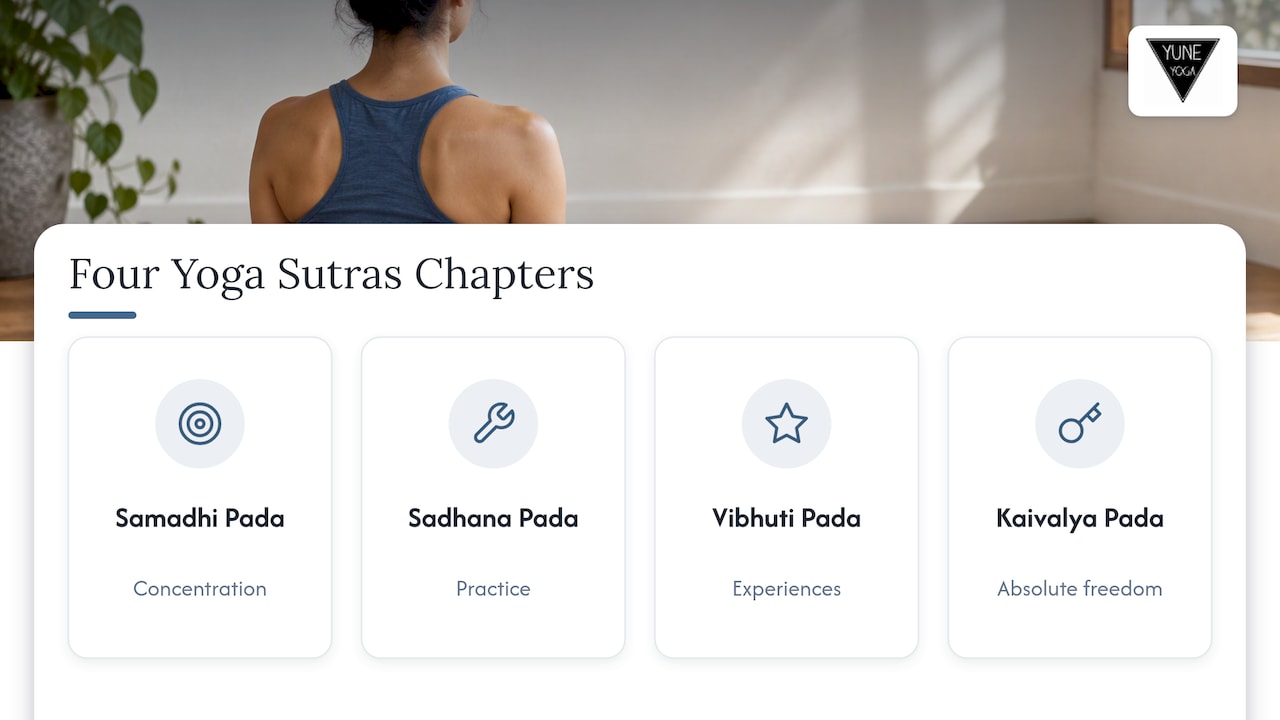
The Yoga Sutras are short, aphoristic verses, so each one is usually read with a commentary. According to the yogaeducation.org text on yoga literature, there are 196 sutras in four chapters: concentration (Samadhi Pada), practice (Sadhana Pada), experiences (Vibhuti Pada) and absolute freedom (Kaivalya Pada).
The central line is sutra 1.2, where yoga is defined as the stilling of the fluctuations of the mind. In everyday terms: your attention is constantly pulled around by thoughts, worries and reactions, and yoga is the training that lets it settle.
The same material summarizes three principles behind the text: suffering comes from faulty and limited perception, the peace we look for is our true identity hidden by ignorance, and peace comes from mastering the mind. You do not have to adopt every metaphysical claim to use the practical advice. Plenty of practitioners start with the mind-training and let the bigger questions come later.
A word you will meet often is prakṛti and puruṣa. In Patañjali’s system, a person is a combination of matter (prakṛti) and spirit (puruṣa), and practice is about discerning the difference. The Yoga Philosophy Fundamentals material that tops many searches adds that prakṛti is woven from three qualities, the guṇas, that keep shifting. You can come back to this once the eight limbs feel familiar.
The eight limbs of yoga
The eight-part path, called ashtanga (“eight limbs”), appears in the second chapter, sutras 2.26 to 2.29, as the means to clear mental impurities and develop discernment. The Internet Encyclopedia of Philosophy lists them as yamas, niyamas, āsana, prāṇāyāma, pratyāhāra, dharana, dhyana and samādhi. Here is what each means.
- Yamas (restraints). How you treat the world: non-violence, truthfulness, not stealing, celibacy (often read more broadly as moderation) and letting go of unnecessary possessions. The Sutras call these a “great vow” that applies regardless of class, place, time or circumstance.
- Niyamas (observances). How you treat yourself: cleanliness, contentment, discipline, self-study and devotion.
- Āsana (posture). Physical postures. The original sense was a steady, comfortable seat for meditation.
- Prāṇāyāma (breath control). Regulating the breath to settle the nervous system and steady attention.
- Pratyāhāra (sense withdrawal). Turning attention inward, away from the constant pull of stimuli.
- Dhāraṇā (concentration). Holding attention on one object.
- Dhyāna (meditation). Attention flowing without effort.
- Samādhi (absorption). The separate observer fades into the object of attention.
The last three are grouped as saṃyama, the inner practice, according to U of Yoga’s guide to the eight limbs. Notice the proportions. The St Andrews entry points out that posture gets only three sutras (2.46 to 2.48), and that the guidance there is brief: the posture should be steady and comfortable (sthira and sukha).
Plenty of modern teachers say the same thing in their own words. Iyengar wrote in Light on Yoga that postures without yama and niyama are mere acrobatics, and Jois wrote that sun salutations without breath, gaze and focus are little more than exercise.
Yamas and niyamas: the part beginners skip
These first two limbs are the most portable ideas in yoga because they need no equipment and no studio. A North Seattle College interview with an Iyengar-trained teacher describes them as morality and ethics toward our environment and ourselves. The teacher also says studying philosophy helps untangle the modern idea of yoga from the classical one.
The yama most people meet first is ahimsa, non-violence. On the mat it means not forcing a pose through pain. Off the mat it means thinking before you speak sharply, to yourself included. The niyama svadhyaya, self-study, means observing yourself closely during practice and in daily life.
How the poses, breath and meditation connect
It can seem odd that a path about the mind spends so long on bodies. The Entangled Religions article answers this: in modern postural yoga, the body is both the entry point and the place where the spiritual side is focused and expanded. Practitioners of posture-driven styles generally see the physical emphasis as including mental and spiritual growth, not blocking it.
The practical chain looks like this:
- A steady, comfortable posture means you are not distracted by strain.
- Slow breathing calms the nervous system and steadies attention. U of Yoga describes pranayama in these terms.
- With the body quiet and the breath even, concentration is easier to hold.
- Meditation cannot be forced. Lokayoga School’s guide says you can only build the conditions for it: consistency, a dedicated space and guidance.
Chanting is another thread. Mantras and aartis are part of the Vedic tradition that yoga grew out of, and some musicians now set them to modern beats, as in this piece on Vedic chant and electronic rhythm. If you are new to meditation, sound can give the mind something to rest on.
If you want a gentle place to begin on the physical side, try our guide to easy yoga poses for beginners.
Bringing it into a normal week
Philosophy only helps if it changes what you do on a Tuesday. The North Seattle College teacher puts it neatly: yoga is what stays with us once we leave the classroom.
Here is a starter week, adapted from U of Yoga’s beginner approach and Lokayoga School’s everyday examples:
- Pick one yama or niyama for the week. Ahimsa is a good first choice. Before a hard conversation, ask whether what you are about to say is both true and kind.
- Practice poses at about 70 percent effort. Let ahimsa set the limit instead of the deepest version of the shape.
- Add three minutes of breathing. Beginner options include three-part breath, ujjayi and alternate nostril breathing.
- End with stillness. A few minutes with your eyes closed is a first taste of pratyahara. Keeping your phone in another room for one meal works too.
- Sit for five minutes. For concentration, count ten breaths and start over without comment when you lose count.
- Reflect once a week. Three honest lines at night, or a longer review on Sunday, is svadhyaya in practice.
None of this needs a perfect routine. Yoga teacher Stephanie Mansour, writing for Today, describes using deep nasal breathing at her desk, at bedtime and on walks as a way to practice the limbs between classes.
A note on safety
Beginner breathing is gentle, but the stronger techniques are different. Yoga Nisarga’s faculty advise that pranayama with breath retention, bandhas and the cleansing practices of the Hatha Yoga Pradipika should be learned from a qualified teacher. They also say that anyone who is pregnant, has high blood pressure or has a medical condition should ask a doctor first.
What to read first
Start with the Yoga Sutras in an edition that includes commentary. Yoga Nisarga’s reading list suggests Swami Satchidananda’s translation or B.K.S. Iyengar’s Light on the Yoga Sutras of Patanjali, read slowly and compared across translations before you buy. Kupala Yoga’s resource page suggests a short introduction to Sāṃkhya philosophy first, and highlights Rutgers professor Edwin Bryant’s translation and commentary on the Sutras for the traditional meaning.
Then pair the classical text with something practical. One page of commentary and ten minutes of sitting teach more than a full evening of skimming.
Why your mat matters to all of this
Philosophy lives in repetition, and repetition needs a place. Lokayoga School’s point about a dedicated space is a quiet argument for a mat that is always ready: you unroll it, and the practice begins. If you travel, a foldable mat keeps the habit going when the routine does not.
Yune Yoga offers yoga mats, including natural rubber mats, eco mats, foldable travel mats and custom mats, along with yoga towels and straps. Our yoga clothes and accessories collection covers the rest of what you need to practice at home or on the move.

If you want to try a towel first, the Spruce yoga towel is one place to start, and the Aphrodite yoga mat is a studio, home and outdoor option.
Our perspective
We built Yune Yoga around a simple belief: the best yoga gear is the kind that makes you want to practice tomorrow as well.
The Sutras ask for a posture that is steady and comfortable. We take that line seriously when we design and choose mats, towels and straps. A mat should disappear under you so your attention can go where the tradition says it belongs: the breath, the body and the mind.
We also think sustainability and yoga belong together. Non-violence and letting go of unnecessary possessions are among the oldest ideas in the tradition, and choosing natural rubber and eco-conscious materials is our way of working in that spirit.
Philosophy is not homework. Pick one idea, practice it on your mat, then see where it shows up in your day.
Nicholas
FAQ
Do I have to be religious to practice yoga philosophy?
No. The Yoga Sutras use the language of the Indian tradition, but the practical guidance on ethics, breath, attention and self-study can be used by anyone. Many beginners start with the mind-training and explore the deeper questions later.
What is the difference between yoga philosophy and yoga as exercise?
Yoga philosophy is the full path, including ethics, breath, concentration and meditation. Exercise-focused yoga draws mainly on postures and breathing. As yoga.org’s FAQ puts it, asana is only one limb of an eight-limbed path.
What are the most important ideas to learn first?
Start with the definition of yoga as stilling the mind’s fluctuations, then the eight limbs, then the yamas and niyamas. These three give you a framework for everything else, and they translate easily into small daily habits.
Do I need a teacher?
You can begin with a book, a commentary and a few minutes of daily practice. For advanced breathing with retention, bandhas or cleansing practices, learn from a qualified teacher. If you are pregnant or have a medical condition, check with your doctor first.
Sources
- Yoga for Exercise, The Nutrition Source, Harvard T.H. Chan School of Public Health
- Indian Yoga Association concept note
- St Andrews Encyclopaedia of Theology, Yoga
- Internet Encyclopedia of Philosophy, Yoga Sutras of Patanjali
- Entangled Religions, Reclaiming the Spirit through the Body
- North Seattle College Continuing Education, The Philosophy of Yoga
- Yoga History, Literature and Philosophy
- Philosophy 101 manual
- The 8 Limbs of Yoga Explained, U of Yoga
- The 8 Limbs of Yoga, Lokayoga School
- Yoga is more than a fitness routine, Today
- Best Yoga Books, Yoga Nisarga
- Yoga education resources for going Beyond Asana, Kupala Yoga
- What is yoga? FAQ, yoga.org
- Yogic Beats: Vedic chant and electronic rhythm