

Mastering Mindfulness: A Guide to Easy Yoga Poses for Beginners
Starting yoga can feel a bit intimidating, right? So many poses, so much talk about alignment. It’s easy to feel like you’re not flexible enough or just plain lost. But honestly, it’s not that complicated. We’re going to look at some basic yoga poses for beginners, the kind that will get you moving without feeling like you’re in a competition. Think of it as dipping your toes in the water, not diving into the deep end. This guide is all about making your first yoga flow feel simple and doable.
Key Takeaways
- Start with simple yoga poses for beginners to build confidence and learn the basics.
- Focus on proper form and listen to your body to avoid injuries.
- Breathing is a big part of yoga; pay attention to your breath throughout your practice.
- Consistency is more important than how long you practice each time.
- Don't be afraid to ask for help from a qualified yoga teacher.
Understanding Foundational Yoga Poses for Beginners
Starting yoga can feel a bit like learning a new language, and the foundational poses are your first vocabulary words. These aren't just random stretches; they're the building blocks for everything else you'll do on the mat. Think of them as the sturdy base of a house – without a solid foundation, the rest of the structure is unstable. Mastering these basic yoga stances provides a stable base for more complex movements and prevents injuries.
Mountain Pose: Your Starting Point
Mountain Pose, or Tadasana, is where many yoga journeys begin. It might seem like just standing there, but it's actually a really active pose. You want to feel grounded, like your feet are really connected to the earth. This pose is all about finding your center and setting a stable foundation for everything else you'll do. It helps you stand taller and feel more aware of your body. It's the starting point for building better posture and a sense of calm.
Here's how to get into it:
- Stand with your feet together, or if that feels too tight, leave a little space between them.
- Distribute your weight evenly across both feet. Feel the four corners of your feet pressing down.
- Gently engage your thigh muscles and lengthen your spine upwards.
- Let your shoulders relax down away from your ears.
- Your arms can hang by your sides, palms facing forward or towards your body.
Downward-Facing Dog: A Full-Body Energizer
Downward-Facing Dog, or Adho Mukha Svanasana, is a pose that stretches and strengthens the entire body. It's a fantastic way to build heat and energy, and it's also a great pose for beginners to get a feel for inversions without being too intense. It helps to lengthen the spine and can relieve tension in the neck and shoulders. Plus, it's a pose you'll see in many yoga sequences, so getting comfortable with it early on is a good idea.
To get into Downward-Facing Dog:
- Start on your hands and knees, with your wrists directly under your shoulders and your knees directly under your hips.
- Tuck your toes under and lift your hips up and back, forming an inverted 'V' shape with your body.
- Press firmly through your hands, spreading your fingers wide.
- Let your head hang loosely between your arms, and try to lengthen your spine.
- You can keep a slight bend in your knees, especially if your hamstrings feel tight. The goal is a long spine, not necessarily straight legs.
Plank Pose: Building Core Strength
Plank Pose, or Phalakasana, is a powerful pose that builds strength in your core, arms, and shoulders. It’s a great way to prepare your body for more challenging poses and to develop stability. While it might look simple, holding a strong plank requires engagement throughout your body.
Here’s how to do it:
- Begin in a push-up position, with your hands directly under your shoulders.
- Extend your legs back, so your body forms a straight line from your head to your heels.
- Engage your abdominal muscles to prevent your hips from sagging.
- Keep your neck in a neutral position, looking slightly ahead of your hands.
These initial poses are more than just physical postures; they are tools for self-discovery. They help you understand your body's capabilities and limitations, fostering a connection between your mind and body that can extend far beyond your yoga practice. By focusing on these principles, you create a safe and effective practice that will serve you well as you explore more challenging sequences later on. Learning these basic yoga poses is a great way to start your yoga journey.
Cultivating Calm with Seated and Restorative Yoga Poses
After we've moved our bodies a bit, it's nice to find some poses that bring us closer to the ground. These seated and resting positions are really good for building a sense of calm and stability, and honestly, they're pretty easy for most people to get into. They give you a chance to really settle in and connect with your breath.
Easy Pose: Embracing Stillness
Easy Pose, or Sukhasana, is pretty much what it sounds like – an easy way to sit! It's a simple cross-legged position that's perfect for when you want to meditate, do some breathing exercises, or just take a moment to be present. It helps you find a comfortable, upright posture without a lot of fuss. The key here is to sit tall, lengthening your spine, and letting your shoulders relax away from your ears.
Here's a simple way to get into it:
- Start by sitting on the floor.
- Cross your legs comfortably, placing your feet under your opposite knees.
- Rest your hands on your knees, palms facing up or down, whatever feels best.
- Sit tall, lengthening your spine, and relax your shoulders away from your ears.
This pose is a great way to practice mindfulness and get your body and mind ready for deeper relaxation. It’s a gentle reminder that yoga isn't always about big movements; sometimes, it's about finding stillness.
Sometimes, the most profound progress in yoga comes not from pushing your limits, but from learning to be comfortable in stillness. Easy Pose invites this kind of quiet exploration.
Child's Pose: Finding Tranquility
After some movement, you need a moment to just be. That's where Child's Pose, or Balasana, comes in. It’s like a gentle hug for your body, especially your back. You kneel on the floor, bring your big toes to touch, and then let your knees spread a bit apart. From there, you fold forward, resting your forehead on the mat and letting your arms stretch out in front of you or rest alongside your body. It’s a pose that really lets you sink into yourself and just breathe. It’s a great way to reset and find some calm, and it’s perfect for anyone looking to ease back pain. You can even place a cushion under your forehead or between your hips and heels if that feels more comfortable.
Supported Poses for Deep Relaxation
Restorative yoga uses props like blankets, bolsters, and blocks to support your body in gentle poses for longer periods. The goal here isn't to stretch deeply, but to allow your body to relax completely and release tension. It's like giving your nervous system a much-needed break.
Here are a few restorative poses to try:
- Supported Child's Pose: Place a bolster or folded blankets between your thighs and chest, allowing your torso to rest fully. Your forehead can rest on the mat or a block.
- Legs-Up-the-Wall Pose (Viparita Karani): Sit with your side against a wall, then swing your legs up the wall as you lie back. This pose is amazing for circulation and calming the mind. You can place a blanket under your hips for extra comfort.
- Supported Bridge Pose: Lie on your back with knees bent and feet flat on the floor. Place a block or bolster under your sacrum (the bony part at the base of your spine). Let your body be supported by the prop.
Remember, the key to restorative yoga is comfort and support. Don't hesitate to adjust props until you feel completely at ease. It’s all about letting go and allowing your body to be held.
Mastering Key Poses for Strength and Flexibility
Alright, so you've gotten a feel for the basics, and now it's time to talk about some poses that really start to build that inner strength and help you open up. Don't let the simplicity fool you; these poses are powerhouses. They work your muscles in new ways and start to lengthen those tight spots.
Warrior Pose: Standing Tall
Warrior Pose, or Virabhadrasana, is a fantastic standing posture that builds strength in your legs and core while opening up your chest and shoulders. It's a pose that really makes you feel grounded and powerful. There are a few variations, but we'll focus on Warrior II (Virabhadrasana II) as a great starting point. It's excellent for building stamina and improving focus.
Here's how to get into Warrior II:
- Start in Mountain Pose, then step your feet wide apart, about three to four feet.
- Turn your right foot out 90 degrees and your left foot in slightly. Make sure your front heel lines up with the arch of your back foot.
- Inhale and raise your arms parallel to the floor, reaching out in opposite directions. Keep your gaze over your front fingertips.
- Exhale and bend your front knee so it's directly over your ankle. Aim for your thigh to be parallel to the floor, but don't push it if it's too much. Keep your torso upright.
- Hold for a few breaths, feeling the strength in your legs and the openness in your chest.
- Repeat on the other side.
Forward Fold: Releasing Tension
Forward Fold, or Uttanasana, is a pose that's all about letting go. It's a great way to release tension in your hamstrings, calves, and lower back. When you're feeling stressed or just need a moment to decompress, this pose can be incredibly soothing. It's a simple yet profound way to calm the nervous system.
To do a standing Forward Fold:
- Begin standing with your feet hip-width apart.
- Inhale and lengthen your spine.
- Exhale and hinge at your hips, folding your torso forward. Let your head and arms hang heavy.
- You can keep a generous bend in your knees, especially if your hamstrings feel tight. The goal is to lengthen your spine, not to force your head to your knees.
- Allow your breath to deepen as you hang here, releasing any tension you're holding.
This pose is a wonderful counter to all the time many of us spend sitting. It helps to create space in the spine and can bring a sense of calm and mental clarity.
Cat-Cow Pose: Spinal Mobility Flow
Cat-Cow Pose, or Marjaryasana-Bitilasana, is a gentle, flowing sequence that's perfect for warming up your spine and connecting with your breath. It's a dynamic duo that helps improve flexibility and relieve stiffness in the back. It’s a great way to start any practice or to do anytime you need to move your spine.
Here's the flow:
- Start on your hands and knees, with your wrists directly under your shoulders and your knees under your hips.
- On an inhale, drop your belly towards the mat, arch your back, and lift your chest and tailbone. This is Cow pose.
- On an exhale, round your spine towards the ceiling, tuck your chin to your chest, and let your back puff up. This is Cat pose.
- Continue to move back and forth between Cat and Cow, linking your breath to the movement for a minute or two. Feel your spine gently articulating with each breath.
Improving Balance and Stability on the Mat
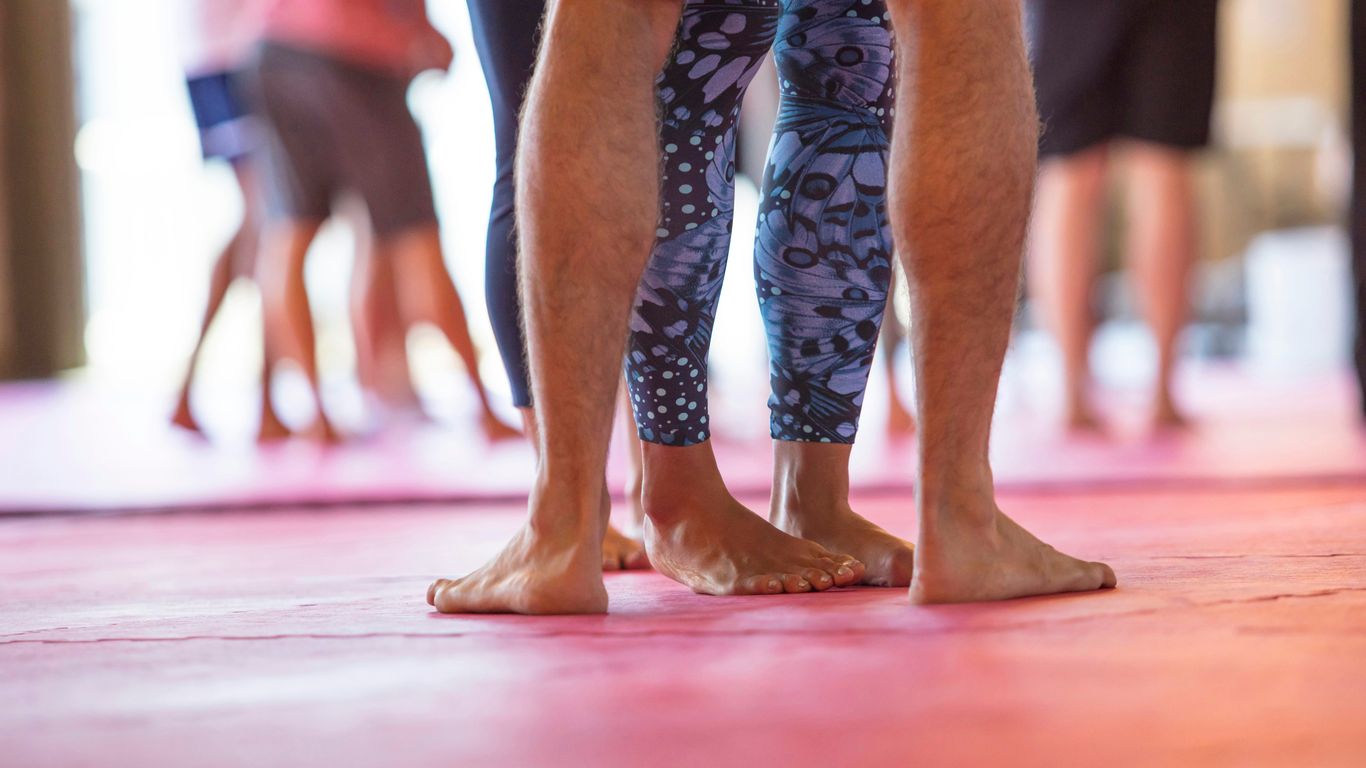
Finding your balance on the yoga mat is a big part of the practice, and it's something that gets better with time and patience. It's not just about standing perfectly still; it's about learning to find your center and gently come back to it when you feel a wobble. This skill translates off the mat too, helping with everyday coordination and posture.
Tree Pose: Finding Your Center
Tree Pose (Vrksasana) is a classic for a reason. It challenges you to stand on one leg, which is a direct way to work on your stability. When you're ready to try it:
- Start standing in Mountain Pose, feeling your feet grounded.
- Shift your weight to one foot. Bend the other knee and place the sole of your foot on your inner calf or thigh, avoiding the knee joint.
- Bring your hands to your heart center or extend them overhead like branches.
- Focus your gaze on a steady point in front of you to help maintain equilibrium.
Don't worry if you sway or need to put your foot down. That's totally normal! The goal is to keep trying and notice how your body adjusts. You can even start by placing your lifted foot on a block for extra support.
The Role of Drishti in Balance
In yoga, 'drishti' refers to a focused gaze. It's a really useful tool when you're trying to balance. By picking a single, unmoving spot to look at, you give your mind something steady to focus on, which in turn helps your body stay more stable. It's like giving your brain a little anchor. This practice of focused attention can really calm the nervous system, making it easier to hold poses like Tree Pose or Warrior III. It's a simple technique that makes a big difference.
Using Props for Support
Props aren't cheating; they're smart tools to help you practice safely and effectively. For balance, think about using a wall for support, especially when you're first learning poses like Tree Pose. A yoga block can be placed under your foot for stability, or you can use a strap to help extend your reach in poses where you might otherwise strain. These aids allow you to experience the pose more fully without compromising your alignment or risking a fall. They help you build confidence and strength gradually, making your practice more accessible. You can find some great beginner yoga poses for seniors that highlight the use of props to improve balance and stability.
Building balance is a journey, not a destination. Each time you step onto your mat, you have an opportunity to connect with your body and notice where you are. Be kind to yourself, celebrate small victories, and trust that with consistent practice, your stability will grow.
Integrating Breath and Body Awareness
Yoga isn't just about striking a pose; it's about what happens inside you while you're in it. That's where paying attention to your breath and how your body feels really comes into play. Think of your breath as your personal guide, always there to keep you grounded.
The Anchor of Your Breath
Your breath is like the steady beat of a drum during your yoga practice. It's not just about taking air in and out; it's about the rhythm and the sensation. When you inhale, you might feel your chest or belly expand. As you exhale, you can notice that expansion soften. Trying to match your breath to your movements can make even simple poses feel more connected and meaningful. For instance, as you stand up straighter in Mountain Pose, take a deep inhale. When you fold forward, let that exhale help you release tension.
Listening to Your Body's Signals
Your body is constantly communicating with you. In yoga, it's important to tune into those messages. A gentle stretch feels different from a sharp pain. If something feels like it's pulling too hard or causing discomfort, that's your body's way of saying, 'Hey, ease up a bit.' It's perfectly okay to modify a pose or take a break. Remember, yoga is a journey, not a race, and pushing too hard can lead to injury.
Here's a simple way to check in:
- Feel: Notice where you feel sensation. Is it a stretch, a warmth, or maybe a slight tension?
- Breathe: Can you maintain a steady breath in this position? If your breath is shallow or held, it might be a sign to adjust.
- Adjust: Make small shifts to find a place where you feel a stretch but no pain.
Mindful Movement and Presence
When you bring your awareness to your breath and your body's sensations, you naturally become more present. This means you're not worrying about what's for dinner or replaying a conversation from earlier. You're right there, on your mat, experiencing the moment. This focused attention can quiet the mental chatter and bring a sense of calm. It's about being fully engaged with what you're doing, right now.
Being mindful in your yoga practice means paying attention without judgment. It's about observing what's happening in your body and mind, and accepting it, whatever it may be. This acceptance is a big part of the peace yoga can bring.
Creating Your Accessible Yoga Practice
So, you've been trying out some yoga poses, and maybe you're starting to feel a bit more comfortable on the mat. That's awesome! Now, let's talk about how to make this whole yoga thing a regular part of your life without it feeling like a chore. It's really about finding what works for you, not trying to fit into some perfect yoga mold.
Consistency Over Intensity
Forget about trying to do super long or complicated sessions every single day. That's a fast track to burnout. Instead, aim for showing up regularly, even if it's just for 10 or 15 minutes. Think of it like watering a plant – a little bit each day does more good than a huge watering once a month. Little and often is the name of the game here. Building a habit is way more important than pushing yourself to the limit every time you practice. You'll find that over time, those short sessions start to add up, and you'll feel the benefits without feeling exhausted.
Seeking Guidance from Instructors
While it's totally fine to practice on your own, especially with beginner poses, getting some help from a qualified instructor can make a big difference. They can spot things you might miss, like if your alignment is a bit off in Mountain Pose, which could lead to strain later. They also know all sorts of ways to adjust poses so they work better for your body. You can find instructors at local studios or even through online classes. Look for someone who seems patient and experienced with people who are just starting out. They can really help you build a solid foundation and avoid common beginner mistakes.
Modifications for Every Body
This is a big one. Yoga isn't one-size-fits-all. Your body is unique, and it's going to have different needs on different days. That's where modifications come in. If a pose feels too intense, or if you have an old injury acting up, there are always ways to change it. For example, if Forward Fold is too much for your hamstrings, try bending your knees or using blocks under your hands. If balancing in Tree Pose is tricky, don't be afraid to stand near a wall for support. Here are a few ideas:
- Knees: If kneeling is uncomfortable, try sitting on a cushion or a folded blanket.
- Flexibility: Use props like blocks or straps to bring the floor closer to you or to extend your reach.
- Energy Levels: If you're feeling tired, opt for more restorative poses like Child's Pose or Supported Bridge Pose.
Remember, the goal is to feel good in your body and connect with your breath, not to force yourself into a shape that doesn't feel right. Yoga is about listening to what your body needs in the moment and responding with kindness.
It's all about making yoga work for your life, not the other way around. So, be patient with yourself, celebrate the small wins, and enjoy the journey of discovering what yoga can do for you. You might even find yourself looking forward to your mat time! If you're looking for a place to start, checking out some essential yoga poses can be a great first step.
Keep Moving Forward
So, that's a look at some basic yoga poses that are pretty easy to get into, even if you've never rolled out a mat before. Remember, the whole point isn't to be perfect right away. It's about showing up for yourself, even for just a few minutes, and paying attention to how your body feels. These simple movements can really make a difference in how you feel, both physically and mentally. Don't get discouraged if a pose feels a bit awkward at first, or if you can't do it exactly like the pictures. Just keep practicing, listen to your body, and be kind to yourself. You've got this.
Frequently Asked Questions
What are the most important things to remember when starting yoga?
The most important thing is to listen to your body. Yoga isn't a competition, so don't push yourself into pain. If something hurts sharply, stop. Also, remember that flexibility and strength build over time. Start with simple poses, use props if you need them, and know that Child's Pose is always a safe place to rest. Showing up regularly is more important than how long you practice each time.
How does my breath help in yoga?
Your breath is like an anchor in yoga. It helps you stay in the moment and can calm your mind, especially when a pose feels challenging. Try to match your breath with your movements. For example, breathe in as you stretch your body longer, and breathe out as you deepen a stretch. Focusing on your breath makes even simple poses feel more meaningful.
Why is it good to have a yoga instructor when I'm a beginner?
An instructor can be really helpful when you're new. They can check your form, help you avoid mistakes that might cause injury, and suggest ways to make poses work better for you. They know how to guide beginners safely. If you can't go to a studio, many online classes also offer good instruction.
What are some basic poses that are good for beginners?
Some great starting poses include Mountain Pose for standing tall and feeling grounded, Downward-Facing Dog to stretch your whole body, and Plank Pose to build core strength. For relaxation, Easy Pose is a simple seated position, and Child's Pose is a wonderful resting pose. Cat-Cow Pose is excellent for moving your spine gently.
How can I get better at balancing in yoga?
To improve balance, focus on tightening your core muscles and keeping your knees slightly bent for a stable base. In poses like Tree Pose, pick a spot in front of you to focus your gaze (this is called a drishti). Slow, deep breathing also helps calm your mind and steady your body. Using props like a wall or a block can give you extra support when you need it.
What if I'm not flexible enough for some poses?
It's totally okay! Yoga is for every body, and flexibility comes with practice. You can use props like blocks or straps to help you reach poses more comfortably without straining. For example, if you can't touch your toes in a Forward Fold, use a strap or place blocks under your hands. The goal is to feel a stretch, not pain, and to build strength and flexibility gradually.

