Yoga for Jet Lag: Poses and a Routine for Arriving Rested
Yoga will not move your body clock by itself, but it handles the part of jet lag you can feel in your body: stiff hips, tight calves, swollen ankles, a wired mind at 3 a.m. The best approach pairs a short, well-chosen sequence with the timing tools that actually shift your clock, mainly light and sleep schedule. Below you will find what to do before you fly, in your seat, and in the first evening after you land, plus how to build a routine you can do anywhere with a light, foldable mat.
TL;DR
- The CDC’s Yellow Book lists yoga among the complementary approaches suggested for short-term travel-related sleep problems.
- Your body clock shifts with timed light and a gradual change in sleep schedule. Yoga is the piece that releases stiffness and helps you settle down.
- On the plane, seated cat-cow, seated twists and shoulder rolls keep you moving. After landing, a 20-minute sequence ending with Legs-Up-the-Wall works well on a hotel carpet.
- A thin foldable travel mat gives you a clean, non-slip practice surface in any room.
Table of Contents
- What jet lag is, and where yoga fits
- Set the clock first: light and sleep timing
- Before you fly: loosen up and start shifting
- In your seat: stretches that keep you moving
- After you land: a 20-minute reset sequence
- Breathing to settle at bedtime
- Practicing on the road: why the mat matters
- Your travel-day plan, start to finish
- Our perspective
- Take the routine with you
- FAQ
- Sources
What jet lag is, and where yoga fits
The NHS describes jet lag as a disturbance of your normal sleep pattern after a long flight, one that usually improves within a few days. Typical symptoms include trouble falling asleep and waking up, daytime tiredness, poor sleep quality, and problems with concentration and memory. Some people also get indigestion, nausea, constipation, changes in appetite, and mild anxiety.
Two things are going on at once. Your internal clock is out of step with local time, and your body has been folded into a seat for hours. Yoga speaks directly to the second problem. The NCCIH, part of the US National Institutes of Health, notes that relaxation techniques, mindfulness-based stress reduction and yoga are among the approaches people use for sleep trouble, and the CDC lists yoga in its travel guidance for the same reason.
Think of the practice as the way you unwind your body so that the timing tools can do their work. Sitting is essentially a long forward bend. Hips and hip flexors shorten, calves tighten, the chest sinks and the ribs move less. Poses that reverse that shape feel good for a concrete reason, and a body that feels better settles into sleep more easily.
Set the clock first: light and sleep timing
Before the poses, here is the part that moves your clock. The American Academy of Sleep Medicine’s practice parameters say that for eastward travel, shifting your sleep one hour earlier per day for three days before departure, combined with morning bright light, may lessen symptoms. The same document covers melatonin timing, which is a question for your doctor or pharmacist, especially if you take other medications or are pregnant.
A peer-reviewed review in Current Treatment Options in Neurology adds a useful detail for short trips: for travel of two days or less, keeping your home sleep and wake times produced better jet-lag ratings than adopting destination times.
In practice:
- Flying east (for example New York to Paris): aim for bright light in the morning at your destination, and move bedtime earlier before you go.
- Flying west (for example Chicago to Honolulu): seek light in the evening and let bedtime drift later.
- Quick trip of a couple of days: stay close to your home schedule.
Your yoga session slots into this plan. It is a wind-down ritual at the new bedtime, or a gentle wake-up in morning daylight.
Before you fly: loosen up and start shifting
Two or three days out, make your evening practice the signal that the day is ending, and move it an hour earlier or later in line with your direction of travel. A 10-minute routine is plenty. Our guide to how yoga can help you achieve restful sleep walks through a calming order of poses, and the evening routine with Kassandra is a good template you can repeat until it becomes automatic.
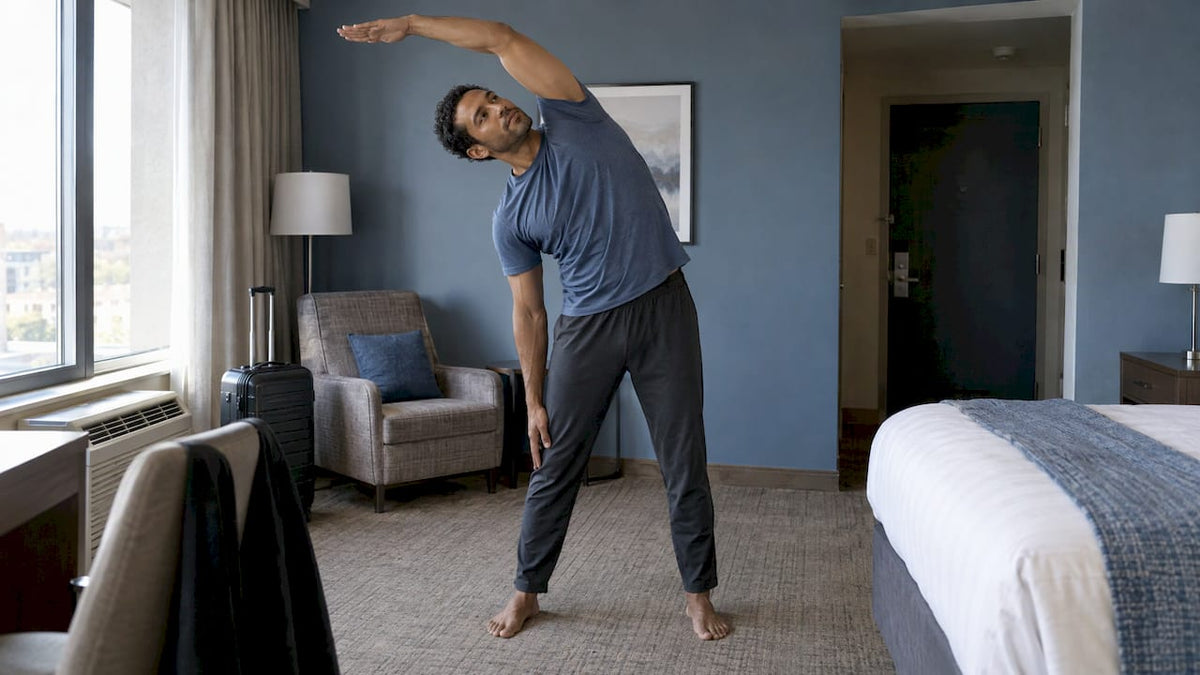
On the day of the flight, a short standing and hip-opening session before you leave for the airport helps. Low lunges, a standing forward fold and a few slow side bends take five minutes and mean you start the flight with some range in your body.
In your seat: stretches that keep you moving
The Cleveland Clinic’s travel yoga guide suggests five poses you can do without leaving your seat:
- Seated cat-cow. Repeat at least three times, inhaling as you lift your chest and exhaling as you round. If you want the details of the movement, see our cat-cow guide for beginners.
- Seated spinal twist. Hold 3 to 5 breaths per side, using the armrest or seat back for gentle leverage.
- Slow neck rolls. Stop immediately if you feel any pain.
- Shoulder rolls. Big, slow circles to undo the hunch.
- Seated forward fold. Go easy if you feel dizzy.
Add ankle circles and calf pumps, and walk the aisle when the seat belt sign is off. Long periods of immobility are a circulation concern for any traveler, and if you have a history of blood clots or circulation problems, talk to your doctor before a long flight. Our post on airplane yoga practice covers more ways to stretch and relax in flight.
Skip anything forceful in a confined space. Breathing exercises are the exception: slow, steady breathing needs no room at all, and it is the easiest way to keep your nervous system calm at 35,000 feet. If anxiety tends to climb on flights, these polyvagal exercises to calm anxiety are short enough to use in your seat.
After you land: a 20-minute reset sequence
This sequence draws on poses and timings recommended in post-flight guides from The Inertia and Yoga Journal. Do it after you check in, in daylight if you arrive in the morning, or as an evening wind-down if it is already night at your destination.
You need about two meters of floor, a wall, and a mat if you have one. Move slowly and let each pose be mild. Nothing here should hurt.
| Order | Pose | Time | What it does after a flight |
|---|---|---|---|
| 1 | Child’s Pose with prayer hands | 1 to 2 minutes | Eases neck and shoulder tension |
| 2 | Downward-Facing Dog | 5 to 10 breaths | Lengthens the spine and hamstrings |
| 3 | Uttanasana (standing forward fold) | 5 to 10 breaths | Releases the back of the legs |
| 4 | Pyramid Pose | 10 to 15 breaths per side | Targets calves and hamstrings that tighten from sitting |
| 5 | King Dancer prep | 10 to 15 breaths per side | A standing backbend that counters the forward-bend shape of sitting |
| 6 | Lizard Lunge Twist | 5 to 10 breaths per side | Opens hip flexors and the psoas, a deep hip muscle that shortens when you sit; the twist helps digestion |
| 7 | Legs-Up-the-Wall | 3 to 5 minutes | Reduces leg and ankle swelling and quiets the mind |
Where people go wrong
- Rushing the hips. After hours of sitting, hip flexors are short. Ease into the lunge and stop before sharp sensation.
- Pushing a backbend. King Dancer prep is a prep for a reason: use a wall or chair for balance and keep the lift small.
- Fighting the dog. If your hamstrings are tight, bend your knees generously in Downward-Facing Dog. The spine matters more than straight legs.
- Falling asleep at the wrong time. If you land in the morning and the session ends with a long rest, keep it short, so a long nap does not delay your adjustment to local time.
Inversions after a long flight
Legs-Up-the-Wall is a gentle, supported way to elevate your legs. Full inversions such as headstand or shoulderstand are a different matter: they are best practiced with a teacher, not tried for the first time right after a long flight, and they are modified or skipped in pregnancy and with high blood pressure. If you are pregnant or have a heart condition or high blood pressure, check with your doctor before adding any of the more vigorous poses above.
We also keep a set of space-smart hotel room yoga routines for US travelers if you want alternatives for a tight room.
Breathing to settle at bedtime
Your first night is often the hardest. Once you are in bed, try this: lie on your back with one hand on your belly and one on your chest. Breathe in for a count of four and out for six to eight, letting the belly rise first, then the ribs, then the upper chest. Continue for two or three minutes. A longer exhale than inhale is a simple way to signal your body that it is safe to rest.

Yoga nidra, a guided relaxation lying down, is another option for evenings. Treat it as structured rest. It helps you settle, while light, meals and sleep timing keep doing the clock-shifting work.
Practicing on the road: why the mat matters
Hotel carpet is thin, sometimes dusty, and rarely flat. A bare floor makes Downward Dog slippery and Child’s Pose uncomfortable on the knees. A mat solves both, but a standard mat does not fit in a carry-on.
That is the reason we make foldable travel mats. Our Jerome Turquoise, Copper River and Calacatta foldable travel mats are 2 mm thick, lightweight, non-slip and eco-friendly, designed for on-the-go practice. A mat that folds flat into a bag is a mat you actually unroll at the end of a travel day, and the habit is what makes the routine work.

A yoga strap is also handy in a small space. It lets you reach your feet in a seated forward fold or hamstring stretch without strain. You will find them on our homepage, along with towels and other accessories.
Your travel-day plan, start to finish
- 2 to 3 days before: shift bedtime an hour a day toward your destination, and make a 10-minute yoga wind-down part of it.
- Departure day: five minutes of lunges, forward fold and side bends.
- In flight: seated cat-cow, twists and shoulder rolls every hour or so, plus aisle walks.
- After landing: get daylight if it is morning (or evening light after westward travel), then do the 20-minute sequence.
- First night: Legs-Up-the-Wall, then belly breathing, at local bedtime.
- Next few days: repeat a short version each evening.
Our perspective
We think jet lag is best handled as two problems with two toolkits. The clock problem belongs to light, sleep timing and, if your doctor agrees, melatonin. The body problem belongs to movement, and that is where a regular yoga practice earns its place in your luggage.
What we see in the way people travel with yoga is simple: the sequence you can do in ten minutes on a hotel floor beats the perfect sequence you skip. That is why we design for portability. A foldable 2 mm mat that is lightweight and non-slip removes the excuse. You open the bag, unfold it, and begin.
Pick three or four poses you trust, such as Child’s Pose, Downward-Facing Dog and Legs-Up-the-Wall, and repeat them at the same point of every trip. Your body learns the cue, and the routine becomes a signal that the day is ending, wherever you are.
Nicholas
Take the routine with you
If you travel often, a mat that packs small makes the difference between planning to practice and practicing. Our foldable travel mats are made for exactly that, and you can browse the whole range, from natural rubber to eco mats, on the Yune Yoga store.

FAQ
Can yoga cure jet lag?
Yoga is not a cure on its own, because your body clock responds mainly to timed light and sleep schedule. It is a recognized complementary approach: the CDC lists yoga among the options for short-term travel-related sleep problems. Use it for movement, relaxation and a consistent bedtime ritual alongside light timing.
What is the fastest way to get over jet lag?
The fastest route is to shift your clock with light: bright light in the morning after eastward travel and in the evening after westward travel, plus moving your sleep one to two hours toward destination time before you fly. Melatonin timing is covered in the AASM guidelines, so ask your doctor whether it suits you. Gentle yoga at local bedtime supports all of this.
What are the worst days of jet lag?
The NHS says jet lag usually improves within a few days, so the first couple of days after a long, multi-time-zone flight are typically the hardest. Keeping a short evening routine each night helps you settle until your sleep normalizes.
Which pose is best after a long flight?
Legs-Up-the-Wall is the most popular choice, held for 3 to 5 minutes, because it eases leg and ankle swelling and calms the mind. Pair it with Downward-Facing Dog and a forward fold to release the back of the legs.
Do I need a mat to do yoga in a hotel room?
You can practice on carpet, but a thin foldable mat gives you grip for standing poses and cushioning for kneeling ones. A 2 mm travel mat folds small enough for a carry-on.
Sources
- CDC Yellow Book: Complementary and Integrative Health Approaches to Travel
- NCCIH: Travel-Related Ailments and Complementary Health Approaches
- NHS: Jet lag
- AASM: Practice Parameters for the Clinical Evaluation and Treatment of Circadian Rhythm Sleep Disorders
- Current Treatment Options in Neurology review (Zee et al., 2010)
- Cleveland Clinic: Yoga for Traveling, 5 Poses to Try
- The Inertia: 5 Yoga Poses to Try Post Flight
- Yoga Journal: 5 Poses to Help You Unwind After Flying