
Why Yoga Reduces Injury Risk: An Athlete's Evidence Guide
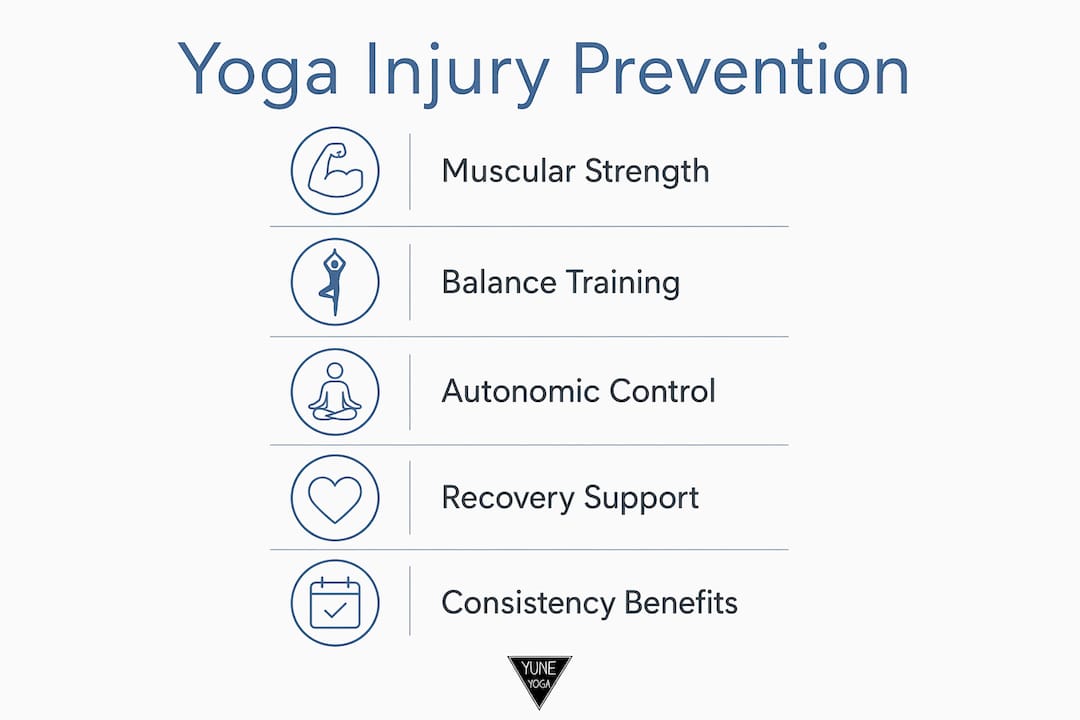
Regular, appropriately dosed yoga measurably lowers certain injury risks for athletes and active people by improving strength, balance, proprioception, and autonomic regulation. That is not a wellness claim — it is the conclusion of multiple peer-reviewed reviews and clinical trials. The mechanisms are specific: yoga conditions connective tissue, trains stabilizer muscles, sharpens proprioceptive feedback, and uses breathwork to downregulate the sympathetic nervous system in ways that reduce the physiological precursors to overuse injury. The AAOS OrthoInfo resource for clinicians identifies improved proprioception, strength through extension, and balance as the primary protective factors — while also flagging that improper technique creates its own risks.
The standout, measurable benefits documented across studies include:
- Reduced perceived injury proneness and fatigue in athlete populations following structured yoga protocols
- Improved balance and ankle/knee stability, particularly in programs with dedicated balance components
- Greater range of motion and connective-tissue resilience with consistent practice over weeks
- Autonomic regulation via pranayama, which plausibly reduces chronic muscle tension and inflammatory load
- Better interoceptive awareness, letting athletes detect asymmetric tension patterns before they become acute injuries
One caveat worth stating upfront: the evidence is real but uneven. Most studies are small, interventions vary widely, and serious adverse events from yoga are reported to be relatively uncommon but not zero. The sections below unpack what the research actually shows, why the mechanisms work, and how to integrate yoga without adding new risk.
Table of Contents
- What does the research actually show about yoga and injury risk?
- How yoga reduces injury risk: the physiological and neuromuscular pathways
- How to integrate yoga into your athletic training program
- Common yoga-related injuries and how to avoid them
- How long until yoga produces measurable injury-prevention benefits?
- What are the limitations of the current evidence?
- A research-backed sample weekly routine for injury prevention
- Key Takeaways
- The case for taking yoga seriously as a training tool
- Gear that supports safer yoga practice
- Useful sources and further reading
What does the research actually show about yoga and injury risk?
The peer-reviewed picture is encouraging but not definitive. Here is a snapshot of the most relevant study designs and their primary outcomes:
| Study / Review | Design | Sample | Duration | Primary Outcome |
|---|---|---|---|---|
| PMC feasibility trial (soccer athletes) | Feasibility RCT | Student athletes | 10 weeks | Reduced perceived injury proneness and fatigue (RESTQ-Sport); improved recovery scores |
| PMC safety review | Systematic review | Mixed yoga practitioners | Varied | Serious adverse events relatively uncommon; most issues were strains/sprains from advanced poses |
| PMC physiotherapy + yoga trial | Comparative clinical study | 212 knee-injury patients | several months | Significant WOMAC improvements in pain, stiffness, and function in yoga group vs. conventional group |
| Sports Science & Health Advances review | Narrative review | Multi-sport athletes | Varied | Flexibility, stabilizer strength, and proprioception improvements linked to lower overuse injury susceptibility |
The 10-week adapted yoga intervention with soccer players produced reductions on the RESTQ-Sport injury and fatigue subscales alongside improved self-reported recovery scores. That is a feasibility trial, not a definitive RCT, but the direction of effect is consistent with the broader literature. More compelling for clinical audiences: a comparative study of 212 patients recovering from nonsurgical knee injuries found that yoga combined with conventional physiotherapy produced significantly better WOMAC scores for pain, stiffness, and function at 6 weeks, 3 months, and several months post-injury compared to physiotherapy alone.
The PMC safety review adds important context: serious adverse events are reported to be low and comparable to rates seen in non-yoga practitioners across several studies. Most reported problems are muscle strains, sprains, and localized pain tied to advanced or incorrectly executed poses. That framing matters. Yoga is not uniquely dangerous, but it is not consequence-free either.
Where the evidence is strongest: balance outcomes, perceived injury proneness, and rehabilitation-phase functional recovery. Where it is still preliminary: long-term injury incidence in prospective cohorts, dose-response relationships, and sport-specific injury prevention.
How yoga reduces injury risk: the physiological and neuromuscular pathways
The protective effect is not one thing. It is the convergence of at least three distinct pathways working simultaneously.
Musculoskeletal conditioning
Yoga loads connective tissue through sustained isometric and eccentric contractions in ways that differ from conventional resistance training. Tendons and ligaments respond to slow, progressive mechanical loading by increasing collagen density and tensile strength. Poses like Warrior III, Chair, and single-leg balances recruit the hip abductors, rotator cuff, and spinal erectors as stabilizers rather than prime movers. That stabilizer activation is exactly what most gym programs underload. A sports science review links regular yoga practice to improvements in stabilizing muscle function, postural control, and body awareness that together reduce susceptibility to overuse injuries across multiple sports.

One training science distinction worth understanding: static stretching immediately before high-intensity activity can transiently reduce force production. Dynamic yoga sequences before training do not carry that cost. Long-held passive stretches belong after training or on recovery days, not in a pre-competition warm-up.
Proprioception and motor control
Balance and alignment training in yoga drives proprioceptive adaptation at the joint level. Single-leg poses, slow transitions between stances, and closed-chain movements all challenge the mechanoreceptors in the ankle, knee, and hip capsules. Research associates balance-centered programs, including yoga components, with reductions in lower-limb injuries. The mechanism is straightforward: better proprioceptive feedback means faster neuromuscular corrections during unexpected perturbations, which is when most acute ankle and knee injuries happen.

Interoception, the body’s ability to sense internal states, also develops through yoga’s emphasis on scanning during poses. Detecting micro-tension or asymmetric activation early is a practical early-warning system. Athletes who practice this consistently tend to catch the tightness in a hip flexor or the fatigue in a stabilizer before it compounds into a strain.
Autonomic and inflammatory regulation
Pranayama and meditative practices influence autonomic regulation through vagal stimulation, consistent with polyvagal theory. Slow, controlled breathing shifts the autonomic balance toward parasympathetic dominance, reducing resting muscle tension and lowering circulating inflammatory markers. Chronic sympathetic overactivation, common in athletes with high training loads and poor recovery, keeps muscles in a state of low-grade tension that accelerates tissue fatigue. Breath-based regulation addresses that directly. For a deeper look at how pranayama works mechanically, Yuneyoga’s guide on breath awareness in yoga covers the physiological detail.
Pro Tip: Pairing mobility gains with targeted strength work is non-optional. Increasing range of motion without building the strength to control that range creates joint instability. If yoga opens your hip flexors, add single-leg glute work in the same training week.
How to integrate yoga into your athletic training program
The timing and type of yoga matter as much as the practice itself. Using the wrong style at the wrong point in a training week can undermine performance or add fatigue rather than reduce it.
Warm-up vs. recovery
Dynamic sequences belong before training. Sun Salutations, mobility flows, and active hip-opening sequences prepare tissues for load without the force-production cost of static stretching. Yoga Journal’s practitioner guidance recommends active sequences for warm-up and passive holds post-training, with pose choices targeting sport-specific tightness. After training or on rest days, longer passive holds and restorative sessions with bolsters and blocks allow the nervous system to downregulate and connective tissue to adapt. Clinicians recommend periodizing yoga like any other training modality: dynamic and active before performance, restorative and slow-hold on recovery days.
Periodization across the training week
- High-load training days: A short duration of dynamic yoga as warm-up is recommended; avoid long holds that add muscular fatigue
- Moderate training days: Moderate duration functional or vinyasa-style yoga is recommended as a secondary session, focusing on stabilizer activation
- Rest or recovery days: Longer restorative or yin yoga sessions can support recovery, targeting connective tissue and autonomic recovery
- Pre-competition week: Reduce yoga volume; keep primarily dynamic warm-up sequences
For a structured approach to fitting yoga within a broader athletic program, the training periodization guide from HTK Training offers a practical framework for load management across a training cycle.
Matching yoga style to training goal
| Goal | Recommended Style | Example Poses/Sequences |
|---|---|---|
| Pre-training mobilization | Vinyasa / dynamic flow | Sun Salutations, lunge flows, hip circles |
| Stabilizer strength | Functional yoga | Warrior III, Chair, single-leg balance series |
| Recovery and tissue adaptation | Restorative / yin | Supported pigeon, supine twists, bolster-supported backbends |
| Stress and autonomic regulation | Restorative + pranayama | Legs-up-the-wall, box breathing, yoga nidra |
Sport-specific notes
Runners benefit most from hip flexor, glute, and IT band work. Poses like low lunge, pigeon, and bridge address the chronic tightness patterns that drive iliotibial band syndrome and patellofemoral pain. Yuneyoga’s yoga for runners guide covers this in detail.
Cyclists need thoracic extension and hip flexor release to counteract the sustained flexion position. Cat-cow, supported fish, and thread-the-needle are high-yield choices.
Team sport athletes (soccer, basketball, football) benefit from ankle and knee stability work: single-leg tree pose, warrior balance series, and lateral hip-opening sequences.
Pro Tip: Before adding yoga to an athlete’s program, loop in their strength coach or physical therapist. Load management is a team decision. What feels like “just stretching” can meaningfully affect tissue readiness on heavy training days.
Common yoga-related injuries and how to avoid them
The PMC safety review is clear: serious adverse events from yoga are reported to be relatively uncommon, but the most frequent problems are predictable and preventable.
Most common injury types:
- Muscle strains and sprains, particularly in the hamstrings, lower back, and shoulders
- Neck pain from unsupported inversions or forced cervical flexion
- Wrist and elbow strain from weight-bearing poses without adequate preparation
- Lower back pain from deep forward folds or spinal twists performed with poor pelvic alignment
Common causes:
- Rushing progressions without building foundational strength first
- Mismatching pose intensity to current readiness (the yogic principle of adhikara, or readiness, maps directly to training readiness)
- Excessive frequency without adequate recovery, particularly in hot yoga formats
- Poor instruction or self-teaching advanced techniques like inversions and forceful pranayama
- Hot yoga in individuals with cardiovascular conditions or heat sensitivity
Safety checklist before and during practice:
- Complete a basic movement screen or consult a physical therapist if you have a prior injury
- Start with foundational poses and build progressively over weeks, not days
- Use regressions freely: blocks under hands, straps for hamstring poses, bolsters under knees in backbends
- Prioritize alignment cues over depth; a shallower pose with correct alignment protects more than a deep pose with compensation
- Allow at least one full rest day between intense yoga sessions
- Avoid hot yoga if you have uncontrolled hypertension, pregnancy complications, or a history of heat illness
Red flags — stop and seek care if you experience:
- Sharp, shooting, or electric pain during or after a pose
- Persistent neurological symptoms (numbness, tingling, weakness) in the limbs
- Unusual swelling or joint instability after practice
- Chest pain or dizziness in any yoga format
How long until yoga produces measurable injury-prevention benefits?
The honest answer: some adaptations come quickly, others take months. The timeline depends on what you are measuring.
Earlier adaptations (2–6 weeks):
- Balance and proprioceptive improvements are among the fastest to appear, because they reflect neuromuscular learning rather than structural tissue change
- Perceived recovery and reduced fatigue, as seen in the 10-week soccer athlete trial, can emerge within the first few weeks of consistent practice
Later adaptations (8–16+ weeks):
- Connective tissue remodeling (tendon and ligament collagen adaptation) requires sustained mechanical loading over months
- Long-term flexibility gains that persist through a competitive season require consistent practice, not a short block
Dosage recommendations by goal:
| Goal | Weekly Frequency | Session Length | Primary Focus |
|---|---|---|---|
| Balance and proprioception | 2–3 sessions | 20 minutes | Single-leg poses, balance flows |
| Stabilizer strength | 2–3 sessions | 30–45 minutes | Functional/strength yoga |
| Connective tissue resilience | 3–4 sessions | 45–60 minutes | Mixed dynamic + yin |
| Autonomic recovery | 1–2 sessions | 45–90 minutes | Restorative + pranayama |
The published protocols reviewed here used sessions ranging from roughly 20 minutes (athlete warm-up integrations) to 90 minutes (full therapeutic sessions). Two to four sessions per week appears to be the practical range where benefits accumulate without adding excessive training load. Individual adherence, training history, and how yoga is integrated with other modalities all shift these timelines. The mobility and athletic longevity guide from HTK Training provides additional context on how mobility work fits within long-term athlete development.
What are the limitations of the current evidence?
The research supports yoga for injury prevention, but reading it uncritically leads to overconfidence. The methodological weaknesses are consistent across the literature and worth knowing.
Main limitations:
- Small sample sizes: Most trials involve fewer than 50 participants, which limits statistical power and generalizability
- Heterogeneous interventions: “Yoga” in one study may mean a 20-minute vinyasa flow; in another, a 90-minute Iyengar session with props. Comparing outcomes across these is difficult
- Short follow-up periods: Most trials run 8–12 weeks. Long-term injury incidence data across full competitive seasons is scarce
- Lack of blinded outcomes: Participants and instructors cannot be blinded to yoga interventions, introducing performance and expectation bias
- Self-reported measures: Many outcomes (perceived fatigue, injury proneness, recovery) rely on questionnaires rather than objective injury incidence counts or biomechanical tests
A short methodology checklist for evaluating any yoga study:
- Is it an RCT or a controlled cohort, or just a case series?
- Is the sample size large enough to detect a clinically meaningful effect?
- Are outcomes objective (balance tests, injury incidence, range-of-motion measurement) or self-reported only?
- Is the yoga intervention described in enough detail to replicate (style, duration, instructor qualifications)?
- Is follow-up long enough to capture injury outcomes, not just surrogate markers?
Where the evidence is strongest: balance and proprioception outcomes, short-term perceived recovery in athlete populations, and rehabilitation-phase functional recovery when yoga is added to physiotherapy. Where it remains preliminary: prospective injury incidence in large cohorts, dose-response curves, and sport-specific injury prevention protocols.
The absence of large RCTs does not mean yoga does not work for injury prevention. It means the evidence base is still maturing. The mechanistic rationale is solid; the clinical trial infrastructure has not yet caught up.
A research-backed sample weekly routine for injury prevention
This plan draws from the protocols in the reviewed studies and practitioner guidance from IDEAfit’s yoga therapy framework. Adapt it to your sport and current training load.
Sample week (moderate training load):
| Day | Session Type | Duration | Primary Focus |
|---|---|---|---|
| Monday | Dynamic yoga warm-up | — | Hip mobility, thoracic rotation, ankle prep |
| Tuesday | Strength-focused yoga | — | Warrior series, single-leg balance, core stability |
| Wednesday | Rest or light activity | — | — |
| Thursday | Dynamic yoga warm-up | — | Shoulder mobility, glute activation, lateral hip |
| Friday | Vinyasa flow | 45 min | Full-body integration, breath coordination |
| Saturday | Restorative yoga | 60 min | Supported poses, pranayama, nervous system recovery |
| Sunday | Rest | — | — |
4–8 week progression:
- Weeks 1–2: Establish foundational poses with correct alignment. Hold times of 30–45 seconds. No advanced inversions or deep backbends.
- Weeks 3–4: Increase hold times to 60 seconds in stability poses. Add single-leg balance progressions. Introduce basic pranayama (box breathing, 4-7-8).
- Weeks 5–6: Add functional strength sequences (Warrior III to standing splits, chair to single-leg chair). Introduce yin holds of 2–3 minutes for connective tissue work.
- Weeks 7–8: Integrate sport-specific sequences. Runners add hip-flexor and glute emphasis; cyclists add thoracic extension work; team sport athletes add lateral ankle stability drills.
Quick regressions for common pain patterns:
- Lower back pain: Replace forward folds with supported bridge; use blocks under hands in all standing poses
- Knee discomfort: Avoid deep flexion; use blankets under knees in kneeling poses; substitute chair pose with wall-supported squat
- Shoulder pain: Replace Chaturanga with knees-down modification; use blocks under hands in Downward Dog
For sport-specific rehabilitation progressions, Yuneyoga’s yoga for injury rehabilitation resource provides sequencing examples for common sports injuries.
Key Takeaways
Yoga reduces injury risk through a combination of neuromuscular, structural, and autonomic mechanisms, and the evidence is strongest when yoga is practiced consistently, dosed appropriately, and integrated with existing training rather than used as a standalone fix.
| Point | Details |
|---|---|
| Evidence is real but limited | Clinical trials show balance, recovery, and functional improvements; large prospective RCTs are still scarce. |
| Mechanisms are multidimensional | Stabilizer strength, proprioception, connective-tissue loading, and vagal regulation all contribute to lower injury risk. |
| Timing and type matter | Dynamic yoga before training; restorative and yin sessions on recovery days; 2–4 sessions per week is the practical dose range. |
| Safety requires progression | Most yoga injuries stem from rushing poses, poor alignment, or excessive frequency — not from yoga itself. |
| Yuneyoga supports safer practice | Yuneyoga offers equipment (grip mats, bolsters, straps) and a blog library that help athletes build a safe, evidence-informed routine. |
The case for taking yoga seriously as a training tool
The conventional framing of yoga as a flexibility add-on undersells what the research actually shows. The injury-prevention case for yoga is not primarily about touching your toes. It is about training the neuromuscular system to make faster, more accurate corrections under load, conditioning connective tissue in ways that resistance training alone does not, and building the autonomic resilience that separates athletes who stay healthy across a long season from those who accumulate overuse injuries.
What the literature does not support is the idea that any yoga, practiced any way, at any frequency, prevents injuries. The PMC safety review makes clear that frequency, intensity, and technique all modulate risk. A poorly supervised hot yoga class three days before competition is not injury prevention. A well-structured restorative session the night before a hard training day probably is.
The gap in most athletic programs is not that athletes are unaware of yoga. It is that they use it inconsistently, at the wrong times, and without connecting it to the specific physical deficits that make them injury-prone. A runner with chronic IT band issues does not need more hamstring stretching. They need hip abductor loading and proprioceptive work at the ankle. Yoga can deliver both, but only if the sequencing is targeted.
The practical takeaway: treat yoga like you treat strength training. Periodize it, progress it, and match the style to the physiological goal. Consult a physical therapist or certified yoga therapist if you are working around a prior injury. The evidence supports the investment.
This article is general information, not medical or clinical advice. Consult a qualified healthcare provider or sports medicine professional for guidance specific to your injury history and training situation.
Gear that supports safer yoga practice
The right equipment does not replace good instruction or clinical care, but it does reduce the mechanical risk of common yoga injuries. Grip is the most underrated factor: a mat that slips in Warrior III forces compensatory tension through the ankle and knee that a stable surface eliminates. Alignment blocks let you maintain correct joint positioning in poses your current range of motion does not yet support, which is exactly the scenario where most strains happen. A bolster makes restorative sessions genuinely restorative rather than uncomfortable, and a strap allows progressive hamstring and shoulder work without forcing range.

Yuneyoga carries natural rubber mats with high-grip surfaces, eco-friendly travel mats, yoga straps, and bolsters built for both performance and recovery use. None of these products are a substitute for proper technique or medical guidance, but they make consistent, safe practice easier to maintain. Browse the full range at Yuneyoga and find the gear that fits your training setup.
Useful sources and further reading
The sources below form the evidence base for this article. Each is worth reading directly if you want to evaluate the methodology or find sample protocols.
-
Safety and Prevention of Injuries in Yoga (PMC) — Systematic review covering adverse event rates, risk factors (frequency, technique level, hot yoga), and safety recommendations. The primary reference for the safety section.
-
Mitigating the Antecedents of Sports-related Injury through Yoga (PMC) — Feasibility trial with soccer athletes; covers the RESTQ-Sport outcomes, autonomic regulation mechanisms, and proprioception findings. The most directly relevant trial for athlete populations.
-
Physiotherapy Combined with Yoga in Sports Injury Rehabilitation (PMC) — Comparative clinical study of 212 knee-injury patients; provides WOMAC outcome data and the strongest clinical evidence for yoga’s role in functional recovery.
-
Expert Perspectives on Yoga’s Multidimensional Effects (PMC) — Sports-medicine and yoga-therapy perspectives on periodization and the combined mechanical and nervous-system effects of yoga.
-
The Role of Yoga in Injury Prevention for Athletes (Sports Science & Health Advances) — Narrative review linking flexibility, stabilizer strength, and proprioception to reduced overuse injury susceptibility across sports.
-
Yoga Injury Prevention (AAOS OrthoInfo) — Patient-facing clinical summary from the American Academy of Orthopaedic Surgeons; useful for the protective mechanisms and technique safety guidance.
-
Yoga Therapy for Injury Prevention and Recovery (IDEAfit) — Practitioner resource on individualized yoga therapy sequencing for injury-prone athletes; covers warm-up applications and therapist-led progressions.
-
9 Yoga Poses to Keep Athletes Injury-Free (Yoga Journal) — Practitioner-friendly guidance on dynamic warm-up sequences and post-training passive holds; useful for sport-specific pose selection.
A note on evidence quality: The PMC peer-reviewed sources carry the highest methodological weight. The AAOS and IDEAfit resources are authoritative practitioner references. Yoga Journal provides practical sequencing guidance grounded in professional yoga instruction. Read the methods sections of the PMC trials before citing specific outcome figures in clinical or coaching contexts.