

Yoga for Runners: Performance, Recovery, and Injury Prevention
Yoga for runners is a targeted practice that addresses the specific muscle groups, movement patterns, and recovery needs created by running. Unlike general yoga classes, it focuses on hip flexors, hamstrings, IT band health, and core stability — the exact systems that determine how efficiently and safely you run. Yoga warm-ups improve joint alignment, core strength, and neuromuscular engagement, leading to measurably reduced injury risk. The benefits of yoga for runners extend beyond flexibility: consistent practice reshapes your running gait, sharpens mental focus, and accelerates recovery between hard training days.
What is yoga for runners, and how does it differ from regular yoga?
Yoga for runners is a specialized application of yoga that prioritizes the muscles and joints most stressed by repetitive forward motion. Standard yoga classes serve a broad population. Runner-specific yoga targets the hip flexors, glutes, hamstrings, calves, and thoracic spine — the exact areas that tighten, weaken, or misalign under high mileage.
The distinction matters because running creates imbalances that general yoga does not always address. Your hip flexors shorten from constant flexion. Your glutes underfire because your hamstrings compensate. Your thoracic spine stiffens from the forward lean of long efforts. Runner-specific yoga corrects these patterns directly.
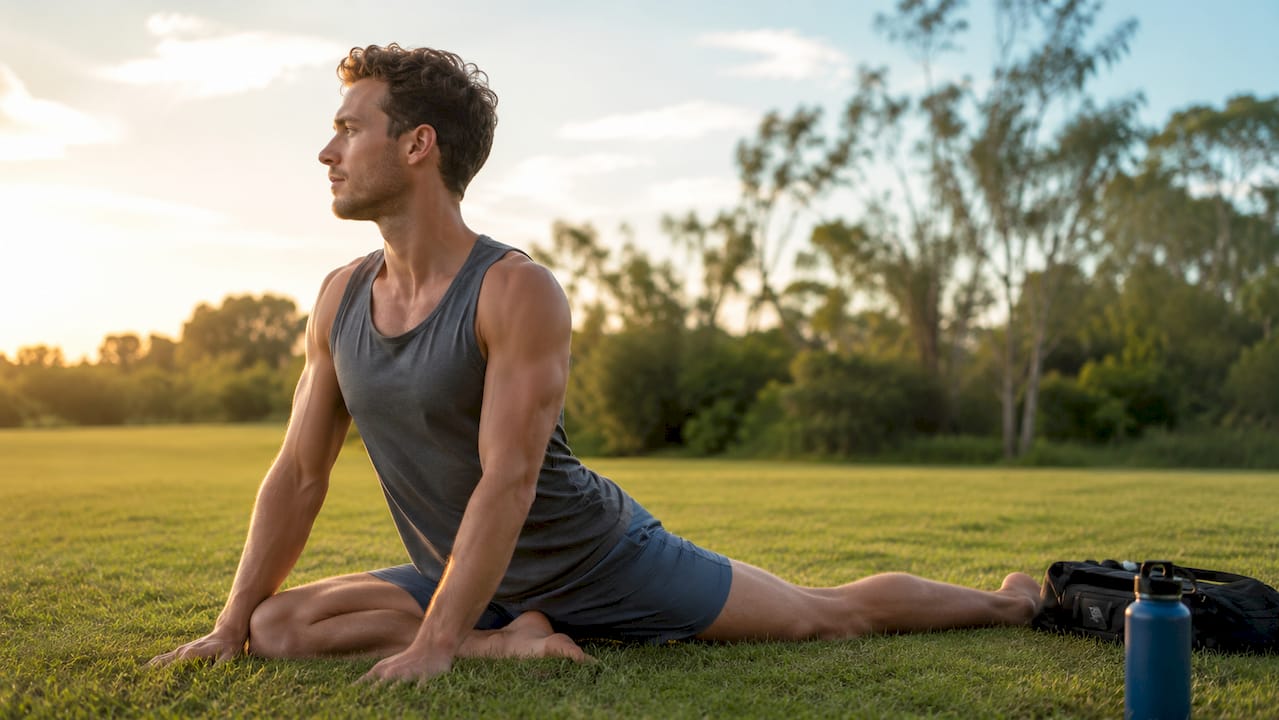
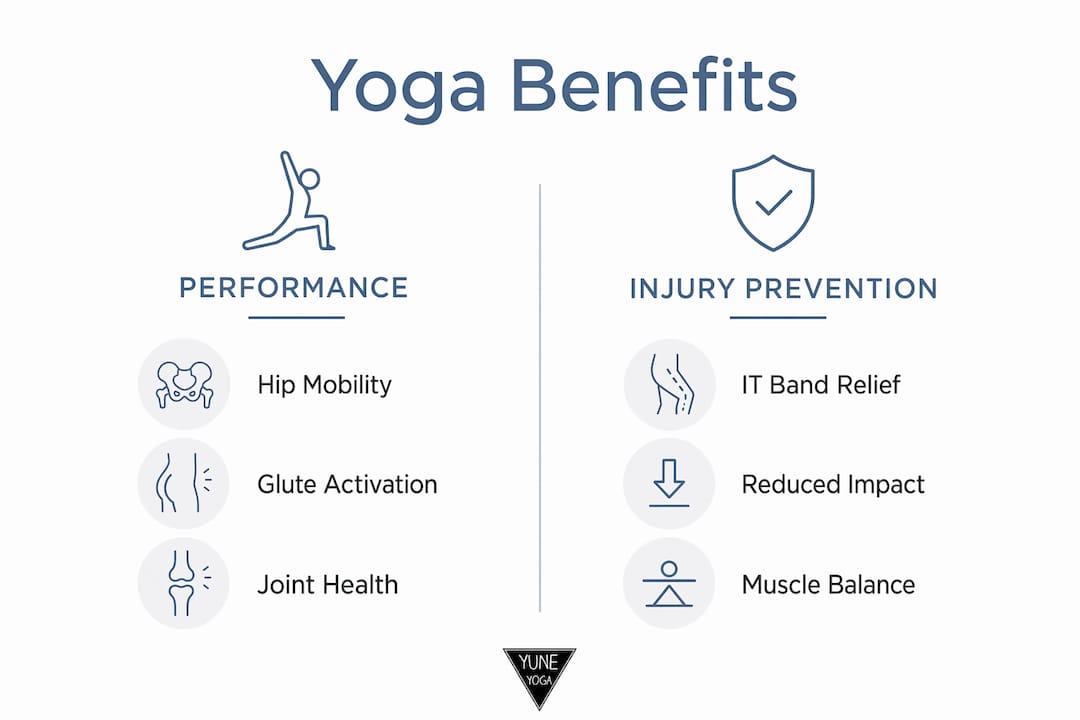
Yoga works muscles in opposite planes of motion, reducing overuse injuries and improving joint health. That is the core mechanical argument for adding yoga to your training. Running is linear and repetitive. Yoga is multidirectional and restorative.
How does yoga improve running biomechanics and prevent injury?
The biomechanical case for yoga is stronger than most runners expect. A biomechanical study found that yoga-trained runners saved 44% more energy during foot strike compared to controls. That energy saving comes from improved hip range of motion and better muscle activation timing, both of which yoga directly trains.
When your hips move through a fuller range before each stride, your glutes fire earlier and your landing forces distribute more evenly across the lower limb. The result is a gait that is both faster and safer. Traditional static stretching before a run does not produce this effect. Dynamic yoga flows do, because they warm tissue while training neuromuscular coordination simultaneously.
Pro Tip: Use a sun salutation sequence as your pre-run warm-up instead of standing quad stretches. Five rounds take under four minutes and activate your glutes, hip flexors, and thoracic spine before your first mile.
The injury prevention angle is equally concrete. IT band syndrome and patellofemoral pain are the two most common overuse injuries in distance runners. Both trace back to weak or poorly timed glute and hip stabilizer activation. Yoga poses that target the gluteus medius and piriformis address the root cause, not just the symptom.
| Yoga benefit | Biomechanical effect |
|---|---|
| Hip range of motion | Earlier glute activation, reduced hamstring compensation |
| Core engagement | Improved trunk stability, reduced lateral sway |
| Neuromuscular timing | Lower ground reaction forces at foot strike |
| Thoracic mobility | Better arm drive, reduced shoulder tension |
Which yoga poses for runners deliver the most benefit?
Four foundational poses address the most common areas of tightness and weakness in runners. Holding these poses for at least 90 seconds per side yields significant muscle release and recovery benefits. Shorter holds produce less tissue change and minimal lasting effect.
-
Low lunge with quad stretch. This pose opens the hip flexor and rectus femoris simultaneously. Runners who log high weekly mileage develop chronically shortened hip flexors, which tilt the pelvis forward and compress the lumbar spine. Hold for 90 seconds per side, keeping the back knee on the mat and the front shin vertical.
-
Supine figure-four. Lying on your back, cross one ankle over the opposite thigh and draw both legs toward your chest. This targets the piriformis and gluteus medius, the two muscles most responsible for IT band tension. It is safer than pigeon pose for runners with acute hip or knee pain.
-
Pigeon pose. The deepest hip opener in this sequence, pigeon pose releases the piriformis and hip external rotators. It requires properly warmed muscles. Never practice pigeon pose cold, because the hip joint is under significant load and cold tissue tears rather than releases.
-
Half-splits (Ardha Hanumanasana). This pose targets the hamstrings and calf complex without the spinal compression of a standing forward fold. Runners with tight hamstrings often compensate with lumbar flexion, which loads the lower back. Half-splits isolate the posterior chain correctly.
One critical misconception deserves direct correction. Direct stretching of the IT band is ineffective. The IT band is a dense connective tissue structure, not a muscle. It does not lengthen under stretch. Releasing the gluteus medius and piriformis, which pull the IT band taut, is what actually resolves IT band syndrome. Foam rolling the IT band itself produces pain without producing change.
Pro Tip: If pigeon pose causes knee pain, substitute supine figure-four. The mechanical benefit is nearly identical, and the spinal position is safer for runners with tight hips.
When and how to add yoga to your running training cycle
Timing determines whether yoga helps or hinders your running. Dynamic yoga flows work best as pre-run warm-ups, while restorative poses serve best as post-run recovery or on rest days. Mixing these up, specifically doing deep static holds before a hard run, increases injury risk rather than reducing it.
A practical structure for most runners looks like this:
-
Pre-run (5–10 minutes): dynamic flow. Cat-cow, low lunge with rotation, and leg swings prepare your joints without reducing muscle power. Static holds before a run temporarily reduce force production. Dynamic movement does not.
-
Post-run (10–20 minutes): restorative sequence. After a run, your muscles are warm and pliable. This is the best time for pigeon pose, half-splits, and supine figure-four. Short, targeted sessions of around 10 minutes boost power, strength, and injury resistance effectively. A 20-minute session on recovery days provides more comprehensive tissue release.
-
Rest days: full restorative practice. A longer session on your easy day gives your nervous system time to downregulate and your connective tissue time to remodel. This is where you address accumulated tightness from the week’s training.
-
Consistency over duration. Regular practice of specific yoga poses yields better performance and injury prevention than infrequent full-length classes. Ten minutes every day outperforms a 60-minute class once a week.
The most common mistake runners make is treating yoga as an occasional supplement rather than a training tool. Sporadic practice produces sporadic results. Build it into your weekly structure the same way you schedule tempo runs and long runs.
How does yoga improve mental performance for runners?
Yoga’s mental benefits are as concrete as its physical ones. Mindfulness and breath control from yoga help runners manage physical discomfort and improve recovery through nervous system regulation. This is not a soft claim. Breath-focused yoga activates the parasympathetic nervous system, which counteracts the chronic sympathetic activation that hard training creates.
Runners who practice breath awareness carry that skill into races and hard workouts. When your heart rate spikes at mile 20 or your legs tighten on a tempo interval, controlled nasal breathing is the fastest tool available to lower perceived effort. Learning breath awareness in yoga practice transfers directly to race-day execution.
“Yoga teaches you to stay present when your body is uncomfortable. That skill is exactly what separates runners who hold their pace in the final miles from those who don’t. The breath is the lever. Yoga teaches you how to use it.”
Savasana, the final resting pose in most yoga sessions, is not optional recovery theater. It is the phase where your nervous system consolidates the session’s neuromuscular changes. Skipping it is the equivalent of cutting your cool-down run short. The adaptation happens in the rest, not the effort.
Key Takeaways
Yoga for runners produces measurable gains in biomechanics, injury prevention, and mental performance when practiced consistently with the right poses at the right training phases.
| Point | Details |
|---|---|
| Biomechanical gains | Yoga warm-ups reduce ground reaction forces and improve glute activation timing before runs. |
| Targeted poses matter | Four poses — low lunge, supine figure-four, pigeon pose, and half-splits — address the most common runner injuries. |
| IT band misconception | Stretching the IT band directly does nothing; release the gluteus medius and piriformis instead. |
| Timing is critical | Dynamic flows belong pre-run; restorative holds belong post-run or on rest days. |
| Consistency wins | Ten minutes daily outperforms a 60-minute class once a week for functional running benefits. |
Why most runners are doing yoga wrong
I’ve watched runners treat yoga like a punishment they endure after a hard week. They show up to a 60-minute class once a month, force themselves into pigeon pose with cold muscles, and wonder why it doesn’t help. That approach doesn’t work, and it’s not a yoga problem. It’s a sequencing problem.
The runners I’ve seen benefit most from yoga share one habit: they do a short, targeted sequence consistently. Not a full class. Not a complex flow. Five to eight poses, held properly, four to five times a week. That regularity is what changes tissue quality and movement patterns over time.
The other mistake I see constantly is cold deep stretching. Pigeon pose on a cold hip is a fast path to a hip flexor strain. Your connective tissue needs blood flow before it will release. A five-minute walk or a light jog before your yoga session changes everything about how your body responds to the poses.
My honest recommendation: start with the four foundational poses covered here. Add them after every run for two weeks. You will feel the difference in your hip mobility and your post-run recovery before the two weeks are up. If you want to go deeper, yoga for injury rehabilitation is a natural next step for runners managing chronic tightness or returning from injury.
— Nicholas
Gear up for your yoga practice with Yuneyoga
Running and yoga share one non-negotiable requirement: the right surface under you. A mat that slips during pigeon pose or bunches during a low lunge breaks your focus and your form.

Yuneyoga carries a curated selection of natural rubber yoga mats built for the grip and cushioning that runners need during deep hip openers and restorative holds. The eco-friendly foldable travel mats are a practical choice for runners who practice post-run at the track or on the road. Yuneyoga also stocks yoga straps, which are genuinely useful for half-splits and hamstring work when your flexibility is still developing. A quality mat and a strap are the only two tools you need to start.
FAQ
What is yoga for runners, exactly?
Yoga for runners is a targeted practice that addresses the muscle groups and movement patterns most stressed by running, including hip flexors, glutes, hamstrings, and core stabilizers. It differs from general yoga by focusing on injury prevention, gait efficiency, and running-specific recovery.
Should runners do yoga before or after a run?
Dynamic yoga flows belong before a run to activate muscles and improve joint mobility. Restorative and static poses belong after a run or on rest days, when muscles are warm and the nervous system benefits most from downregulation.
How long does a yoga session need to be to help runners?
Ten minutes of targeted yoga is enough for daily maintenance and injury prevention. A 20-minute session on recovery days provides more complete tissue release and nervous system recovery.
Does yoga actually help with IT band syndrome?
Yoga helps IT band syndrome by releasing the gluteus medius and piriformis, the muscles that pull the IT band taut. Stretching the IT band directly does not work because it is connective tissue, not muscle, and does not lengthen under stretch.
How often should runners practice yoga to see results?
Consistent short sessions produce better results than occasional long ones. Four to five targeted sessions per week of 10–20 minutes each will improve flexibility, reduce injury risk, and support recovery more effectively than one weekly class.


