
Heat Can Raise Phthalates Fivefold: PVC Yoga Mat Safety Tested
PVC yoga mats aren’t inherently dangerous in casual use, but independent lab testing has repeatedly found additives, like phthalates and DOTP, that can migrate out of the material, especially under heat. The evidence supports a precautionary approach: choose a non-PVC mat when you can, per findings from the Ecology Center, the CDC, and the EPA. If you’re keeping a PVC mat for now, skip hot yoga on it and air it out before your first session.
TL;DR:
- PVC yoga mats often contain additives like phthalates, heavy metals, and flame retardants, which can migrate out and pose health risks during use.
- Heat significantly increases chemical off-gassing from PVC mats, especially during hot yoga sessions, raising exposure levels through inhalation and skin contact.
- Labels like PER, “eco,” or Prop 65 warnings can be misleading, as many products falsely market PVC or contain unknown chemical contents despite these claims.
- Replacing PVC mats with natural rubber or cork offers a safer alternative, with fewer synthetic chemicals, better grip when damp, and minimal off-gassing.
- If sticking with PVC, airing out the mat, avoiding hot sessions, and regular cleaning can reduce chemical exposure risk.
Table of Contents
- What PVC Yoga Mat Safety Actually Involves
- The Chemicals to Watch For in PVC Mats
- How PVC Mats Release Chemicals During Practice
- Reading Labels: PER, “Eco,” and Prop 65 Warnings
- How to Choose a Safer Yoga Mat: A Practical Checklist
- Comparing Non-PVC Materials: Rubber, Cork, TPE, and Textiles
- Keeping Your PVC Mat? Do These Four Things
- Why We Steer Customers Toward Non-PVC Mats
- Ready to Make the Switch? Start Here
- Sources
- FAQ
What PVC Yoga Mat Safety Actually Involves
PVC, or polyvinyl chloride, is one of the most common materials in budget and mid-range yoga mats because it’s cheap, durable, and grippy. The safety concern isn’t the PVC polymer itself sitting inert on your floor. It’s the additives blended into it during manufacturing that aren’t chemically locked in place and can work their way out over time.
Four hazard categories show up repeatedly in independent testing and toxicology literature: plasticizers (chemicals added to make rigid PVC flexible), heavy metals like lead and cadmium (sometimes used as stabilizers), flame retardants, and manufacturing or disposal byproducts such as dioxins released when PVC is produced or burned. None of these categories are unique to yoga mats. They show up in shower curtains, vinyl flooring, and countless other consumer products, but a yoga mat puts you in unusually close, prolonged, repeated contact with the material.
Exposure happens through three main routes:
- Inhalation of volatile compounds that off-gas from the mat’s surface, especially in a warm, poorly ventilated room.
- Dermal contact, where sweat and skin oils help pull chemicals out of the mat and onto your skin during a session.
- Dust ingestion, as mats degrade slightly with use and shed fine particles that settle around your home.
The lifecycle angle matters too. PVC manufacturing can release dioxins, and burning PVC at end of life does the same, which is one reason environmental health researchers flag it as a material worth avoiding beyond just personal exposure.
The Chemicals to Watch For in PVC Mats
Not every chemical on this list carries the same weight of evidence, and treating them all identically would be dishonest. Here’s what the research actually shows, chemical by chemical.
Phthalates are the biggest concern and the most studied. They’re plasticizers added to PVC to keep it flexible, and they’re not chemically bound to the polymer, so they migrate out over time. The concern centers on endocrine disruption, meaning these compounds can interfere with hormone signaling in the body. A 2018 study measured a meaningful shift in phthalate concentration in the air around a heated PVC surface.
At hot-yoga temperatures around 104°F, researchers measured phthalate air concentrations rising from roughly 0.2 parts per billion to about 1 part per billion, according to reporting on the study in Scienceline. That’s a fivefold increase tied directly to heat.
The CDC’s own phthalate fact sheet is careful to note that the health effects of low-level, everyday phthalate exposure in humans remain genuinely uncertain. This isn’t a case of “phthalates definitely harm you at any dose.” It’s a case of “we don’t fully know, and the precautionary choice is to reduce exposure where it’s easy to do so.”
DOTP (dioctyl terephthalate), often marketed as DEHT, is the phthalate substitute manufacturers switched to as public pressure mounted against traditional phthalates. The Ecology Center’s testing found DOTP in several mats marketed as safer alternatives. It’s likely a genuine improvement over older phthalates, but the toxicology on DOTP is thinner. Fewer decades of study means fewer answers, not necessarily fewer risks.
Heavy metals, mainly lead and cadmium, sometimes appear in PVC as stabilizers that keep the plastic from degrading under UV light and heat. These metals don’t off-gas the way phthalates do, but they accumulate in the body over a lifetime of low-level exposure, which is why even small amounts in a product you touch daily draw scrutiny.
Organophosphate flame retardants (PFRs) show up in some PVC products, and the reproductive health signal here deserves a clear-eyed read. An observational cohort study published in Environmental Health Perspectives linked higher levels of certain flame retardant metabolites to lower success rates in IVF treatment. That’s a real finding worth taking seriously, but it’s also an association from one population, not proof that a specific yoga mat causes fertility problems. The honest takeaway is that PFRs belong on a watchlist, not a guaranteed-harm list.
Azodicarbonamide, a blowing agent used to create the foam texture in some PVC mats, rounds out the list of flagged additives. It’s been studied more in the context of food packaging and rubber products, and its presence in mat manufacturing is one more reason independent lab testing matters more than a brand’s own marketing copy.
How PVC Mats Release Chemicals During Practice
Off-gassing isn’t a mysterious process. It’s the same reason a new shower curtain or a freshly unrolled carpet smells strong for the first few days: volatile compounds trapped in the material evaporate into the air around it, and that evaporation rate isn’t constant.
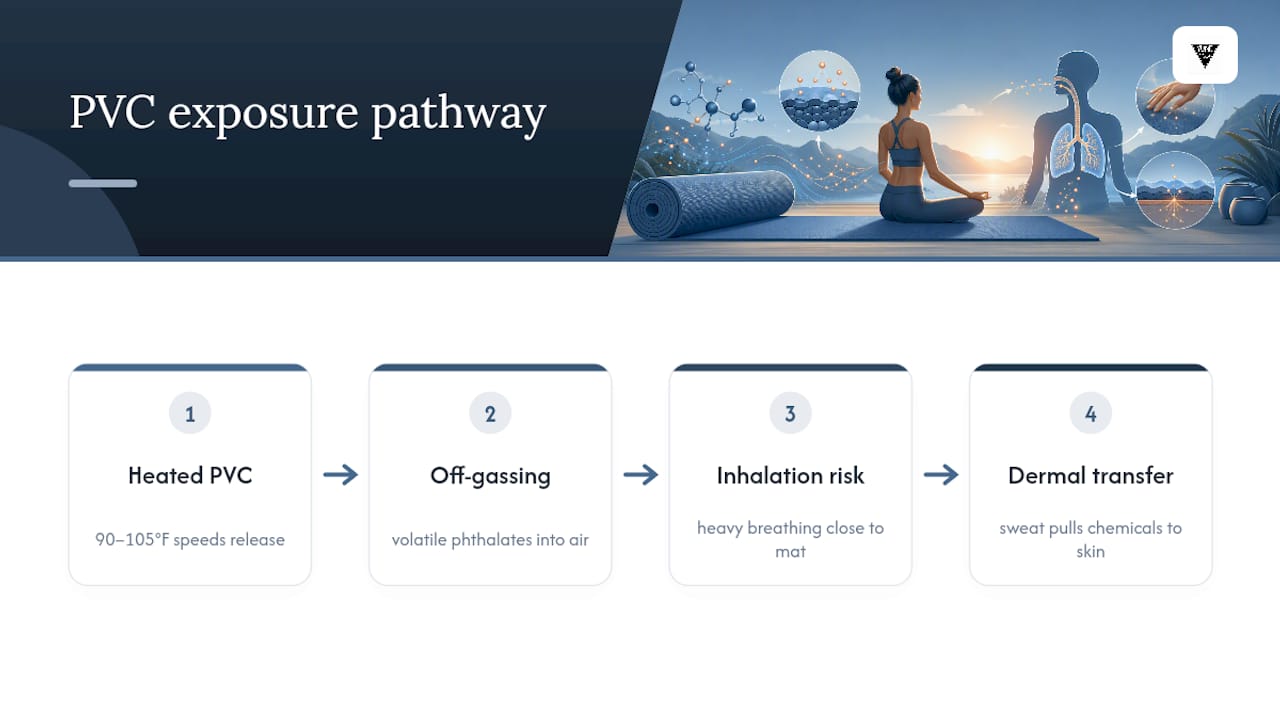
Temperature is the main accelerant. Heat gives molecules more energy to break free from the plastic matrix, which is exactly why the phthalate levels measured near a heated PVC surface jumped as sharply as they did in the 2018 study. A hot yoga room, typically kept between 90°F and 105°F, creates close to ideal conditions for this kind of migration. Add in the fact that you’re breathing heavily and lying face down on the mat for extended stretches, and you’ve combined the two biggest risk multipliers: heat and prolonged inhalation proximity.
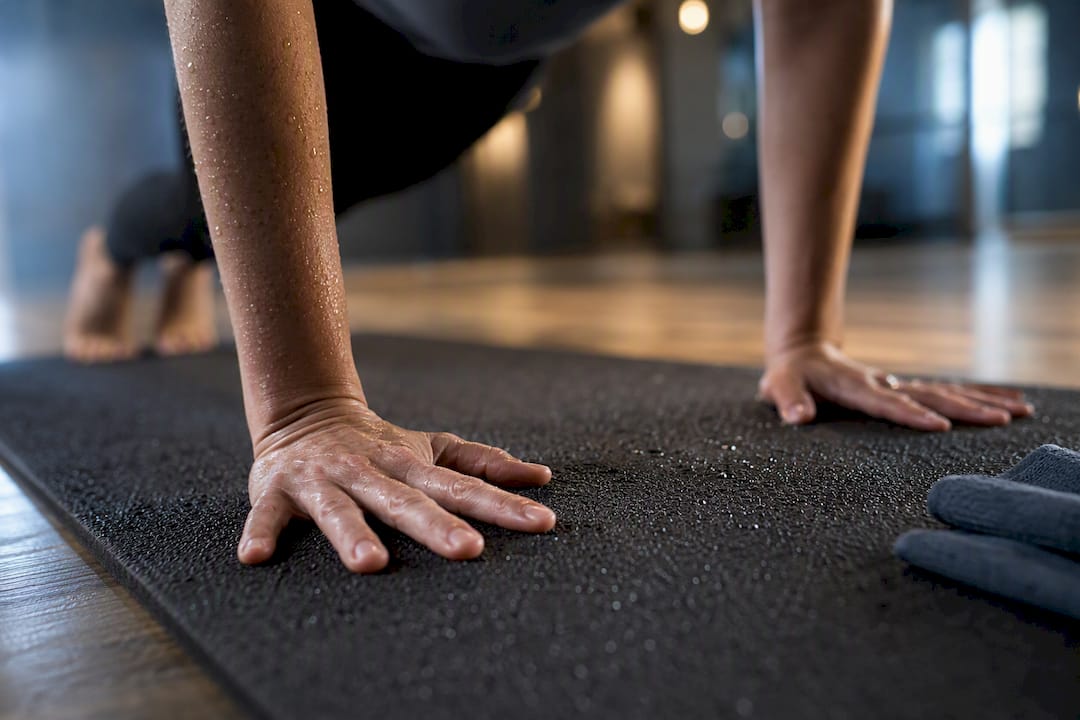
Dermal transfer works through a related but separate mechanism. Sweat acts as a solvent, pulling surface chemicals off the mat and onto your skin during downward dog, savasana, or any pose where skin contact is sustained. Repeated exposure over months and years, session after session, is a fundamentally different exposure profile than touching a vinyl product once in a while.
Pro Tip: If you practice hot yoga several times a week on a PVC mat, that’s the single highest-priority scenario for switching materials. Heat plus frequency plus skin contact is the combination that turns a theoretical concern into a practical one.
For most people practicing at room temperature a few times a week, the exposure picture looks less urgent. The math changes fast, though, once you add daily hot practice, a poorly ventilated studio, or a mat that’s already showing signs of wear, since degrading material tends to off-gas more readily than a fresh one.
Reading Labels: PER, “Eco,” and Prop 65 Warnings
“PER” is one of the more misleading terms floating around the yoga mat market, and it’s worth understanding exactly what it does and doesn’t mean. The Ecology Center’s 2019 testing report found several mats labeled as PER, sometimes marketed as an eco-friendly alternative to PVC, that turned out to be primarily PVC once tested in the lab. PER is not a standardized, regulated material category. It’s a term suppliers can apply loosely, and without independent verification, it functions more as a marketing signal than a chemical guarantee.
“Phthalate-free” claims have a similar problem. A mat can be legitimately free of traditional phthalates while still containing DOTP, which the same Ecology Center testing detected in multiple samples marketed this way. That’s not necessarily a red flag on its own, but it does mean “phthalate-free” doesn’t tell you as much as it sounds like it does.
California’s Proposition 65 warning label causes a lot of unnecessary alarm, and it’s worth demystifying. Prop 65 requires a warning on products that contain any of a long list of chemicals at any detectable level, without specifying which chemical, how much, or what the actual exposure risk is. Many manufacturers slap the warning on nationally distributed products just to avoid the cost of tracking which state each shipment lands in, according to Scienceline’s reporting on the issue. Seeing a Prop 65 label doesn’t automatically mean a product is dangerous, but it should prompt you to ask more questions, not fewer.
Here’s what a genuinely credible disclosure looks like:
- A full material breakdown listing the base polymer and any plasticizers by name, not vague terms like “eco-friendly compound.”
- Independent, third-party lab reports you can actually request and read, not just a brand’s internal safety claims.
- Clear disclosure of which plasticizer is used if the product isn’t 100% PVC-free, since “no added phthalates” can still mean DOTP or another substitute is present.
How to Choose a Safer Yoga Mat: A Practical Checklist
Replacing a mat doesn’t require a chemistry degree, but it does require asking the right questions before you hit “buy.” Here’s the order of operations that actually protects you.
- Start with material, not marketing language. Natural rubber, cork, and organic cotton have far simpler chemical profiles than PVC, with fewer synthetic additives that can migrate. If a listing doesn’t name the actual base material clearly, that’s a signal to look elsewhere.
- Ask for independent lab testing, not brand claims. A credible seller should be able to point to third-party testing for VOCs, phthalates, and heavy metals, similar in spirit to what the Ecology Center conducts. If a company can’t produce this on request, treat that as informative in itself.
- Weigh certifications for what they actually cover. OEKO-TEX certification tests for a defined list of harmful substances in textiles, which is meaningful, but it’s not a blanket guarantee against every possible additive. Certifications are a strong signal, not a complete substitute for asking direct questions.
- Factor in real performance trade-offs. Natural rubber grips well but can be heavier and carries a natural latex smell some people don’t love. Cork offers excellent grip when your hands and feet are damp with sweat, which sounds counterintuitive until you try it. TPE blends are lighter and often cheaper but vary widely in chemical composition depending on the manufacturer.
- Send a direct question before you buy. Something as simple as: “Can you share the full material composition and any third-party lab test results for phthalates and heavy metals?” filters out sellers who can’t or won’t answer.
Pro Tip: Save that exact question as a template. Reuse it for every mat, towel, or strap purchase, and you’ll quickly learn which brands take material transparency seriously.
Comparing Non-PVC Materials: Rubber, Cork, TPE, and Textiles
Natural rubber is the material most health-conscious practitioners land on first, and for good reason. It offers strong grip, holds up well over years of regular use, and doesn’t rely on the plasticizers that make PVC a concern. The one caveat: natural rubber is derived from latex, so anyone with a latex allergy needs to steer clear or choose a different material entirely.
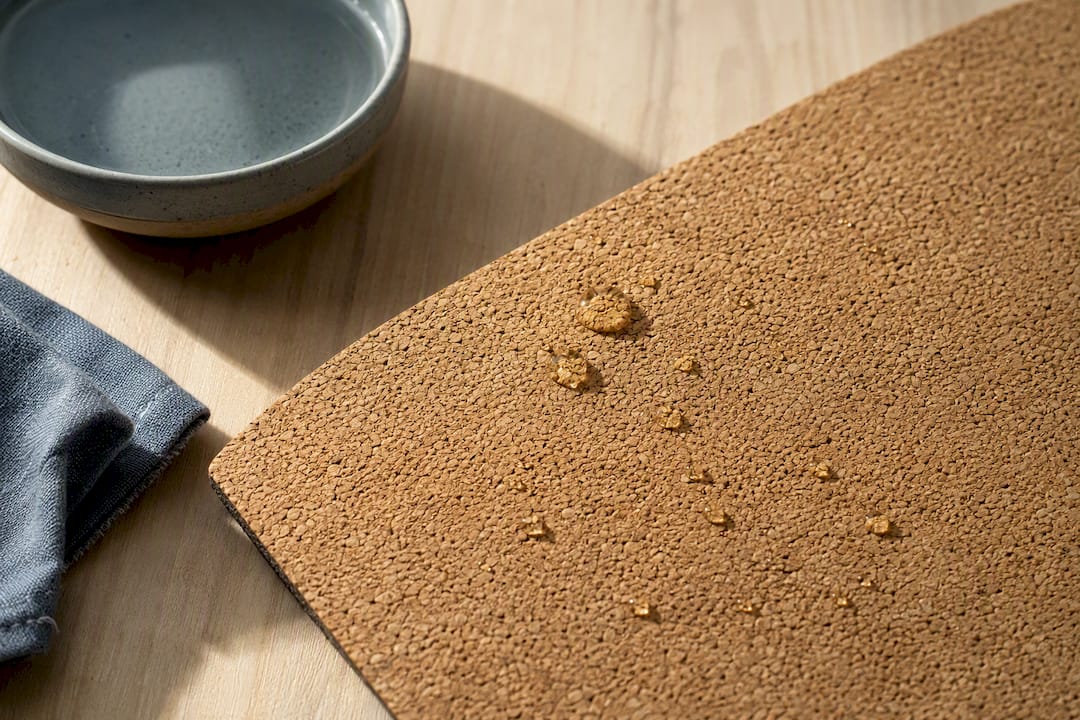
Cork has quietly become a favorite for practitioners who sweat heavily during practice, since it gets grippier as it gets damp rather than more slippery. It also has natural antimicrobial properties that cut down on odor buildup between washes, and its manufacturing process involves far less chemical processing than PVC, which translates to a lower off-gassing profile.
TPE (thermoplastic elastomer) and polyurethane blends sit in a gray zone. Some formulations are genuinely lower in harmful additives than PVC, but quality varies enormously by manufacturer, and “TPE” alone doesn’t tell you much without knowing how a specific brand sources and processes it.
Organic cotton and jute mats trade some cushioning and durability for breathability and a lighter environmental footprint, since both are natural, biodegradable fibers. They tend to work best for restorative or gentle practice styles rather than sweaty vinyasa flows, where a slicker natural fiber surface can become a slipping hazard. It’s also worth noting that “recycled” materials aren’t automatically cleaner. The Ecology Center’s testing found phthalates showing up in solvent extracts from some recycled-wetsuit rubber mats, a reminder that recycled feedstock can carry forward whatever chemicals were in the original product. For a deeper breakdown of how these materials stack up, see this guide to understanding different yoga mat materials.
Keeping Your PVC Mat? Do These Four Things
If you’re not ready to replace your mat today, a few habit changes meaningfully cut your exposure in the meantime.
- Air out a new mat for several days before your first use. Unroll it in a well-ventilated space, ideally outdoors or near an open window, before it ever touches your skin.
- Skip hot yoga on a PVC mat, or add a thick towel barrier. Given how sharply phthalate off-gassing increases with heat, this is the single highest-impact change you can make.
- Clean it regularly with a simple solution of water and mild soap, avoiding harsh solvents that can actually accelerate the breakdown of the mat’s surface.
- Never burn a PVC mat for disposal, since combustion releases dioxins. Check for local textile or plastic recycling programs that accept vinyl products before tossing it in the trash.
Pro Tip: The EPA’s guidance on indoor VOCs confirms that simple ventilation, an open window, a fan, practicing near airflow, measurably lowers indoor concentrations of off-gassed chemicals. It costs nothing and takes thirty seconds.
Why We Steer Customers Toward Non-PVC Mats
At Yuneyoga, we built our catalog around natural rubber, cork, and other low-additive materials because the evidence on PVC’s migrating chemicals is too consistent to ignore. Every product page spells out the actual material composition, not vague marketing language. If you want more detail before buying, our support team can walk you through what testing information is available. Evidence-driven choices beat convenient assumptions every time.
— Nicholas
Ready to Make the Switch? Start Here
Many yoga mat catalogs are built around one idea: you shouldn’t have to choose between a mat that performs and a mat that’s made from materials you actually trust. Our natural rubber mats, cork options, and eco-conscious foldable travel mats skip the plasticizers and flame retardants that show up in conventional PVC testing, without giving up the grip and durability serious practitioners need.

If you’re still narrowing down which material fits your practice, our breakdown of the 5 best non-toxic yoga mats for a safer practice walks through real trade-offs between grip, thickness, and feel. And if you’re shopping for a travel companion or a sweat towel to pair with a new mat, our yoga clothes and accessories collection rounds out the essentials. Before you buy from any seller, ours included, ask for the material composition and any available lab reports. Browse the current mat collection and find one built for how you actually practice.
This article is general information, not a substitute for advice from a qualified doctor. Consult a qualified healthcare professional about your own circumstances before acting on anything here.
Sources
- Yoga Mats Testing Reveals Greenwashing
- Why my yoga mat scared me — and what I did about it
- Volatile organic compounds’ impact on indoor air quality (EPA)
FAQ
What material should I avoid in a yoga mat?
Avoid PVC when possible, since independent testing has found migrating additives like phthalates and DOTP in mats made from it, particularly under heat.
Is PVC a good material for yoga mats?
PVC performs well for grip and durability, but its additives raise precautionary health concerns backed by lab testing from the Ecology Center, making it a weaker choice than natural rubber or cork for health-conscious practitioners.
Which yoga mat is better, TPE or PVC?
TPE generally involves fewer of the additives associated with PVC, though quality varies by manufacturer, so it’s worth requesting composition details for either material before buying.
What is the healthiest material for a yoga mat?
Natural rubber and cork currently have the strongest safety profile among common mat materials, with lower off-gassing and fewer synthetic additives than PVC or TPE blends. Yuneyoga’s natural rubber mat collection is built specifically around this material.