
That New Yoga Mat Smell: Is It Off-Gassing, and Is It Safe?
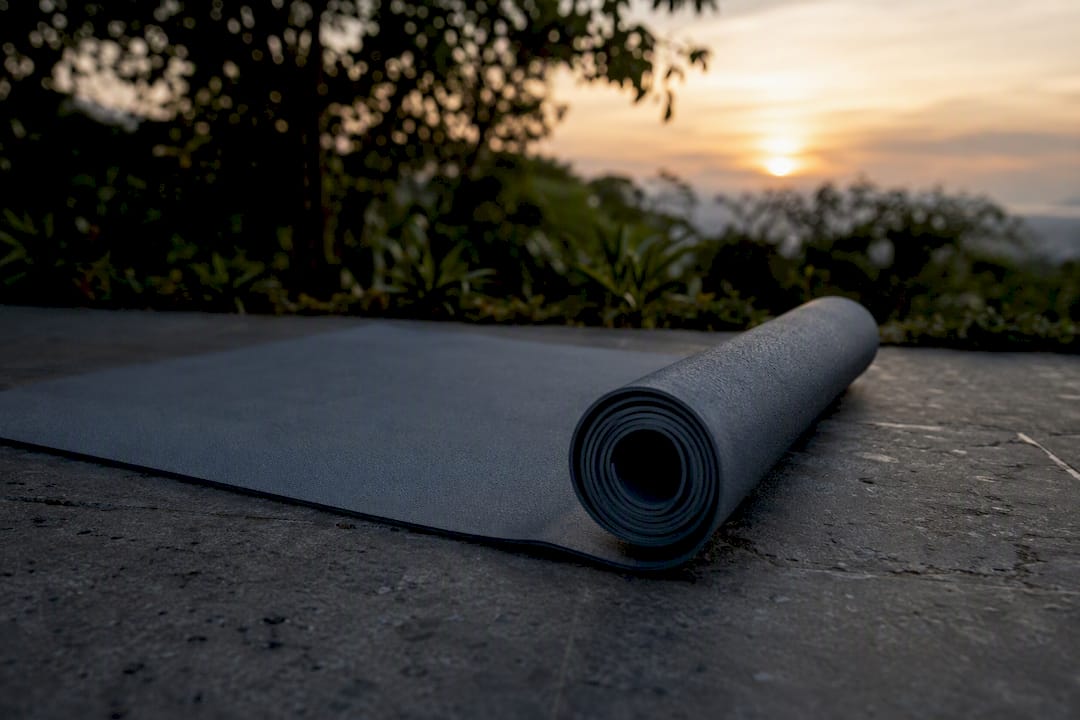
That sharp, rubbery, sometimes chemical scent rolling off a brand-new mat is almost always off-gassing, either from volatile organic compounds (VOCs) leaving the material or natural rubber finishing its curing process. Neither one means your mat is dangerous, but neither one means you should ignore it either.
Here’s what to do right now, before your next class:
- If the smell makes your eyes water, gives you a headache, or triggers coughing, stop using the mat indoors and move it to a ventilated space immediately.
- If it’s just a strong “new rubber” or “plastic” smell with no physical symptoms, unroll the mat flat somewhere with moving air, a fan or open window works.
- Wipe it once with a barely damp cloth and a drop of mild dish soap, then a clean water rinse.
- Let it dry completely, flat or hung, before your first practice.
That sequence handles most cases within a few days.
Key Takeaways
Most new-mat odor is off-gassing or rubber curing that fades within one to four weeks with ventilation, gentle cleaning, and smart material choices.
| Point | Details |
|---|---|
| Smell isn’t the whole story | Odor is an imperfect safety signal; natural rubber can smell strong while emitting fewer plasticizers than a scentless PVC mat. |
| Ventilate before you clean | Unroll flat in moving air for several days before reaching for soap or baking soda. |
| Peak happens fast | Emissions peak in the first 24 to 72 hours, then decline sharply over the following weeks. |
| Heavy users face more exposure | Teachers and daily practitioners accumulate more cumulative VOC exposure than occasional users. |
| Material choice prevents the problem | Yuneyoga curates natural rubber, cork, and tested TPE mats specifically to minimize off-gassing from the start. |
This article is general information, not a substitute for advice from a qualified doctor. Consult a qualified healthcare professional about your own circumstances before acting on anything here.
Table of Contents
- What Causes Yoga Mat Off Gassing in the First Place
- Are Yoga Mats Harmful? Understanding the Real Exposure Risk
- How Long Does Yoga Mat Off Gassing Actually Last?
- The Step-by-Step Fix: How to Get Rid of Yoga Mat Smell Safely
- Choosing a Safer Mat: What to Check Before You Buy
- Sources
What Causes Yoga Mat Off Gassing in the First Place
VOCs are chemical compounds that evaporate easily at room temperature, and they’re released by an enormous range of household items, not just mats. The EPA notes that indoor VOC concentrations are often significantly higher than outdoors because so many common products, paint, furniture, foam, adhesives, emit them into enclosed spaces. A yoga mat is one more source added to that mix.
Rubber curing smell is different chemically but similar in experience: it’s the natural odor of processed latex finishing its manufacturing reaction, not a synthetic solvent.
Several factors make a new mat smell stronger than it will a month from now:
- Mats sit sealed in plastic packaging for weeks or months during shipping and warehousing, trapping emissions until you open the box.
- Warm shipping containers and storage accelerate the release of compounds, so a mat that traveled through summer heat may reek more than one shipped in winter.
- Textured surfaces and printed coatings add surface area and extra material layers, both of which hold onto odor longer.
- Vague labeling terms like “PER” or “eco-friendly” sound reassuring but say nothing concrete. Testing by the Ecology Center’s Healthy Stuff Lab found several mats marketed with ambiguous terms were actually PVC, containing plasticizers like DOTP and DEHT along with fillers and mold-release agents.
Are Yoga Mats Harmful? Understanding the Real Exposure Risk
Toxicology comes down to one simple equation: exposure equals concentration multiplied by time. A faint smell for ten minutes is a different exposure than a strong smell for a 90-minute hot yoga class, and proximity matters more with mats than with most household items, because your face hovers inches from the surface during pranayama and floor poses.
A 2026 study measuring VOC emissions from yoga mats found that PVC construction, waterproof surface coatings, and raised textured patterns all increased emission levels compared to plain natural rubber, cork, or properly tested TPE. Design choices, not just base material, shape how much you’re breathing in.

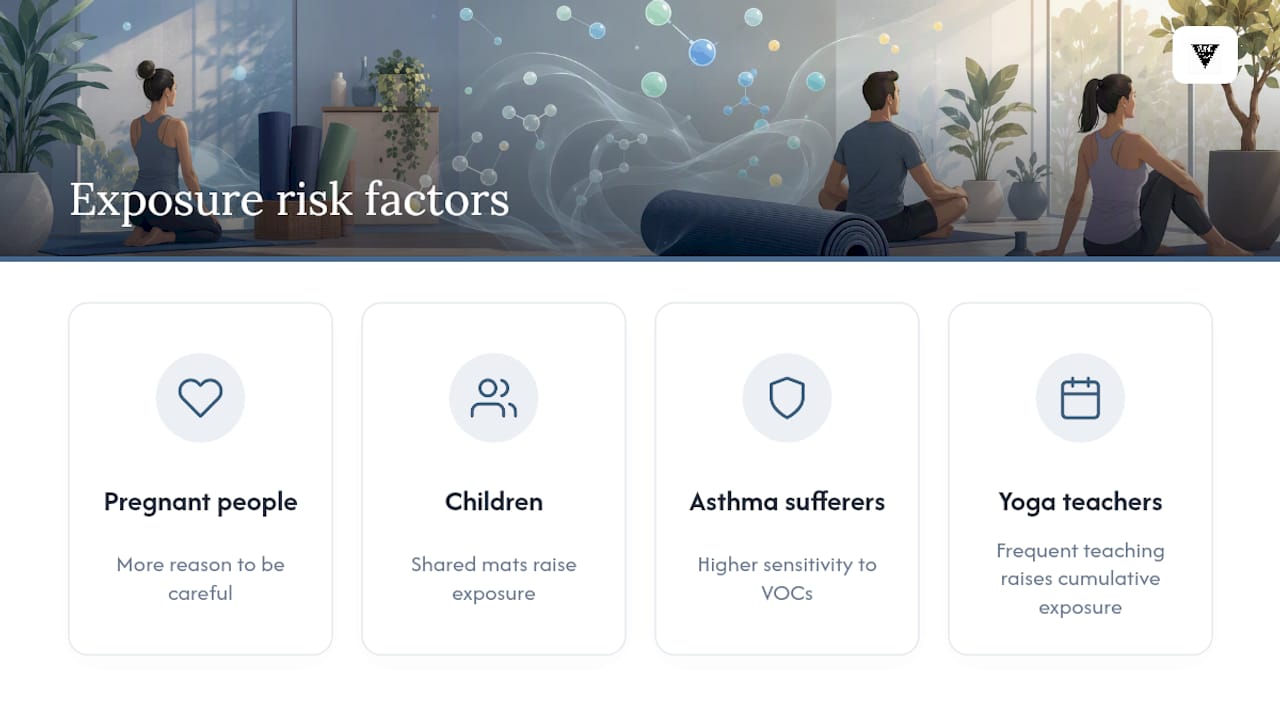
Certain groups have more reason to be careful. Pregnant practitioners, young children on shared family mats, people with asthma or chemical sensitivities, and yoga teachers who spend many hours weekly on mats face a cumulative exposure that occasional weekend practitioners don’t. That last group matters more than people assume: a studio teacher demonstrating on a mat five days a week accumulates exposure a once-a-week student never approaches.
Smell alone is an unreliable gauge. Natural rubber can smell intensely “rubbery” while emitting fewer harmful plasticizers than an odorless PVC mat coated to mask its scent, according to Yoga Journal’s reporting on new mat smell. When you’re uncertain, ventilation and verified low-emission certifications are more trustworthy than your nose.
How Long Does Yoga Mat Off Gassing Actually Last?
Most mats follow a predictable decay curve. Emissions peak somewhere in the first 24 to 72 hours after unboxing, then drop sharply over the following one to four weeks. A low-level tail can linger longer for PVC or heavily coated mats, sometimes for a couple of months at barely detectable levels.
A few things stretch or compress that timeline:
- Heat speeds up the process; a warmer room airs out a mat faster than a cooler one.
- Humidity slows evaporation, so a damp basement is the wrong storage spot.
- Coated or textured surfaces hold onto residual compounds longer than smooth, single-material designs.
- As a rule of thumb: give a new mat 3 to 7 days of active airing before daily indoor use, and if the smell hasn’t faded noticeably by week two, escalate to the cleaning steps below.
The Step-by-Step Fix: How to Get Rid of Yoga Mat Smell Safely
Work through these in order. Most people solve the problem in step one or two.
-
Ventilate first. Unroll the mat completely flat in a room with airflow, near an open window or a fan on low. Flip it every day so both sides get exposure. Keep it shaded unless the manufacturer specifically says the material tolerates sun, since UV can degrade some rubber and foam surfaces faster than it clears odor.
-
Do a gentle wipe-down. Mix a small amount of mild dish soap with water, wipe the surface with a damp cloth, then wipe again with a clean, water-only cloth to rinse residue. This removes manufacturing film and packaging chemicals sitting on the surface rather than trying to pull VOCs out of the material itself. Never soak the mat or submerge it; trapped moisture inside foam layers causes far worse problems than a lingering smell.
-
Dust with baking soda for stubborn cases. Sprinkle a light layer over the surface, let it sit a few hours, then shake or vacuum it off. Baking soda absorbs surface odor without leaving residue.
-
Try heat-acceleration on a day you’re out. Emission rates roughly double with every 18°F increase in temperature, so a warm, closed room for a few hours while you’re at work, paired with thorough ventilation afterward, can meaningfully shorten the timeline. Never do this while sleeping in the space or with young kids and pets nearby.
-
Add an air purifier with activated carbon as backup. Carbon filtration captures VOCs that standard HEPA filters pass through, but only if the unit is sized for your room. An undersized purifier running in a large studio does very little.
Pro Tip: Run the heat-acceleration step on a morning you’ll be gone all day, then crack windows the moment you’re back. You get the speed benefit of warmth without breathing the concentrated air it releases.
What not to do: skip essential oils or heavy fragrance sprays to mask the smell, they add their own VOC load on top of what’s already there. Don’t roll the mat while it’s still damp from cleaning, and don’t leave PVC or coated mats in direct sun for hours trying to “bake it faster,” since UV breaks down some coatings and can create new odors rather than clearing old ones.
If the smell is still solvent-like after two to three weeks of consistent airing, or if the mat develops a sticky, tacky residue that wasn’t there originally, that’s a sign to stop using it and consider returning it rather than continuing the cleaning cycle.
Choosing a Safer Mat: What to Check Before You Buy
Material choice determines how much of this whole process you’ll deal with in the first place. Natural rubber, cork, and well-tested TPE consistently show lower VOC emissions than PVC, according to the same 2026 emissions study. Natural rubber does carry a caveat: it comes from latex, so anyone with a latex allergy should check the product specifically rather than assume “natural” means allergy-safe. Cork mats, for a deeper look at why they perform well, are worth understanding on their own merits, including their odor and durability characteristics.
When you’re comparing product pages, look past marketing adjectives and check for real documentation:
- GREENGUARD certification or a finished-mat emissions report tied to a specific SKU and test method (CDPH-style chamber testing is the gold standard buyers should ask for).
- A report that’s current, not five years old and covering a discontinued version of the mat.
- Red flags: vague terms like “PER,” no disclosure of surface coatings or adhesives, and heavy emphasis on “fresh scent” as a selling point rather than low emissions.
Buyers should request the actual test file rather than trust a “low-VOC” label with nothing behind it, a distinction HTS Yoga’s buyer guidance lays out clearly. Reading up on how different mat materials behave before you buy saves you from guessing after the fact.
How Yuneyoga Thinks About Low-Emission Mats
We curate toward natural rubber, cork, and tested TPE specifically because they tend to off-gas less and clear faster than PVC. If you’re dealing with a smell right now, the airing-and-wipe protocol above works. If you’d rather sidestep the issue on your next purchase, choosing a lower-emission material from the start is the more direct fix.
— Nicholas
Shop Curated, Low-Emission Mats
Skipping weeks of airing out a mat that shouldn’t have smelled that strong to begin with is the real fix, and it starts with what you buy. Yuneyoga curates mats in natural rubber, cork, and other lower-emission materials specifically so you’re not troubleshooting chemical odor before your first class.

If your current mat needs a cleaning pass while it airs out, our homemade cleaner recipes walk through the gentle-wipe method step by step, and studios managing class schedules around ventilation windows can look at free scheduling tools built for that kind of logistics. When you’re ready to shop, browse Yuneyoga’s full mat collection and start with a material that gives you less to air out in the first place.
Sources
- Volatile organic compounds’ (VOCs) impact on indoor air quality — EPA
- Your yoga mat is polluting your air, new study finds (2026) — YogaJala
- Indoorhumidity
%20leaving%20the%20material%20or%20natural%20rubber%20finish...)