
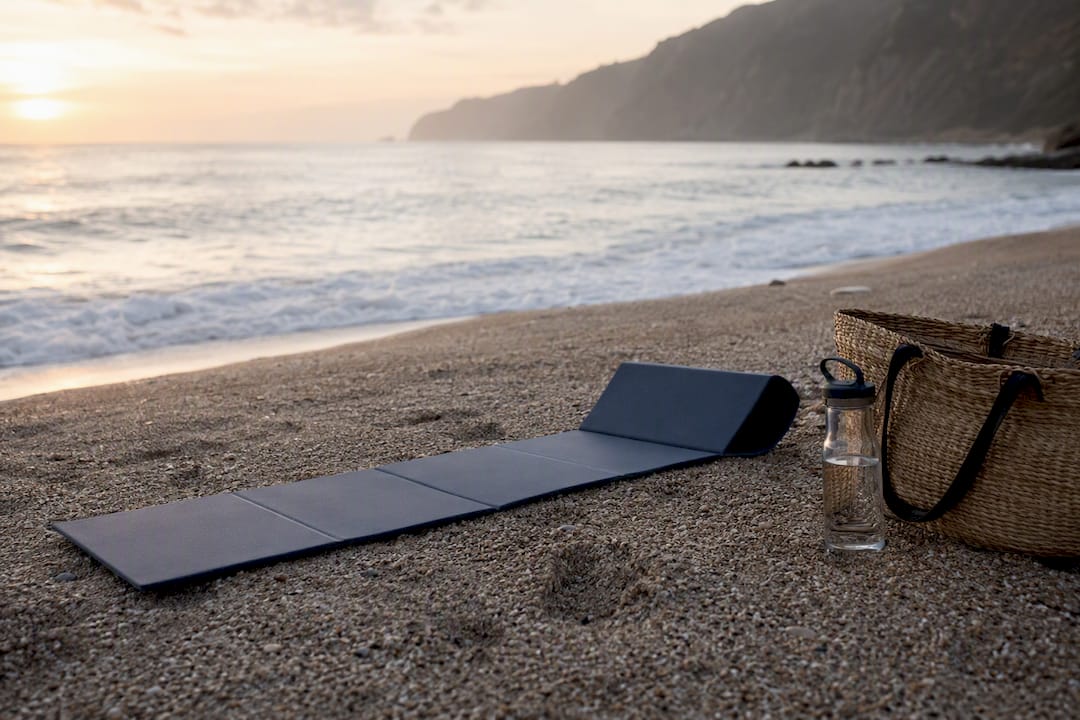
The Best Van Life Yoga Mat Is Foldable, Not Rolled
A thin, foldable travel mat beats a standard rolled mat for van life, full stop. If you need extra cushion for knees or hips, a slightly thicker foldable travel mat (up to 3mm) is the only real trade worth making. Here’s why the foldable style wins for anyone practicing out of a vehicle:
- Packability: folds flat into a bag-sized bundle instead of hogging a cylindrical chunk of cabinet space.
- Outdoor grip and durability: natural rubber and dense foldable foams hold traction on grass, dirt, and gravel without shredding.
- Easy cleaning: a flat folded mat rinses, wipes, and dries faster than a rolled one that traps moisture in its core.
Yuneyoga’s foldable travel mats are built around exactly this brief, and they’re a solid place to start if you’re outfitting a van from scratch.
Key Takeaways
A foldable, thin natural-rubber or closed-cell travel mat outperforms a standard rolled mat for van life on packability, grip, and drying speed.
| Point | Details |
|---|---|
| Choose foldable over rolled | Folded mats fit flat storage spots a rolled mat can’t use, like behind seats or under bed slats. |
| Match thickness to surface | Use around 2mm for grass and dirt, 2.5 to 3mm for gravel or concrete. |
| Weigh material trade-offs | Natural rubber grips better outdoors; closed-cell foam dries faster and resists moisture. |
| Dry before folding | Never fold a damp mat away, since it’s the fastest route to mildew in tight storage. |
| Start with Yuneyoga | Yuneyoga’s foldable travel mats and care guides are built around these exact van life constraints. |
Table of Contents
- What to Look for in a Van Life Yoga Mat
- Where to Store a Foldable Mat Inside a Van
- How to Clean a Yoga Mat on the Road
- Turning One Mat Into a Full Practice Setup
- A Practitioner’s Notes From the Field
- The Van-Life Yoga Checklist Most Guides Get Wrong
- Get a Travel Mat Built for Van Life
- Sources
What to Look for in a Van Life Yoga Mat
Most yoga mats are designed for a studio floor, not a rig that bounces down forest service roads. Before you buy, run any candidate mat through this checklist.
- Foldable over rolled. A folded mat tucks into flat, oddly shaped storage (behind a seat, under a cushion) that a rolled mat simply can’t use. Look for a folded footprint close to a laptop bag, roughly 13 by 10 inches or smaller.
- Thickness matched to your surfaces. For grass and packed dirt, 2mm generally provides enough cushion. Practicing on gravel or concrete pads more often calls for 2.5 to 3mm so your knees and wrists aren’t taking the full impact.
- Material trade-offs. Natural rubber grips better when you sweat and holds up longer under UV exposure, but it weighs a bit more and needs gentler care. Closed-cell PVC or EVA foam sheds water fast and wipes clean easily, though it can feel slicker underfoot in humid conditions.
- Weight you’ll actually carry. A travel mat weighing close to 2.3 pounds with a built-in strap is light enough to grab on your way out the door, not something you have to talk yourself into hauling.
- Specs worth checking before checkout: folded dimensions, total weight, warranty terms, and whether the surface texture is closed-cell or open-cell (this affects how it handles moisture).
Pro Tip: Check the fold lines before buying. Mats with reinforced or pre-scored fold lines resist cracking over hundreds of fold cycles. Cheap mats that fold “however” tend to develop permanent creases that turn into weak spots.
If you’re weighing natural rubber against foam, think about your climate first. Rubber performs better in cold and holds grip on wet grass; foam wins if you’re mostly parked in dry desert heat and want something that never seems to hold a smell.
Where to Store a Foldable Mat Inside a Van
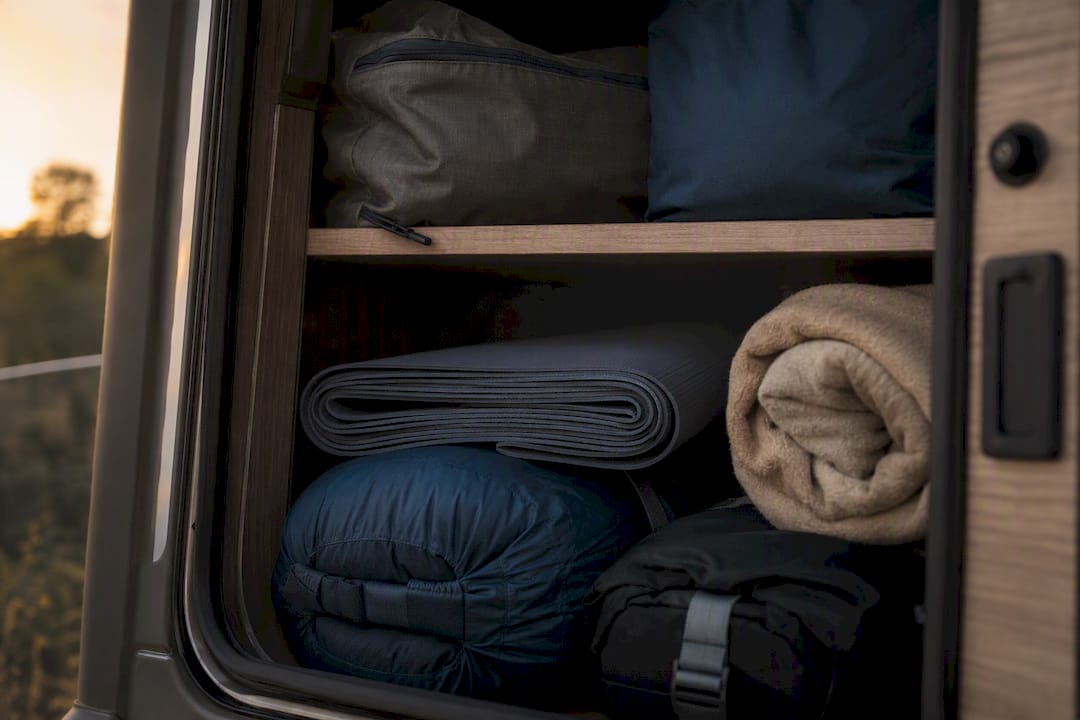
Storage is where a foldable mat earns its keep. A rolled mat needs a dedicated tube-shaped slot; a folded one can go almost anywhere flat.
- Behind seat cushions or bench seats works well in smaller camper vans where every cubic inch of cabinet space is already claimed.
- Under bed platforms, especially if you’ve built slats with even an inch of clearance, gives you a spot that’s out of sight and out of the way.
- Gear hammocks or overhead nets keep the mat accessible without eating into counter or floor space, and this method suits vans with limited built-in storage.
- Hooks or strap mounts near the rear doors turn grabbing your mat into a five-second habit instead of a dig-through-the-cabinet chore, which matters more than it sounds for actually staying consistent.
Whatever spot you pick, prioritize ventilation. A damp mat stuffed into a sealed cabinet is how mildew starts. If your storage spot doesn’t breathe, leave the mat slightly unfolded or add a mesh bag until it’s fully dry.
How to Clean a Yoga Mat on the Road
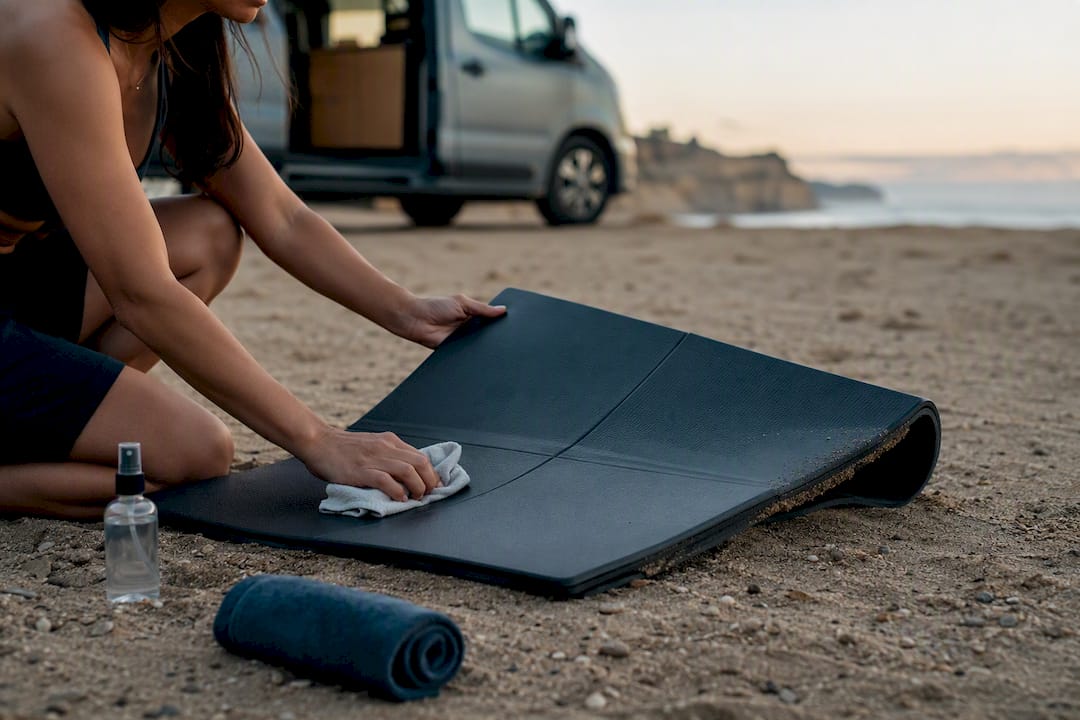
Outdoor practice means dirt, pollen, sap, and the occasional ant. None of that is a problem if you build a two-tier routine: quick after every session, deep every couple of weeks.
- Shake it out. Debris falls off easier than you’d think if you just snap the mat like a bedsheet before folding it.
- Wipe it down. A mat-safe spray or diluted mild soap handles sweat and light grime in under a minute. Our full mat cleaning guide covers what solutions to avoid.
- Dry it fully before folding. Hang it over a door, a bike rack, or a tree branch and let the sun finish the job. Folding a damp mat is the single fastest way to grow mildew inside your storage spot.
- Deep clean monthly. Unfold it completely, wipe both sides with soap and water, rinse, and hang until bone dry.
Natural rubber doesn’t like hot water or direct high heat, so skip the dashboard-drying trick even if it’s tempting. Closed-cell mats tolerate a rougher wipe-down and dry faster, which matters if you’re on a tight morning schedule.
Pro Tip: Mats with a stay-clean fold design keep the practice surface from ever touching the dirtier bottom layer, which cuts down how often you need a full deep clean.
Turning One Mat Into a Full Practice Setup
A single mat plus a small kit of accessories replaces most of what you’d find in a home gym, and none of it needs its own drawer.
- Resistance bands roll into a fist-sized bundle and add strength work to any yoga flow.
- A compact suspension trainer hooks to a tree, ladder rack, or open door for planks, rows, and stretches, and pairs naturally with van life setups that already run light on gear.
- Foldable knee pads solve the gravel-and-rock problem without adding real thickness to your mat.
On sand or loose gravel, widen your stance in standing poses and skip anything that demands a pivot on one foot. A mat that grips well through planks and lunges does double duty as informal strength equipment, which is really the whole point of packing light.
A Practitioner’s Notes From the Field
. Years of testing gear in cramped storage conditions teaches you things a spec sheet won’t.
Fold your mat with the top surface facing inward, away from the bottom. It sounds minor, but it’s the difference between pulling out a clean mat and pulling out one that picked up dust from its own underside for two weeks straight.
A built-in carry strap is worth more than people expect. It’s not just convenience: it keeps the fold tight so the mat doesn’t slowly unfurl inside your storage nook. In practice, folded dimensions under roughly 13 by 10 inches fit almost any van build, from a Sprinter conversion to a hatchback setup.
If you want to see how these features show up in an actual product, Yune Yoga’s foldable mat lineup is designed around this exact set of constraints.
The Van-Life Yoga Checklist Most Guides Get Wrong
Most gear guides treat mat thickness as the main decision. It’s not. Storage geometry is the bigger constraint, and thickness is secondary to whether the mat folds flat and fits your actual cabinet space.
The conventional advice to “just get a thin travel mat” skips the part that actually determines whether you’ll use it: can you grab it in five seconds, and will it still be dry when you do? A mat buried under gear in a stuff sack loses to a mat hanging on a rear door hook every time, regardless of thickness or material.
Prioritize access and dryness first, then material, then thickness. Get those three right and the mat becomes something you actually reach for at 6 AM before the light gets harsh, instead of gear you own but rarely use.
— Nicholas
Get a Travel Mat Built for Van Life
Yuneyoga’s foldable travel mats are built for exactly the constraints this guide walks through: tight storage, outdoor surfaces, and the need for a mat that dries fast and folds flat. If you’re piecing together a minimalist gear kit for a van, a natural rubber foldable mat gives you grip on grass and gravel without the bulk of a standard rolled mat.
Yuneyoga also stocks the foldable options built for compact storage covered throughout this guide, along with straps and towels that round out a full travel kit. If you’re ready to stop wedging a bulky rolled mat behind the driver’s seat, browse the travel mat collection and pick the thickness that matches where you park most.
Sources
- Quick Picks: Best Yoga Mats and Fitness Gear for Van Life… | Epic Van Life
- Yogo - Ultralight Foldable Travel Yoga Mat with Non-Slip FSC-Certified Natural Rubber
%20is%20the%20only%20real%20t...)