Article: 7 Yoga Towel Uses That Fix Slipping in Hot Classes
7 Yoga Towel Uses That Fix Slipping in Hot Classes
A yoga towel is a thin, absorbent layer you spread over your mat to soak up sweat, boost your grip, and keep your actual mat cleaner between washes. The three jobs it handles best are traction in sweaty classes, hygiene on shared or rented mats, and a lightweight stand-in mat for travel. The rest of this guide walks through every practical use, how to set one up correctly, which material fits which class, and how to keep it working.
TL;DR:
- Microfiber towels are the best choice for hot yoga due to their fast moisture-wicking and quick-drying properties, especially when traveling.
- Corner-pocket towels provide a more secure fit during dynamic classes with frequent transitions, reducing shifting and bunching.
- Regular washing after each sweaty session is essential to maintain grip and prevent fibers from becoming slippery or moldy.
- For traction, textured or silicone-backed towels perform better than smooth fabric towels when sweat levels increase during intense classes.
- A towel alone is suitable only for short outdoor or travel practices; for studio or joint-heavy classes, it should be used over a supportive mat.
Table of Contents
- 7 Practical Yoga Towel Uses for Every Type of Class
- How to Set Up Your Yoga Towel Before Class
- Microfiber, Bamboo, or Silicone-Backed: Which Material Fits Your Practice
- Washing and Care: Keeping Your Towel Working Like New
- Can a Towel Replace Your Mat Entirely?
- Common Mistakes That Ruin Your Grip (and How to Fix Them)
- Is Your Yoga Towel Actually Eco-Friendly?
- Yoga Towel vs. Mat Spray vs. Mat: What Each One Actually Solves
- Why Your Towel Matters More Than Your Mat in a Hot Class
- Building Your Yoga Towel Kit With Yune Yoga
- Sources
- FAQ
7 Practical Yoga Towel Uses for Every Type of Class
A towel earns its place in your bag for reasons that go well beyond wiping your forehead. Here’s where it actually changes how a session feels.
-
Grip control in hot and heated classes. Bikram, hot yoga, and any heavily heated studio session turn a rubber mat into a hazard once sweat pools on the surface. Yoga towels prevent slipping by absorbing that moisture and are especially useful in hot classes like Bikram and hot yoga, where a bare mat alone often can’t keep up.
-
Traction that improves as you sweat, not despite it. This is the part most beginners get backwards. Purpose-built towels pair moisture-wicking fibers with silicone or textured backing, so friction actually increases as perspiration rises rather than turning the surface slick. Vinyasa and power classes, where you’re moving fast between poses, benefit just as much as Bikram sessions do.
-
Hygiene on shared or rented mats. Studio rental mats get used by dozens of people a week, and gym mats fare worse. Laying a towel down gives you a barrier between your skin and whatever residue is on that surface, which matters more than most people think until they skip it once and regret it.
-
Extra cushioning under knees and wrists. Fold a hand towel and slide it under your knee in low lunge, or under your wrist in a plank-heavy sequence, and you get instant relief without breaking your alignment. This trick works for props too. A rolled towel under a yoga block edge stops it from digging into your palm during longer holds.
-
A travel mat when packing a full mat isn’t realistic. A yoga towel functions as a temporary mat for hotel rooms, outdoor practice, or beach sessions where sand and grit would ruin a foam mat anyway. It won’t give you the cushioning of a real mat, but for a quick morning flow in a small space, it’s enough.
-
Aerial and outdoor practice support. Outdoor yoga on grass, wood decking, or a park pavilion floor comes with unpredictable texture. A towel smooths that out and gives you a consistent surface to plant your hands and feet on, which matters more in balance poses than people expect.
-
Life outside the mat. Once class ends, the same towel wipes down equipment, wraps around a water bottle in your bag, or covers your shoulders for the walk to the car in cold weather. It’s a small multi-tasker, and that versatility is part of why so many practitioners keep two in rotation.
How to Set Up Your Yoga Towel Before Class
Getting the placement right takes thirty seconds and saves you from a mid-flow slip. Follow this sequence every time you unroll your mat.
- Lay your mat flat first and smooth out any air bubbles or curling edges before adding the towel.
- Align the towel’s edges with your mat’s edges. Overhang on either side is what causes bunching later.
- Check that the silicone dots or textured grip side faces down against the mat, not up toward your skin.
- Press down firmly across the whole surface so the backing grips the mat instead of floating on top of it.
- Test traction with your palm before class starts. Push down and slide slightly. If it shifts, reposition and press again.
Corner-pocket towels, which slip over the four corners of your mat like a fitted sheet, hold in place better during fast transitions than towels that just sit centered on top. If you’re doing a flow-heavy class with frequent jumps or transitions, corner pockets are worth the extra few dollars. For a slower, static practice like restorative or yin, a centered towel with no pockets is fine since you’re not generating the lateral movement that causes shifting.
Before any inversion, arm balance, or deep lunge, press your hand or foot into the towel and check for slide. If your palms are already damp, a quick re-mist with a small spray bottle can actually help; moisture is what activates the traction on a properly built towel, not what ruins it.
Pro Tip: Keep a second, smaller hand towel clipped to your mat bag specifically for wiping your palms mid-class. Reaching for your main mat towel to wipe sweat defeats the purpose. It gets damp in the wrong spot right when you need grip there most.
Microfiber, Bamboo, or Silicone-Backed: Which Material Fits Your Practice
The material decision comes down to one question: how much sweat are you generating, and how fast do you need it gone?
- Microfiber wicks moisture fastest and dries quickly between uses, which is why it’s the standard recommendation for hot yoga and travel. It’s also the lightest option to pack.
- Bamboo or viscose blends bring natural antimicrobial properties and a smaller environmental footprint, though they don’t quite match microfiber for raw absorbency in the sweatiest sessions.
- Silicone-backed or latex-dot towels add mechanical stability for power and flow classes where you’re transitioning quickly, since the dotted grip resists shifting in a way smooth fabric can’t.
- Cotton blends feel soft and familiar, but cotton holds water instead of wicking it away, so it turns heavy and slippery once it’s actually wet, which is the opposite of what you want mid-class.
- Size matters as much as material. Full-mat towels cover your entire practice surface for hot or heated classes, half-mat towels work for restorative practice where your lower body stays still, and a hand towel alone is fine if you’re only managing sweat, not traction.
If you already own a microfiber yoga towel and mostly take restorative or gentle classes, you likely don’t need to upgrade. But anyone moving into hot or power yoga for the first time should treat material choice as the first decision, not an afterthought.
Washing and Care: Keeping Your Towel Working Like New
A yoga towel that hasn’t been washed in a month isn’t just unpleasant. It’s actively worse at its job, since trapped oils and salt buildup dull the fibers’ ability to grip and absorb.
- Wash after every hot or high-sweat session. For lighter practices, wash regularly to maintain hygiene.
- Use warm or cold water with a mild detergent. Skip fabric softener entirely, since microfiber’s fiber structure traps oils and moisture, and softener coats those fibers, killing the very absorbency you’re washing to restore. Bleach breaks down silicone backing over time, so avoid that too.
- Air-dry whenever possible. If you need a dryer, use low heat, and make sure the towel is fully dry before folding it away, since damp storage is the fastest path to mildew.
- Watch for replacement signs: a persistent musty smell that survives a wash, silicone dots peeling or flaking off, fibers going visibly thin, or grip that just isn’t there anymore even when damp.
- Store it loosely rolled or hung, never balled up in a gym bag for days, which is where mildew gets a head start.
A quick way to think about the maintenance rhythm: match your wash frequency to your sweat volume, not the calendar. A twice-weekly Bikram practitioner needs a wash after every single session, while someone doing gentle Hatha once a week can stretch to a biweekly wash without issue.
Can a Towel Replace Your Mat Entirely?
Sometimes, yes. Mostly, no. A towel-only setup works fine for short beach sessions, hotel-room stretching, or a quick outdoor flow where packing a full mat isn’t practical. What it doesn’t give you is cushioning, and that gap shows up fast in anything balance-heavy or joint-intensive.
- Travel and outdoor practice: towel-only is genuinely fine for a short session, but don’t expect the padding a foam or rubber mat provides.
- Standing balance and joint-heavy sequences: a bare towel on hard flooring puts more stress on knees and wrists than most practitioners realize until they feel it the next day.
- Studio classes: many studios still require a mat regardless of what you bring on top of it, both for insurance reasons and shared hygiene standards.
- Best combination for light travel: a thin foldable travel mat topped with a towel gives you padding and grip in a package that still fits in a carry-on.
- Best combination for hot classes: a full-size mat plus a full-coverage towel handles both cushioning and traction without compromise.
If you’re only ever practicing at home on carpet, a towel alone might genuinely be all you need. Everyone else should treat the towel as an addition to a mat, not a replacement for one.
Common Mistakes That Ruin Your Grip (and How to Fix Them)
Most traction failures aren’t a towel problem. They’re a setup or habit problem.
- Smooth the towel flat and check under your knees and feet before you start moving. Bunching under a single knee is what causes most mid-pose slips.
- Never substitute a bath towel for a real yoga towel. Bath towels are built to hold water, not wick it, so they turn slick and heavy the moment they get damp, which is the exact opposite of what you’re trying to achieve.
- Test your grip with a hand press before attempting an inversion or deep lunge, and re-mist your palms lightly if the towel feels dry under pressure.
- Retire a towel the moment it stops gripping even when damp. Pushing a worn-out towel through another month of hot classes is how falls happen.
- Keep a dedicated small towel just for wiping sweat mid-class so your main mat towel stays dry where it needs to stay dry.
Pro Tip: If you notice your towel sliding during the same pose every single class, it’s rarely the pose. Check whether you’re overstretching the towel past the mat’s edge on that side. A half-inch of overhang is often the entire problem.
Is Your Yoga Towel Actually Eco-Friendly?
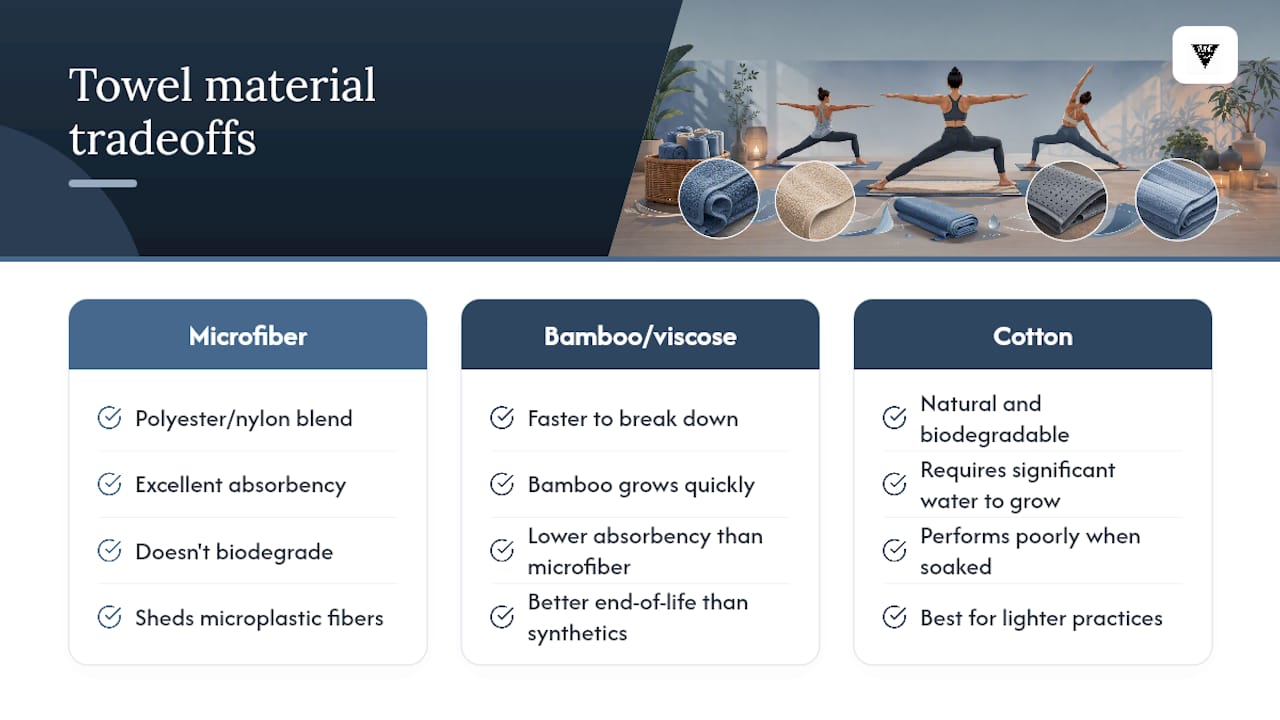
Material choice affects more than grip and drying speed. It affects what happens to the towel once it’s worn out. Microfiber towels are typically made from polyester and nylon blends, which means they’re synthetic through and through. They perform brilliantly for absorbency but don’t biodegrade, and washing synthetic fabric sheds microplastic fibers into wastewater over the towel’s lifespan.
Bamboo and viscose blends address part of that problem. Bamboo grows quickly without heavy pesticide use, and the resulting fabric breaks down faster at the end of its life than pure synthetic fiber does. The tradeoff, as covered earlier, is a slight dip in raw absorbency compared to microfiber, so you’re weighing environmental footprint against peak performance in your sweatiest classes.
Cotton sits in the middle: a natural, biodegradable fiber, but one that demands significant water to grow and doesn’t perform well once soaked, which limits its practical use to lighter practices anyway.
The most sustainable move for most practitioners isn’t necessarily picking the “greenest” raw material. It’s buying one durable towel and using it for years instead of cycling through cheap ones that wear out and get tossed every few months. A well-cared-for towel, washed properly and retired only when it genuinely stops performing, has a smaller footprint over its lifetime than three disposable-feeling replacements bought out of frustration with peeling silicone or dulled fibers.
Yoga Towel vs. Mat Spray vs. Mat: What Each One Actually Solves
These three accessories get compared constantly, but they’re solving different problems, not competing for the same job.
A yoga mat provides the cushioning and joint protection your body needs, especially in kneeling or seated poses. Nothing else in your bag substitutes for that padding. A mat spray, usually a mix of water, witch hazel, and essential oil, cleans and deodorizes the mat surface between deeper washes, but it does nothing for grip or sweat volume during class. A towel handles the moment-to-moment problem: sweat management and traction while you’re actually moving through poses.
Where people go wrong is assuming one accessory can cover for another. Spraying your mat before a hot class won’t stop it from getting slick once you’re thirty minutes in and dripping. Relying on a towel alone on a hardwood studio floor won’t protect your knees the way a mat does. The three work best stacked together: mat for cushioning, towel for grip and hygiene during practice, spray for keeping the mat itself fresh between full washes.
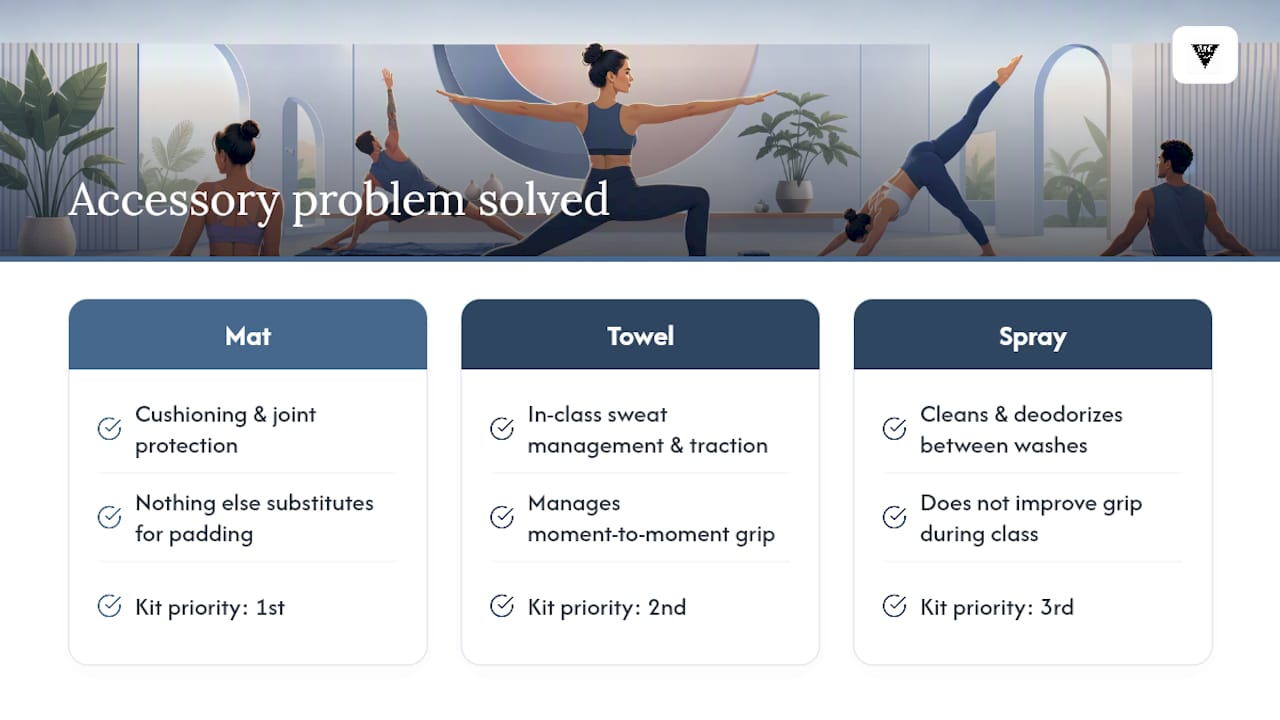
If you’re building a kit from scratch, prioritize in that order. Get a mat, add a towel once you’re taking hotter or sweatier classes, and pick up a spray last as routine upkeep rather than a core purchase.
Why Your Towel Matters More Than Your Mat in a Hot Class
Most practitioners obsess over mat thickness and rubber quality, then treat the towel as an afterthought grabbed on the way out the door. That’s backwards for anyone taking heated classes regularly. In a Bikram or hot vinyasa session, the towel is doing more moment-to-moment work than the mat underneath it, since it’s the surface actually touching your skin once sweat starts flowing.
The other thing practitioners underestimate is how much material choice changes over a single class. A cotton or blended towel that feels fine at minute five is often noticeably heavier and slicker by minute forty, right when you’re moving into the poses that demand the most grip. That’s not a flaw in your technique. It’s the fabric failing at the exact moment you need it most.
Yune Yoga builds its towel and mat lines around that timing problem specifically, pairing durable, sustainably sourced materials with the kind of grip that holds up as a class gets sweatier, not just at the start. For anyone assembling a full kit, a towel that matches your mat’s size and texture, rather than whatever spare bath towel happens to be closest, is the upgrade that pays off first.
— Nicholas
Building Your Yoga Towel Kit With Yune Yoga
Once you know which use case matters most to you, hot classes, travel, or studio hygiene, choosing the right towel gets a lot simpler. Some towel lineups are built from durable, sustainable materials designed to handle exactly the scenarios covered above, without the guesswork of comparing a dozen unfamiliar brands.
A few practical starting points:
- If hot yoga or power flow is your main practice, pair a full-size towel with a natural rubber mat for the traction-plus-cushion combination heated classes demand.
- If you travel often, a foldable travel mat and a lightweight towel together weigh almost nothing and pack into a small bag.
- If you’re outfitting a full kit at once, look at bundled sets that pair a mat, towel, and strap so materials and sizing match by design instead of by luck.
Browse the full Yune Yoga collection to see current towel, mat, and strap options, or check the accessories category if you’re rounding out a kit you’ve already started. Either page lists current materials and pricing directly, so you can match a towel to your practice without digging through spec sheets.
Sources
- Microfiber fact sheet — WSPEHSU (UCSF)
- What’s A Yoga Towel And Do I Need One? — Towel Super Center
- Yoga mat and towel guide — TheYogaCare
- Yoga mat towel guide 2026 — TheYogaFitness
FAQ
Do you have to wash a yoga towel after every use?
Wash it after every hot or high-sweat session, and at minimum once a week if you’re practicing gentler styles less frequently.
Is a yoga towel just a microfiber towel?
Not exactly. A true yoga towel is engineered with moisture-wicking fibers and often a silicone or textured backing for grip, while a generic microfiber towel may lack the grip layer entirely.
What’s the difference between a yoga mat and a yoga towel?
A mat provides cushioning and joint protection, while a towel manages sweat and traction on top of that mat; they solve different problems and work best paired together.
Is a yoga towel worth buying?
For anyone taking hot, power, or vinyasa classes regularly, yes. It solves a slipping problem a bare mat can’t handle once sweat builds up, and brands like Yune Yoga offer options built specifically for that use.
Can a yoga towel replace a mat completely?
Only for short, low-impact sessions like travel or beach practice. For studio classes or anything balance-heavy, a towel should sit on top of a mat, not instead of one.

