
The Eco-Conscious Yoga Brand Checklist for Smart Shoppers
Use this five-point checklist — materials, certifications with transaction certificate proof, supply-chain transparency, durability and circularity, and chemical and packaging disclosures — to verify whether a yoga brand is genuinely eco-conscious before you buy. Two quick signals to look for on any product page: a GOTS certification number for organic textiles and an OEKO-TEX Standard 100 label for chemical safety. For vetted mats and accessories that already clear most of these checks, Yuneyoga is a strong starting point.
Your five-point point-of-sale checklist:
- [ ] Materials: Is there a full fiber breakdown with percentages? Are organic or recycled fibers backed by a named standard (GOTS, GRS)?
- [ ] Certification proof: Is there a certificate number or a transaction certificate (TC), not just a logo?
- [ ] Supply-chain transparency: Does the brand publish a factory list, audit summary, or supplier map?
- [ ] Durability and circularity: Is there a warranty, repair guide, or take-back program?
- [ ] Chemical and packaging transparency: Are dyes, adhesives, and packaging materials disclosed?
Pro Tip: Print or screenshot this checklist before you shop. If a product page can’t answer all five items in under 60 seconds, treat that as a signal to dig deeper or move on.
Key Takeaways
A genuinely eco-conscious yoga brand provides verifiable proof across materials, certifications, supply-chain transparency, durability, and chemical disclosures — not just marketing language.
| Point | Details |
|---|---|
| Transaction certificates matter | A GOTS or GRS logo alone doesn’t confirm your product is covered — request a TC number and verify it. |
| LCAs beat “natural” labels | Peer-reviewed research confirms natural fibers can carry heavy footprints; prefer brands that reference life-cycle data. |
| Durability is a sustainability strategy | Cost-per-wear math almost always favors the durable option; check warranties and take-back programs before buying. |
| Five checks at point of sale | Run the seven-item scored checklist; a score of 8 or above is a strong buy signal. |
| Yuneyoga for vetted mats | Yuneyoga’s natural rubber mats and accessories include material descriptions you can verify directly on the product page. |
Table of Contents
- What makes a yoga brand truly eco-conscious?
- Which fabrics and materials should you actually choose?
- Which certifications actually mean something?
- What does real supply-chain transparency look like?
- Why durability and take-back programs are core sustainability signals
- Realistic performance expectations for sustainable yoga gear
- Your printable pre-purchase checklist
- Brand examples (U.S.-available) across categories
- How Yuneyoga designs for sustainability
- A practical note on shopping sustainably
- Yuneyoga’s mats and accessories meet the checklist
- Sources
What makes a yoga brand truly eco-conscious?
Three pillars define genuine sustainability for yoga clothing and gear: environmental impact, labor and social conditions, and material safety. A brand that excels on one while ignoring the others is not fully eco-conscious — it’s selectively green.
Environmental impact covers the full production chain: water consumption in cotton farming, energy use in fiber processing, and carbon emissions from shipping. Labor and social conditions matter because most yoga apparel is manufactured in countries where wage theft and unsafe conditions remain real risks. Material safety is especially relevant for yoga gear because leggings, mats, and towels are all skin-contact items — chemical finishes, dyes, and adhesives can off-gas or absorb through skin during a hot practice.
The credibility signals that separate a genuine sustainability philosophy from marketing copy are specific and verifiable. Look for published supplier maps, life-cycle assessment (LCA) summaries or references, and take-back or repair programs with actual instructions. Vague language like “made with the planet in mind” or “eco-friendly materials” with no supporting evidence is a red flag.
Pro Tip: On any product page, scroll past the marketing copy to the materials section. If you see fiber percentages, a named certifier, and a certificate number, that’s a verifiable claim. If you see only adjectives — “sustainable,” “conscious,” “green” — with no evidence, ask the brand directly before buying. Guides on spotting greenwashing in activewear recommend asking specifically about fiber percentages, dye types, and independent verification.
Which fabrics and materials should you actually choose?
Prefer certified organic natural fibers (GOTS-verified), recycled synthetics backed by the Global Recycled Standard (GRS) or Recycled Claim Standard (RCS), and low-impact cellulosics like TENCEL. Avoid unspecified “eco” polyester or nylon and unlabeled elastane blends when microplastic shedding is a concern.
Peer-reviewed life-cycle analysis research confirms that “natural” labeling alone can be misleading — a conventional cotton shirt can carry a heavier water footprint than a well-managed recycled polyester one. The material’s actual impact depends on farming practices, processing chemistry, and end-of-life behavior, not just the fiber name.
| Material | Environmental tradeoffs | Performance notes | End-of-life behavior |
|---|---|---|---|
| Organic cotton (GOTS) | Lower pesticide load; still water-intensive | Breathable, soft; low stretch | Biodegradable if undyed/unblended |
| TENCEL (lyocell) | Closed-loop solvent process; low water use | Soft, moisture-wicking | Biodegradable in industrial conditions |
| Recycled polyester (rPET) | Diverts plastic waste; still sheds microfibers | Excellent stretch and durability | Not biodegradable; recyclable in some programs |
| Natural rubber | Renewable; latex allergy risk | Superior grip; heavy | Biodegradable; some take-back programs |
| Cork | Renewable harvest; low processing | Good grip; firmer feel | Biodegradable |
| TPE (thermoplastic elastomer) | PVC-free; lower toxicity than PVC | Moderate grip; lighter | Recyclable in some programs |
| Recycled PVC | Diverts waste; still contains plasticizers | Durable; poor breathability | Difficult to recycle further |
For recycled synthetics, ask for a transaction certificate tied to the specific fabric lot — a GRS logo on a website does not confirm that your particular product is covered. Microfiber shedding from rPET is a real concern: use a Guppyfriend wash bag and wash on cold, gentle cycles to reduce fiber release.
Pro Tip: Ask the brand for the fiber breakdown as a percentage, not just a list of materials. “Made with recycled polyester” could mean 5% or 95%. The percentage changes everything about the claim.
Which certifications actually mean something?
Prioritize these five in order of what they verify:
- GOTS (Global Organic Textile Standard): Covers organic fiber content AND processing chemistry across the full supply chain. The gold standard for organic apparel.
- GRS / RCS (Global Recycled Standard / Recycled Claim Standard): Verifies recycled content and chain of custody. Required for any “recycled” fiber claim to be credible.
- OEKO-TEX Standard 100: Tests finished textiles for harmful substances. The primary check for skin-contact safety — covers dyes, finishes, and residual chemicals.
- Fair Trade / SA8000: Verifies labor conditions and fair wages at the factory level. SA8000 is the more rigorous of the two for manufacturing audits.
- B Corp / ISO 14001: Company-level certifications. B Corp covers social and environmental performance broadly; ISO 14001 verifies an environmental management system is in place.
A logo on a product page is not enough. Transaction certificates tie a specific shipment or fabric lot to the certified supply chain. Without a TC number, you cannot confirm that the product in your cart is actually covered by the certification — only that the facility holds a license. To verify, go directly to the certifier’s registry: GOTS, OEKO-TEX, and GRS all maintain searchable databases where you can enter a certificate number and confirm its scope and validity.
Red-flag phrasing to distrust: “eco,” “conscious,” “planet-friendly,” “sustainable materials,” or “green” without a named certifier, certificate number, or verifiable evidence. These are marketing adjectives, not verified claims.
Pro Tip: On the GOTS public database at global-standard.org, you can search by company name or certificate number. Do this before you buy — it takes 30 seconds and tells you whether the certification covers the specific product category you’re purchasing.
What does real supply-chain transparency look like?
Prefer brands that publish factory lists, third-party audit summaries, and clear anti-subcontracting policies. If none of those exist on the brand’s website, ask before buying. A brand with nothing to hide will answer quickly and specifically.
Verification artifacts you can request or look for:
- Factory list or supplier map: Names and locations of tier-1 (cut-and-sew) and ideally tier-2 (fabric mills) suppliers.
- Third-party audit summaries: SMETA, BSCI, or equivalent social audits with dates and findings.
- Wastewater reports: Relevant for dye-heavy operations; confirms chemical discharge is managed.
- LCA summaries: A life-cycle assessment reference on a brand page signals that the brand has done the math on total impact, not just cherry-picked a favorable metric.
- Anti-subcontracting policy: Confirms production stays within audited facilities.
Packaging sustainability belongs in this conversation too. Recycled or FSC-certified cardboard, minimal plastic, and compostable mailers all reduce your purchase’s total footprint. A brand that invests in sustainable packaging is usually consistent about it elsewhere in the supply chain.
Questions you can send to a brand’s customer service before buying:
- “Can you share the name or location of the factory where this product was made?”
- “Do you have a recent third-party audit summary you can share?”
- “What is your policy on subcontracting?”
- “Are your dyes certified low-impact or OEKO-TEX verified?”
A startup vetting framework for eco-conscious activewear suppliers recommends contractual controls on subcontracting and lab test reports as baseline requirements — the same logic applies to consumer purchases.
Why durability and take-back programs are core sustainability signals
Longevity is often the single biggest sustainability win available to a shopper. A well-made pair of yoga leggings worn 200 times has a fraction of the per-wear impact of a cheaper pair worn 30 times before pilling out.
Practical checks for durability and circularity:
- Seam construction: Flatlock seams resist chafing and hold up better under repeated high-stretch use than overlocked seams.
- Waistband resilience: Ask whether the waistband is bonded or sewn; bonded waistbands can delaminate with heat washing.
- Pilling and stretch tests: Look for brands that publish or reference independent pilling and stretch-recovery test results.
- Repair instructions: Published repair guides signal that the brand expects and supports long-term use.
- Take-back or recycling partnerships: Programs that accept worn-out garments for material reclamation or resale are a strong circularity signal.
For mats, check adhesive quality and VOC testing. Even a natural rubber mat can off-gas or delaminate if the bonding agent is poor. Ask the brand about adhesives and whether VOC testing has been done.
Pro Tip: Calculate cost-per-wear before you buy: divide the price by the number of times you realistically expect to use the item. A $120 legging worn 150 times costs $0.80 per wear. A $40 legging worn 25 times costs $1.60 per wear — and ends up in a landfill twice as fast. The math almost always favors the durable option.
For mats and accessories, Yuneyoga’s eco-friendly and durable material guidance covers what to look for in natural rubber construction and durability testing.
Realistic performance expectations for sustainable yoga gear
Sustainable materials can meet the performance demands of yoga, but tradeoffs exist. Knowing them upfront prevents disappointment.
- Organic cotton: Breathable and soft but has minimal stretch. Not ideal for high-intensity flow unless blended with a small percentage of elastane.
- TENCEL: Excellent moisture management and drape; less compression recovery than synthetic blends.
- Recycled polyester (rPET): Matches conventional polyester for stretch and durability. The tradeoff is microfiber shedding, not performance.
- Natural rubber mats: Superior grip, especially when wet. Heavier than TPE or PVC alternatives, which matters for travel.
- Cork: Naturally antimicrobial and grips better when slightly damp. Firmer underfoot than rubber, which some practitioners prefer and others find uncomfortable.
- TPE: Lightweight and PVC-free. Grip is adequate for most practices but less reliable in hot yoga.
For yoga specifically, compression and rebound matter more than in most other fitness contexts. High-stress seam locations — inner thigh, waistband, crotch gusset — are where cheap construction fails first. On a product page, look for seam construction details, fabric weight (gsm), and whether the brand offers a fit guarantee or free returns.
A responsible sustainable brand should offer at minimum a 30-day return window and clear sizing guidance. If a brand makes returns difficult, that friction often discourages returns of ill-fitting items — which is not a sustainability win, it’s a retention tactic.
For a deeper look at how material choices affect mat performance and selection, Yuneyoga’s sustainability meets style guide walks through the key tradeoffs.
Your printable pre-purchase checklist
Run through this before you complete any yoga gear purchase. Score each item: Yes (2), Partial/Unclear (1), No (0). A score of 8 or above is a strong buy signal. Below 6, ask questions or reconsider.
- Fiber breakdown: Does the product page list all fibers with percentages?
- Certification with evidence: Is there a named certifier (GOTS, GRS, OEKO-TEX) AND a certificate number or TC?
- Supply-chain disclosure: Does the brand publish a factory list, supplier map, or audit summary?
- Durability and circularity: Is there a warranty, repair guide, or take-back/recycling program?
- Chemical and dye transparency: Are dyes, finishes, and adhesives disclosed or certified?
- Packaging sustainability: Is packaging recycled, minimal, or compostable?
- Returns and fit policy: Does the brand offer a clear return window and sizing guidance?
Example scored checklist for a hypothetical product:
A score of 10 out of 14 is a reasonable buy for most shoppers, with the missing TC and factory list as items worth following up on.
Brands that score consistently below 8 on this checklist are relying on marketing language rather than verifiable proof. The checklist is not about perfection — it’s about knowing exactly what you’re buying and what you’re not.
Brand examples (U.S.-available) across categories
These brands illustrate how the checklist applies in practice. They are representative examples, not a ranked list. Third-party editorial guides like Good On You’s sustainable yoga clothing guide can help cross-check brand-level practices, but always verify against certifier registries directly.
Apparel brands
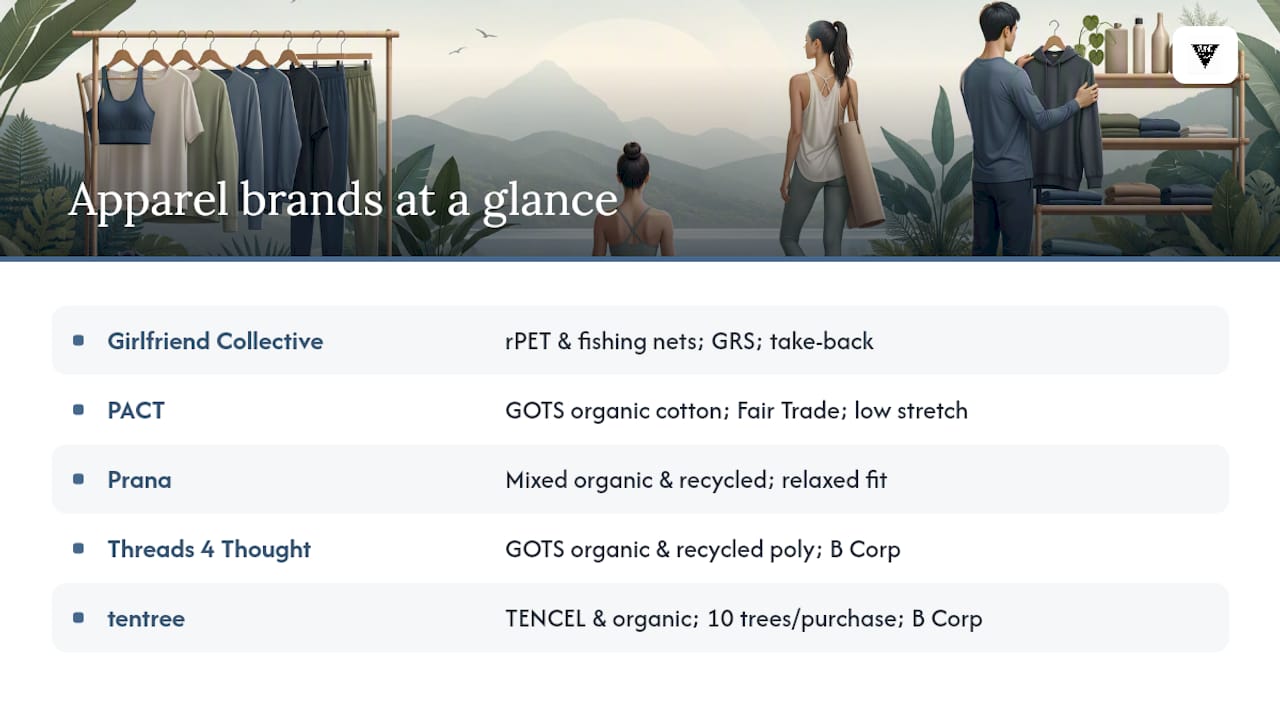
Girlfriend Collective builds its line primarily from recycled post-consumer plastic bottles (rPET) and fishing nets, with GRS verification for recycled content. The brand publishes its factory partners and runs a ReGirlfriend take-back program that accepts worn items for recycling. Performance is strong — the fabric has good compression and stretch recovery. The main gap: no GOTS certification, since the line is synthetic-focused.
PACT leads with GOTS-certified organic cotton across most of its apparel line and holds Fair Trade certification for its primary factory. It publishes its factory name and location, which is more transparency than most brands at its price point. The tradeoff is that organic cotton has limited stretch, so PACT’s yoga pieces work best for gentler practices or as layering pieces.
Prana uses a mix of organic cotton, recycled nylon, and TENCEL across its line, with GOTS and bluesign certifications on select products. The brand has published a supplier list and references third-party audits. Fit tends toward a relaxed, lifestyle-oriented cut rather than high-compression performance wear.
Threads 4 Thought focuses on GOTS-certified organic cotton and recycled polyester blends. The brand is B Corp certified, which covers company-level social and environmental performance. Product pages include fiber percentages, which is a basic but often missing detail. The line skews casual-to-yoga rather than high-performance activewear.
tentree plants ten trees per purchase and uses a mix of TENCEL, organic cotton, and recycled materials. The brand publishes an impact wallet showing trees planted and carbon offset per order. B Corp certified. Performance is moderate — the focus is lifestyle and light activity rather than high-intensity yoga.
Mats and accessories
Yuneyoga offers natural rubber mats and sustainable accessories with transparent material descriptions on product pages. Natural rubber is a renewable resource with strong grip performance and biodegradability advantages over PVC. For shoppers who want a mat that clears most of the materials and durability checks without extensive research, Yuneyoga’s curated selection is a practical starting point. The eco-friendly yoga mat guide on the Yuneyoga blog walks through how to evaluate mat materials against the checklist criteria above.
Applying the checklist to a real product page: Take any of the apparel brands above and open their most popular yoga legging. Check for fiber percentages (most list them), then look for a certificate number rather than just a logo. Click through to the certifier’s registry and enter the number. That single step — 90 seconds of work — confirms whether the certification covers that specific product or only the facility.
The most useful thing this checklist does is shift the burden of proof. Instead of trusting a brand’s marketing copy, you’re asking for evidence. Brands that have done the work will have it ready.
Pro Tip: Good On You rates brands across environment, labor, and animal welfare and is a useful first filter. But always cross-check their ratings against certifier registries — editorial scores and verified certificates are different things.
How Yuneyoga designs for sustainability
Yuneyoga focuses on natural rubber mats and sustainable accessory materials, with product pages that include material descriptions and specifications readers can verify directly.
Concrete proof points available to readers:
- Natural rubber sourcing is described on product pages, including material properties and performance characteristics.
- The Yuneyoga blog publishes detailed guidance on eco-friendly mat approaches, material tradeoffs, and how to read product labels.
- Product bundles include curated combinations of mats, towels, and straps, with material information for each component.
- The blog covers natural dye benefits and low-tox finishing options — relevant to the chemical transparency check in the checklist.
Pro Tip: To verify Yuneyoga’s material claims, go directly to the product page for any mat and check the materials section. If you want more detail on sourcing or adhesives, contact the brand directly — a transparent brand will answer specifically.
A practical note on shopping sustainably
If a product page can’t answer the five checklist items in 60 seconds, assume further verification is needed. That’s the rule I apply every time.
Three quick in-the-field habits that make a real difference:
- Search the certifier’s registry before you add to cart, not after. It takes less time than reading the marketing copy.
- Ask one specific question in the brand’s chat or email — “What factory made this?” — and judge the response. A vague answer is data.
- Calculate cost-per-wear on the spot. It reframes every purchase from a price decision to a value decision.
Yuneyoga’s product curation reflects the same approach: prioritize traceable materials, publish what’s verifiable, and let the product specs speak for themselves.
Yuneyoga’s mats and accessories meet the checklist
Shoppers who’ve worked through the checklist and want a mat that clears the core criteria without hours of research will find Yuneyoga’s natural rubber line a strong fit. Natural rubber is renewable, biodegradable, and delivers grip performance that synthetic alternatives rarely match.
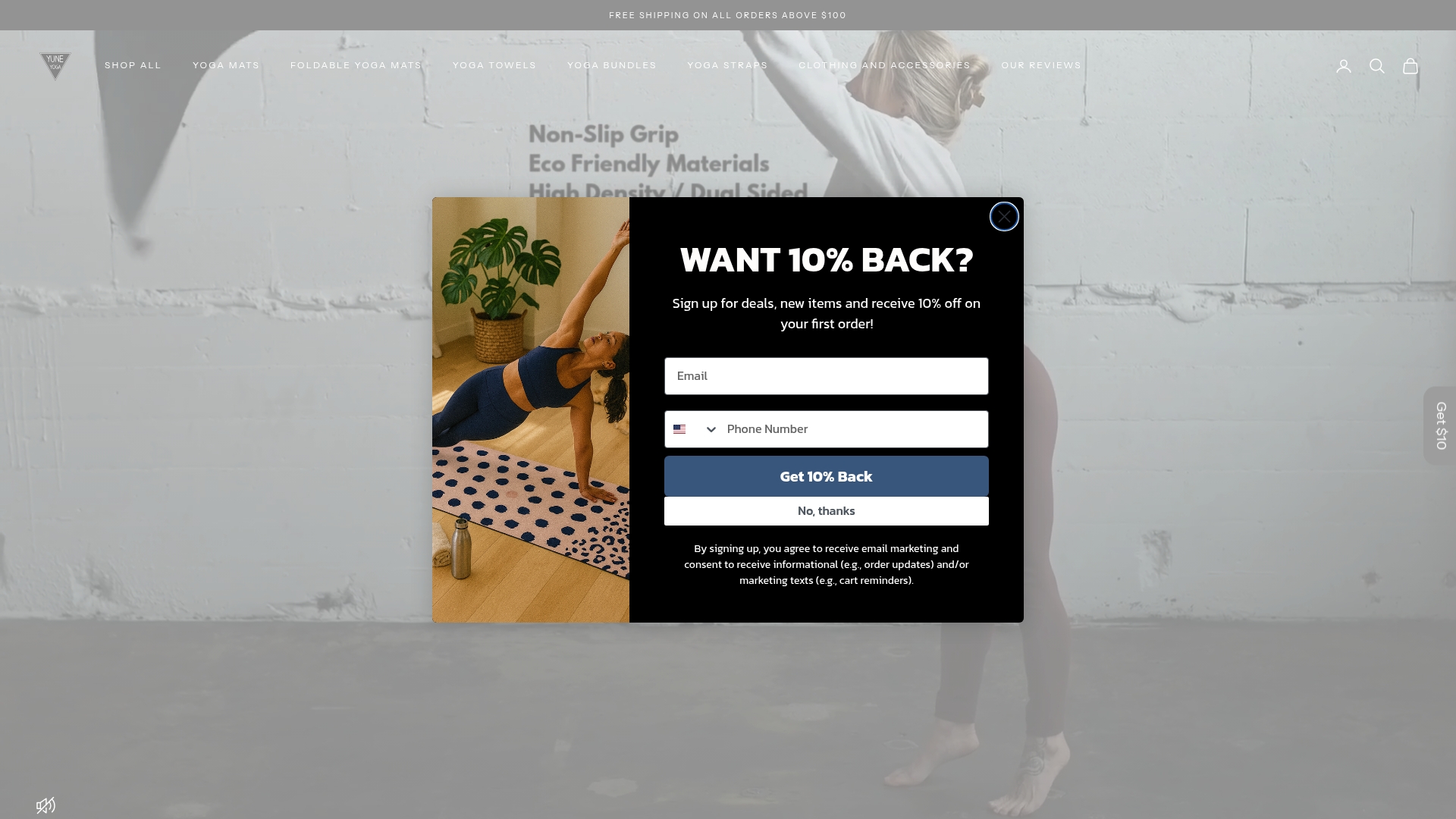
Yuneyoga’s product pages include material descriptions you can read and verify, not just marketing language. The blog resources cover everything from how to read yoga product labels to specific material tradeoffs — useful whether you’re buying a mat or evaluating a brand you found elsewhere. Bundled starter kits pair mats with towels and straps, all with consistent material standards across the set.
Browse the full selection of mats, towels, and accessories at Yuneyoga and use the checklist above to verify any product that catches your eye.
Sources
These are the fastest places to cross-check a brand’s sustainability claims before you buy.
- Oeko-tex
- PubMed article on life-cycle comparisons
- Tilth
- The Ultimate Guide to More Ethical and Sustainable Yoga Clothing — Good On You
On LCAs: a brand that has commissioned or references a life-cycle assessment for its materials is doing more than most. Look for LCA summaries or references in a brand’s sustainability report or materials page. If none exists, that’s not automatically disqualifying, but it does mean the brand’s environmental claims rest on less rigorous ground. Understanding how biodegradable materials impact the environment across their full lifecycle is also worth reading before you assume “biodegradable” equals low-impact.


