

Natural Dye Yoga Mat Benefits for Eco-Conscious Yogis
Natural-dye yoga mats offer two distinct advantages: they reduce your exposure to synthetic chemical processes and, when herb-infused using Ayurvastra methods, may deliver mild topical wellness properties through plant compounds like those in neem, turmeric, and tulsi. The evidence for sustainability is solid. The health claims are plausible but not clinically proven for topical contact during yoga, so going in with clear expectations matters.
Who these mats make the most sense for: practitioners with sensitive skin, buyers who prioritize supply-chain transparency, and anyone drawn to Ayurvastra-style products that connect practice to plant-based tradition.
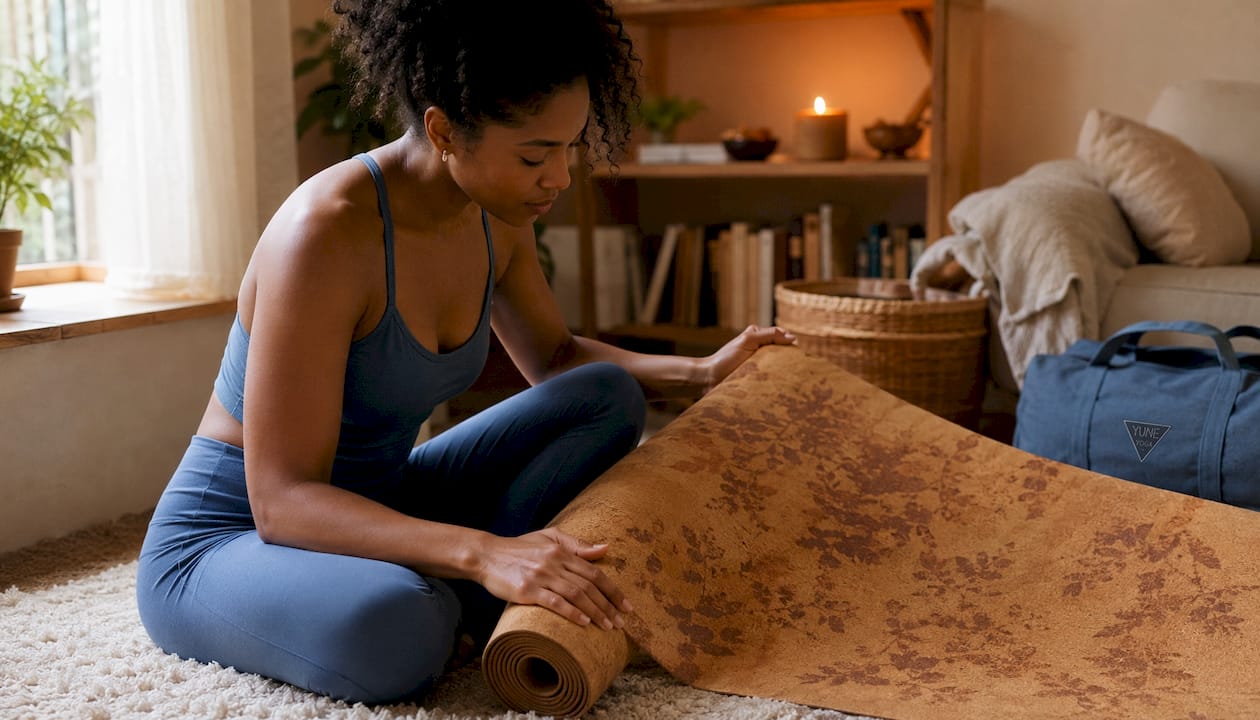
Pro Tip: Before buying, look for the dye source by plant name (not just “natural extracts”), GOTS certification on the cotton, and a clear statement about rubber sourcing. If a listing can’t answer those three questions, keep looking.
Table of Contents
- What natural dyes and Ayurvastra actually are
- Health claims vs. the evidence
- Environmental benefits and real trade-offs
- Durability, care, and cost expectations
- How to choose a trustworthy natural-dye yoga mat
- Key Takeaways
- Why sourcing transparency matters more than the “natural” label
- Yuneyoga’s eco-conscious mat collection
- Sources and further reading
What natural dyes and Ayurvastra actually are
Natural dyes come from plants, minerals, microorganisms, and some animals. In textile applications, plant sources dominate: roots, bark, leaves, and heartwood all yield usable colorants. The contrast with synthetic dyes is straightforward. Synthetic dyes, which have dominated since William Henry Perkin synthesized the first one in 1856, are produced from petrochemical processes and can include compounds that are non-biodegradable or outright toxic. Natural dyes skip that chemistry entirely.
Ayurvastra is the Ayurvedic practice of dyeing textiles with medicinal herbs so that plant compounds remain in the fabric and transfer to the skin during wear or practice. Common herbs include neem (antibacterial, anti-inflammatory), turmeric (curcumin-rich, antioxidant), and tulsi (holy basil, traditionally calming). Some formulations also incorporate triphala. These herbs are typically prepared as concentrated infusions, and the cotton fiber is immersed and processed through a mordanting step that helps fix the dye.
Natural fibers accept natural dyes far better than synthetics do. GOTS-certified cotton is the most common base for Ayurvastra mats, with natural rubber used for the grip layer. That combination matters: the cotton surface stays in contact with your skin, while the rubber base keeps the mat stable without PVC.
Health claims vs. the evidence
Some plant dyes genuinely contain phytochemicals with functional properties. Lab studies confirm that compounds like saponins, tannins, flavonoids, and anthocyanins can show antimicrobial activity in fabrics. Curcumin from turmeric and the active compounds in neem have well-documented antioxidant and anti-inflammatory profiles in pharmacological research. The gap is between lab results and what actually happens during a 60-minute yoga session.
| Claimed property | Mechanism | Evidence type | Confidence level |
|---|---|---|---|
| Antibacterial | Saponins, tannins, flavonoids in fiber | Lab studies on dyed fabrics | Moderate (lab, not clinical) |
| Anti-inflammatory | Curcumin (turmeric), neem compounds | Pharmacological research | Strong for ingestion; limited for topical contact |
| Antioxidant | Anthocyanins, carotenoids, flavonoids | Lab studies | Moderate (lab, not clinical) |
| Aromatherapeutic | Volatile compounds in tulsi, neem | Traditional Ayurvastra | Anecdotal/traditional |
| Antifungal | Tannins, flavonoids | Lab studies on textiles | Moderate (lab, not clinical) |
Artisan producers of herb-dyed mats highlight anti-bacterial and soothing properties from neem and turmeric contact, and those claims align with the known phytochemistry. What’s missing is clinical trial data on dermal absorption during yoga specifically. Treat the wellness angle as a plausible bonus, not a medical claim.
Practical notes for sensitive skin and allergy concerns:
- Patch-test any new herb-dyed mat on your inner forearm for 24 hours before full practice.
- Ask whether metallic mordants were used; some traditional mordants (alum, iron) can irritate sensitive skin.
- Look for “hypoallergenic” or biomordant disclosures if you have known metal sensitivities.
- If you notice redness, itching, or irritation during practice, stop using the mat and consult a dermatologist.
Pro Tip: If a mat causes any skin reaction, discontinue use immediately. Herb-infused doesn’t automatically mean allergen-free — tulsi and neem can trigger reactions in some people.
Environmental benefits and real trade-offs
Natural dyes are biodegradable and sourced from renewable materials, which gives them a clear advantage over synthetic dye processes that require significant water, energy, and chemical inputs. That advantage is real at the production stage. The full picture is more nuanced.
| Dimension | Natural dye processes | Conventional synthetic dye processes |
|---|---|---|
| Biodegradability | High — plant-derived, breaks down naturally | Low — many compounds persist in wastewater |
| Chemical toxicity | Generally low; some mordants are exceptions | Often high; azo dyes and fixatives are problematic |
| Water use profile | Variable; traditional methods can be water-intensive | High — wet processing is a major water consumer |
| Colorfastness | Lower; fading is a known limitation | High — engineered for durability |
| Shade reproducibility | Difficult at scale; batch variation is common | Consistent and scalable |
| Feedstock renewability | Renewable (plants, minerals) | Non-renewable (petrochemical-derived) |
Where natural dyes score well: reduced persistent chemical pollution, biodegradable waste streams, and support for small-scale artisan supply chains. Where they currently lag: poor fastness, low dye uptake, and difficulty reproducing shades at industrial scale. Emerging technologies like enzyme treatment, plasma fixation, and biomordants are narrowing that gap, but they’re not yet standard in most artisan production.
Certifications are your best verification tool. GOTS-certified cotton confirms organic fiber and responsible processing. Sustainably harvested natural rubber confirms the grip layer isn’t undermining the mat’s eco credentials. Look for both.
Durability, care, and cost expectations
Expect faster color fading than you’d get from a synthetic-dyed mat. That’s not a defect; it’s a property of how natural dyes bond to fiber. Photodegradation from UV exposure accelerates the process, so how you store and dry the mat makes a real difference.
Cotton-based Ayurvastra mats fade faster than rubber-backed mats with only a surface dye treatment, because the cotton surface has more direct UV and sweat exposure. The upside is that cotton mats are often machine-washable, which extends their usable life considerably.
Care guidance that actually preserves both color and herb properties:
- Dry in shade, never in direct sunlight.
- Spot-wash with cool water and a gentle, fragrance-free soap; avoid harsh detergents that strip the dye.
- If machine-washable (cotton mats), use a cold, gentle cycle and a mesh laundry bag.
- Roll loosely for storage rather than folding, which can crack rubber backing over time.
On cost: hand-dyed, GOTS-certified, artisan-made mats carry a meaningful price premium over mass-produced options. That premium reflects small-batch dyeing labor, certified organic fiber sourcing, and fair-trade artisan partnerships. It’s not marketing inflation; the production process genuinely costs more.
Pro Tip: Rotating between two mats cuts UV and sweat exposure per mat roughly in half, which meaningfully extends the color life of natural-dye textiles.
How to choose a trustworthy natural-dye yoga mat
Prioritize material transparency and third-party certifications over marketing language. A mat described as “natural” or “herbal” with no supporting documentation is just a claim.
- Confirm fiber certification. Look for GOTS-certified organic cotton on the surface layer. GOTS covers both fiber and processing standards.
- Verify the dye source by plant name. “Dyed with turmeric, neem, and tulsi” is verifiable. “Natural plant extracts” is not.
- Ask about mordants. Biomordants or non-metallic fixation methods (enzymes, plasma) are preferable. Metallic salt mordants can be problematic for sensitive skin and the environment.
- Check rubber sourcing. The grip layer should specify sustainably harvested natural rubber, not TPE or PVC.
- Look for fair-trade or artisan partnership disclosures. Handwoven, small-batch production is part of the value chain for authentic Ayurvastra mats.
- Read the care instructions. A legitimate natural-dye mat will have specific care guidance. No care instructions is a red flag.
- Confirm return or exchange policy. Given that patch-testing takes time, a reasonable return window matters.
Red flags to watch for:
- “Natural extracts” with no plant species named
- No third-party certification (GOTS, OEKO-TEX) anywhere on the listing
- Claims of permanent, fade-proof color from natural dyes
- No care instructions or vague “wipe clean” guidance
- Health claims framed as medical treatment
Sample questions to ask sellers: “Which specific herbs are used and how are they fixed to the fiber?” A good answer names the plants and the fixation method. “Is the cotton GOTS-certified?” A good answer includes a certification number or body. “What mordant is used?” A good answer names a biomordant or non-metallic process.
Key Takeaways
Natural-dye yoga mats are a genuinely sustainable choice for eco-conscious practitioners, with plausible topical wellness benefits from Ayurvastra herbs and clear limitations in colorfastness and cost.
| Point | Details |
|---|---|
| Sustainability is the strongest case | Natural dyes are biodegradable and reduce toxic chemical use versus synthetic dye processes. |
| Herb benefits are plausible, not proven | Neem, turmeric, and tulsi contain active phytochemicals; clinical evidence for topical yoga contact is limited. |
| Fading is expected | Natural dyes have lower colorfastness than synthetics; shade-dry and avoid direct UV to extend color life. |
| Certifications matter most | GOTS-certified cotton and sustainably harvested natural rubber are the two most reliable verification signals. |
| Yuneyoga for eco-conscious buyers | Yuneyoga offers eco-friendly mat options built around natural rubber and sustainable materials with clear sourcing disclosures. |
Why sourcing transparency matters more than the “natural” label
The wellness and sustainability case for herb-dyed mats is real, but it’s easy to overstate. What I find more interesting than the health claims is the supply-chain story. A mat dyed with named herbs, certified cotton, and sustainably harvested rubber represents a fundamentally different production model than a mass-produced PVC mat. That difference has compounding effects: it supports artisan livelihoods, reduces persistent chemical waste, and creates a product that biodegrades at end of life.
The health angle is worth taking seriously but not literally. Neem and turmeric have documented phytochemical activity. Whether that translates to measurable skin benefit during a yoga session is genuinely unknown. What’s not unknown is that avoiding synthetic dye chemicals in a product that spends an hour pressed against your skin is a reasonable precaution, especially for sensitive skin.
Yuneyoga evaluates mat options with exactly this lens: materials transparency, certifications, and honest sourcing over marketing claims. The rise of eco yoga mats reflects a real shift in what practitioners expect from their gear, and the brands worth trusting are the ones that can answer the hard questions about where their materials come from.
Yuneyoga’s eco-conscious mat collection
If the checklist above describes what you’re looking for, Yuneyoga’s collection is built around the same criteria: natural rubber bases, sustainable materials, and sourcing transparency that goes beyond a “natural” label.

What sets Yuneyoga’s approach apart for buyers who’ve done this research:
- Natural rubber grip layers with clear sourcing, no PVC or TPE substitutes
- Eco-friendly construction aligned with GOTS and sustainable materials standards
- Travel-friendly options including foldable mats that don’t sacrifice material quality for portability
- Bundled accessories including yoga towels and straps from durable, sustainable materials
The collection is designed for practitioners who want their gear to match their values without compromising on performance. Browse the full eco-friendly mat selection at Yuneyoga and find the option that fits your practice.
Sources and further reading
- Advancements in Sustainable Natural Dyes for Textile Applications: A Review (PMC/MDPI) — Primary source for environmental lifecycle analysis, colorfastness limitations, and emerging fixation technologies (enzyme, plasma, biomordants).
- Insight into the Progress on Natural Dyes: Sources, Structural Features, Health Effects (PMC) — Covers phytochemical functional properties (antioxidant, anti-inflammatory, antimicrobial) and the evidence base for natural dye health effects.
- Natural Dyes and Pigments: Sustainable Applications and Future Scope (MDPI) — Details phytochemicals responsible for antimicrobial activity in dyed textiles (saponins, tannins, flavonoids).
- Made of Ayurvedic Herbs, This Hand Woven Yoga Mat Beats All Plastic (The Better India) — Ayurvastra practitioner perspective; illustrates traditional herb use (neem, turmeric, tulsi) and topical wellness claims.
- Organic Herb Dyed Yoga Mat (ayurvedafabrics.com) — Real-world product example showing GOTS-certified cotton, herbal dyeing, and natural rubber construction.
- 9 Best Yoga Mats With Eco-Friendly Materials (The Good Trade) — Industry reviewer guidance on certifications (GOTS, sustainably harvested rubber) as verification signals for eco-conscious buyers.


