Do Yoga Towels Shrink? What to Expect and How to Prevent It
Some yoga towels shrink and some barely change, and the fiber decides which. Cotton and other plant-based fabrics shrink in the wash, mostly in the first cycle. Synthetic microfiber towels, the kind most made for yoga, are far more stable, and they hold their size when you wash and dry them sensibly. Heat, harsh detergent and fabric softener are what shorten a towel’s life and its grip.
This guide explains why shrinkage happens, which materials to trust, and a wash routine that keeps a towel the right length for your mat.
TL;DR
- Cotton, linen and viscose towels are the ones most likely to shrink. Most of it happens in the first wash-and-dry cycle.
- Polyester-rich microfiber shrinks much less, and independent testers found two popular microfiber yoga towels held up well to repeated machine washing and drying.
- Skip fabric softener and high heat. Softener leaves a film that lowers absorbency, and heat is the main trigger for shrinkage.
- Launder your towel after every practice, and measure it against your mat before you buy so a little shrinkage will not leave you short.
Table of Contents
- The short answer: it depends on the fiber
- Why some fabrics shrink and others do not
- What testing shows about microfiber yoga towels
- How to wash and dry a yoga towel without shrinking it
- Checking whether your towel has shrunk
- Yoga towel versus regular towel
- What to look for when buying a towel that will not shrink
- Our perspective
- Find a towel that fits your mat
- FAQ
- Sources
The short answer: it depends on the fiber
A yoga towel is only as stable as the yarn it is made from. Two towels that look similar on a shelf can behave very differently after a hot dryer cycle.
- Natural, absorbent fibers (cotton, linen, viscose): these shrink. A 2022 textile study of woven cotton fabrics found shrinkage in all ten fabrics tested after domestic washing, with the largest change after the first wash-and-dry cycle.
- Polyester and nylon microfiber: these generally shrink less. The same study notes that polyester-rich fabrics are more dimensionally stable than fibers that absorb water and swell.
- Blends: the more polyester, the more stable. A cotton-polyester blend sits between the two extremes.
So the honest answer to the question is: a cotton towel almost certainly will, a microfiber towel usually will not noticeably, and how you wash either one changes the result.
Why some fabrics shrink and others do not
Shrinkage is mostly about water and tension. During weaving and finishing, yarns are stretched. When the fabric is soaked and tumbled, the fibers relax and the cloth pulls back toward its natural size.
The textile study above explains why fiber type matters so much: hydrophilic fibers such as cotton, linen and viscose absorb water and swell, which makes them more prone to shrinking. Polyester barely absorbs water, so it has much less room to swell and contract.
Pratt Institute’s Textile Research Lab makes the same point about cotton in practical terms: cotton is likely to shrink in the wash unless it has been pretreated. Pretreated, or preshrunk, fabric has already gone through much of that change at the factory, so it moves less at home.
Two takeaways follow:
- The first wash is the big one. If a cotton towel is going to lose length, you will see most of it right away.
- Heat speeds it up. Hot water and a hot dryer make fibers relax faster and further.
What testing shows about microfiber yoga towels
Most towels made specifically for yoga are microfiber, a fine synthetic fiber valued for durability and moisture wicking. When Wirecutter tested hot-yoga towels, it reported that the two premium towels it examined were mostly microfiber. Its testers also found that both towels held up well to repeated machine washing and drying.
The fabric composition explains it. Wirecutter reported that one of those towels is woven from 90% polyester, part of it recycled, and 10% nylon. A construction that is almost entirely polyester has little reason to shrink the way cotton does.

There is a caveat worth knowing. In a roundup of the best yoga towels, Women’s Health reported that testers said one microfiber hot-yoga towel shrank in the washing machine. Microfiber is not magic. Weave, blend ratio, finishing and your own wash settings all play a part, so “microfiber” on a label is a good sign, not a guarantee. This is why we recommend a gentle routine even for synthetic towels.
Material comparison at a glance
| Material | Shrinkage risk | Grip when wet | Care notes |
|---|---|---|---|
| 100% cotton | High, mostly in the first wash and dry | Moderate, gets heavy and slow to dry | Wash cool, dry low, expect some size change |
| Cotton-polyester blend | Moderate | Moderate | Durable, but still treat gently |
| Polyester-nylon microfiber | Low | High, designed to wick and grip | Skip softener, avoid high heat |
| Linen or viscose | High | Low to moderate | Rarely used for yoga towels, handle like cotton |
The shrinkage column reflects the fiber behavior described in the textile research above. The grip and care columns are general guidance on how these fabrics behave on a mat.
If you want a deeper look at how each fabric performs, our breakdown of yoga towel material and green claims covers it test by test.
How to wash and dry a yoga towel without shrinking it
You do not need a special routine. You need to avoid the three things that cause trouble: heat, softener and neglect.
Step by step
- Wash after every use. Wirecutter says all yoga towels should be laundered after each use, and that how often you wash and dry affects how long a towel lasts. Sweat and skin oils left in the fabric break down grip and cause odor.
- Use cool or warm water, not hot. Cooler water is gentler on any fiber and takes away one of the main triggers of shrinkage.
- Use a mild detergent. Heavy scents and additives can coat fibers. Less is better.
- Leave out fabric softener. Consumer Reports notes that liquid fabric softener leaves a film that decreases towel absorbency. For a towel whose whole job is grabbing moisture and gripping the mat, that is the opposite of what you want.
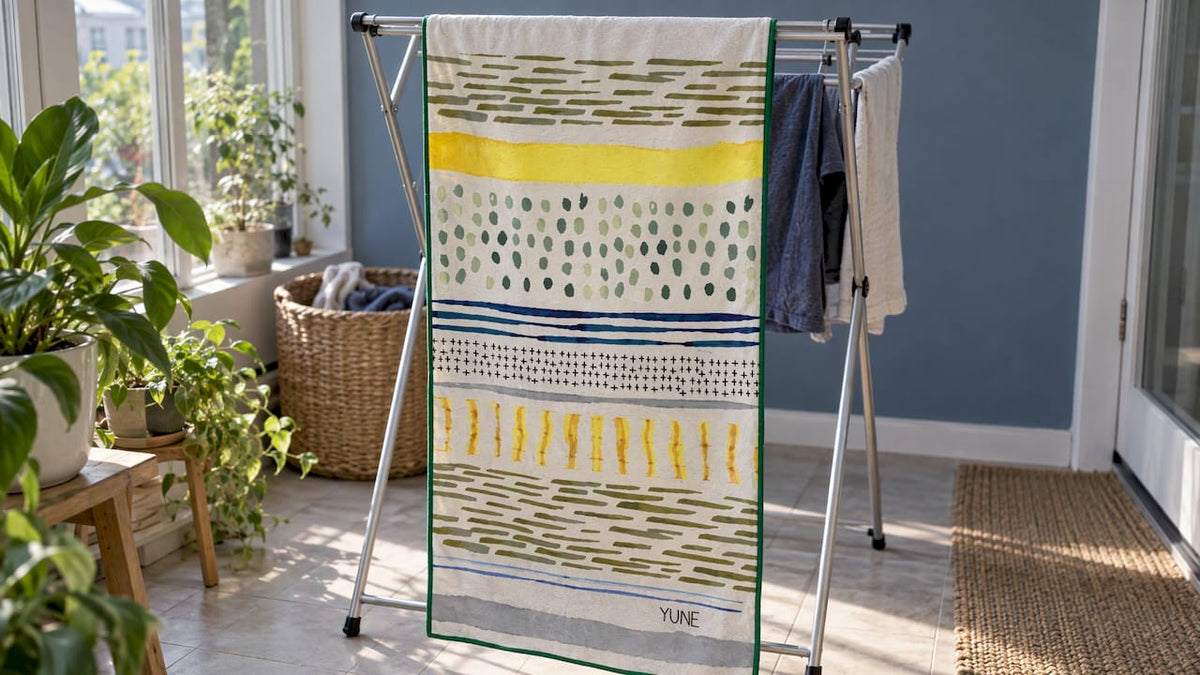
- Dry on low heat, or hang it. Consumer Reports says most towels shrink and recommends using the dryer’s appropriate heat setting, and it points out that a moisture sensor is useful. A sensor stops the cycle when the towel is dry instead of baking it. Microfiber also dries fast on a rack or over a door, so air drying costs you very little time.
- Shake it out and fold it flat. Do not leave a damp towel balled up in your bag. Mildew can set in within a day.
We go further into grip and odor in our guide on how to wash a yoga towel without killing its grip.
A note on mixing loads
Wash your yoga towel with similar synthetics rather than with heavy cotton items like jeans or bath towels. Cotton sheds lint that can cling to microfiber and dull its surface, and a crowded drum with a heavy load usually means a hotter, longer dry cycle.
Checking whether your towel has shrunk
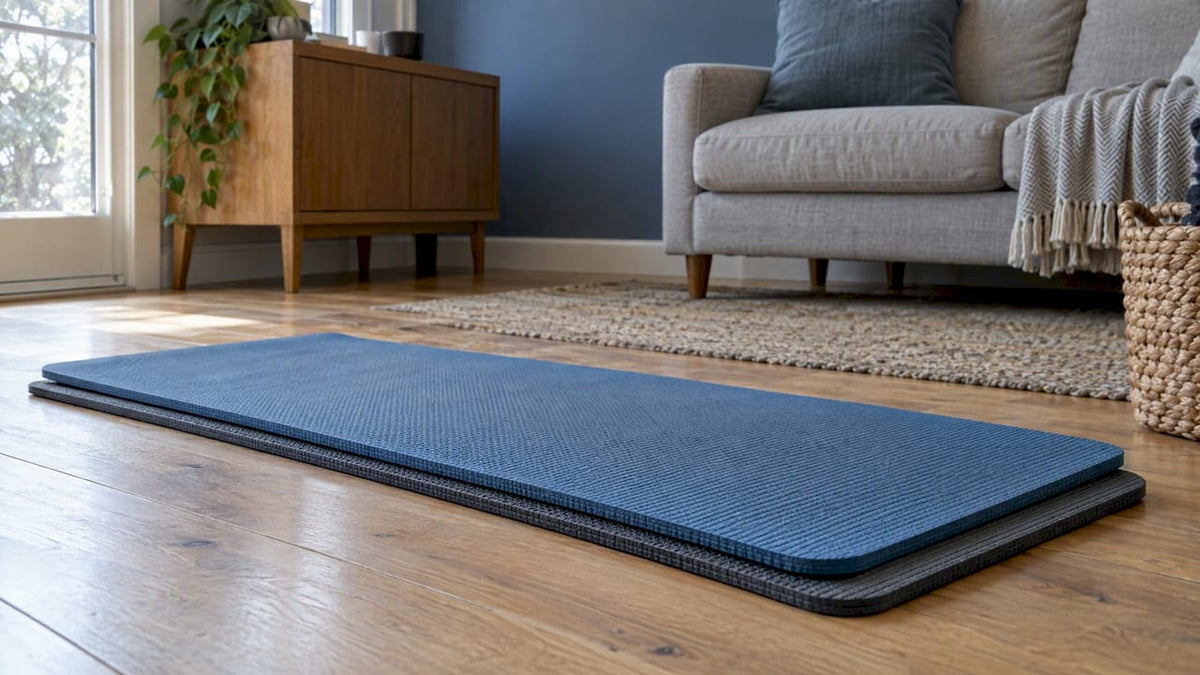
Shrinkage on a yoga towel is easy to spot because the towel has a job: cover the mat. Lay the clean, dry towel on your mat and check three things.
- Length: the towel should reach from the top edge to the bottom edge, so your hands and feet stay on it in every pose.
- Width: a narrow towel slides sideways in wide-legged poses.
- Shape: edges that curl or pull in can mean the fabric has tightened unevenly.
A typical mat is about 68 to 72 inches long and 24 inches wide, though extra-long and wide mats exist. If your mat is longer than average, buy a towel that matches it, then you have room for a small amount of change over years of washing. Our comparison of top yoga mat towels helps with matching sizes.
If it has already shrunk
You can sometimes recover a little length. Soak the towel in lukewarm water, lay it flat and gently stretch it back toward its size, then let it air dry. This works better on natural fibers than on synthetics, and it will not restore a badly shrunk towel. If the towel no longer covers your mat, it is time to replace it. A towel that is too short is more annoying than useful, and it can leave you sliding at exactly the wrong moment.

Yoga towel versus regular towel
A regular bath or beach towel is usually cotton terry, and it works as a stopgap. On a mat, though, the differences show up fast:
- Size and shape. A yoga towel is cut to the footprint of a mat. A bath towel is shorter and wider than you need, and it bunches.
- Fabric. Terry loops absorb a lot of water but get heavy and slip on the mat surface. Microfiber with a textured or waffle weave wicks sweat and grips when damp.
- Drying time. Cotton terry stays wet for hours. Thin microfiber dries quickly, which also keeps odor down.
- Shrink behavior. Because a cotton bath towel is the fiber type most prone to shrinking, it is the one most likely to change size over time.
If you want to see how weave affects wet grip, read our guide on waffle weave yoga towels, and for fabric basics, the ultimate guide to choosing a microfiber yoga towel.
What to look for when buying a towel that will not shrink
Use this short checklist before you add anything to your cart:
- Check the fiber label. Look for a polyester and nylon microfiber blend rather than cotton if size stability matters most.
- Look at the weave. A tight, even weave resists distortion better than a loose one.
- Read the care instructions. A reliable maker tells you the wash and dry temperatures. If it says “do not use fabric softener,” that is a good sign the towel is built for grip.
- Match the size to your mat. Measure the mat first, then pick a towel that covers it with a little to spare.
- Think about where you practice. For hot classes, you want fast-wicking microfiber. For travel, you want one that folds small and dries overnight.
Our best microfiber yoga towel guide and the piece on the benefits of using a microfiber yoga towel go through each point in more detail.
Our perspective
We hear this question often, and our answer is the same every time: choose the fiber first, and the shrinking question mostly answers itself.
We build our yoga towels around microfiber because a yoga towel has to do three things at once: stay the size of your mat, soak up sweat, and grip when wet. Cotton can do the second job, but it is the weakest at the first and third. When a fabric swells and relaxes with every wash, you end up with a towel that no longer fits your mat.
Our approach is simple. We design for a clean fit on a standard mat, we favor durable, sustainable materials, and we tell you how to care for the towel so it keeps its grip. Wash it after each session, keep the heat low, leave out softener, and it is designed to stay with you for a long time.
If you practice at home, a towel over your mat gives you grip on days you sweat more than usual. If you travel, a thin microfiber towel gives you a mat surface you can pack in a carry-on and dry overnight in a hotel bathroom.
We would rather you buy one towel that fits and lasts than three that shrink and slip.
Nicholas
Find a towel that fits your mat
If you are ready to replace a shrunken towel, we make microfiber yoga towels for home practice, hot classes and travel. Browse the Rowan yoga towel, the SE34 yoga towel or the Reed yoga towel, and pair one with a natural rubber or foldable travel mat from the Yune Yoga shop.

Each towel page lists size and care details, so you can check the fit against your own mat before you order.
FAQ
Do microfiber yoga towels shrink in the dryer?
Usually very little. Polyester-rich fabrics are more stable than cotton, and testers found two well-known microfiber yoga towels held up well to repeated machine washing and drying. High heat can still damage fibers and reduce grip, so use a low setting or air dry.
Can I put a yoga towel in the dryer?
Yes, on a low heat setting. Consumer Reports advises using the heat setting that suits the fabric and notes that a moisture sensor helps prevent over-drying. Hanging the towel is the safest option, and microfiber dries quickly this way.
How often should I wash a yoga towel?
After every use. Wirecutter’s guidance is that all yoga towels should be laundered after each session, and that washing and drying habits affect how long the towel lasts. Washing it promptly also keeps sweat and oils from building up and costing you grip.
Is a yoga towel different from a regular towel?
Yes. A yoga towel is sized to cover a mat and is typically made from microfiber that wicks sweat and grips when damp. A regular bath towel is usually thick cotton terry, which is heavier, slower to dry and more prone to shrinking.
Should I use fabric softener on my yoga towel?
No. Consumer Reports reports that liquid fabric softener leaves a film that decreases towel absorbency. That film works against a towel meant to absorb sweat and grip the mat, so leave it out of the wash.
Sources
- What Separates a $70 Hot Yoga Towel From a $20 One? (Wirecutter)
- How to Choose Bath Towels That Last (Consumer Reports)
- The effect of fabric structure parameters on dimensional stability after domestic washing
- Cellulosic Fibers (Pratt Textile Research Lab)
- The 8 Best Yoga Towels, Per Yoga Instructors (Women’s Health)