
Article: Bleach on a Yoga Mat: What to Do Now and What to Use Instead
Bleach on a Yoga Mat: What to Do Now and What to Use Instead
Bleach does not belong on a yoga mat. It is a harsh disinfectant that can degrade mats over time and can soak into porous surfaces. If bleach has already touched your mat, stop using it, ventilate the room, and rinse the mat with plenty of clean warm water if the care label allows it. Then let it dry completely, out of direct sun. If you are reading this before cleaning, skip the bleach and use mild dish soap and warm water instead.
TL;DR
- Never use bleach to clean or disinfect a yoga mat. Its harsh chemistry can reduce the mat’s integrity.
- If bleach already got on the mat: stop using it, open a window, do not add another cleaner, rinse with warm water, and air-dry flat.
- If bleach touched your skin or eyes, flush with water and call Poison Help at 1-800-222-1222.
- For a personal mat, a few drops of dish soap in warm water is enough. Disinfecting is mainly for shared mats.
- If the mat still smells strongly of bleach, or feels damaged or slippery after drying, replace it.
Table of Contents
- Why bleach and yoga mats do not mix
- What to do if bleach already got on your yoga mat
- Why people reach for bleach, and what is actually needed
- How to clean a yoga mat without bleach
- How often to clean your mat
- Drying matters as much as cleaning
- When to replace the mat
- Choosing a replacement that is easy to keep clean
- FAQ
- Sources
Why bleach and yoga mats do not mix
A yoga mat is a surface that touches your hands, feet, face and sometimes your whole body for an hour at a time. That makes two things matter: how the material holds up, and what chemical residue it may leave behind.
On the material side, the guidance is consistent. Wirecutter describes bleach as a harsh disinfectant that can break mats down with repeated use, and notes that disinfectants can absorb into porous mats. Martha Stewart’s cleaning guide gives the same plain answer to the question people ask: no, never use bleach to disinfect a yoga mat.
On the residue side, the concern is practical. Chlorine bleach is made to be rinsed off hard surfaces. The American Cleaning Institute’s general procedure for bleached surfaces is to rinse with warm water, wipe dry, and wash your hands. A mat is not a countertop. If the material is soft or absorbent, you cannot be sure that every trace has left it.
You may see forum posts from people who spray diluted bleach on a mat and say it works fine. A mat that looks fine on day one can still be wearing down. The surface is what gives you grip, and a surface that has been chemically attacked can turn tacky, brittle, chalky or slippery. We would not bet your footing in downward dog on it.
How the risk depends on your mat’s material
Mats differ, and the damage differs with them. Wirecutter points out that mats vary in absorbency and material, including natural rubber, TPE and PVC, and tells readers to check the manufacturer’s cleaning guidelines first.
The most useful split is between open-cell and closed-cell construction:
| Mat type | How it behaves | What bleach risk looks like |
|---|---|---|
| Open-cell (many natural rubber mats) | Absorbs sweat, which can trap dirt and bacteria | Liquid can soak below the surface, so residue and damage are harder to rinse out |
| Closed-cell (many PVC and TPE mats) | Does not absorb moisture | Stays on the surface, so it rinses more easily, but the surface can still be harmed over time |
| Natural rubber specifically | Soft, grippy and porous | The one we would protect most. Harsh chemicals are the fastest way to age it |
If you are not sure which kind you own, press a damp fingertip on the surface. If the spot darkens and soaks in, you probably have an open-cell mat and should treat any spill as something that has gone inside.
What to do if bleach already got on your yoga mat
Stay calm, and do these in order. This sequence follows Wirecutter’s guidance on bleach-contaminated mats and CDC advice on chlorine exposure.
- Stop using the mat. Do not do one more practice on it “to see.” Wirecutter advises against continuing to use a bleach-contaminated mat until it has been thoroughly rinsed and dried.
- Ventilate. Open a window or door and move the mat to a well-aired space. Bleach fumes irritate. The CDC lists burning of the eyes, nose, throat and lungs among the effects of chlorine exposure.
- Do not add another cleaner. This is the step people get wrong. The CDC warns that household bleach can release chlorine gas when mixed with certain other cleaning products. Do not spray vinegar, ammonia, or a commercial mat spray on top of it to “neutralize” the smell.
- Check the care label or manufacturer’s page. If rinsing is allowed, go to the next step. If it is not clear, contact the manufacturer before going further.
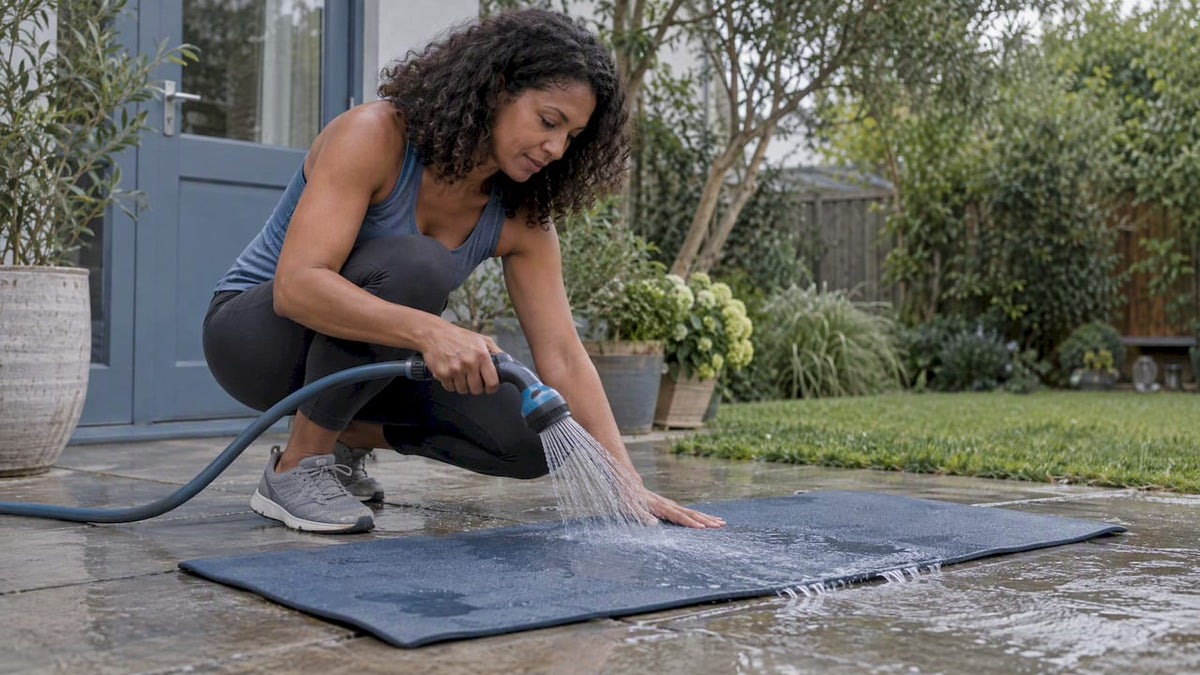
- Rinse with plenty of clean warm water. Rinse the affected area, and ideally the whole mat, in a tub, shower or outdoors with a hose. Wipe or gently squeeze the mat until the water runs clear. Do not scrub hard, which can tear a soft surface.
- Air-dry completely. Hang or lay it flat in a shaded, ventilated spot, away from direct sunlight. Flip it halfway through. Do not roll it up while damp.
- Judge the result. Once dry, sniff and feel it. If bleach was absorbed, if the mat still smells strongly of it, or if the surface is damaged or slippery, the safe move is to discard it or ask the manufacturer whether it is still safe to use.
If bleach touched your skin or eyes
The CDC says chlorine exposure can cause skin pain, redness or blisters. Wash the skin with lots of lukewarm water. For burning eyes, rinse for 10 to 15 minutes. Then call Poison Help at 1-800-222-1222 in the United States. Do this before worrying about the mat.
If you have asthma or another breathing condition and the fumes are bothering you, leave the room and get fresh air first. Seek medical care if symptoms continue.
A small spill versus a soaked mat
A few drops on a closed-cell mat that you wiped up immediately is a different situation from a mat that was sprayed through and left for an hour. The steps above are the same, but your decision at the end differs. A small, surface-level spill on a mat that rinses clean and dries with no smell and no change in texture is usually fine to keep. A soaked open-cell mat is the one to retire. When in doubt, the manufacturer is the right person to ask, not a forum.

Why people reach for bleach, and what is actually needed
Most people think of bleach because they want the mat to be “germ-free.” That goal is a bit stricter than health requires.
Cleveland Clinic says that soap and water are sufficient for a personal yoga mat, and that disinfecting is generally recommended only for shared mats, such as those at gyms, where you do not know what germs may be present. Its experts also separate two ideas: cleaning removes dirt and organic matter, while disinfecting kills germs on a surface that has already been cleaned. The CDC makes the same distinction in its guidance on cleaning supplies, and adds that the products you choose should not damage the surface being cleaned.
Wirecutter quotes a Northwestern University engineering professor making a calming point: a personal mat does not need to be sterile for you to stay healthy, because microbes are everywhere anyway.
So the honest answer is that a mat you alone use needs regular, gentle cleaning, not a disinfectant, and certainly not bleach.

How to clean a yoga mat without bleach
This is the routine we recommend for most personal mats.
The soap-and-water method
- Fill a basin or sink with warm water and add a few drops of mild dish soap.
- Dip a soft cloth or rag, wring it out, and gently scrub both sides of the mat.
- Wipe again with a cloth dampened in plain water to remove soap.
- Hang or lay the mat flat to air-dry fully before rolling it up.
This matches Cleveland Clinic’s advice and Wirecutter’s recommendation of mild dish soap and warm water for most personal mats. Keep the soap to a few drops. Too much leaves a film that makes the surface slick.
Read the care instructions first
Not every familiar home remedy suits every mat. Wirecutter notes that vinegar, dish soap and tea tree oil may not be appropriate for all mats. Natural rubber in particular can react to oils and strong acids, so follow what your mat’s maker says. Our own guides walk through the process in more detail: see 5 easy steps to deep clean your yoga mat, and our detailed guide to cleaning and caring for your mat. If you prefer a spray, we have homemade yoga mat cleaner recipes to try.
When you truly need to disinfect
Sometimes you do: you lent your mat to someone who was sick, you practiced on a shared studio mat, or you have an open skin condition. In that case:
- Clean first, then disinfect. Disinfectants work on a clean surface.
- Use an EPA-approved, non-toxic disinfectant that is safe for skin contact, or the cleaning product your mat’s manufacturer recommends.
- Follow the label. Federal rules require the label directions of EPA-registered disinfectants to be followed, and the CDC notes that off-label use may carry liability for injuries and enforcement action.
- If you want something gentler, Martha Stewart’s guide points to disinfectants made with natural ingredients as a milder option than bleach.
- Rinse or wipe off residue as the label directs, and let the mat dry.
What about disinfectant wipes? Wirecutter says they are generally not recommended for yoga mats. That includes the household wipes people ask about by brand name. They are formulated for hard, non-porous counters, not for a surface your hands and face will touch.
How often to clean your mat
The simple schedule from Martha Stewart’s guide: wipe your mat down after every practice, and give it a more thorough cleaning about once a week, depending on how often you use it.
Adjust it to your life:
- Hot or sweaty classes, daily practice: wipe after each session, wash weekly.
- A few gentle sessions a week: quick wipe after use, a full wash every two to three weeks is reasonable.
- Travel mat that gets packed in a bag: wipe before packing, and air it out fully when you arrive home.
- New mat: many have a slick factory film or a rubber smell. A gentle wipe with mild soap and water, then a full air-dry, is a sensible first step. Follow your maker’s instructions.
If you share a mat with a partner or kids, clean it a little more often. If you take it to a studio, the shared-use logic applies to the studio’s loaner mats, not to yours.
Drying matters as much as cleaning
Moisture, more than germs, is what ruins most mats. Martha Stewart’s guide says a wet mat should air-dry completely before you roll or store it, because storing it damp can encourage mold and mildew growth.
Some habits that help:
- Dry it flat or hung over a rail, in the shade. Direct sun can dry out and age rubber and foam.
- Flip it once so both sides get air.
- For a quicker dry, press a clean towel along the mat as you roll it. We cover that in our towel roll method for drying a mat by material.
- Do not store it in a closed bag or hot car until it is bone dry.
A yoga towel over your mat also soaks up sweat before it reaches the surface, which means fewer deep cleans. If a towel gets musty, our guide to removing mildew from a yoga towel helps. And if you share space at a studio, our studio mat hygiene guide covers keeping shared and personal mats clean.
When to replace the mat
Sometimes cleaning is not the answer. Replace a mat when:
- It still smells strongly of bleach or chemicals after rinsing and a full dry.
- The surface feels sticky, chalky, crumbly or unusually slippery.
- Pieces are flaking off, or the mat has started to crack or peel.
- Mold or mildew keeps coming back through the material.
A mat that slips is a safety issue, not just a cosmetic one. Sliding in a lunge or chaturanga is how wrists, shoulders and knees get hurt. If you are unsure, ask the manufacturer whether the mat is safe to use after contact with bleach.
Our perspective
We think about mats the way we think about shoes: the right care keeps them working, and the wrong shortcut ruins them. Natural rubber is the material we love for grip, and it is also the one that deserves the gentlest treatment. That is why we steer people to soap, warm water and patient air-drying, and away from anything harsh.
The bleach question usually comes from a good place: people want a clean, safe surface. But a personal mat does not need to be sterile. It needs to be clean, dry and grippy. A routine that takes five minutes after practice does more for your mat than any strong chemical, and it keeps the surface the way it was designed to feel.
If you have damaged a mat, it is not a failure. Rinse it, let it dry, and be honest about whether it still gives you secure footing. If it does not, replacing it is a safety choice. We build our mats, towels and straps for home and travel practice with sustainable materials in mind, so the one you pick next is easier to look after.
Nicholas
Choosing a replacement that is easy to keep clean
If your mat did not survive, a few things make the next one easier to care for:
- Match the material to your practice. Natural rubber gives strong grip for sweaty or dynamic styles. Closed-cell mats wipe clean more simply. Our open-cell mat buying checklist explains the tradeoffs for hot classes.
- Plan for a towel. A towel layer takes the sweat so the mat stays cleaner for longer.
- Think about travel. A foldable mat packs into a bag, so wipe and dry it before you fold it.
- Read the care instructions before you buy. A maker that tells you clearly how to clean a mat is a good sign.
We make natural rubber mats, eco mats, foldable travel mats, yoga towels and straps, and we explain care for each. You can browse the full range at Yune Yoga, or look at a yoga towel to keep sweat off your mat.

For a gentler cleaning kit, our yoga clothes and accessories collection has pieces to round out your practice. For more care guidance, our blog’s mat-cleaning posts cover natural rubber step by step.
FAQ
Can I use diluted bleach on a yoga mat if I rinse it well?
We would not. Guidance from Wirecutter and Martha Stewart is to avoid bleach on mats altogether, because even diluted it can wear down the material over time and can absorb into porous mats. Dish soap and warm water clean a personal mat well. If you need to disinfect, use a skin-safe product made for the purpose and follow its label.
Can you use Lysol wipes on a yoga mat?
Disinfectant wipes are generally not recommended for yoga mats. They are made for hard surfaces, not for materials your skin will rest on. Use mild soap and water for routine cleaning, and a mat-safe disinfectant only when sharing a mat.
What happens if a yoga mat gets wet?
Getting wet is fine. Storing it wet is the problem. Let it air-dry completely before you roll it up, because a damp mat can grow mold and mildew. Dry it in the shade, flip it once, and keep it out of closed bags until it is fully dry.
How often should I clean my yoga mat?
Wipe it down after every practice and give it a fuller wash about once a week, depending on how often you use it. Disinfecting is mostly for shared mats, such as those at gyms. For a mat only you use, soap and water is enough.
Is a mat that smells of bleach safe to use?
Not until it has been rinsed and fully dried. If it still smells strongly, or the surface looks damaged or feels slippery afterward, discard it or ask the manufacturer whether it is safe. If you breathed fumes and feel unwell, get fresh air and call Poison Help at 1-800-222-1222.
Sources
- How to Clean a Yoga Mat, Wirecutter
- How to Clean Your Yoga Mat and How Often You Should Do It, Martha Stewart
- Chlorine, Chemical Emergencies, CDC
- How to Use Bleach, American Cleaning Institute
- How (and Why) You Should Clean Your Yoga Mat, Cleveland Clinic
- Cleaning Supplies and Equipment, CDC
- Guideline for Disinfection and Sterilization in Healthcare Facilities, CDC

