Home Practice: 4 Yin Yoga Props Built to Last
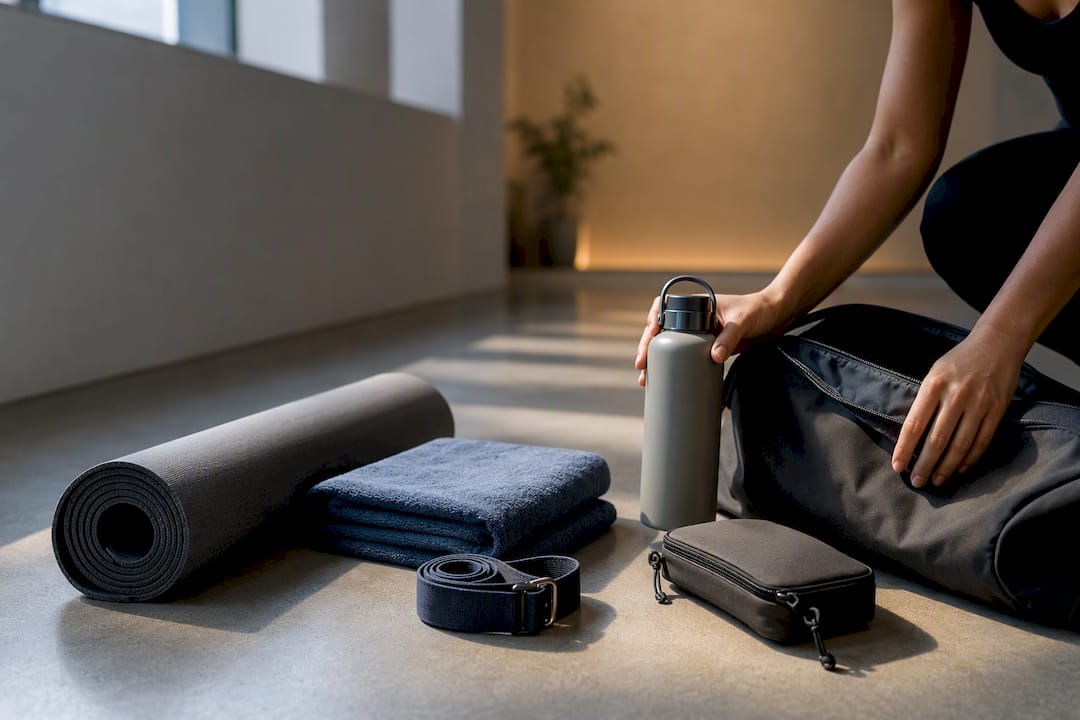
A solid Yin practice needs four things: a bolster, two blocks, a blanket, and a strap, with an eye pillow as an optional fifth That short list covers most of what a home practice requires, because these props create the stillness and support needed to hold poses safely for several minutes at a time. Everything below explains why each one earns its place, how to use it, and what to buy first.
TL;DR:
- Properly shaped and durable props like firm bolsters, cork blocks, and wool blankets ensure long-lasting support and maintain their shape during extended holds.
- Overpropping can eliminate the necessary sensation or edge in poses, so support should feel comfortable but not overly passive or strain-inducing.
- Adaptive positioning, such as adjusting block heights or using household items temporarily, helps tailor support for different body proportions and flexibility levels.
- Regular maintenance, including washing covers and checking firmness, prolongs prop lifespan and maintains safety during prolonged use.
- Starting with essential props like a bolster and cork blocks and gradually adding supportive items ensures a cost-effective, sustainable Yin practice setup.
Table of Contents
- 1. Core props explained: roles and quick usage notes
- 2. Why props matter in Yin: practice principles and safety
- 3. How to choose materials and shapes (bolster, blocks, blankets, straps)
- 4. Starter kit and budget: what to buy first and approximate costs
- 5. How to use each prop: setups, placements, and substitutions
- 6. Prop-supported sequences and timing for a home practice
- 7. Care, maintenance, and replacement cues
- 8. Comparing commercially available prop brands and quality indicators
- 9. Personalizing prop use for your body and flexibility
- 10. Safety considerations and common mistakes with props
- Building a prop habit that actually sticks
- Building your kit with Yune Yoga
- Sources
- FAQ
1. Core props explained: roles and quick usage notes
Each prop in a Yin kit does a specific job, and knowing that job helps you reach for the right one without guessing.
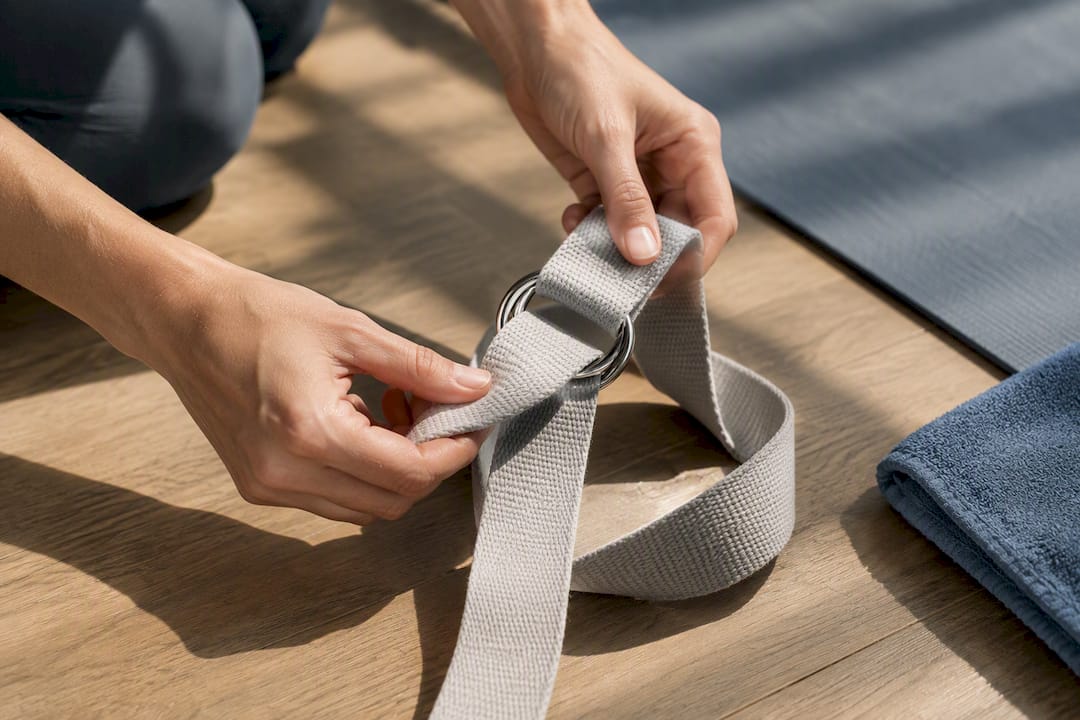
A bolster gives your spine, chest, or hips a stable, elevated surface, most often under the knees, spine, or belly in poses like supported fish or reclined butterfly. Shape and firmness matter here: a bolster that sags loses its support halfway through a five-minute hold, which defeats the purpose. Blocks are almost always used in pairs, stacked or angled under the hips, forehead, or feet to close the gap between your body and the floor. A blanket, folded into a firm rectangle, raises your seat in seated poses or adds warmth over your shoulders during long, still holds. A strap loops around a foot or knee to extend your reach without forcing a stretch, which is one of the few active tools in an otherwise passive practice. An eye pillow adds gentle weight to calm the eyes in savasana, and a sandbag does something similar for the belly or palms.
- Bolster: primary spinal and chest support for reclined and prone poses.
- Blocks (pair): height and stability under hips, forehead, or feet.
- Blanket: seat elevation, warmth, or a rolled substitute for a bolster.
- Strap: extends reach in seated forward folds and butterfly variations.
- Eye pillow/sandbag: added weight and sensory calm for savasana.
A yoga mat with enough density and a folding chair can stand in when you are missing a prop, though neither replaces the shape-specific support a bolster or block gives you.
2. Why props matter in Yin: practice principles and safety
Yin Yoga is built around three ideas: finding an appropriate edge, staying still once you get there, and holding the pose long enough for connective tissue, not muscle, to feel the work. Bernie Clark’s framework ties all three together, and props exist to make each one achievable without strain.
Props transfer load away from muscles that would otherwise have to fire to hold you up. When a bolster takes the weight of your torso in supported fish, your shoulder and chest muscles can let go, and the stretch reaches the tissue Yin is actually trying to target. Without that support, most people tense up within a minute, which cancels the point of the hold. This load transfer also explains the practice’s calming effect, since a body that is not gripping tends to settle into a parasympathetic state more easily during a three to five minute pose.
Teachers commonly warn against overpropping, where so much support is added that there is no edge left to work with. A short safety checklist helps: check that you feel sensation, not pain; make sure your neck has no sharp bend; and confirm you can breathe easily before settling in for the full hold.
3. How to choose materials and shapes (bolster, blocks, blankets, straps)
Buying the right shape and material once saves you from replacing gear within a year.
A firm, rectangular bolster gives you a flat, stable surface for the spine and works for supported fish, saddle, and reclining poses without rolling away, which round bolsters can do during a passive hold. Cork blocks resist compression better than foam over multi-minute holds, so they keep their height and grip session after session, while foam blocks can flatten and lose their edge over time. Wool or cotton blankets fold into a predictable, non-slip thickness that foam or synthetic throws rarely match. For straps, look for a cotton or nylon strap around 6 to 8 feet long with a secure metal cinch buckle, since a slipping buckle mid-hold is more than an annoyance. Eye pillows filled with flaxseed or lavender-scented rice add gentle, even weight.
- Bolster: firm rectangular fill, flat top, no rolling.
- Blocks: cork over foam for long holds; foam compresses.
- Blanket: wool or cotton for grip and consistent loft.
- Strap: 6 to 8 feet with a metal cinch buckle.
Household substitutes, like a firm couch cushion or a rolled towel, work in a pinch but rarely hold their shape for a full five-minute pose the way a purpose-built prop does.
Pro Tip: Test any substitute prop in a short one-minute hold before trusting it for a full-length pose.
4. Starter kit and budget: what to buy first and approximate costs
If you are building a kit from scratch, buy in this order: bolster first, then two cork blocks, a wool blanket, a strap, and finally an eye pillow or sandbag. This sequence matches how often each prop shows up across a typical Yin class, with the bolster appearing in nearly every pose and the eye pillow reserved mostly for savasana.
A teacher-tested starter kit commonly converges on a firm rectangular bolster, two cork blocks, and a wool blanket as the core three purchases, with a strap and eye pillow rounding things out. Durable materials cost more upfront but hold their shape and height through years of long holds, which makes them the better investment for anyone practicing more than once a week.
- Bolster: the single highest-priority purchase; buy this first.
- Two cork blocks: next, for height and stability under joints.
- Wool blanket: third, for seat elevation and warmth.
- Strap and eye pillow: last, since they support fewer poses overall.
Home practitioners without a teacher’s daily wear and tear on gear can prioritize the bolster and blocks and delay the rest, while anyone practicing several times a week benefits from investing in cork and a firm bolster right away, since those two items see the most repeated pressure.
5. How to use each prop: setups, placements, and substitutions
Once you have your kit, the setups themselves are simple. A few core arrangements cover most of what a Yin class asks for.
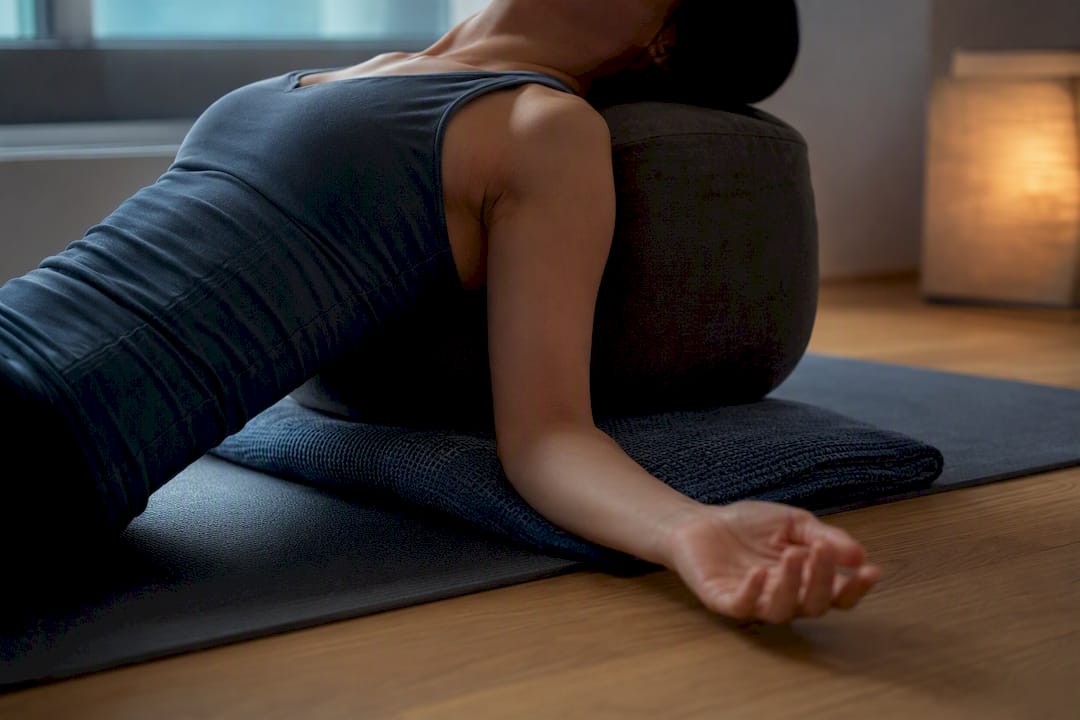
- Supported fish: place the bolster lengthwise along your spine, lie back over it, and let your arms fall open. Add a folded blanket under your head if your neck feels unsupported.
- Supported child’s pose or tadpole: set the bolster lengthwise between your knees and hug it, letting your chest and forehead rest into it.
- Reclined butterfly: put the bolster under your spine, bring the soles of your feet together, and let your knees drop toward the floor, supported by blocks if your hips are tight.
- Supported pigeon: slide a bolster or folded blanket under the hip of your bent front leg to level your pelvis.
- Forward folds with blocks: stack two blocks under your forehead so your neck can release instead of straining forward toward your shins.
The inclined bolster, made from two blocks and a bolster, is one of the most versatile setups in a prop-supported Yin sequence. Three practical versions: set both blocks at their lowest height under one end of the bolster for a gentle incline, raise both blocks to medium height for a steeper support in poses like supported sphinx, or stagger the two blocks at different heights to fine-tune the angle for your own torso length. Always check that the incline does not force your neck into a sharp bend before settling into the hold.
Blanket folding has its own quick recipes: fold in thirds for a seat-height lift under sitting bones, roll it into a tube to sit behind the neck in supported fish, or double-fold it as a bolster substitute in a smaller space, an approach that works well for restorative sequences with minimal props.

Pro Tip: A firm couch cushion can stand in for a bolster in a pinch, but it will flatten faster and support less evenly than a purpose-built one.
For quick reference, a firm pillow gives moderate support but tends to shift during long holds, a bolster holds its shape and height reliably, and a folded blanket offers adjustable but less consistent support depending on how tightly it is folded.
6. Prop-supported sequences and timing for a home practice
A short sequence built around the inclined bolster setup is one of the easiest ways to get comfortable with props.
- Start with two minutes of basic relaxation lying flat, arms at your sides, to settle your breath.
- Move into supported sukhasana, sitting cross-legged with a folded blanket under your seat, held for three to five minutes.
- Set up an inclined bolster using two blocks at low height, then move into supported sphinx, forearms on the floor, chest resting into the incline, held for three to five minutes.
- Return the bolster flat under your spine for reclined butterfly, feet together and knees open, held for four to six minutes.
- Add a gentle supported twist, bolster running alongside your hip, for two to three minutes per side.
- Close with savasana, with an optional eye pillow, for five minutes or longer.
Before settling into the inclined bolster, check that your lower back is not compressing and that your neck has no sharp angle. If either shows up, lower the incline by dropping one block a height. Beginners can shorten every hold to two or three minutes and build up gradually as the poses feel more familiar. To increase sensation, move the bolster or blocks slightly farther from your body; to ease off, bring them closer or add a folded blanket for extra cushioning.
7. Care, maintenance, and replacement cues
Props that get regular use need a little upkeep to stay safe and comfortable.
- Wash bolster covers on a gentle cycle every few weeks with regular use, and check the inner fill for lumps or flattening once or twice a year.
- Wash wool or cotton blankets sparingly and air dry when possible, since heat drying can shrink them and change their folded thickness.
- Wipe cork blocks down with a damp cloth rather than soaking them, since cork can absorb moisture and lose its density over time.
- Replace a bolster once it no longer holds its shape under your body weight, and replace a strap the moment its buckle stops gripping securely.
For travel, a folded blanket and a strap pack down small, and a rolled towel can substitute for a bolster on the road, though it will not match a full-size bolster’s support for longer holds at home.
8. Comparing commercially available prop brands and quality indicators
Not all props are built the same, and the difference usually shows up after a few months of use rather than on day one. The clearest quality indicator for a bolster is fill density: a firm, evenly packed bolster holds its shape through a five-minute hold, while a loosely stuffed one starts to sag within weeks. For blocks, durable materials like cork cost more upfront but maintain their height and grip far longer than foam, which tends to compress permanently under sustained weight.
For blankets, look at weave tightness and fiber content rather than size alone, since a tightly woven wool or cotton blanket folds into a consistent, non-slip thickness that a thin synthetic throw cannot replicate. Straps are the simplest item to judge: a metal cinch buckle that holds firmly under tension beats a plastic slide buckle almost every time.

When comparing options, check stitching on bolster covers, the weight and rebound of a block when pressed, and whether a blanket holds its fold after a few uses. These small details tend to separate a prop that lasts years from one that needs replacing within a season, regardless of the price tag attached to it.
9. Personalizing prop use for your body and flexibility
Prop needs shift depending on your body’s proportions and how much range of motion you naturally have, so a setup that works for one person may need adjusting for another.
Longer-legged practitioners often need a taller stack of blocks under the forehead in forward folds, since the distance to the floor is simply greater. Tighter hips in reclined butterfly usually call for a block or bolster under each knee rather than letting them hang unsupported, which keeps the pose from tipping into strain instead of stretch. More flexible practitioners may need less support overall and can move blocks farther away or lower the incline on a bolster to preserve a genuine edge, since too much propping removes the sensation the pose is meant to create.
A shorter torso may need a smaller, lower bolster in supported fish, while a longer torso benefits from a taller stack or an extra folded blanket to fill the gap under the head. There is no single correct height for any of these setups, only the version that lets your specific body settle into stillness without gripping or straining.
10. Safety considerations and common mistakes with props
The most common mistake with Yin props is overpropping, stacking so much support under the body that there is no meaningful edge left to hold, which turns the pose into passive rest rather than a targeted stretch. The opposite mistake, using too little support, often shows up as a strained neck in forward folds or a compressed lower back in reclined poses.
Sharp pain anywhere in a pose, especially in a joint, means the setup needs adjusting immediately rather than pushing through it. A restorative props overview notes that bolsters and blankets are meant to improve stability and make long holds safer, not to force a stretch beyond what feels sustainable.
A short checklist before any long hold: confirm your neck has no sharp bend, check that your breath stays easy and unrestricted, and make sure any sensation you feel is a stretch, not a pinch. If a setup requires constant small adjustments to stay tolerable, it usually needs more support, not less.
Building a prop habit that actually sticks
Props are not a shortcut, they are what let your body settle enough for a pose to do its job. I’d rather see someone practice with a folded towel three times a week than wait to buy a full kit before starting at all. Add one prop a month if budget is tight, and let consistency, not gear, carry your practice forward.
— Nicholas
Building your kit with Yune Yoga
Yune Yoga’s accessories collection covers the strap and add-on pieces of the starter kit described above, made from durable, sustainable materials designed to hold up through repeated long holds rather than a single season of use. This focus on eco-conscious, functional design matches the buy order recommended here: sturdy pieces meant for long-term use rather than frequent replacement.
- Straps and accessories built from sustainable materials for long-term use.
- Designs meant to hold their shape through repeated, extended holds.
- A practical way to fill out a kit once your bolster and blocks are covered.
Browse the Yune Yoga shop to see current accessories and start rounding out your Yin kit.
Sources
- Best Yoga Props for Yin Yoga in 2026 — Teacher Setup Guide | FLOW | FLOW Yoga Sequence Builder
- Using Props in Yin Yoga
- Essential Yoga Props To Elevate Your Practice
- A Prop-Supported Yin Yoga Sequence - Yoga International
FAQ
What props does Yin yoga use?
A typical Yin kit includes a bolster, two blocks, a blanket, and a strap, with an eye pillow or sandbag as optional extras. These core restorative props provide support and stability during long, still holds.
What are the five elements of Yin yoga?
Yin Yoga draws on the traditional Chinese five elements (wood, fire, earth, metal, and water) as a framework some teachers use to organize sequences around different meridians and body regions. Definitions and applications vary by teacher and lineage, so treat this as a loose organizing tool rather than a fixed rule.
What are the five archetypes of Yin yoga?
Archetype frameworks in Yin Yoga vary by teacher and are not a single standardized system, so there is no one universally agreed list. If you encounter this term in a class, ask the teacher how they are using it, since it is not a core part of Bernie Clark’s foundational framework.
What are the four tenets of Yin yoga?
Yin Yoga is most consistently described around three core principles: finding an appropriate edge, remaining still, and holding the pose for a sustained duration, as outlined in Bernie Clark’s practice framework. Some teachers add a fourth idea, often framed around mindful attention or breath, but this varies by lineage.
How do I use yoga props for restorative poses?
Place a bolster under your spine or knees for support, use blocks in pairs to fill gaps under your hips or forehead, and fold a blanket for seat height or warmth. Test any setup for a minute before committing to a full-length hold, and adjust immediately if you feel sharp pain rather than a gentle stretch.