Match Your Mat to Heat: Material Care and 10 Minute Rescue for Yogis
Heat damage to yoga mats is real, and it happens faster than most practitioners expect. A mat left in a hot car, on a sunny windowsill, or under a radiator can warp, soften, lose its grip, or start smelling off within days. If your mat has already taken heat damage, get it out of the heat immediately, let it return to room temperature, unroll it fully, and air-dry it before you touch it with soap or water. Never blast it with hot water, a hair dryer, or a clothes dryer to speed things up. Those moves almost always make the damage worse, not better.
TL;DR:
- Heat exposure can cause permanent delamination and cracking in yoga mats if the internal layers have separated or the material has turned crumbly.
- Natural rubber mats resist heat better but still degrade over time with sun and prolonged exposure, while PVC mats soften and yellow at lower temperatures.
- Immediately cooling and fully drying a overheated mat can prevent irreversible damage, but persistent odors and structural issues indicate it needs replacement.
- Using a towel during hot yoga and avoiding storage in hot cars or direct sunlight throughout the day significantly extend a mat’s lifespan.
- Choosing mats made from durable, heat-resistant materials and following proper care routines from the start helps prevent damage and prolongs usability.
Table of Contents
- What Heat Damage to Yoga Mats Actually Looks Like
- Why Heat Damages Mat Materials in the First Place
- How Different Mat Materials React to Heat
- Preventing Heat Damage: Daily and Travel Habits That Actually Work
- What to Do Right After Heat Exposure
- Repair, Refurbishment, or Replacement: Making the Call
- Yune Yoga’s Perspective on Material-Aware Mat Care
- How Humidity Makes Heat Damage Worse
- Is It Heat Damage or Just Normal Wear?
- Professional Repair Options and What They Cost
- Balancing Grip, Weight, and Heat Resistance in Real Practice
- Find Mats Built to Handle the Heat
- Sources
- FAQ
What Heat Damage to Yoga Mats Actually Looks Like
Heat damage doesn’t always announce itself the same way twice. Depending on how hot the mat got, how long it sat there, and what it’s made of, you might see one symptom or a whole cluster of them.
The most common signs include:
- Warping or curling at the edges or across the whole surface, where the mat won’t lie flat anymore
- Softening or a sticky, tacky feel that wasn’t there before, especially on PVC and some TPE mats
- Loss of grip, which shows up as slipping during poses that used to feel stable
- Delamination, where you can see or feel layers separating, often starting at a corner or seam
- Increased brittleness and cracking, particularly on mats that have been baked repeatedly
- Discoloration and off-gassing odors, a chemical or musty smell that gets stronger in a warm room
Some of these are fixable. Surface tackiness and a mild curl at the edges often resolve once the mat cools and dries out completely, according to cleaning guidance from Wirecutter. Deep delamination and structural brittleness usually aren’t. Once a mat’s internal layers have separated or the material has turned crumbly, no amount of conditioning brings that back.
Four quick checks tell you how bad it is. Run your palm across the surface in a grip test, pressing down like you would in downward dog. Then try a flex test, folding a corner gently to see if it cracks or feels chalky instead of pliable. Take a smell check, since a strong chemical or moldy odor signals off-gassing or trapped moisture. Finally, do a visual inspection for bubbles, soft spots, or any place where the top layer looks like it’s lifting away from the base. If two or more of these checks come back positive, you’re looking at damage that goes beyond a quick clean.
Why Heat Damages Mat Materials in the First Place
Every yoga mat is built from some kind of polymer, whether that’s PVC, TPE, natural rubber, or a foam blend, and every polymer has a temperature range where it behaves the way you expect. Push past that range and the material’s internal structure starts to shift.
Heat lowers a polymer’s internal viscosity. In plain terms, the material gets softer and more prone to flow, which is exactly why a mat left in a hot car can end up with a permanent wave or dip where it was folded or pressed against something. That softening is also what makes an overheated mat feel tacky in spots that used to be smooth. The polymer chains have loosened enough to start behaving more like a liquid and less like a solid, and once they cool back down, they don’t always settle back into their original shape.
Multi-layer and hybrid mats face an extra risk: the adhesive holding the layers together. Most microfiber-topped or hybrid mats use a laminate bond between the textured top layer and the rubber or foam base. Heat weakens that bond faster than it weakens the base materials themselves, which is why delamination tends to start at the mat’s edges or in whatever spot got the most direct sun or contact with a hot surface.
Sunlight adds a second mechanism on top of straight heat. Ultraviolet exposure accelerates oxidation in most rubber and plastic compounds, and that oxidation shows up as the yellowing or dulling you might notice on a mat that’s spent a season near a window. Heat speeds up that oxidation reaction, so a mat that’s both hot and sun-exposed degrades faster than one that’s just hot or just sunny. This is part of why sun damage to yoga mats and heat damage often travel together rather than showing up as separate problems.
There’s also a moisture angle. A mat that gets warm while still damp from sweat is a better environment for microbial growth than a warm, dry one. Research on shared exercise surfaces has found that microbes can accumulate on mats and contribute to skin issues, and thorough drying is one of the most effective ways to cut that risk down, according to a study on microbial contamination of exercise equipment. Heat alone won’t grow bacteria, but heat plus trapped sweat is a combination worth avoiding.
How Different Mat Materials React to Heat
Not all mats fail the same way under heat, and knowing your material tells you what to watch for and what to do the moment things go wrong.
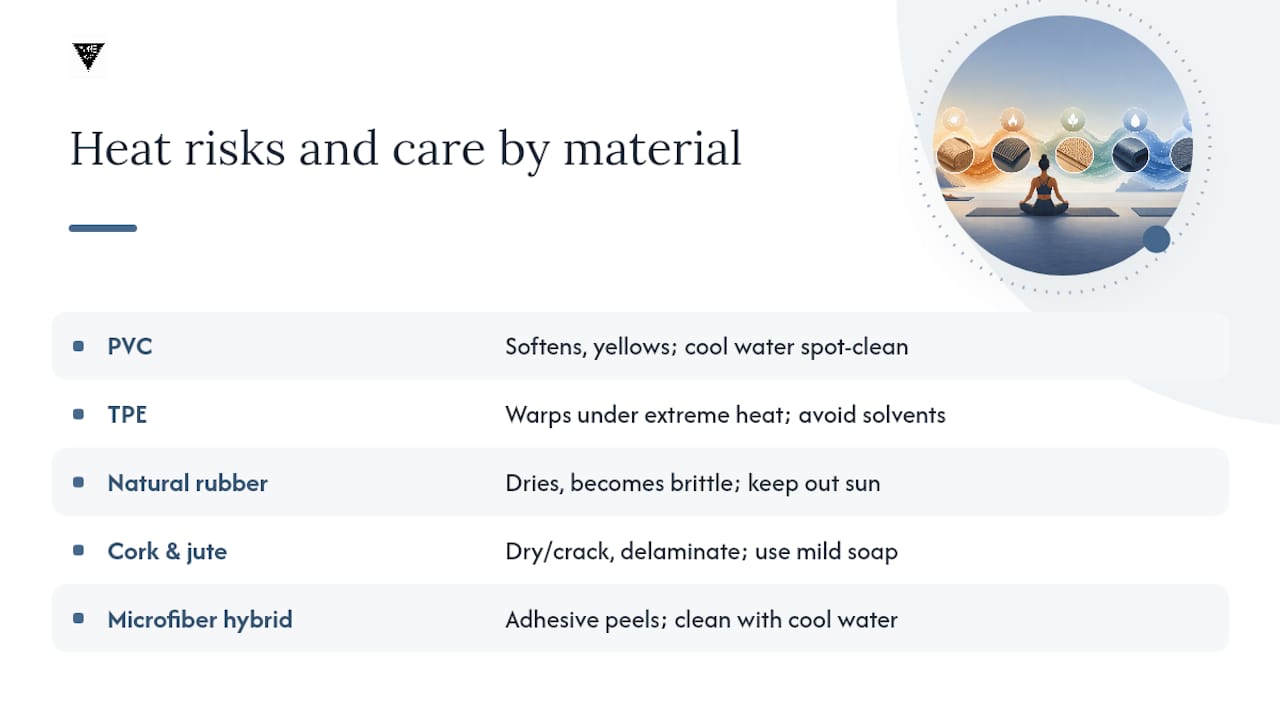
PVC mats are the most heat-sensitive of the common options. They soften and get sticky at lower temperatures than TPE or rubber, and prolonged sun exposure will accelerate that softening along with visible yellowing. If your PVC mat has taken heat, spot-clean with cool water only and let it air-dry completely out of direct sunlight. Minor softening often reverses once it cools; if the surface stays permanently tacky or starts flaking, that’s usually a sign to replace it.
TPE mats generally hold up better than PVC, and consumer testing has found TPE offers improved heat tolerance compared to PVC, though it still warps under extreme, sustained heat. Follow the manufacturer’s cleaning instructions, skip the dryer, and avoid chemical solvents, which can react badly with the foam structure. Warping in TPE is sometimes reversible if caught early and the mat is allowed to relax flat in a cool room for a day or two.
Natural rubber mats offer some of the best grip on the market, and that grip tends to hold up well even in sweaty, hot conditions. The tradeoff is that rubber dries out and gets brittle with repeated sun and heat exposure over time. Roll natural rubber mats with the rubber side facing inward to shield it from UV and heat, and keep them out of direct sun whenever possible. New natural rubber mats also tend to off-gas a mild rubber scent, which is normal and fades with ventilation rather than a sign of heat damage.
Cork and jute mats are the most vulnerable to intense or prolonged heat because natural fibers dry out and lose flexibility faster than synthetic materials. Strong detergents make this worse, not better. Handle these mats gently, clean with the mildest soap you have, and store them somewhere cool and dry. Cracking or delamination in cork and jute mats is rarely repairable and usually means it’s time to replace the mat.
Microfiber-topped hybrid mats carry a specific risk: heat breaks down the bond between the microfiber layer and the rubber or foam base underneath. Clean these with cool water only, skip the soap-heavy scrub, and air-dry fully before rolling. Once you see the microfiber layer starting to peel at a seam, heat exposure has likely already compromised the adhesive, and that kind of separation tends to spread rather than stay contained.
Across every material, the same pattern holds: mild softening or surface tackiness is often reversible with cooling and time, while delamination, cracking, and structural brittleness are usually permanent.
Preventing Heat Damage: Daily and Travel Habits That Actually Work
Preventing heat damage to yoga mats comes down to a handful of habits, most of which take less effort than the damage they prevent.
For everyday care, follow these steps:
- Let your mat cool and dry fully before rolling it back up after every session.
- Rotate which side faces out if your mat sees regular sun exposure near a window or patio door.
- Never roll a damp mat tightly. Trapped moisture plus warmth is exactly the combination that breeds odor and microbial growth.
- Store the mat loosely rolled or laid flat in a ventilated space, away from windows, vents, and radiators.
- Check your storage spot seasonally. A closet that’s cool in winter can turn into a heat trap in summer if it’s near an attic wall or a sun-facing exterior.
Travel and studio habits matter just as much, and consulting an astrology signs yoga compatibility guide can offer unique insight into aligning your yoga practice with your personal traits. Never leave a mat in a hot car or trunk during summer, even for a quick errand. Car interiors regularly climb well past outdoor temperatures within minutes, and a mat rolled tight in a bag traps that heat against itself. If you’re flying or driving somewhere hot, carry the mat in an insulated sleeve or keep it in the cabin with you rather than checking it with luggage that sits on hot tarmac.
For hot yoga specifically, using a practice towel over the mat surface reduces the mat’s direct exposure to sweat and residual heat from the room, and it cuts down on how often you need a full deep clean. Studios that run heated rooms consistently are effectively accelerating every mat’s aging clock, so a towel barrier is one of the simplest ways to buy back some lifespan.
Pro Tip: If you own a natural rubber mat, always roll it with the rubber side facing inward. This keeps the rubber shielded from UV rays and ambient heat during storage, which slows the drying-out process that eventually leads to cracking.
What to Do Right After Heat Exposure
The first ten minutes after you realize a mat has overheated matter more than anything you do afterward. Move it to shade or indoors immediately, unroll it completely, and resist every urge to speed up the fix with more heat.
Follow this sequence:
- Move and unroll. Get the mat out of the sun or hot car and lay it flat somewhere cool and ventilated. Don’t leave it rolled while it cools; trapped heat inside the roll extends the exposure time.
- Inspect before cleaning. Run through the grip, flex, and smell checks described earlier so you know what you’re dealing with before you add water or soap.
- Clean according to material. Closed-cell mats like most PVC and TPE need only a damp cloth and spot-cleaning, not a full soak. Open-cell and natural rubber mats can handle a cool-water soak with a mild soap, roughly one tablespoon of dish soap per gallon of water, followed by a thorough rinse, a method REI’s cleaning guide recommends. Microfiber hybrids need a cold-water gentle wash and nothing more.
- Skip the harsh stuff. Bleach, rubbing alcohol, and strong solvents strip the surface texture that gives mats their grip, and they can react with heat-softened material in unpredictable ways.
- Air-dry completely. Hang the mat or lay it flat in a shaded, ventilated space. Full drying can take anywhere from a few hours to a full day depending on humidity; a damp mat rolled up too soon is a fast track to mold and odor.
If a chemical or musty smell lingers after a full dry cycle, give it more ventilation time before assuming the worst. Persistent off-gassing that doesn’t fade after several days of proper airing is usually a sign the material itself has broken down, and at that point, retiring the mat is the safer call. Whatever you do, never try to flatten a warped or curled mat with an iron, a hair dryer, or direct sunlight. Repeated cycles of heating and cooling accelerate the same polymer fatigue that caused the deformation in the first place, and a mat that survives one heat-fix attempt often doesn’t survive a second.
For a deeper walk-through of the cleaning process itself, Yune Yoga’s step-by-step maintenance guide covers material-specific timing and drying tips in more detail.
Repair, Refurbishment, or Replacement: Making the Call
Small delamination at a corner or seam is sometimes worth patching. Mat-safe contact adhesives designed for rubber or foam can reseal a lifted edge if you catch it early, but check the manufacturer’s guidance first. Many warranties are voided by unapproved adhesives, and heat-activated glues are a bad idea on a mat that’s already shown heat sensitivity.
Replacement makes more sense once you hit any of these thresholds:
- Persistent grip loss that makes poses genuinely unsafe, not just less comfortable
- Brittle cracking that spreads rather than staying contained to one spot
- Widespread delamination across more than a small corner or edge
- Off-gassing or odor that doesn’t resolve after multiple full dry cycles
- Structural brittleness severe enough that the mat sheds flakes or crumbs during use
Structural damage of this kind is typically irreversible, a point HTS Yoga’s guide on mat shrinkage and repair makes clear when discussing failed at-home fixes. Trying to nurse a structurally compromised mat back to health usually wastes more time than a replacement would cost.
When a mat does reach the end of its life, check local recycling programs before tossing it in the trash. Some municipal programs and specialty recyclers accept PVC and rubber mats separately from general waste, and a few gyms and yoga studios run their own take-back programs. It’s worth a quick search for options in your area rather than assuming the landfill is the only route.
Yune Yoga’s Perspective on Material-Aware Mat Care
Choosing a mat that can handle real-world heat starts before the purchase, not after the damage shows up. Some product lines focus on natural rubber and other sustainable materials specifically because these materials, cared for correctly, hold up to years of regular practice without the rapid breakdown that cheaper synthetic blends often show under heat and sun.
Every material behaves differently under stress, which is why generic “one-size-fits-all” care advice tends to fail practitioners in the long run. Rubber needs different handling than a microfiber hybrid, and a mat bought for hot yoga has different demands than one used mostly at home. Product pages often include material-specific care instructions for exactly this reason: knowing what your mat is made of should change how you clean it, store it, and use it near heat.
*Nicholas, a contributor to yoga practice discussions, has worked through common practical mat care questions from practitioners. For readers who want deeper material breakdowns, some blogs carry detailed guides on cleaning routines and product-specific maintenance worth bookmarking before your next hot class.
How Humidity Makes Heat Damage Worse
Heat rarely acts alone. Humidity changes how heat affects a mat, and the combination is worse than either factor by itself. A hot, dry environment speeds up drying and brittleness in natural fibers like cork and jute. A hot, humid environment does the opposite: it traps moisture against the mat’s surface, which slows evaporation and gives bacteria and mold more time to establish themselves before the mat ever gets a chance to dry out.
This is exactly the situation a heated yoga studio creates. The room is warm, you’re sweating heavily, and the mat absorbs both the ambient heat and your perspiration at the same time. If that mat gets rolled up while still even slightly damp, the moisture has nowhere to go, and the warm, sealed environment inside the roll becomes close to ideal for odor-causing microbes.
Coastal or naturally humid climates compound this even without a heated room. A mat stored in a humid closet during summer will show slower drying times and a higher chance of that musty smell showing up, even if it never sees direct heat exposure. The fix in both cases is the same: never roll a mat that isn’t fully dry, and choose storage spots with airflow over ones that are simply cool. A cool, sealed, humid closet can be worse than a slightly warmer room with a fan or open window.
Is It Heat Damage or Just Normal Wear?
Not every worn-out mat is a heat casualty. Regular use wears mats down in ways that look similar to heat damage but come from a completely different cause, and telling the two apart changes what fix, if any, actually works.
Ordinary wear tends to show up gradually and evenly: a general thinning of the surface texture where your hands and feet land most often, a slow fade in color across the whole mat rather than in one hot spot, and grip that declines slowly over months of practice rather than dropping suddenly. Heat damage, by contrast, tends to be localized and sudden. You’ll often find warping or discoloration concentrated in one section, like the section that was folded against a car seat or pressed against a sunny windowsill, while the rest of the mat looks and feels normal.
Delamination is another useful marker. Wear-related delamination usually starts at the areas of highest friction, like the spots under your palms in downward dog, and progresses slowly. Heat-driven delamination tends to appear at the mat’s edges or corners, wherever direct heat or sun contact was most intense, and can appear suddenly after a single bad exposure rather than building over months.
If your mat has an uneven, localized problem that appeared quickly, suspect heat. If the wear is uniform and has developed slowly over regular practice, that’s standard aging, and no cleaning routine will reverse it.
Professional Repair Options and What They Cost
Most yoga mat damage doesn’t justify a professional repair, but a few situations make it worth exploring. Specialty rubber and foam repair shops, the kind that also handle exercise equipment or outdoor gear, can sometimes reseal delamination on higher-end natural rubber or cork mats using proper bonding adhesives rather than the consumer glues sold for household use.
Costs vary widely depending on the mat’s material and the size of the repair, and there isn’t a standardized industry rate the way there is for something like shoe resoling. A small edge repair on a premium mat is more likely to be worth the cost than an equivalent repair on a budget PVC mat, simply because the replacement cost of a premium mat is higher to begin with. For most PVC and TPE mats in the common price range, professional repair rarely makes financial sense once delamination or brittleness has set in. The labor and materials involved in a proper repair often approach or exceed the cost of a new mat.
Before paying for any repair, ask the shop directly whether they’ve worked with yoga mat materials specifically, since techniques that work on shoe rubber or outdoor gear don’t always transfer cleanly to the thinner, more flexible compounds used in mats. If a repair shop can’t speak specifically to mat materials, a replacement is usually the more reliable choice.
Balancing Grip, Weight, and Heat Resistance in Real Practice
Every mat choice is a trade-off, and pretending otherwise does practitioners a disservice. A mat with the best grip in a hot room is rarely the lightest one in your travel bag, and the most heat-resistant materials aren’t always the most sustainable ones. What actually matters is matching the mat to how you practice, not chasing a mythical mat that wins on every axis at once.
If you take one habit from this whole conversation, make it this: never roll your mat up while it’s still warm or damp. That single move prevents more heat and moisture damage than any cleaning product or storage trick.
Before buying a new mat, read the care instructions the way you’d read a nutrition label, not as an afterthought. And if you’re ever unsure whether a studio’s heated room will be too much for your mat, bring a towel. It costs you nothing and buys your mat real protection.
— Nicholas
Find Mats Built to Handle the Heat
If your current mat has already shown warping, stickiness, or that stale off-gassing smell after one too many hot sessions, the fix isn’t just better cleaning. It’s starting with a mat built from materials that hold up under heat in the first place. Some retailers curate natural rubber and eco-friendly mats with care instructions listed on each product page, so buyers can learn how to handle specific mats before heat becomes a problem.

Every listing spells out the material composition and recommended cleaning approach, which matters more than most shoppers realize until they’ve already ruined a mat guessing. If you’re rebuilding your routine around heat resistance and easier maintenance, browsing Yune Yoga’s mat collection is a practical place to start, and pairing a new mat with a proper cleaner routine from the start extends its life well beyond what a reactive cleanup ever can.
Sources
- How to Clean a Yoga Mat | Wirecutter
- How to Clean Your Yoga Mat | REI Expert Advice
- PMC article — (microbial contamination of shared surfaces / exercise equipment)
FAQ
Should I throw away my heat-damaged yoga mat?
Not necessarily. If the damage is limited to mild surface tackiness or a slight curl, cooling and full air-drying often resolves it. Widespread delamination, persistent brittleness, or grip loss that affects safety means it’s time to replace it.
What is the typical lifespan of a yoga mat?
Lifespan varies by material and use, but a well-cared-for mat used a few times a week generally lasts one to two years before performance noticeably declines, while poor storage and repeated heat exposure can cut that span dramatically shorter.
Can yoga mats cause skin rashes or infections?
Yes. Mats that stay damp and warm can accumulate microbes that contribute to skin irritation, and research on shared exercise surfaces confirms cleaning and thorough drying meaningfully reduce that risk.
Why is my yoga mat turning yellow?
Yellowing usually comes from a combination of UV exposure and heat, which accelerates oxidation in rubber and plastic compounds. Storing your mat out of direct sunlight and away from heat sources slows this discoloration considerably.
Does natural rubber handle heat better than PVC?
Natural rubber generally maintains grip better in hot, sweaty conditions, though it can dry out and become brittle with prolonged sun exposure over time. PVC tends to soften and turn sticky at lower temperatures, making it more vulnerable to everyday heat exposure like a hot car or sunny window.