
Yoga Stretching Mats: Your Sustainable Buyer's Guide
A fitness stretching mat, as covered here, is a yoga mat built to support mat-based stretching and yoga practice. Pick by what you actually do:
- Hot yoga or sweaty flow: A natural rubber mat with a PU or microfiber top layer. Yuneyoga’s natural rubber mats are built for exactly this, and the best mats for stretching routines in this category grip better as you sweat.
- Travel: A foldable mat under 2.5 mm, ideally under 2 lbs. Yuneyoga’s foldable travel mats fold flat into a bag rather than rolling into a bulky cylinder.
- Restorative or meditation: 5–6 mm with high density for joint cushioning on hard floors.
- Everyday mixed practice: A 4–5 mm natural rubber mat covers most people well.
The layered construction of a mat determines how well it handles each of these scenarios.
Key Takeaways
A yoga mat’s grip, density, and material origin matter more than thickness alone when choosing for long-term practice.
| Point | Details |
|---|---|
| Thickness plus density | A denser 4 mm mat outperforms a soft 6 mm mat for stability; test before buying. |
| Grip by sweat level | Natural rubber or PU-top hybrids grip best in sweaty classes; cork improves when damp. |
| Travel mat format | Foldable mats pack flatter than rolled travel mats; check folded dimensions, not just weight. |
| Sustainability check | Look for FSC or OEKO-TEX certification; ask about adhesives and take-back programs. |
| Yuneyoga options | Natural rubber mats, foldable travel mats, towels, and straps with published material specs. |
Table of Contents
- What makes a yoga mat different from a gym floor pad?
- How mat materials and layered construction affect your practice
- Why thickness and density both matter for your joints
- How top-surface and floor-side grip keep you safe
- Choosing the right size and whether a travel mat fits your life
- What eco claims actually mean and which ones to trust
- How to clean and store your mat so it lasts
- Six-step checklist to pick the right mat now
- Which accessories are actually worth adding
- What I’d tell someone choosing their first serious mat
- Yuneyoga’s eco-friendly mats and travel bundles
- Sources
What makes a yoga mat different from a gym floor pad?
A yoga mat is designed for grip, balance, and joint protection during poses and stretches, not for absorbing impact from jumps or weights. That distinction shapes every feature worth caring about.
In a vinyasa flow, you need a surface that holds your hands and feet through transitions without sliding. Hot yoga demands a mat that grips more as you sweat, not less. Restorative practice asks for enough cushion to hold a supported pose for several minutes without your hip bones protesting. Travel stretching just needs something that fits in a carry-on.
Studio floors are usually hardwood or rubber tile, which pairs well with a natural rubber backing. Home practice on carpet calls for a lighter mat since carpet itself provides traction. Outdoor use on grass or packed dirt is where a heavier, textured rubber base earns its keep.
How mat materials and layered construction affect your practice
Material choice should match your practice: cork or PU-topped rubber for sweaty classes, TPE or natural rubber for everyday use.
Most mats have three functional layers:
- Top/grip layer: The surface your hands and feet contact. Options include open-cell natural rubber, cork, PU-coated fabric, or microfiber.
- Core/cushion layer: Provides thickness and compression resistance. Natural rubber, TPE foam, or PVC foam are common.
- Bottom/traction layer: Keeps the mat from sliding on the floor. Textured rubber or suction-cup patterns are standard.
| Material | Grip (dry) | Grip (wet) | Eco profile | Weight |
|---|---|---|---|---|
| Natural rubber | Excellent | Very good | Renewable, biodegradable | Heavier |
| Cork top + rubber base | Good | Improves when damp | Sustainable harvest | Medium |
| PU top + rubber core | Excellent | Excellent | Mixed (synthetic top) | Medium |
| TPE foam | Good | Fair | Recyclable, no latex | Light |
| PVC | Good | Poor | Persistent, not biodegradable | Medium |
Pro Tip: A PU or microfiber top bonded to a natural rubber core is the strongest all-around build for hot yoga. The top layer wicks moisture while the rubber base stays planted on the floor.
Why thickness and density both matter for your joints
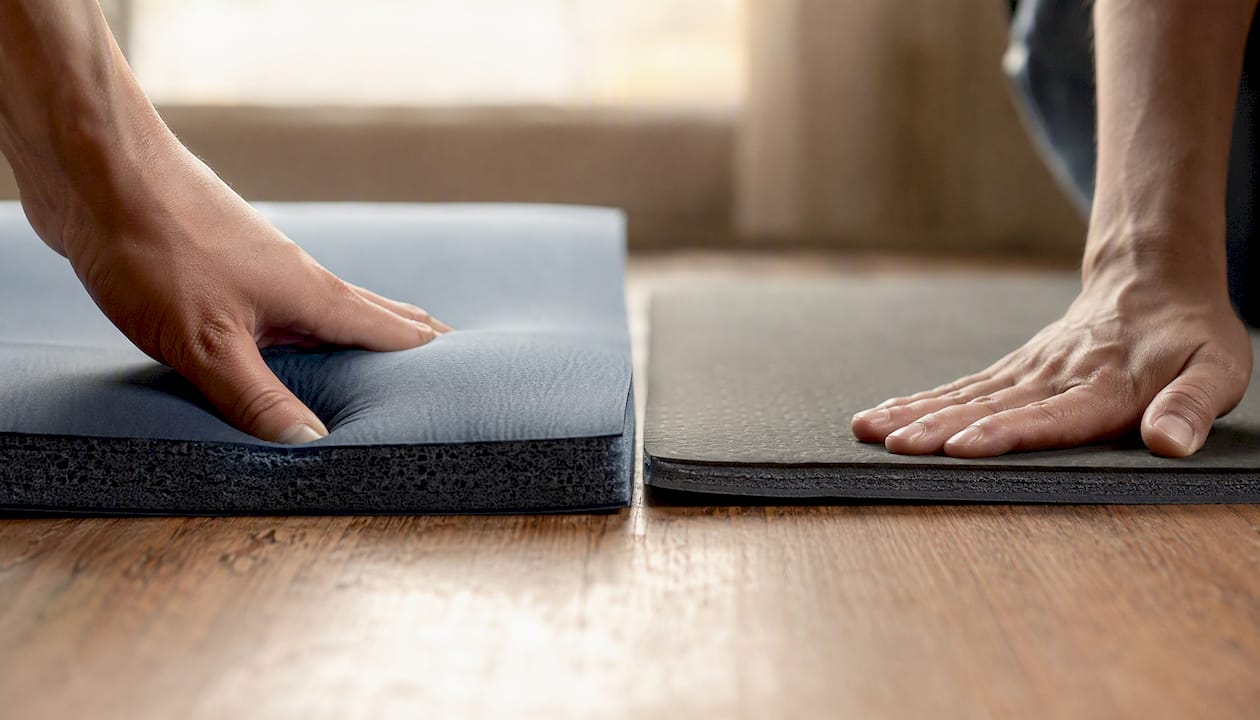
Thickness is measured in millimeters, but density determines how a mat actually feels under load. A dense 4 mm mat can feel more stable than a soft 6 mm mat because it resists compression rather than collapsing under your weight.
| Thickness | Best for | Trade-off |
|---|---|---|
| under 2.5 mm | Travel, balance-heavy practice | Minimal joint cushion |
| 3–4 mm | Flow yoga, stability work | Less padding on hard floors |
| 5–6 mm | Mixed practice, joint comfort | Slightly less ground feel |
| 6–8 mm | Restorative, hard floors | Reduced balance feedback |
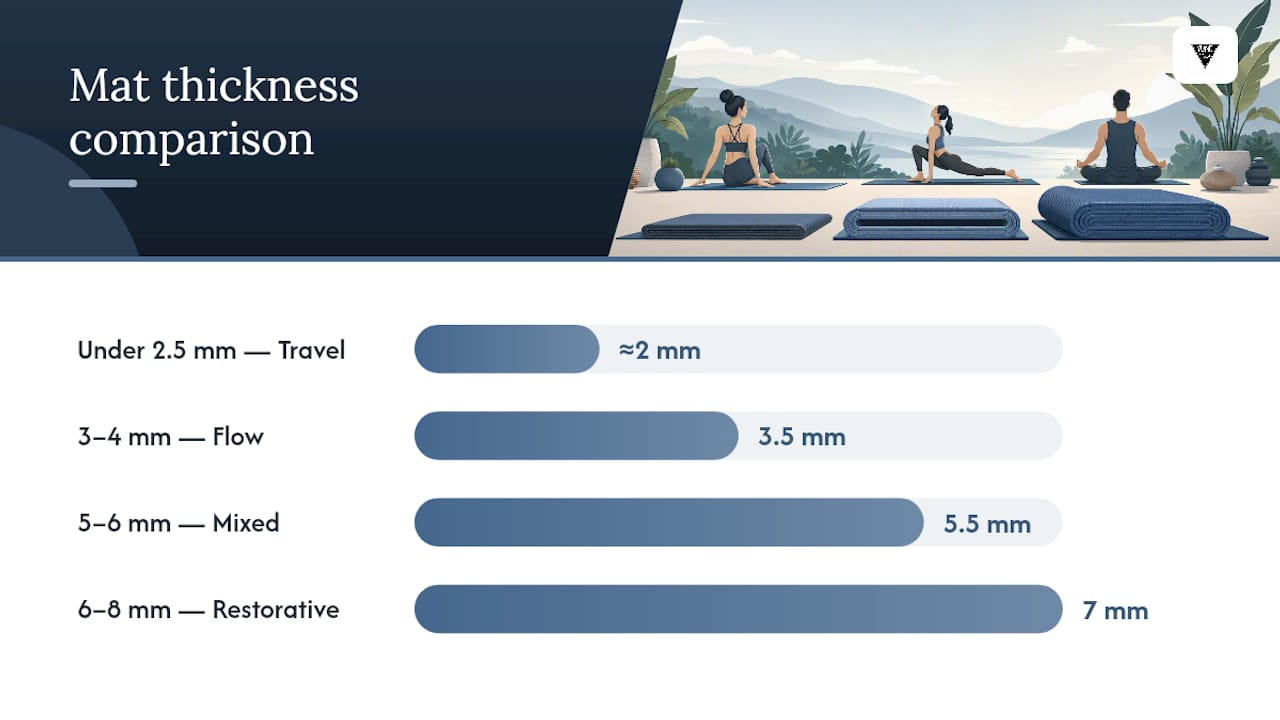
Practical guidance: 5 mm works as a one-mat solution for most people. Go thicker only if you practice restorative regularly or have sensitive knees and wrists.
Two quick tests before you buy: press your knee into the mat and hold for 10 seconds. If you feel the floor, go thicker or denser. Stand on one foot for 30 seconds. If the mat compresses so much that your ankle wobbles, it is too soft for balance work.
How top-surface and floor-side grip keep you safe
Grip works differently on each side of the mat, and both sides matter.
- Natural rubber top: Tacky when dry, and natural rubber’s open-cell structure improves traction as it warms and becomes slightly damp, which is why it suits hot yoga well.
- Cork top: Starts with moderate grip and gets stickier as moisture builds. Good for moderate-sweat classes.
- PU top: Grips well in both dry and wet conditions. Best for very sweaty sessions.
- Textured rubber backing: The standard for keeping a mat anchored on hardwood. On carpet, almost any backing works since the carpet itself provides friction.
Pro Tip: If you already own a natural rubber mat and practice hot yoga, a microfiber towel laid on top is cheaper than buying a new mat. The towel absorbs sweat and grips the rubber surface underneath.
Choosing the right size and whether a travel mat fits your life
Standard mats run 68–72 inches long and 24 inches wide. If you are taller than 5’8", look for 71–85 inch options so your head and feet stay on the mat in savasana. A 26-inch width gives more room for wide-stance poses.
Weight is where the trade-offs get real. Natural rubber mats typically weigh 5–7 lbs, which is fine for a studio bag but noticeable in a carry-on. TPE and travel-specific materials cut that to 2–3 lbs. Foldable mats go further: they compress into a rectangle that fits inside a suitcase rather than strapping awkwardly to the outside.
For travel mat sizing, check the folded dimensions against your bag’s interior, not just the weight. A mat that folds to 12" x 10" x 2" fits in most backpacks. One that rolls to a 14-inch diameter does not.
Pro Tip: Check whether a travel mat is foldable or rollable before buying. Foldable mats pack flat and stay flat; rolled travel mats can curl at the edges during practice if the material has memory.
What eco claims actually mean and which ones to trust
Natural rubber is renewable and biodegradable when responsibly sourced, but it contains latex proteins, making it unsuitable for people with a latex allergy. PVC, by contrast, persists in landfills for centuries. TPE sits in the middle: recyclable in theory, though municipal recycling programs rarely accept it.
Certifications worth checking:
- FSC (Forest Stewardship Council): Confirms responsible rubber tree sourcing.
- OEKO-TEX Standard 100: Verifies the finished product is free from harmful chemicals.
- EU REACH disclosures: Relevant for mats sold in Europe; confirms restricted substances are absent.
Hybrid mats (rubber core plus synthetic top) complicate end-of-life disposal since the layers cannot always be separated. A pure natural rubber mat is easier to dispose of responsibly.
Pro Tip: Ask the manufacturer three questions: Where is the rubber sourced? What adhesive bonds the layers? Is there a take-back or recycling program? A brand that answers all three is worth trusting.
How to clean and store your mat so it lasts
Cleaning steps vary by material:
- Natural rubber: Wipe with a damp cloth and a few drops of mild dish soap. Avoid alcohol, vinegar, and essential oils, which degrade rubber over time. Air-dry flat, away from direct sunlight.
- Cork: Wipe with water only or a very dilute soap solution. Cork is naturally antimicrobial, so deep cleaning is rarely needed.
- PU/TPE: Most tolerate a light spray cleaner. Check the manufacturer’s guidance before using anything acidic.
Store rolled (not folded) for rubber mats to prevent crease lines. Keep all mats away from heat and UV exposure, both of which accelerate material breakdown. New rubber mats sometimes feel slippery for the first few uses. Wipe them down with a damp cloth and let them air out for 24 hours before the first session.
Natural rubber mats last roughly 5–10 years with proper care. Replace a mat when you see thinning at the center, surface cracking, grip that does not return after cleaning, or an odor that persists through multiple washes.
Six-step checklist to pick the right mat now
- Name your primary practice. Hot yoga, flow, restorative, and travel each pull toward different thickness and material choices.
- Check length against your height. Taller than 5’8"? Filter for 72 inches or longer from the start.
- Test thickness plus density. Use the knee-press and single-leg balance tests described above. A mat’s seven key factors include grip and thickness as the top two.
- Confirm material constraints. Latex allergy rules out natural rubber entirely. Go with TPE or cork.
- Weigh portability against cushion. If you travel more than twice a month, a second lightweight travel mat is worth the cost.
- Validate sustainability claims. Look for FSC, OEKO-TEX, or direct material-origin transparency before paying a premium for “eco-friendly.”
Which accessories are actually worth adding
A mat alone handles most practice, but a few accessories close real gaps:
- Microfiber towel: Lay it over any mat for hot yoga. It absorbs sweat and grips rubber surfaces well. Skip it for dry, low-intensity sessions.
- Yoga strap: Useful for deepening stretches and carrying a rolled mat over your shoulder. A 6-foot cotton or recycled-polyester strap covers both uses.
- Knee pad: A small folded pad under the knee during low-lunge or kneeling poses protects joints without requiring a thicker mat for your whole practice.
- Carry strap or bag: If your mat does not have built-in loops, a simple carry strap keeps it secure on the way to class.
Bundles make sense for travel: a foldable mat plus a compact microfiber towel fits in a single packing cube and dries faster than a full-size mat after a sweaty session.
Pro Tip: For travel, a foldable mat and a microfiber towel together weigh less than most standard mats alone. Buy them as a bundle when you can; the towel doubles as a mat cover on studio rental mats.
What I’d tell someone choosing their first serious mat
The single mistake most people make is buying thickness without checking density. A 6 mm mat that compresses to almost nothing under your knee is not protecting your joints. Press your thumb firmly into the mat surface before buying. If it bottoms out, move on.
The second thing: do not buy one mat and expect it to do everything. A 4 mm natural rubber mat is a better daily driver than a 6 mm soft foam mat, but it is not a great travel companion. A foldable 2 mm mat is perfect for a suitcase but uncomfortable for an hour of restorative work. Two mats, chosen deliberately, cost less in the long run than replacing one mat that never quite fit.
Yuneyoga’s eco-friendly mats and travel bundles
Yuneyoga offers natural rubber mats, foldable travel mats, microfiber towels, yoga straps, and curated bundles, all built around the trade-offs this article covers: grip, cushion, portability, and material transparency.
The natural rubber mats are a strong match for daily practice and hot yoga. The foldable travel mats fold flat for carry-on packing. Towels and straps are available individually or as part of travel starter sets. Every product page lists thickness, weight, and material origin so you can verify specs before buying.
Browse the full mat collection or check the yoga mat guide to match a specific mat to your practice style.
Sources
- Best yoga mats (GearJunkie)
- What to Look for in a Yoga Mat: 7 Factors That Matter
- Natural rubber yoga mat guide (MingYogaMat)
- Natural Rubber Yoga Mats: Complete Guide 2026 (WarriorAddict)
- How to choose a yoga mat (2026): What to look for | HTS YOGA


