

Eco-Friendly Qigong Tai Chi Mats, Towels and Straps
For floor-based movement practice, the single best buying route right now is a midweight (3–4 mm) foldable natural-rubber travel mat, a microfiber travel towel, and an organic-cotton strap from Yuneyoga. Natural rubber’s open-cell surface grips better as your body warms the mat, which is exactly what slow, weight-shifting qigong and tai chi-style movements demand. Yuneyoga bundles all three into travel-ready sets with verified sustainability credentials and a take-back promise, so you are not just buying gear — you are buying gear that has an end-of-life plan.
What makes this the right call:
- A foldable natural-rubber travel mat at 3–4 mm gives you enough cushion for kneeling transitions without the spongy give that throws off standing balance.
- A microfiber travel towel manages sweat and dries fast enough to reuse the same day.
- An organic-cotton strap packs flat, weighs almost nothing, and doubles as a gentle assist for floor stretches.
- Yuneyoga’s take-back and repair program means the bundle stays out of landfill when it eventually wears out.
Pro Tip: If you practice outdoors or on hard floors, prioritize density over thickness. A 4 mm dense natural-rubber mat outperforms a 6 mm foam mat for stability because it does not compress unevenly under your feet.
Table of Contents
- Which product types actually matter for your practice?
- How do you choose the right mat, towel, and strap?
- What are the real differences between mat materials?
- How do you pack and care for your gear on the road?
- Yuneyoga’s recommended picks for travel practice
- Key Takeaways
- Why lifecycle thinking changes what you should buy
- Yuneyoga’s travel bundle is ready when you are
- Sources and further reading
Which product types actually matter for your practice?
The right gear depends less on style and more on where and how you practice. Here is how the three core product types map to real use cases.
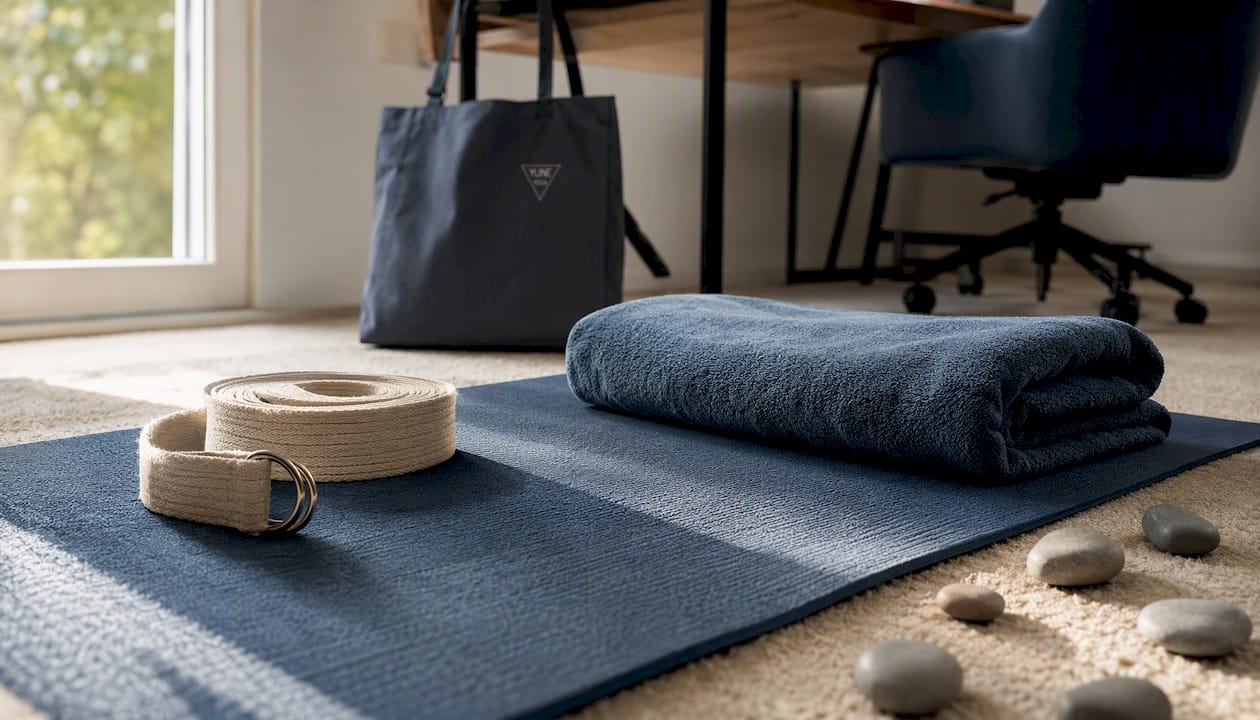
Travel-friendly natural rubber mats typically weigh around 2.1 lbs and are often thinner (1.5–2 mm) to facilitate folding, making them the practical default for anyone who practices away from home. Jute mats run slightly heavier but offer a rougher, more tactile surface that some practitioners prefer for grounding.
Towels earn their place in two situations: hot or sweaty sessions where the mat surface gets slick, and shared studio spaces where hygiene matters. A full-length microfiber practice towel lays over your mat and grips better as it gets damp. For travel, a half-size microfiber towel weighs under 3 oz and dries in under an hour.
Straps are the most underrated piece of the three. An organic-cotton strap folds to the size of a paperback, adds almost no weight, and handles everything from shoulder openers to seated forward folds. Thinner webbing straps pack even smaller if you are counting ounces.
Pro Tip: For a week-long trip where you need stability and minimal bulk, pack a 1.5–2 mm foldable rubber mat, one half-size microfiber towel, and a single cotton strap. That combination fits inside a standard packing cube with room to spare.
How do you choose the right mat, towel, and strap?
Run through this checklist before you buy. The first five criteria are non-negotiable for balance-focused practice; the second group separates genuinely sustainable products from greenwashed ones.
Primary criteria:
- Stability and low give — the mat should not compress more than 1–2 mm under your full body weight.
- Thinness for balance — for standing and weight-shifting work, 3–4 mm is the sweet spot; thicker is not better.
- Surface grip — look for open-cell rubber, laser-etched topography, or natural cork grain. Surface texture actively channels moisture away from contact points, reducing slip risk during longer sessions.
- Packability — confirm whether the mat folds or rolls, and check the folded dimensions against your bag.
- Weight — under 2.5 lbs for travel; up to 5 lbs is fine for a dedicated home mat.
Secondary criteria (sustainability and lifecycle):
- Third-party certifications: FSC for rubber sourcing, GOTS for organic textiles, OEKO-TEX Standard 100 for chemical safety. “Eco-friendly” and “non-toxic” are unregulated marketing phrases — certifications are not.
- Closed-loop manufacturing and take-back programs. Industry analysts flag these as the hallmarks of credible sustainability claims, not just the raw material.
- Disclosed weight and thickness specs on the product page.
- Warranty length and repair options.
Red flags to walk away from:
- “Eco” or “green” claims with no certification names cited.
- Missing material transparency (no mention of what the mat is actually made from).
- No end-of-life option: no take-back, no recycling guidance, nothing.
- Thickness listed but density omitted. Density is what actually determines stability.
What are the real differences between mat materials?
Natural rubber
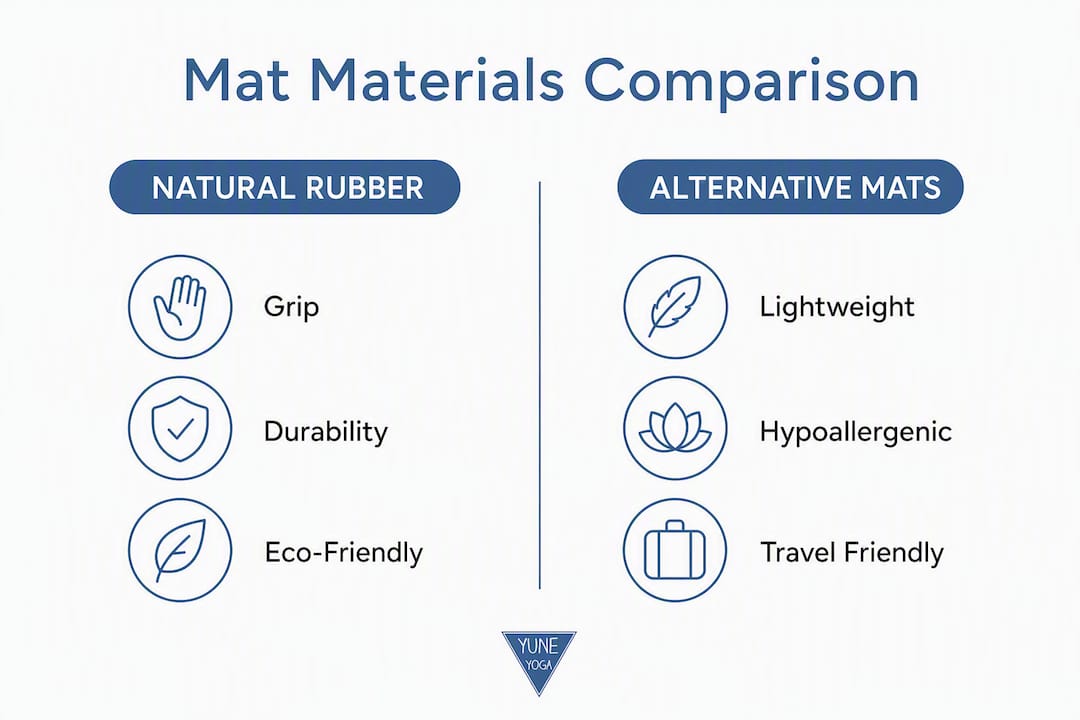
Natural rubber remains the performance standard for grip-dependent practice. Its open-cell structure creates microscopic friction that improves as the mat warms, which is a genuine advantage for slow, deliberate movement. A well-maintained natural rubber mat can last many years, and one long-term review documented a rubber mat in daily use lasting about ten years. The caveat: latex allergies are real, and natural rubber is not hypoallergenic.
Jute and cork
Jute adds a coarse, earthy texture that grips well dry and travels light. Cork goes further: its grain channels moisture away from contact points and carries natural antimicrobial properties, so it stays fresher between washes. Cork grip actually improves when slightly damp, which makes it a strong choice for anyone who runs warm during practice.
Recycled TPE
TPE is latex-free, lightweight, and hypoallergenic, which makes it a reasonable transitional choice for allergy-sensitive practitioners. The trade-off is biodegradability: TPE’s end-of-life recycling claims vary by manufacturer, and it does not break down the way natural rubber or jute does. If long-term environmental impact is your priority, natural rubber wins on lifecycle.
Microfiber towels and organic-cotton straps
For towels, OEKO-TEX Standard 100 certification confirms no harmful dyes or finishes. Microfiber dries in under an hour and grips better wet than dry. For straps, GOTS-certified organic cotton is the cleanest choice: no synthetic coatings, no chemical finishes, and it softens with use rather than stiffening.
| Material | Grip | Weight | Biodegradable | Best for |
|---|---|---|---|---|
| Natural rubber | Excellent | Medium | Yes | Studio, home, travel |
| Jute | Good (dry) | Light | Yes | Travel, dry practice |
| Cork | Excellent (wet) | Medium | Yes | Hot practice, floor work |
| Recycled TPE | Good | Very light | Partial | Allergy-sensitive travel |
| Microfiber (towel) | Improves when damp | Very light | No | Sweat management |
| Organic cotton (strap) | N/A | Very light | Yes | Assist, portability |
The most sustainable mat is the one that lasts longest. Proper care extends natural-rubber mat life to 5–10+ years, cutting lifecycle environmental impact far below that of a cheaper synthetic replaced every two years.
How do you pack and care for your gear on the road?
Packing a foldable mat
- Lay the mat flat and fold it in thirds lengthwise, then fold or roll from one end.
- For cork-surface mats, fold cork-side out to avoid cracking the surface layer.
- Slip the folded mat into a mesh bag or a dedicated mat sleeve to protect it from sharp items in your luggage.
- Place it flat against the back panel of your bag, not crammed into a corner.
- For carry-on travel, a 1.5–2 mm foldable mat fits inside most overhead bins without unrolling.
Cleaning and care:
- After each session, wipe the surface with a damp cloth and let it air-dry before folding.
- Weekly: clean with a diluted solution of water and mild dish soap; avoid alcohol-based sprays on natural rubber, which degrade the open-cell structure over time.
- Never leave a rubber or cork mat in direct sunlight for extended periods. UV exposure accelerates breakdown.
- For microfiber towels: machine-wash cold, skip the fabric softener (it clogs the fibers and kills grip), and air-dry or tumble-dry on low.
Pro Tip: Roll your microfiber towel inside the folded mat before packing. It fills the hollow center, keeps the mat from unfolding in transit, and saves you from hunting for the towel at the bottom of your bag.
Yuneyoga’s recommended picks for travel practice
Yuneyoga’s travel bundle for floor-based practice centers on three pieces that work together rather than three products that happen to ship together.
The core bundle:
- Foldable natural-rubber travel mat (3–4 mm): open-cell grip surface, folds to carry-on dimensions, weighs approximately 2 lbs, and meets the stability threshold for standing balance work. Sustainability credentials include FSC-certified rubber sourcing and a take-back program.
- Microfiber travel towel: full-length or half-size options, OEKO-TEX certified, quick-dry construction that grips better as it gets damp. Packs to roughly the size of a water bottle.
- Organic-cotton strap: GOTS-certified cotton, available in multiple lengths, folds flat. No synthetic coatings.
Why Yuneyoga for this purchase:
- Single vendor for the complete bundle, so sizing and sustainability credentials are consistent across all three pieces.
- Take-back and repair options mean the gear has an end-of-life plan, not just a purchase price.
- Detailed travel mat guidance on the Yuneyoga blog covers packing, care, and surface selection in depth.
Pro Tip: Check the bundle page for current shipping thresholds. Buying the mat, towel, and strap together often clears the free-shipping minimum in a single order.
Key Takeaways
For floor-based movement practice, a foldable natural-rubber mat paired with a microfiber towel and organic-cotton strap from Yuneyoga covers every performance, portability, and sustainability requirement in one purchase.
| Point | Details |
|---|---|
| Mat thickness sweet spot | 3–4 mm dense natural rubber gives stability without the spongy give that disrupts balance. |
| Natural rubber grip advantage | Open-cell friction improves as the mat warms, making it ideal for slow, weight-shifting practice. |
| Certifications over claims | Demand FSC, GOTS, or OEKO-TEX Standard 100; “eco-friendly” alone is an unregulated phrase. |
| Longevity beats novelty | A well-maintained natural rubber mat lasts 5–10+ years, outperforming cheaper synthetics on lifecycle cost. |
| Yuneyoga bundle | Foldable rubber mat, microfiber towel, and organic-cotton strap ship together with take-back credentials. |
Why lifecycle thinking changes what you should buy
The conventional wisdom in yoga gear shopping is to optimize for feel at first touch: how grippy does it feel in the store, how plush does it feel underfoot. That instinct leads most people toward thicker, softer mats that feel luxurious on day one and compress unevenly by month six.
For balance-based practice specifically, that trade-off is backwards. A mat that gives too much underfoot forces constant micro-corrections that fatigue the stabilizing muscles you are trying to train. Thinness and density are not compromises; they are the point.
The same logic applies to sustainability. A mat with impressive raw-material credentials but no take-back program still ends up in a landfill. Closed-loop manufacturing and repair programs are not marketing extras — they are what separates a genuinely sustainable product from a well-packaged one. Yuneyoga’s approach of pairing certified materials with end-of-life options is the right framework, and it is one most gear brands still do not match.
Yuneyoga’s travel bundle is ready when you are
Yuneyoga builds travel bundles specifically for practitioners who need gear that performs on a hotel room floor as reliably as it does at home. The foldable natural-rubber mat, microfiber towel, and organic-cotton strap ship as a set with FSC and OEKO-TEX certifications documented, a take-back program in place, and no guesswork about what the mat is actually made from.
Shipping is straightforward, and buying the bundle as a set typically clears the free-shipping threshold. Returns are handled directly through the Yuneyoga site.
Buying assurances:
- FSC-certified natural rubber and OEKO-TEX-certified towel included in the bundle.
- Take-back program available for worn mats at end of life.
- Detailed care and packing guidance included with every order.
Shop the Yuneyoga travel bundle and have your gear sorted before your next trip.
Sources and further reading
The research and editorial guidance behind this article comes from the following sources. Each one informed a specific claim about materials, certifications, or travel performance.
- Tips for finding eco-friendly yoga mats — Yoga Gear Flow on closed-loop manufacturing and take-back programs as sustainability benchmarks.
- This natural rubber yoga mat lasted me a decade of daily practice — The Guardian’s 2025 long-form review documenting ten-year rubber mat lifespan.
Yuneyoga blog resources for deeper reading:
- Top foldable yoga mats for easy storage and travel
- What is a sweat-resistant yoga mat?
- Sustainable balance: the rise of the eco yoga mat


%20foldable%20natural-rubber%20travel%20mat,%20a%20microfiber%20travel%20towel,%20and%20an%20organic-cotton%20strap%20from%20Y...)