

How to choose the best mats for hot yoga: Grip, cushioning, and care guide
Key Takeaways
The best mats for hot yoga balance traction, comfort, and easy care rather than chasing one feature alone.
- Choose a surface that stays dependable as sweat builds.
- Match thickness and firmness to your joints and balance work.
- Consider a towel when portability or extra absorbency matters.
- Clean and dry the mat after every heated session.
- Weigh grip, size, materials, and storage against your actual routine.
Understand what makes mats for hot yoga different
Hot yoga changes the conditions beneath your hands and feet. Heat softens some surfaces, while sweat can turn a normally reliable finish slick. The right mat should help you stay steady without feeling overly sticky, bulky, or difficult to carry. Start by thinking about how you practice, where you practice, and how much moisture your mat regularly sees.
How heat and sweat affect traction
A dry studio test tells only part of the story. During class, perspiration collects under your palms, along your feet, and around your knees, so traction may change from the first pose to the final rest. Some surfaces become more secure with moisture; others need a towel to keep sweat from pooling. Wet grip matters most when your practice includes long holds and quick transitions.
The useful question is not simply whether a mat feels grippy in the shop. Ask whether it remains predictable after several minutes of movement, when your hands are damp and your breathing has become heavier.
Why mat materials matter in humid rooms
Materials respond differently to warmth, moisture, and repeated cleaning. A porous surface may absorb more sweat but can also need extra drying time. A moisture-resistant finish is easier to wipe down, though it may feel less forgiving when wet. Texture, rubber content, and the finish applied to the top layer all shape the experience.
If you are comparing options online, read the care guidance as closely as the grip description. For a straightforward example of a moisture-resistant, washable surface, the CR24 6mm Tan Non-Slip Yoga Mat is described as PVC, phthalate- and latex-free, and easy to clean.
Balancing grip, cushioning, and stability
Grip is only useful when the mat stays planted. Cushioning can make kneeling and resting more comfortable, but too much softness may make balances feel vague. A thinner, firmer mat gives clearer floor feedback; a thicker one may feel kinder on sensitive joints. Try to choose the least padding that still lets you practice comfortably.
A simple comparison can help narrow the field before you shop:
| Priority | What to look for | Possible trade-off |
|---|---|---|
| Wet traction | Textured or moisture-responsive top layer | May require specific cleaning |
| Joint comfort | Moderate cushioning | Can reduce floor feedback |
| Balance | Firm, stable base | Feels less plush |
| Portability | Thin or lightweight construction | Less protection underneath |
The best choice is the one that supports your most frequent practice, not every possible class. A mat used mostly for heated flows may need a different feel from one carried to a park for occasional movement.
Choosing between a yoga towel and a specialized mat
A yoga towel can be a practical layer when you already like your current mat but need more absorption. It is also easy to wash and pack, making it useful for travel or shared studio spaces. A specialized mat may feel more integrated because its surface and base are designed to work together, but it can weigh more and require more careful drying.
Yune Yoga describes its Hoth Yoga Mat in Blue as a 6mm non-slip mat with balanced cushioning, and its broader range also includes absorbent yoga towels and portable accessories. Think of the towel as a flexible add-on, not an automatic substitute for a surface that loses traction in heavy sweat.
Compare the best materials and surfaces
There is no universally best mat material for a heated class. Natural rubber, polyurethane-topped designs, PVC, cork, and other textured finishes each create a different compromise between grip, cushioning, odor, weight, and maintenance. Focus on the conditions you can realistically manage after class. A high-performing surface that stays damp in a closed gym bag may become frustrating quickly.
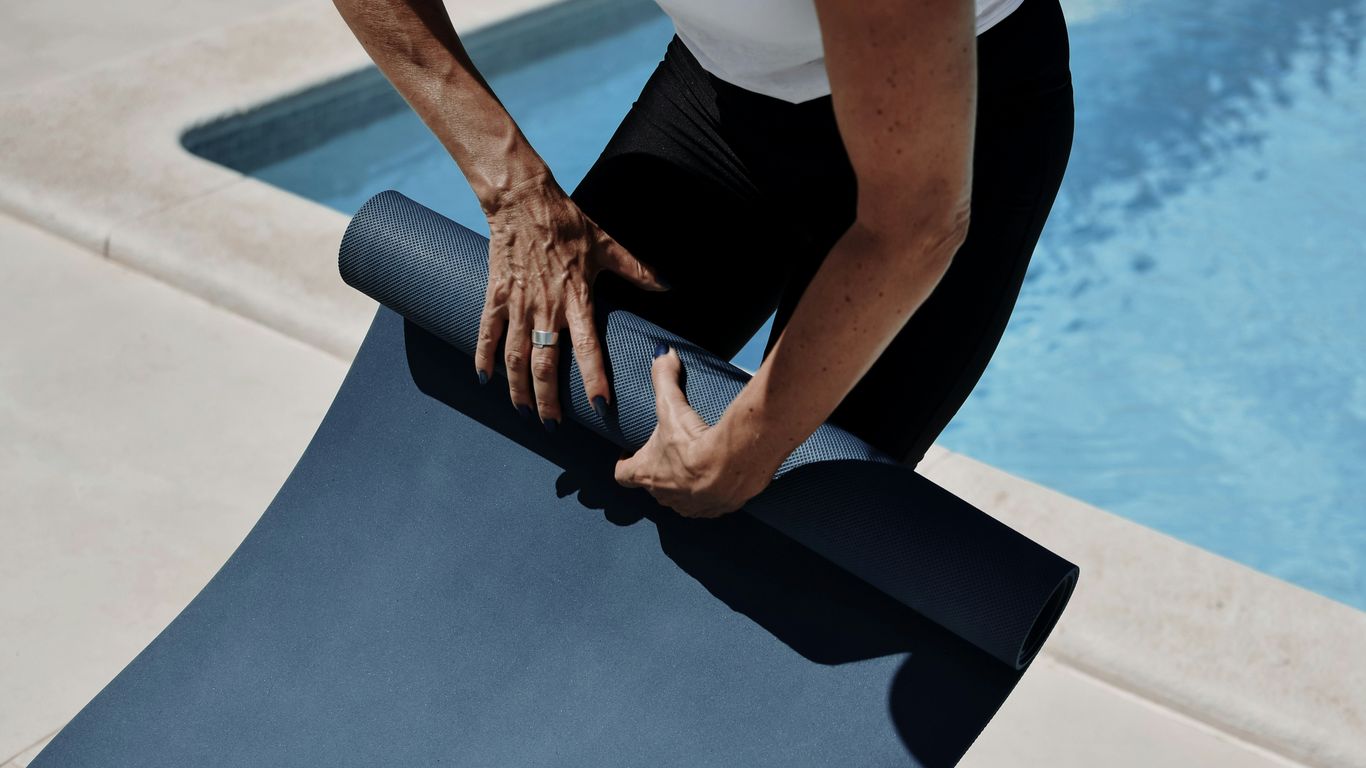
Natural rubber for grip and stability
Natural rubber often feels dense and grounded, which can help a mat stay put during active sequences. It may have a noticeable smell when new, and some practitioners need to avoid latex-containing materials. Check the product specifications rather than assuming that every rubber mat has the same composition or care needs.
The Natural Rubber Yoga Mat Sagittarius is described as a 3mm mat made from sustainably harvested, biodegradable natural rubber, with water-based inks and grip intended for hot classes. That combination illustrates why thin rubber mats can appeal to people who want responsiveness as well as traction.
Polyurethane and other sweat-resistant top layers
A smooth top layer can feel remarkably secure when it is designed to handle moisture, while a microfiber or suede-like finish may absorb perspiration and change feel as class progresses. These surfaces can be excellent for sweaty practices, but they still need prompt cleaning. Oils, residue, and poorly chosen sprays can alter the finish.
Look for clear information about how the top layer should be wiped, washed, and dried. Marketing phrases such as “non-slip” are less useful than a specific care routine you are willing to follow.
PVC for cushioning and durability
PVC mats are common because they can offer consistent cushioning, a broad range of textures, and straightforward wipe-down care. Their feel varies widely, so material alone does not tell you whether a particular mat will slide when wet. Check the texture and moisture guidance as well as the thickness.
For a 6mm option, the IR77 6mm Gray Non-Slip Yoga Mat is described as phthalate- and latex-free PVC with anti-tear construction, a textured surface, and moisture resistance. Those details are more useful than judging PVC as one uniform category.
Cork and textured surfaces for heated practices
Cork can feel firm and natural underfoot, while raised textures can give fingers and toes more to engage with when the surface is damp. Both may suit practitioners who dislike a soft or sticky sensation. The trade-off can be a different level of cushioning, especially during kneeling poses.
Before choosing an unusual finish, consider whether you can comfortably use it for the entire class. A surface that feels excellent in standing poses may feel too firm during floor work, so test the full range if possible.
Choose the right size, thickness, and feel
Dimensions shape how freely you can move, but a larger mat is not automatically better. It may take up more studio space, add weight to a commute, and require a larger drying area. Thickness also affects balance, joint comfort, and how easily the mat fits into a bag. Treat these choices as practical fit questions rather than status markers.
Selecting thickness for comfort and balance
Around 3mm can offer a close connection to the floor and a lighter carry, while 6mm generally gives more cushioning for knees and wrists. The ideal thickness depends on the surface beneath you and the positions you spend the most time in. On a hard floor, a little extra padding can be welcome; on a sprung studio floor, too much may feel unstable.
If you want a middle-ground reference, the Gabbro Yoga Mat is described as a 6mm mat balancing cushioning and stability for practices including hot yoga. Use that kind of specification as a starting point, then compare it with your own joint comfort and balance needs.
When a longer or wider mat makes sense
A longer mat can prevent your hands or feet from reaching beyond the edges during extended poses. Extra width may help if you change direction often or prefer more space for transitions. Measure the area where you practice before buying; an oversized mat can be awkward in a crowded studio.
For home practice, also check whether the mat can lie flat without blocking furniture or doorways. A little planning prevents a comfortable mat from becoming a storage problem.
Matching firmness to wrists, knees, and joints
Firmness affects pressure more than thickness alone. A dense mat may support your hands well but feel unforgiving under bony knees. A softer surface can cushion contact points but make weight shifts less precise. If one area is especially sensitive, a folded towel or small pad may solve the issue without changing your entire mat.
Try a few familiar positions before deciding. Notice whether your wrists sink, whether your knees bottom out, and whether standing poses feel stable rather than springy.
Considering weight and portability
A mat that stays at home can be selected for comfort first. One that travels by train, plane, or car needs a realistic packed size and manageable weight. Thin mats fold more easily, while thicker mats often roll better but occupy more room. Do not forget the towel, strap, and water bottle that will share the bag.
Yune Yoga places particular emphasis on convenience and portability, including foldable travel mats and accessories. That perspective is useful if your practice moves between studios, hotel rooms, beaches, or parks rather than staying in one dedicated space.
Evaluate grip during common hot yoga poses
Grip should be judged in motion, not by pressing one dry palm against a sample. Think about the positions where you regularly lose contact or adjust your hands. A good surface supports alignment without making you tense your fingers or claw your toes. It should also stay predictable as sweat accumulates.

Staying grounded in downward-facing dog
Downward-facing dog reveals whether your hands and feet remain stable under sustained pressure. Place your palms evenly, spread your fingers, and notice whether the mat moves beneath either end of your body. If your hands slide forward, the problem may be the surface, excess moisture, or a setup that needs a towel.
A reliable mat should let you focus on distributing weight rather than repeatedly resetting your hands. Still, no surface replaces careful placement and a clean, dry practice area.
Maintaining traction during standing balances
Standing balances expose small shifts in the feet. Sweat around the soles can make a smooth finish feel uncertain, especially when you move from a grounded pose into a single-leg position. Test whether the mat offers enough grip without forcing your toes to grip the floor.
Practice a simple balance on both sides. If the surface feels secure on one side but not the other, check whether sweat or uneven flooring is contributing before rejecting the mat.
Protecting alignment in transitions
Transitions create lateral forces that static poses do not. Stepping forward, turning, or moving from plank toward the floor can make an unstable mat curl or drift. A firm base and dependable texture help you move with less hesitation.
A few controlled transitions are more revealing than a brief standing test. Notice whether the mat shifts, whether your hands land where you expect, and whether the surface catches your skin abruptly.
Testing grip before a full class
Give a new mat a short trial before taking it into a demanding session. Use the same movements that usually challenge you, and test it once dry and once after light perspiration. Read the care label before applying any cleaner, since a product that leaves residue may change the feel.
A useful pre-class check includes:
- Several breaths in downward-facing dog.
- A slow step-through from plank.
- A standing balance on each side.
- A kneeling pose and seated fold.
Afterward, think about consistency rather than a single impressive moment. If the mat behaves well across these positions and dries reasonably quickly, it is more likely to suit your routine.
Decide which features fit your practice
Features matter when they solve a recurring problem. Open or closed construction, odor control, carrying systems, and environmental claims all sound appealing, but each needs context. Ask what you will notice after a month of classes, not only what looks impressive on a product page. Convenience is part of performance when it determines whether you bring the mat at all.
Open-cell versus closed-cell construction
Open-cell materials may offer a more absorbent feel, while closed-cell surfaces are often easier to wipe clean because moisture is less likely to penetrate. Neither label gives the complete answer about grip or durability. Texture, density, adhesives, and the top finish still matter.
If you sweat heavily, prioritize clear instructions for post-class cleaning and drying. If you share equipment or practice outdoors, a surface that cleans quickly may be the more practical choice.
Odor resistance and antimicrobial properties
Odor usually reflects a combination of sweat, residue, drying time, and storage. Claims about antimicrobial treatment should be read carefully, especially when they do not explain testing or care requirements. Regular cleaning remains necessary regardless of a material claim.
Avoid sealing a damp mat in a bag. Even a low-odor surface can develop an unpleasant smell when moisture and warmth are trapped together.
Carrying straps, travel weight, and storage
A strap can make a rolled mat easier to carry, while a foldable design may fit better in luggage or a small cupboard. Consider whether you will walk with it, cycle, or store it in a shared locker. A mat that is slightly less cushioned but easy to bring may serve you more often.
For readers comparing practical gear beyond mats, QR Gym describes QR-code access and equipment information; that is a reminder that a smooth practice routine includes the small logistics around the workout, too. The mat itself should have a storage plan: unroll it after class, let it dry, and keep it away from prolonged heat.
Eco-friendly materials and manufacturing claims
Look for specific language about material source, inks, packaging, and delivery rather than relying on a broad “eco” label. A product may use one lower-impact component while still requiring adhesives or synthetic layers elsewhere. The most useful claim is one you can understand and compare.
The Nakata Yoga Mat is described as eco-friendly and latex-free, with a moisture-resistant surface and UV-cured inks. That example shows why several concrete details are more informative than a single environmental adjective.
Clean and maintain your hot yoga mat
Care is part of choosing a hot yoga mat because sweat-heavy sessions place extra demands on every surface. A short wipe-down after class helps prevent residue from building up, while thorough drying protects the mat and your storage space. Use less product than you think you need, and follow the maker's instructions when they are available. Good maintenance should be simple enough to repeat.
Removing sweat after every session
Wipe the mat soon after class with a clean, damp cloth or a cleaner approved for its material. Pay attention to the hand and foot zones, where oils and perspiration collect most quickly. Avoid rolling the mat while it is still visibly wet.
If you use a towel, wash it after sweaty sessions rather than leaving it folded in the same bag. Small habits reduce the amount of deep cleaning needed later.
Deep-cleaning without damaging the surface
Deep cleaning should be occasional, not an excuse to soak every mat. Excess water can enter porous materials, weaken finishes, or lengthen drying time. Use a mild method suited to the surface, rinse only as directed, and skip abrasive brushes that can roughen the top layer.
Do not assume that vinegar, essential oils, or household disinfectants are safe for every construction. A plain, approved cleaner is usually a better starting point than an improvised mixture.
Drying and storing the mat correctly
Let the mat dry fully in a ventilated place before rolling it. Keep it out of strong, prolonged direct sun unless the care instructions specifically allow it, since heat and light can affect some materials. Store it loosely enough that the surface is not pressed against damp clothing or towels.
A breathable carrier can help during transport, but it does not replace drying. If you finish class late, unroll the mat as soon as you get home and deal with storage in the morning.
Knowing when to replace it
Replace a mat when its grip has changed permanently, the surface flakes or splits, or the base repeatedly slides despite a clean floor. Flattened cushioning and deep grooves can also affect comfort and alignment. Cosmetic marks alone are not necessarily a problem, but structural wear deserves attention.
Before replacing it, check whether the issue comes from cleaner residue, a damp storage habit, or a worn floor underneath. If the mat no longer feels predictable after those factors are addressed, it has likely reached the end of its useful life.
Conclusion
Choosing among mats for hot yoga comes down to a realistic match between sweat, grip, cushioning, size, and care. Pick the surface that stays dependable in your common poses, the thickness that supports your joints without blurring balance, and the format you will actually carry and maintain. A thoughtful choice makes the practical parts of practice quieter, so you can get on with moving.
Frequently Asked Questions
What makes a mat suitable for hot yoga?
A suitable mat remains stable and provides dependable traction as heat and sweat build. It should also be comfortable enough for floor poses and straightforward to clean after class.
Is a thicker mat better for hot yoga?
Not always. More cushioning can help sensitive joints, while a thinner, firmer mat may offer better balance and clearer contact with the floor.
Should I use a towel on top of my mat?
A towel can absorb sweat and add traction, particularly when your existing mat feels slippery. It is also convenient to wash and pack separately.
How often should I clean a hot yoga mat?
Wipe it after every sweaty session and deep-clean it occasionally according to the material's care instructions. Always let it dry completely before storing it.
Can I use a regular yoga mat for hot yoga?
You can, but its surface may become slippery when wet. Test it during the poses you practice most and add a towel if it does not remain dependable.
What size yoga mat should I choose?
Choose a length and width that let you move without reaching beyond the edges while still fitting your practice space. A larger mat is useful only if you can carry and store it comfortably.
How do I know when a yoga mat needs replacing?
Replace it when the grip, cushioning, or stability changes permanently, or when the surface begins to crack, peel, or slide despite proper cleaning and a suitable floor.


