
Yoga Sanskrit Made Simple for Students and Teachers
Sanskrit is the classical vocabulary of yoga. Every pose name, breath technique, mantra, and philosophical concept in a modern class draws from this ancient Indian language, and knowing even a handful of terms changes how you experience practice. When a teacher calls out Adho Mukha Svanasana, you stop guessing and move. When you understand that pranayama means breath regulation, the instruction lands differently than “control your breathing.”
Yoga Journal describes Sanskrit as the shared language that connects students to the source texts and teachings behind the physical practice. That connection is practical, not academic. Here are five terms you will hear in almost any class:
- Asana (AH-suh-nuh) — posture or seat; the physical poses
- Pranayama (prah-nah-YAH-muh) — breath regulation techniques
- OM (ohm) — a sacred syllable chanted at the start or close of practice
- Namaste (nah-mah-STAY) — a respectful greeting, literally “I bow to you”
- Savasana (shah-VAH-suh-nuh) — corpse pose; the final resting posture
The sections below give you a curated glossary of common terms, pronunciation guidance, teacher cues, cultural context, and a study plan you can begin based on common recommendations.
Key Takeaways
Sanskrit is yoga’s shared classical vocabulary, and learning roughly 30 building-block terms gives students and teachers a practical foundation for any class or lineage.
| Point | Details |
|---|---|
| Sanskrit is a compound language | Most pose names stack a descriptive prefix onto -asana; knowing a dozen roots decodes hundreds of names. |
| Pronunciation is learnable | Use plain-English phonetics for class and an audio tool like FLOW to refine accuracy before teaching. |
| Bilingual cues work best | Give English first, then Sanskrit, until students are comfortable with both. |
| Cultural respect is non-negotiable | Credit lineages, acknowledge contested translations, and never force chanting on students. |
| Five words a week is enough | A steady 3-month plan builds confident recognition of roughly 30 terms without overwhelm. |
Table of Contents
- What does yoga Sanskrit actually mean in class?
- A practical glossary of 30 common Sanskrit terms
- How do you pronounce Sanskrit as an English speaker?
- When and how should teachers use Sanskrit in class?
- Why does cultural sensitivity matter when using Sanskrit?
- Where can you find reliable resources for further study?
- A 3-month study plan for learning yoga Sanskrit
- Sanskrit as a tool, not a test
- Sources
What does yoga Sanskrit actually mean in class?
Yoga Sanskrit refers to the Sanskrit words and compounds used to name poses, breathwork, mantras, and core philosophical ideas in modern yoga. Sanskrit is a classical Indian language with a documented history stretching back more than 3,500 years. Its role in yoga is comparable to Latin in Western medicine: it provides a shared, precise vocabulary that holds meaning across lineages, styles, and countries.
Most pose names are compound words. They stack a descriptive element (a body part, animal, number, or direction) onto the suffix -asana, which means “posture” or “seat.” The International Yoga Conference’s Sanskrit glossary notes that once you recognize this structure, unfamiliar pose names become readable rather than intimidating. Baddha Konasana breaks into baddha (bound) + kona (angle) + asana (posture): Bound Angle Pose.
Learning the building blocks, not just individual words, is the faster path. Yoga Journal’s 200-term Sanskrit glossary shows that a small set of roots and prefixes unlocks numerous pose names. That is the approach this article takes.
A practical glossary of 30 common Sanskrit terms
Terms are grouped by how you encounter them in class. Each entry includes a plain-English pronunciation hint and a one-line note on how teachers use it.
Poses and pose-building elements
- Asana (AH-suh-nuh) — posture; the suffix on nearly every pose name
- Ardha (AR-duh) — half; as in Ardha Chandrasana (Half Moon Pose)
- Supta (SOOP-tuh) — reclining; signals a lying-down variation of a pose
- Uttita (oo-TEET-uh) — extended; often heard in standing pose names
- Pada (PAH-duh) — foot or leg; appears in many standing and forward-fold names
- Mukha (MOO-kuh) — face; Adho Mukha means “downward-facing”
- Adho (AH-doh) — downward; paired with mukha in Downward Dog
- Urdhva (OORD-vuh) — upward; Urdhva Mukha = upward-facing
- Eka (EH-kuh) — one; Eka Pada = one-legged
- Dvi (dvee) — two; Dvi Pada = two-legged
- Tri (tree) — three; as in Trikonasana (Triangle Pose)
- Parivrtta (pah-ree-VRIT-tuh) — revolved; marks a twisted variation
- Baddha (BAH-duh) — bound; indicates a bind in the arms or legs
- Salamba (sah-LOM-buh) — supported; Salamba Sarvangasana = Supported Shoulderstand
Asana at Home’s translation guide points out that ardha, supta, and uttita alone decode dozens of pose names once a student recognizes them.
Breath and energy terms
- Pranayama (prah-nah-YAH-muh) — breath regulation; the fourth limb of yoga
- Prana (PRAH-nuh) — life force or vital energy; carried by the breath
- Apana (ah-PAH-nuh) — downward-moving energy; often cued in grounding practices
- Kumbhaka (koom-BAH-kuh) — breath retention; holding after inhale or exhale
- Ujjayi (oo-JAH-yee) — a breath technique with a slight throat constriction; the “ocean breath”
- Nadi (NAH-dee) — energy channel; Nadi Shodhana = alternate-nostril breathing
For a deeper look at how breath practice connects to physical benefits, the Yuneyoga guide on nose breathing covers the physiology behind pranayama techniques.
Philosophical and class-structure terms
- Dharma (DAR-muh) — duty, purpose, or right action
- Ahimsa (ah-HIM-sah) — non-harming; the first of yoga’s ethical principles (yamas)
- Drishti (DRISH-tee) — a focused gaze point used to build concentration
- Bandha (BAHN-duh) — an internal energy lock; Mula Bandha = root lock
- Chakra (CHAH-kruh) — energy center; seven are described in classical texts
- Vinyasa (vin-YAH-suh) — a flowing sequence linking movement to breath
- Savasana (shah-VAH-suh-nuh) — corpse pose; final relaxation
Common chants and salutations
- OM (ohm) — the primordial sound; chanted at the start and close of practice
- Namaste (nah-mah-STAY) — “I bow to you”; a respectful closing gesture
- Shanti (SHAHN-tee) — peace; chanted three times in the Shanti mantra
How do you pronounce Sanskrit as an English speaker?
Sanskrit pronunciation trips up English speakers in predictable ways. The language has more vowel lengths and consonant distinctions than English does, but the most common classroom terms are manageable with a few rules.
Key sounds to know
| Sanskrit sound | How it appears in text | English approximation |
|---|---|---|
| Long ā | ā or aa | “ah” held slightly longer than in “cat” |
| Short a | a | like the “u” in “but” |
| ś or sh | ś, sh | “sh” as in “shoe” |
| ṭ / ḍ | retroflex t/d | tongue curls back; closer to American “t” in “butter” |
| c | c (in IAST) | always “ch” as in “chair,” never “k” |
| v | v | softer than English “v”; closer to “w” in some positions |
IAST (International Alphabet of Sanskrit Transliteration) is the scholarly standard, using diacritical marks like ā, ś, and ṭ. Most yoga classes use simplified spellings without diacritics. Both systems are fine for classroom use; IAST matters most when you are reading source texts or chanting with precision.
A few practical conversions:
- Śavāsana (IAST) → “shah-VAH-suh-nuh” (simplified spoken form)
- Ādho Mukha Śvānāsana → “AH-doh MOO-kuh shvah-NAH-suh-nuh”
- Ujjāyī → “oo-JAH-yee”
- Trikoṇāsana → “tree-koh-NAH-suh-nuh”
Stress in Sanskrit generally falls on the second-to-last syllable when that syllable is long, and on the third-to-last otherwise. That rule covers most pose names well enough for classroom use.
Pro Tip: Use the FLOW Sanskrit pose lookup tool to hear phonetic breakdowns of specific pose names before you teach them. Pairing a written phonetic hint with audio is faster than rote memorization and produces more accurate pronunciation.
When to simplify: use plain phonetics for students who are new to Sanskrit. When to preserve precision: chants, mantras, and lineage-specific terms deserve closer attention to the original sounds, especially if you are leading a group recitation.
When and how should teachers use Sanskrit in class?
Sanskrit works best as a bridge, not a barrier. Kripalu’s interview with Nicolai Bachman makes the point directly: teachers can present Sanskrit progressively and personally, treating it as an optional connection to tradition rather than a test students must pass.
A practical sequence for teachers
- Give both names first. Say the English name, then the Sanskrit: “Warrior Two, or Virabhadrasana Dvi.” Repeat this pairing for several classes before dropping the English.
- Introduce one new term per class. Write it on a whiteboard or say it slowly twice. Briefly explain what it means.
- Cue pronunciation in the moment. “Say it with me: veer-ah-bah-DRAHS-uh-nuh.” A single group repetition during a hold locks it in faster than a lecture.
- Default to English when clarity matters. Safety cues, alignment corrections, and modifications should always be in plain English first.
- Offer translations for chants. Before leading OM or a Shanti mantra, give a one-sentence meaning so students can choose to participate.
Bilingual cue example
“From Downward Dog, step your right foot forward between your hands. We call this starting position Adho Mukha Svanasana — AH-doh MOO-kuh shvah-NAH-suh-nuh — downward-facing dog.”
Red flags to avoid
- Using Sanskrit to signal expertise or exclude beginners
- Mispronouncing chants and presenting the error as correct
- Stating a contested translation as the only valid meaning
- Forcing students to chant; always make participation optional
Accessibility stays central. Yoga Journal’s teacher guidance recommends pairing Sanskrit cues with anatomical descriptions and modifications so that no student is left behind because of unfamiliar vocabulary. A student who does not know Trikonasana still needs to know where to put their feet.
Using yoga straps and other props alongside clear Sanskrit cues is one practical way to keep classes accessible while building vocabulary over time.
Why does cultural sensitivity matter when using Sanskrit?
Sanskrit is not a neutral technical vocabulary. It is a living classical language with a documented history comparable, as Ancient History Encyclopedia notes, to Latin in Western scholarly and liturgical traditions. It carries the weight of Hindu, Buddhist, and Jain texts, and many of the terms used in yoga classes come directly from sacred scripture.
That context matters for teachers in the United States, where yoga has traveled far from its South Asian origins. Using Sanskrit respectfully means acknowledging where it comes from, not just borrowing its sounds.
Practical guidance for teachers:
- Credit the source when you can. A single sentence works: “This term comes from the Yoga Sutras of Patanjali, one of the foundational texts of classical yoga.”
- Avoid exoticizing. Sanskrit is not a mystical decoration; it is a precise language with grammar and scholarship behind it.
- Do not claim authority you have not earned. If you have not studied with a teacher in a specific lineage, say so rather than presenting lineage-specific interpretations as universal.
- Acknowledge contested translations. Some pose names have multiple plausible English readings. Pāśasana, for example, is translated variously as “noose pose” or “lasso pose.” Presenting one reading as the only correct one is a teaching error.
Pro Tip: When a student asks what a Sanskrit term “really means,” a good answer is: “One common translation is X, though scholars also read it as Y.” That honesty builds more trust than false certainty.
The goal is to use Sanskrit as a thread back to a living tradition, not as a performance of cultural fluency you do not have.
Where can you find reliable resources for further study?
The quality of Sanskrit resources varies widely. Prioritize sources that show their lineage, offer pronunciation audio, and distinguish between scholarly and popular translations.
Recommended resources:
- Yoga Journal’s pose library — pairs English and Sanskrit names with alignment cues, images, and variations; a reliable first stop for any pose lookup
- Yoga Journal’s Sanskrit overview — explains core terms, chants, and mantra meanings with clear context
- Yoga Journal’s 200-term glossary — the most practical single-page reference for building-block roots and common terms
- FLOW Sanskrit pose lookup tool — free digital tool with phonetic breakdowns; useful before teaching a new pose
- Asana at Home’s translation guide — walks through prefixes and suffixes with worked examples
- The Language of Yoga by Nicolai Bachman — a widely recommended reference book with pronunciation audio; covers roots, grammar, and philosophical terms in depth
How to evaluate any Sanskrit resource:
- Does it show who wrote it and what their training is?
- Does it offer pronunciation audio or phonetic guidance?
- Does it distinguish between scholarly and popular translations?
- Does it acknowledge contested or multiple meanings?
A resource that presents every translation as definitive and offers no pronunciation help is worth treating with caution. Start with one glossary, learn five words a week, and add a second resource once the first feels solid.
A 3-month study plan for learning yoga Sanskrit
Five words a week is a sustainable pace. Yoga Journal recommends this kind of steady, incremental approach as the most practical way to build usable classroom vocabulary without burnout.
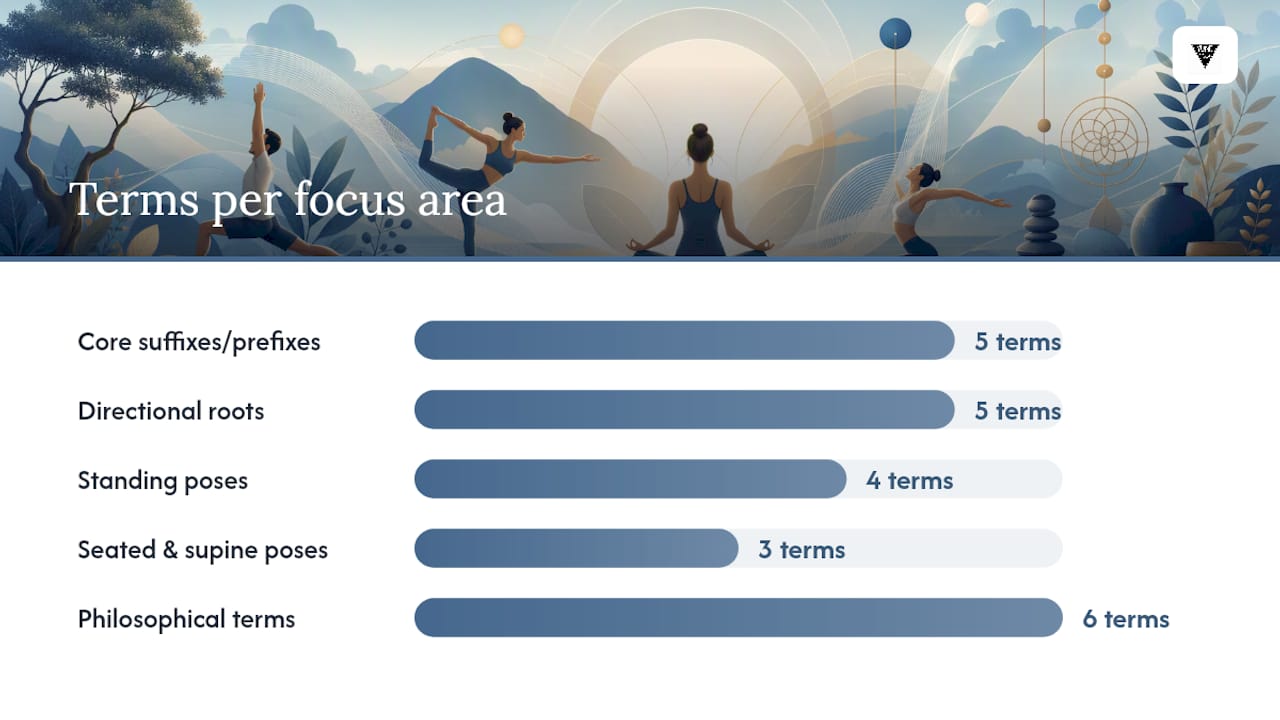
| Weeks | Focus area | Weekly goal | Daily practice (2–5 min) |
|---|---|---|---|
| 1–2 | Core pose suffixes and prefixes | asana, ardha, supta, uttita, pada | Write each term, say it aloud 3 times, use it in a class cue |
| 3–4 | Directional and body-part roots | adho, urdhva, mukha, eka, dvi | Flashcard review + look up one pose using the FLOW tool |
| 5 | Common standing poses | Tadasana, Trikonasana, Virabhadrasana I and II | Pair English and Sanskrit in a practice cue aloud |
| — | Seated and supine poses | Paschimottanasana, Supta Baddha Konasana, Savasana | Record yourself saying each name; listen back |
| 10 | Breath and energy vocabulary | pranayama, ujjayi, kumbhaka, nadi, prana | Link each term to its physical sensation during practice |
| — | Philosophical terms and chants | ahimsa, dharma, drishti, OM, namaste, shanti | Write a one-sentence definition; use one term in conversation |
Weekly practice checklist:
- Write the five new terms by hand (muscle memory reinforces spelling and recall)
- Say each term aloud at least three times, using the phonetic hint
- Use at least one term in a real class cue or conversation
- Review the previous week’s terms for two minutes before adding new ones
- At the end of each month, record yourself naming ten poses and listen back
For progress tracking, a simple habit tracker app or a paper index card system works equally well. The goal after steady study is confident recognition of many terms and comfortable pronunciation of the most common ones.
Sanskrit as a tool, not a test
The most common mistake teachers make with Sanskrit is treating it as a credential rather than a communication tool. Dropping unfamiliar terms without translation does not signal expertise; it signals that the teacher has forgotten what it felt like to be a beginner.
The better frame: Sanskrit is a shared vocabulary that connects a physical practice to a 3,500-year-old tradition of inquiry. Used well, it adds precision and depth. Used poorly, it creates distance between teacher and student. The difference usually comes down to one habit: always give the English alongside the Sanskrit until students ask you to stop.
Start small. Pick five terms from the glossary above, learn their pronunciation using the FLOW tool, and introduce one per class with a brief translation. That is enough. Students who want to go deeper will ask. Students who do not will still benefit from the practice itself, which is the point.
The broader benefits of yoga practice are accessible whether or not a student knows a single Sanskrit word. Sanskrit deepens the experience; it does not gatekeep it.
Sources
- Sanskrit: Yoga Pose, Chant, and Mantra Meanings - Yoga Journal
- Yoga Sanskrit Glossary: 200 Key Terms - Yoga Journal
- Sanskrit Yoga Terms: A Practical Glossary for Class - International Yoga Conference
- Sanskrit Yoga Poses: How To Translate Asanas and Why - Asana at Home
- Why Sanskrit matters: Q&A with Nicolai Bachman - Kripalu
- Sanskrit - Ancient History Encyclopedia
- Yoga poses A–Z: Pose library - Yoga Journal