

Yoga mat sizing: how to choose the right dimensions
Key Takeaways
The right yoga mat dimensions depend on your body, the way you move, and where you practice. A few simple measurements can make the choice much clearer.
- A common mat is about 68 inches long and 24 inches wide, though dimensions vary.
- Choose enough length to keep your head and feet on the mat in resting poses.
- Width is a balance between room to move and the space available around you.
- Thickness affects cushioning and stability, but it is separate from length and width.
- Measure your practice area and compare it with the mat’s listed usable surface before buying.
Understand standard yoga mat dimensions
Yoga mats do not come in one universal size, but many are close to a familiar baseline. Knowing that baseline gives you a useful starting point, not a rule you have to follow. For yoga mat sizing, compare the measurements with your own body and the poses you actually practice.
Common mat lengths and widths
A frequently seen size is 68 inches long by 24 inches wide. Some mats are 72 inches long, while wider options add space from side to side. The table shows common examples as starting points; always check the specific product listing, since naming conventions are not perfectly consistent.
| Approximate dimensions | How it may feel | A useful consideration |
|---|---|---|
| 68 × 24 inches | Compact, familiar footprint | Often suits a smaller practice area |
| 72 × 24 inches | A little more length | May help keep limbs on the mat |
| 72 × 26 inches | More room across the mat | Check the space between neighboring mats |
| 78 × 30 inches | Noticeably more surface | Requires extra room to store and use |
These are examples rather than a universal sizing chart. If you are comparing several options, a yoga mat size chart can offer another view of common lengths, widths, and thicknesses; then confirm each measurement on the product page.
How standard sizes compare with oversized mats
An oversized mat gives you more room to shift, stretch, and settle into poses without moving back onto the floor. That extra surface can be welcome for broad stances or flowing sequences, but it takes up more room in a class and at home. The tradeoff is simple: more room to move also means a larger footprint to carry, store, and lay out.
Consider where the extra area will matter most. If you tend to stay near the center of your mat, a standard width may be enough; if your arms and legs often reach past its edges, added width or length may feel more useful. A mat that is oversized on paper is not automatically a better fit for every practice.
Why dimensions can vary between brands
Mats described as standard can differ by a few inches, and product lines may offer longer or wider versions under different names. Measurements can also be rounded, so a listing might show a whole number even if the actual dimension is slightly different. Treat the listed length and width as more useful than a label such as “extra long.”
Pay attention to whether a stated size describes the mat itself or includes an attached edge or other design feature. If two listings seem nearly identical, compare their numbers directly rather than assuming their size labels mean the same thing. That small habit can prevent surprises when the mat arrives.
How to read a yoga mat’s listed measurements
Product dimensions are usually written as length by width, followed by thickness as a separate measurement. For example, 72 × 24 inches describes the mat’s surface dimensions, while 5 mm describes how thick it is. A product listing should make those distinctions clear, but it is worth checking the order of the numbers and the units.
Some listings use centimeters, so convert them if inches are easier for you to picture. A quick comparison with a tape measure or a mat you already own can make the numbers feel less abstract. Do not assume that the thickness number tells you anything about the mat’s length or width.
Choose a mat length for your height and practice
Length matters most when you lie down, stretch fully, or move between poses without wanting to adjust your position. Your height is a sensible starting point, but it is not the only thing to consider. The way you extend your arms and legs can affect whether a standard mat feels roomy enough.
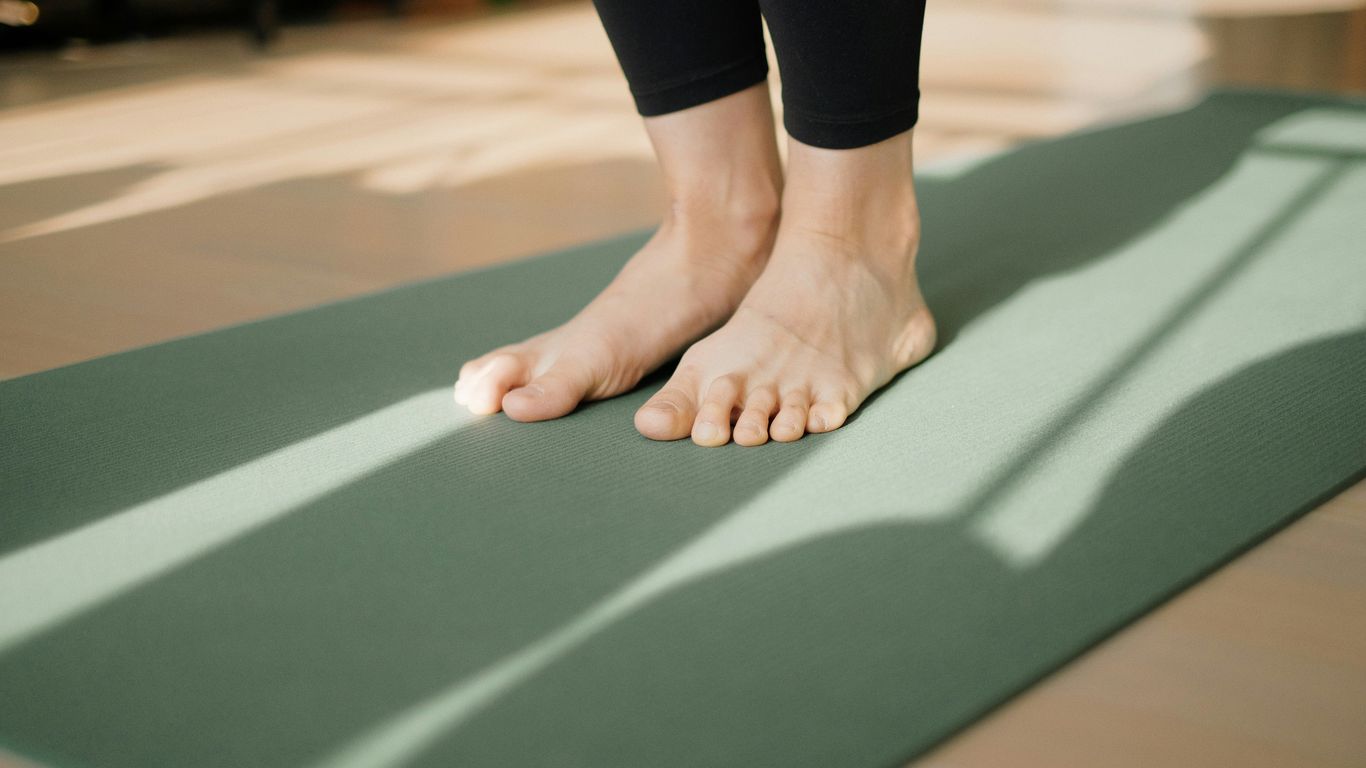
Match mat length to your height
A useful first check is whether the mat is longer than you are when you lie down. A little extra length gives your head and feet some space, though a close fit may be perfectly comfortable for seated or standing practice. Personal preference matters: some people like a defined surface beneath them, while others prefer a clear buffer at both ends.
If you are tall or simply like extra room, compare a longer option before deciding. For a height-specific perspective, advice for practitioners over six feet discusses why a standard-length mat may feel short and what to consider in a longer size. Use that as a prompt to measure yourself rather than a substitute for trying the dimensions against your own practice.
Allow extra room for extended poses
A mat should accommodate more than a neutral lying position if your practice includes long reaches or full-body stretches. In poses where your arms extend overhead or your legs reach away from your torso, a small length buffer can keep hands and feet on the mat. If those poses are part of your regular routine, consider how you feel on your current surface before moving to a new size.
A longer mat can make transitions feel less cramped, especially if you tend to travel along the mat during a sequence. Still, extra length is only useful if you can carry and store it comfortably. The right choice is the one that supports your movement without becoming an inconvenience between practices.
Consider tall practitioners and long limbs
Height gives you a rough guide, but long arms or legs can make a mat feel short even when your torso fits comfortably. Notice where your hands and heels land in poses that stretch your body in opposite directions. That is often a more practical test than relying on height alone.
When you measure yourself, include the positions that tend to expose a tight fit: lying on your back, extending your arms, or moving into a long lunge. If your hands or feet routinely reach the floor beyond the mat, more length may help. If not, there may be little reason to choose a larger size simply because it is available.
Decide when a standard-length mat is enough
A standard-length mat may be a good fit if you can lie down without your head or feet touching the floor and your usual transitions stay within its edges. It can also be easier to carry and place in a shared class. If your practice is mostly upright or centered, a longer mat may not add much.
Before replacing a mat that seems short, notice whether the issue happens often or only in a few poses. A slightly different placement or a more compact resting position might be enough for occasional situations. If you want room to stretch without adjusting, though, a longer option is worth considering.
Find the right mat width
Width is easy to overlook until your arms reach out to the sides or a wide stance brings you close to an edge. A wider surface can feel more accommodating, but it also occupies more of the floor around you. Think about both your movement and the place where the mat will usually be used.
Balance movement space with studio space
In a studio, each person needs enough space to move, and a wider mat can reduce the room left between neighboring mats. At home, that same width may be a welcome buffer if your practice area is open. The ideal dimension depends less on a single standard and more on how much room you can use without crowding the space.
If you attend classes, check whether the mat can fit comfortably within a typical practice spot. Wider may be useful for some poses, but not if it forces you to angle the mat or bump into nearby students. A quick measure of the space you usually have can clarify the tradeoff.
Choose a wider mat for broader poses
Wide-legged standing poses, lateral stretches, and movement that travels from side to side can make a narrow mat feel limiting. Extra width may give your hands and feet a more consistent surface beneath them. It is particularly worth considering if you often find yourself stepping beyond the mat during a familiar sequence.
The gain is not just the number of inches; it is whether the additional area falls where you need it. If your arms extend past the edge in a seated twist, width may matter more than length. If you mainly move front to back, a longer mat could be the more relevant adjustment.
Account for shared classes and crowded rooms
A mat that feels spacious at home may be harder to place in a full class. Before choosing a wider size, think about how close other mats tend to be and whether you need to leave room for walking around yours. The class setting can turn a small change in width into a noticeable difference.
If space is tight, a familiar width may be more practical even if you would enjoy additional room in a private setting. Some people use one mat for both settings and accept a modest compromise; others prefer to choose according to where they practice most often. Neither approach is inherently better.
Check that the mat fits your home practice area
At home, measure the actual floor area you can clear, not just the room’s overall dimensions. Furniture, doors, and walkways can make the usable space smaller than it looks. Lay out a rectangle with tape or a towel to see how the mat’s width will feel in context.
This is also a useful time to account for nearby props or a water bottle. You do not need a large empty room, but it helps to know whether your mat will fit without constant rearranging. Leave enough space to move around it safely.
Consider thickness and usable surface
Thickness describes the mat’s depth, not how much floor area it covers. A thin mat can be long and wide, while a thick one can still have a compact surface. Separate these measurements when comparing products so that cushioning does not distract from a length or width that may not suit you.
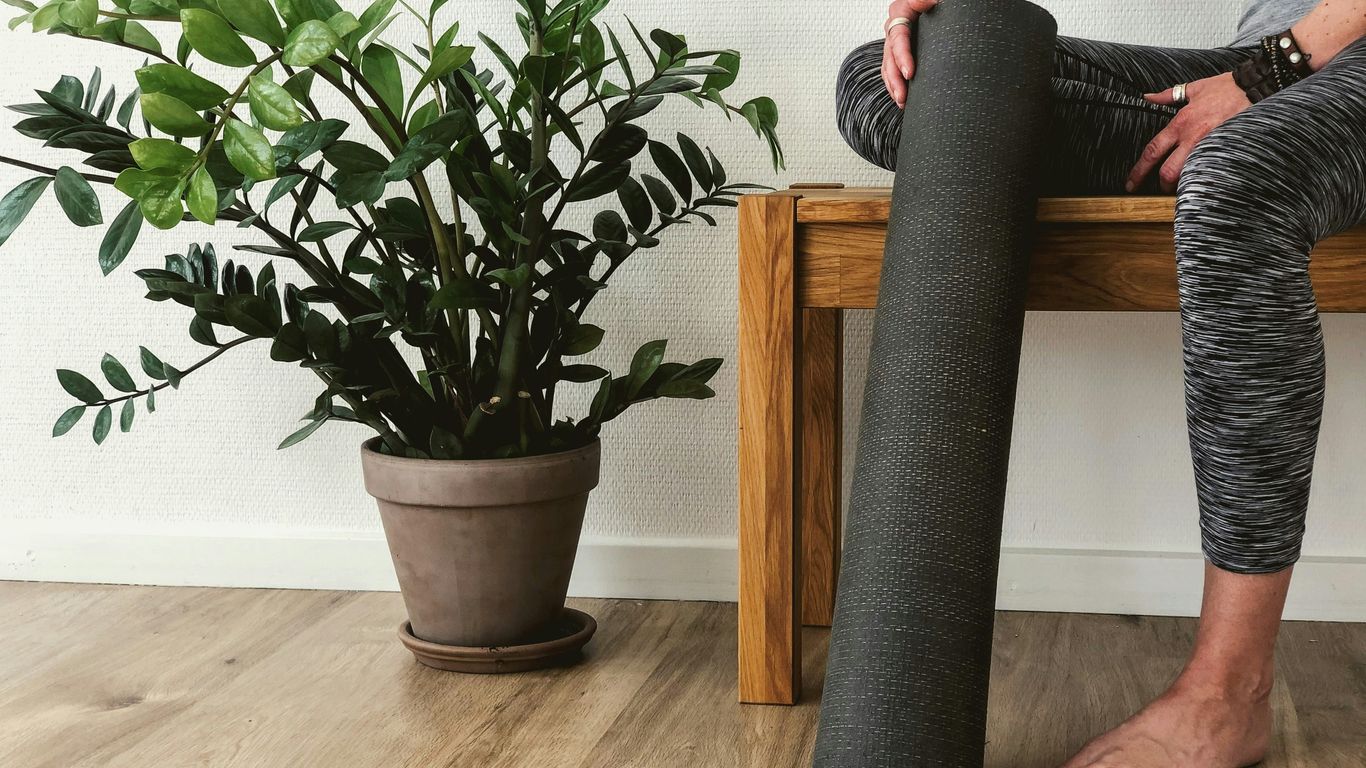
Distinguish mat thickness from length and width
Length and width describe the surface you practice on; thickness describes the distance between that surface and the floor. Listings may show thickness in millimeters alongside dimensions in inches or centimeters. Keep those figures mentally separate when deciding which mat will fit your body and your space.
For instance, the Tofino Yoga Mat is described as a 6 mm mat with textured grip and balanced cushioning. That detail can help you understand its profile, but it does not tell you its length or width. Check the full size listing before assuming that thickness means the surface is larger.
Balance cushioning with stability
More cushioning can feel comfortable under pressure points, while a very soft surface may feel less steady for some standing poses. The balance is personal and depends on the floor, the movements you practice, and what feels secure to you. Try not to choose thickness in isolation from the mat’s grip and overall dimensions.
A short demonstration can help you notice how different mat profiles feel underfoot and in seated positions.
Use any demonstration as a starting point, since the floor beneath your mat and your own preferences will shape the experience. If stability is a priority, consider how firmly you can stand and transition, not only how soft the mat feels when you press it with a hand.
Account for folded or layered mat designs
Foldable or layered mats may behave differently from a single flat mat when packed, opened, or placed on uneven ground. A folded design can be convenient to carry, but the folded thickness is not the same as the mat’s thickness when it is laid out for practice. Look for both the open dimensions and any packed or folded measurements in the listing.
If portability is a priority, the Sycamore Trekk Travel Mat by Yune Yoga is listed as a reversible 5 mm mat weighing 2.5 pounds, with textured surfaces and washable PVC. Those details describe the product’s material, thickness, and portability; check its listed surface dimensions separately to decide whether the open mat gives you enough room.
Check how dimensions affect standing and seated poses
The same mat can feel different from pose to pose. Standing work may make grip and stability more noticeable, while a seated or resting position can draw attention to cushioning and surface length. Notice which of those experiences matters most in your routine instead of judging the mat by a single pose.
If you tend to sit or kneel for longer stretches, a thin mat may feel different on a hard floor than on carpet. If balance poses are central to your practice, a thicker surface may take some getting used to. Whenever possible, test the mat on a floor similar to the one you normally use.
Match mat size to your practice style
Your practice style can help settle questions that body measurements alone leave open. A travel mat needs to be manageable to carry, while a home mat can prioritize room to move. Think about the sessions you do most often rather than buying for a rare pose or an imagined routine.
Choose a compact size for travel
For travel, packed size and weight matter alongside the open dimensions. A mat that is easy to carry may be more likely to come with you to a hotel room, a park, or another temporary practice space. If you want more context on tradeoffs between thickness, portability, and floor feel, this guide to mat portability and cushioning offers useful factors to compare.
The Tattoo Elder Yoga Mat is listed as 24 × 72 inches and about 3 mm thick, with a microfiber suede top, natural rubber base, and included carry strap. Its listed dimensions offer one concrete example of a longer, narrow profile; compare the packed feel and surface size with what you are comfortable carrying. A compact mat only helps if its usable dimensions still work for your practice.
Make room for expansive flow practices
A dynamic flow may move you forward, backward, and into wide stances, so length and width can both matter. If you frequently step off the mat during transitions, consider which direction you travel most. That observation can help you choose a more useful dimension rather than simply picking the largest option.
A little extra space can feel reassuring, but an oversized mat may be awkward to roll, carry, or set down in a crowded room. Consider your most common sequence and your storage situation together. The best fit is a workable balance, not a contest to find the biggest surface.
Consider restorative poses and props
Restorative practice often involves staying in one position for longer and arranging props around the body. In that setting, a larger surface may give you more room to place blocks, blankets, or a bolster nearby, depending on your setup. But you may not need a wider mat if your props sit beside it on the floor.
Think about how you actually arrange your space before choosing extra width. If a calm retreat is part of your plans, a Lake Chatuge retreat offers an example of a restorative getaway setting; the mat decision itself still comes down to your body, props, and available practice area. A familiar mat can be easier to use in a new place than one chosen only for its size.
Adapt your choice for home, studio, or outdoor use
Where you practice changes the practical value of each dimension. At home, you can often leave a mat out or choose a larger one; in a studio, storage and shared floor space may be more important. Outdoors, the ground and the amount of clear space can vary from one session to the next.
For an outdoor session, look for a surface that can be laid flat where you intend to practice and carried without fuss. For a studio, consider how easily it rolls and whether it fits the room. A single mat can serve all three settings, but it is worth deciding which setting will shape your choice most.
Check fit before you buy
A few minutes of measuring can make product listings easier to compare. Start with your body and the floor area, then check the specific mat dimensions and details. If anything remains uncertain, confirm the seller’s return terms before ordering.
Measure your height and practice space
Measure your height, then consider the length of your body when lying down with arms or legs extended. For width, check how much room you need for your broadest regular poses. At home, measure the clear floor area where you expect to practice, leaving space to move around the mat.
A simple check-before-you-commit approach is useful in other settings, too: a roof check in Chickamauga and Ringgold focuses on observing safely, documenting concerns, and knowing when to call a professional. For mat shopping, the equivalent is to measure first and seek clarification if the listing leaves an important detail unclear.
Compare product dimensions with a mat you own
If you already have a mat, measure it rather than relying on memory. Compare its length and width with the product listing, and ask yourself where it feels cramped or where you have more surface than you use. A familiar reference makes a few inches easier to picture.
When comparing options, it helps to keep your criteria visible: space, budget, and convenience may pull in different directions. The same comparison-first habit appears in advice on choosing a New Zealand mortgage adviser, where people weigh qualifications, fees, and communication. For a mat, make your own short list of the dimensions and practical details that matter most.
Look for usable surface area and edge details
The outer dimensions tell you the mat’s overall size, but the space you can comfortably use may be affected by borders, rounded corners, or a printed design. Most mats have a continuous surface, yet the edge shape can still change how large the mat feels under your hands and feet. Inspect product photos as well as the measurements.
Look for details about texture and grip if your hands tend to move during practice, and check whether the listed dimensions refer to the open mat. A business planning guide comparing onshore and offshore options is another example of looking at stated tradeoffs before choosing; here, focus on the mat details that affect your own setup. Do not infer a usable area from a photo alone.
Review return policies if the fit is uncertain
If the dimensions seem close, check whether the seller allows returns and what condition the mat must be in. Keep the packaging until you have confirmed the fit, and follow any instructions about trying the product. This is especially helpful when you cannot see the mat in person before buying.
For online shopping, consider the practical details around delivery, care, and customer support, too. A vacation stay has its own logistics—Home Team Rentals, for example, describes management services such as guest support and cleaning—but a mat purchase calls for checking its own seller’s policies. Make the final choice only after the measurements and terms are clear.
Conclusion
The right yoga mat size is the one that gives you enough room for the way you move without making practice inconvenient where you do it. Start with your height and the space available, then compare length, width, thickness, and portability as separate considerations. A quick measurement and an honest look at your usual practice can turn a vague guess into a confident choice.
Frequently Asked Questions
What is the standard size of a yoga mat?
A commonly seen size is about 68 inches long by 24 inches wide, though many mats differ. Check the individual product measurements rather than relying on the word “standard.”
How long should my yoga mat be?
Choose a length that lets you lie down and extend comfortably without your head or feet reaching the floor. Height is a helpful starting point, but your preferred poses also matter.
Is a wider yoga mat better?
A wider mat can provide more space for broad stances and side-to-side movement. It may be less convenient in a crowded class or a small home practice area, so consider where you will use it.
Does mat thickness affect its length or width?
No. Thickness measures how deep the mat is, while length and width describe the surface area. Compare each measurement separately.
Is a thicker mat more comfortable?
It can provide more cushioning, but comfort and stability are personal. Consider the floor you practice on and whether a thicker surface feels steady in standing poses.
What size yoga mat is best for travel?
A travel mat should be easy to carry and pack, while still offering enough open surface for your practice. Compare both its packed portability and its dimensions when laid flat.
How can I tell if a yoga mat will fit my space?
Measure the clear floor area where you plan to practice, then compare it with the mat’s listed length and width. Leave enough room around the mat to move safely.

