
Yoga mat exercises: A beginner-friendly guide to building a full-body routine
Key Takeaways
A yoga mat can support a complete beginner workout when you balance strength, mobility, and manageable conditioning. Start with controlled movements, build consistency, and adjust the routine to suit your body and space.
- Choose exercises according to your current ability and goals.
- Warm up your joints and clear enough room to move safely.
- Combine lower-body, core, upper-body, and mobility exercises.
- Begin with short sessions and progress gradually.
- Use steady form and stop when pain feels sharp or unusual.
Choose the right yoga mat exercises for your goals
The best yoga mat exercises are not necessarily the most complicated ones. A useful routine includes movements that match what you want to practice, whether that means improving mobility, building strength, or raising your heart rate without jumping. Your mat gives you a stable, comfortable surface for both floor-based and standing work.
Think of the session as a menu rather than a test. You can select a few movements from each category and leave out anything that does not feel appropriate today.
Mobility and flexibility-focused movements
Mobility work takes your joints through comfortable ranges while you stay attentive to control. Cat-cow, child’s pose, thoracic rotations, hip shifts, and gentle downward dog transitions can help you explore movement without rushing into deep stretches. Keep the motion smooth and avoid forcing a position simply because it looks impressive.
Hold a stretch only as long as you can breathe normally. A few measured repetitions often work better for a beginner than trying to remain still at the edge of range for a long time.
Strength-building bodyweight exercises
Bodyweight movements can train the legs, hips, chest, shoulders, and trunk with no extra equipment. Squats, glute bridges, planks, lunges, push-ups, and bird dogs are practical starting points because they can be scaled up or down. The bodyweight exercise guide is another useful source of movement ideas if you want to expand your options.
For strength, move slowly enough to keep your alignment organized. Controlled repetitions matter more than chasing a large number, especially when you are learning a new exercise.
Low-impact cardio and conditioning options
A mat routine can also include conditioning without turning into a high-impact workout. Marching in place, step-backs, bear crawls, slow mountain climbers, and repeated squat-to-reach movements can raise your breathing rate while keeping the emphasis on control. Choose a pace that lets you speak in short sentences rather than sprinting through every interval.
You can alternate a conditioning movement with a slower mobility exercise. That simple contrast gives your breathing time to settle while keeping the session varied.
How fitness level affects exercise selection
Your starting point should determine the version of an exercise, not whether you are allowed to do it. A new exerciser might use a wall or countertop for support, keep the knees down during a plank, or shorten the range of a lunge. Someone with more experience can add repetitions, longer holds, or a more demanding variation.
Use this quick guide when choosing a starting level:
| Training level | Useful starting approach | Progression signal |
|---|---|---|
| New to exercise | Short sets and supported positions | Form stays steady throughout |
| Returning after a break | Moderate repetitions with longer rests | Breathing recovers between sets |
| Regular exerciser | Full variations and timed intervals | You finish with control |
| More experienced | Complex combinations or slower tempos | The routine remains challenging without pain |
After each session, consider whether the exercises felt too easy, appropriately challenging, or too demanding. That feedback is more useful than comparing your routine with someone else’s.
Prepare your body and space safely
A little preparation makes a home workout feel more comfortable and predictable. Check that your mat lies flat, move hard or sharp objects out of the way, and leave enough room for your arms and legs to extend. If you practice in different locations, portability can help you stay consistent; the Juliet Trekk Travel Mat is described as lightweight and designed for practicing anywhere.
Give yourself a few quiet minutes before beginning. You do not need a complicated ritual, but you do need enough attention to notice how your body feels today.
Check your mat, footwear, and surroundings
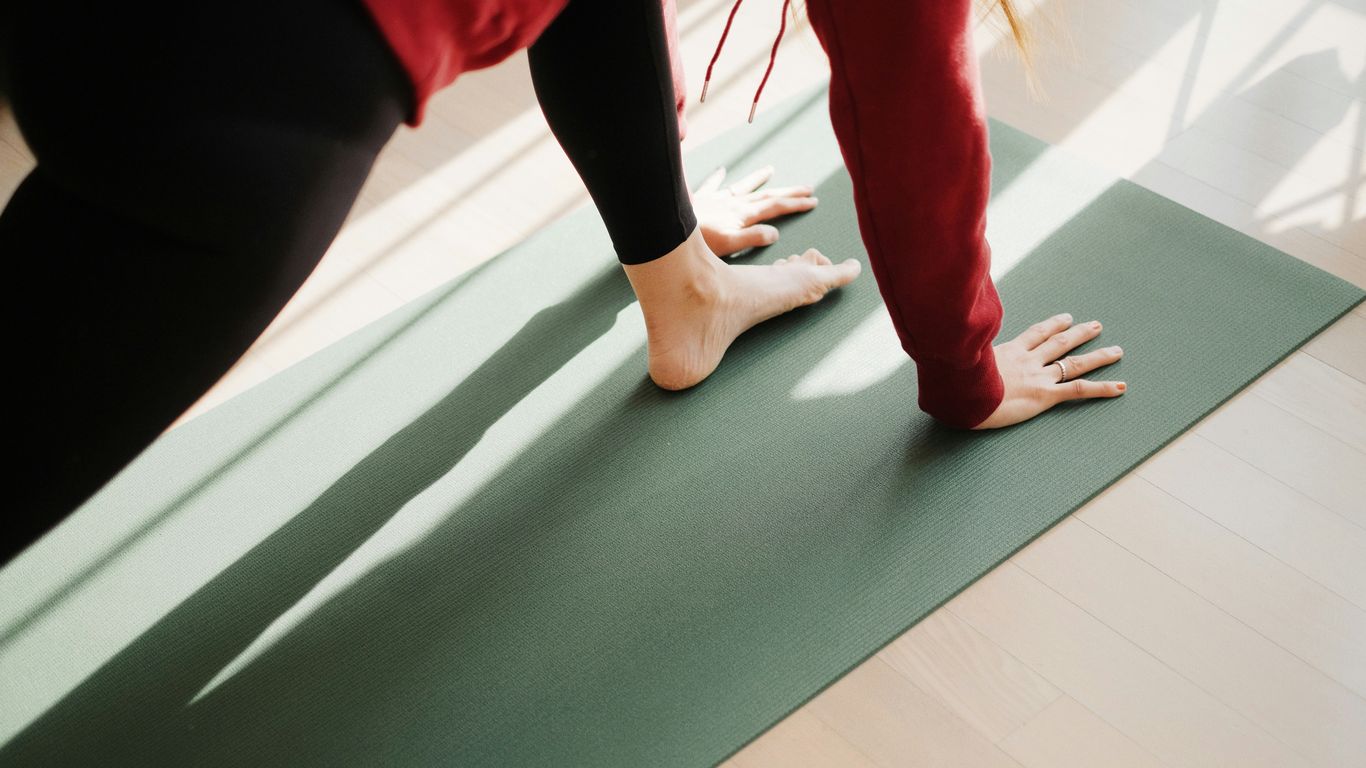
Place the mat on a clean, even surface and test it with a few slow steps. Bare feet often make it easier to feel the floor, though supportive footwear may be useful for some standing exercises or personal preferences. Keep water, a towel, and anything you may need nearby so you are not stepping away mid-set.
If the mat slides during a plank or lunge, stop and fix the setup. A stable base lets you focus on the movement instead of bracing against unwanted motion.
Use dynamic movements to warm up
Begin with gentle, active movements rather than dropping immediately into a long stretch. Try shoulder rolls, ankle circles, easy marches, hip hinges, and several cat-cow repetitions. The goal is to increase movement gradually and rehearse the patterns you will use later.
A warm-up can be brief, often around three to five minutes. Keep the range comfortable, then make it slightly larger as your joints and muscles begin to feel ready.
Modify exercises for wrists, knees, and lower back
Small changes can make an exercise much more approachable. Place your hands on a raised, stable surface if wrist pressure is uncomfortable, use extra mat cushioning under the knees, and reduce the range of motion if your lower back starts to arch or strain. You can also switch from a high plank to a forearm plank or from a full push-up to a wall or knee variation.
The right modification preserves the purpose of the exercise while reducing unnecessary stress. It is not a lesser version; it is a way to practice with better control.
Know when to stop or seek professional guidance
Muscle effort, warmth, and ordinary fatigue are different from sharp pain, sudden weakness, dizziness, or numbness. Stop if a movement produces those warning signs, and seek qualified medical or fitness guidance when you are unsure how to continue. Anyone managing an injury, pregnancy, or a health condition should ask an appropriate professional for personalized advice.
Do not try to push through symptoms just to finish a timer. A shorter, comfortable session is more useful than one that leaves you unable to move normally afterward.
Build lower-body strength on a yoga mat
The lower body responds well to simple patterns repeated with care. Squats train a sit-and-stand motion, bridges emphasize the hips, and lunges introduce balance and single-leg control. These exercises can be practiced on a mat with little space and adjusted for beginners.
Start with a range that feels stable. As your confidence improves, add repetitions or slow the lowering phase before moving to a more complex variation.
Bodyweight squats and squat variations
Stand with your feet about hip-width apart, send your hips back, and bend your knees while keeping your chest comfortably lifted. Press through the feet to return to standing without locking the knees aggressively. If balance is uncertain, squat toward a chair or use a shallow range.
You can progress from regular squats to pause squats, narrow-stance squats, or squat-to-reach movements. Keep the tempo even so the knees and hips do not suddenly drop into the bottom position.
Glute bridges for hips and hamstrings
Lie on your back with your knees bent and feet resting on the mat. Press through the feet, lift the hips until your trunk forms a comfortable diagonal, and lower with control. Keep the ribs relaxed rather than arching the lower back to gain extra height.
Begin with two short sets of repetitions. A pause at the top can make the movement more challenging without adding equipment, but stop the lift before you lose a neutral, comfortable position.
Reverse lunges and split-stance progressions
Step one foot backward and lower both knees only as far as you can remain balanced. Push through the front foot to return to standing, then change sides. Reverse lunges often feel more controlled than stepping forward because the front leg can stay planted as you organize the movement.
Hold a wall lightly if needed. Later, you can practice a split squat with the feet fixed, add a pause near the bottom, or increase the number of repetitions while keeping the torso steady.
Side-lying leg raises for hip stability
Lie on one side with your legs extended or knees slightly bent. Brace gently through the middle, lift the top leg without rolling the pelvis backward, and lower it slowly. The movement is small by design; lifting higher is not automatically better.
Complete the same number of controlled repetitions on both sides. If the hip flexor takes over, move the leg slightly behind the body and reduce the height.
Train your core without equipment
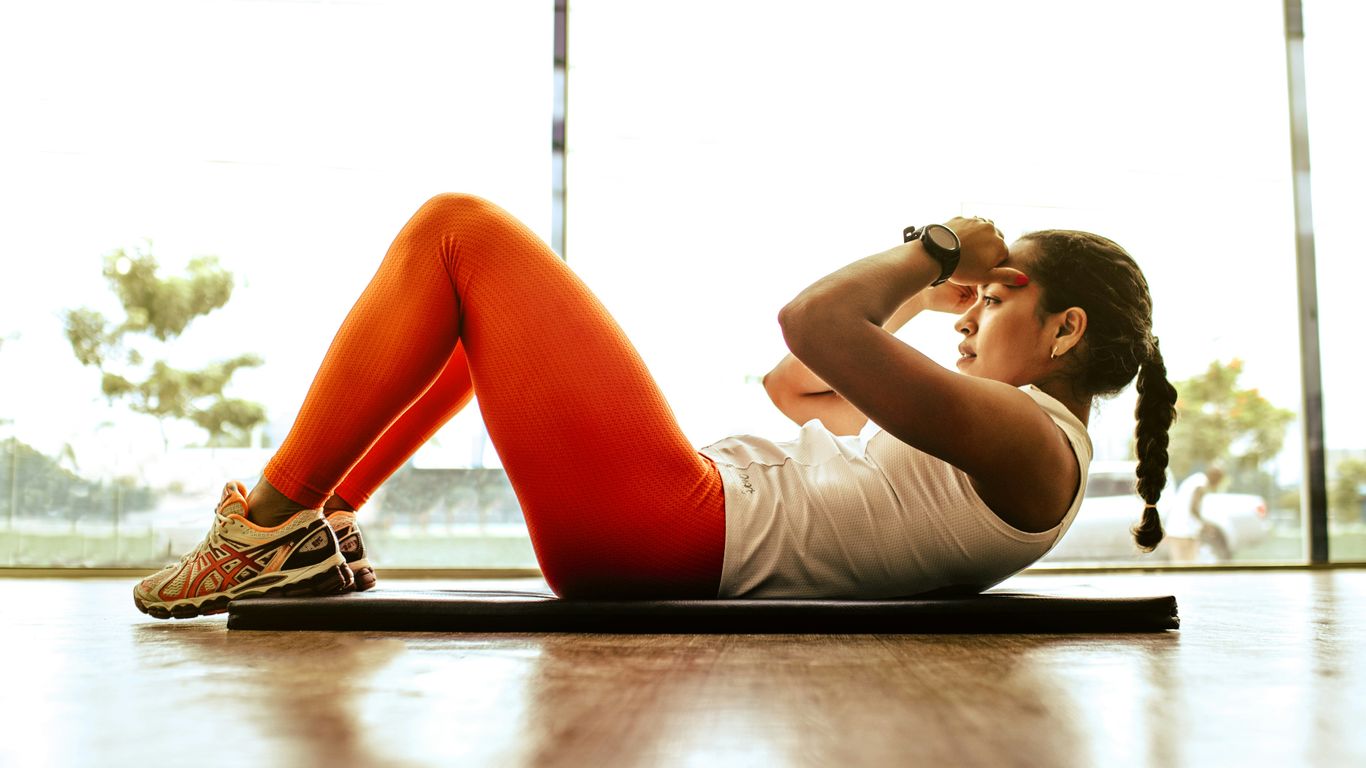
Core training is more than repeated crunches. The trunk helps transfer force between the arms and legs, and many mat exercises challenge it while you hold a steady position. Planks, dead bugs, bird dogs, and controlled leg movements all offer different ways to practice bracing and coordination.
Think of stability as quiet control. If your ribs flare, your back lifts away from the mat, or your hips twist, make the exercise smaller or take a short rest.
Forearm and high plank variations
For a forearm plank, place the elbows below the shoulders and extend the legs behind you, or keep the knees down for an easier version. A high plank uses straight arms with the hands under the shoulders. In both versions, gently tighten the abdomen and glutes while keeping the neck relaxed.
Try short holds of 10 to 20 seconds rather than forcing a long hold with poor alignment. You can also practice shoulder taps from a supported plank if your hips remain relatively still.
Dead bugs for controlled core stability
Lie on your back with the arms reaching upward and the knees bent over the hips. Slowly lower one arm and the opposite leg toward the floor, then return them to the starting position before switching sides. Keep the lower back comfortably supported without pressing so hard that you cannot breathe.
Start with only the arms or only the legs if coordinating both sides feels difficult. The mat abs exercise guide includes other floor-based core ideas, including plank variations and leg raises.
Bird dogs for balance and coordination
Begin on hands and knees with the wrists below the shoulders and knees below the hips. Extend one arm and the opposite leg, pause briefly, and return them without shifting the rest of the body. Move slowly enough to notice whether your hips are opening to the side.
If balance is challenging, slide the foot back along the floor instead of lifting it. You can then progress to lifting the leg, the arm, and eventually both together.
Pilates-inspired leg and abdominal movements
Controlled toe taps, bent-knee marches, and alternating heel slides can train abdominal control while you stay on your back. Keep the movements small and let the pelvis remain quiet. These options are useful when a long plank is uncomfortable or when you want a lower-intensity core block.
Pair one leg movement with a gentle spinal mobility exercise afterward. That change of position can make the session feel less repetitive and gives you a chance to reset your breathing.
Add upper-body and full-body exercises
A full-body routine does not require heavy equipment. Push-up variations challenge pressing strength, crawls connect the arms and legs, and mountain climbers combine bracing with a faster rhythm. Choose versions that allow your shoulders, wrists, and trunk to stay organized.
Use the mat to make transitions more comfortable, but do not let the soft surface encourage rushed technique. The beginner upper-body workout guide offers additional examples of mat-friendly pressing movements.
Push-up variations for different ability levels
Start with a wall push-up or an incline push-up using a stable surface. To work from the mat, place the knees down and keep the body in one line from the head through the hips. Lower only as far as you can control, then press the floor away to return.
Keep the elbows angled slightly back rather than flaring them wide. As strength improves, move from knee push-ups to full push-ups, or add a slow lowering phase.
Bear crawls for total-body coordination
From hands and knees, tuck the toes and hover the knees just above the mat. Move one hand and the opposite foot together, then switch sides while keeping the hips low and the steps short. If the hovering position is too demanding, practice the same opposite-hand-and-foot pattern with the knees down.
Bear crawls can become tiring quickly, so use brief passes across your available space. Rest before your shoulders begin to shrug or your back starts to sway.
Mountain climbers for strength and conditioning
Set up in a high plank with the hands beneath the shoulders. Bring one knee toward the chest, return it, and switch sides at a steady pace. Beginners can step the feet one at a time instead of running them, which makes the movement easier to control.
Keep the shoulders above the hands and avoid bouncing the hips. A slower version still trains the pattern and may be more useful than fast repetitions that lose alignment.
Downward dog transitions for mobility and control
From hands and knees, press the floor away and lift the hips into a comfortable downward dog shape, then return gradually to the starting position. Bend the knees as much as necessary and focus on length through the back rather than forcing the heels down. This transition can connect upper-body loading with hip and shoulder mobility.
Move through it for several calm repetitions. If the wrists are sensitive, take more weight into the legs or use a raised, stable surface for the hands.
Create and progress a yoga mat workout routine
A useful routine should be simple enough to repeat. You can build a session from a warm-up, a lower-body exercise, a core movement, an upper-body exercise, and a short mobility finish. For people who practice away from home, a mat such as the Skaro Yoga Mat is described as suitable for versatile practices including mobility and meditation.
The aim is not to make every workout exhausting. A repeatable plan gives you a clearer way to notice improvements in balance, control, stamina, and confidence.
A simple 15-minute beginner sequence
After a brief warm-up, choose one movement from each major area and work at an unhurried pace. This sample sequence uses short intervals so you can learn the positions before increasing the workload.
- Squats for 45 seconds, followed by 30 seconds of rest.
- Glute bridges for 45 seconds, followed by 30 seconds of rest.
- Knee-supported plank for 20 seconds, followed by 30 seconds of rest.
- Incline or knee push-ups for 45 seconds, followed by 30 seconds of rest.
- Bird dogs for 45 seconds, followed by 30 seconds of rest.
Finish with gentle movement and easy breathing rather than stopping abruptly. If five exercises feel like too much, complete only the first three and repeat them once.
How to combine strength, mobility, and cardio
Place strength exercises early enough that you can perform them with attention, then add a short conditioning block if your energy is good. Mobility can appear in the warm-up, between demanding exercises, and at the end. This approach keeps the routine balanced without requiring a separate workout for every goal.
A practical order might be squats, bridges, a plank, slow mountain climbers, and downward dog transitions. Change the order when your body or available time calls for it.
Repetitions, sets, rest, and exercise order
Beginners can start with one or two sets of 6 to 12 controlled repetitions for strength movements, or 10 to 30 seconds for holds. Rest until your breathing settles enough to repeat the exercise with similar form. More complex movements usually belong earlier in the session, while simpler mobility work fits well at the beginning or end.
There is no need to use the same rep count for every exercise. A bridge, plank, and mountain climber have different demands, so let quality and recovery guide the timing.
Ways to increase difficulty without equipment
Progress gradually by changing one variable at a time. You might add a few repetitions, extend a hold, slow the lowering phase, reduce rest, or choose a more challenging variation. The best progression is one that still lets you complete the movement without compensating.
Avoid increasing everything in one session. If you add time to a plank, keep the rest of the workout familiar so you can tell how that single change affected you.
How to recover and track your progress
Recovery includes sleep, ordinary daily movement, hydration, and enough rest between demanding sessions. Write down the exercises, repetitions, hold times, and a brief note about how they felt. Over several weeks, you may notice that the same routine feels steadier or that you need fewer breaks.
You can also track practical milestones: a deeper comfortable squat, a longer controlled plank, smoother transitions, or the ability to complete the routine consistently. Those changes are meaningful even when the workout never becomes extreme.
Conclusion
Yoga mat exercises can form a practical full-body routine with very little space or equipment. Begin with comfortable versions, move with intention, and progress one small adjustment at a time so the habit remains enjoyable and sustainable.
Frequently Asked Questions
Can beginners do a full workout on a yoga mat?
Yes. Beginners can combine squats, bridges, supported push-ups, planks, bird dogs, and gentle mobility work in a short session. Use easier variations and rest whenever your form starts to change.
How long should a beginner yoga mat workout be?
Fifteen minutes is enough to establish a routine, especially when the session includes a warm-up and a brief cooldown. You can gradually extend the workout as recovery becomes easier.
Do I need shoes for yoga mat exercises?
Many mat exercises can be done barefoot, but footwear is a personal choice. Use whatever allows you to feel stable and comfortable, and make sure the mat does not slide beneath you.
How often should I do mat exercises?
Two or three sessions per week can be a reasonable starting point, with rest or lighter movement between harder sessions. Consistency matters more than trying to train intensely every day.
What should I do if my wrists hurt during planks?
Try a forearm plank, a knee-supported plank, or an incline version with your hands on a stable surface. Stop if the discomfort persists or becomes sharp, and seek professional advice when needed.
Can yoga mat exercises build strength without weights?
Yes. Bodyweight exercises can challenge major muscle groups through repetitions, holds, slower tempos, and more demanding variations. Progress gradually and keep the movement controlled.
How can I make a mat workout harder?
Add a small number of repetitions, lengthen a hold, reduce rest, slow the lowering phase, or move to a more advanced variation. Change only one factor at a time so you can monitor how your body responds.

