

Yoga mat dog guide: How to choose and use a safe, non-slip mat
Key Takeaways
A yoga mat can give your dog a steadier, softer surface, but the right choice depends on your dog, your floor, and how the mat will be used.
- Choose grip, cushioning, and safe materials over appearance alone.
- Measure the area your dog actually needs before buying.
- Introduce the mat gradually and supervise chewing or digging.
- Clean and dry the mat regularly to control odors and mildew.
- Use a purpose-built traction mat, rug, or orthopedic bed when it better suits the job.
Why a yoga mat can help your dog
A yoga mat dog setup can be a simple way to make hard or slippery areas more manageable. The textured surface may give paws more confidence than polished wood or tile, while a little cushioning makes resting and play more comfortable. It is not a treatment for a mobility condition, but it can be a useful household adjustment alongside veterinary advice.
Improving traction on slippery floors
Dogs can lose their footing when they turn quickly, rise from a nap, or walk across smooth flooring. Placing a mat along a commonly used route—such as between a bed and a water bowl—can create a defined strip of traction without covering the whole room. Keep its edges flat and check that it stays in place.
For older dogs with weak legs, a few strategically placed mats may be more useful than one isolated square. This practical idea is also explored in a guide to yoga mats for senior dogs, though every dog’s comfort and movement pattern is different.
Creating a comfortable resting area
A mat can mark out a cool, easy-to-clean resting spot beside your desk or near a patio door. It is firmer than a plush bed, so it may suit a dog that prefers lying on a flat surface, but it should not replace a supportive bed for long sleeping periods. Watch whether your dog settles willingly or keeps moving away.
The best resting area is quiet, large enough for a natural stretch, and free from drafts. A mat with modest cushioning can also soften the feel of a crate floor or a hard indoor surface.
Supporting senior dogs and dogs with mobility issues
For a senior dog, stability often matters more than style. A non-slip surface may make standing, turning, and walking short distances feel less uncertain, particularly near stairs or feeding areas. If your dog is newly hesitant, painful, or unable to rise, arrange a veterinary assessment rather than relying on a mat alone.
Place the mat where it solves a real problem, not where it creates an obstacle. Leave enough room for your dog to step onto it naturally, and combine it with other changes recommended for the dog’s condition.
Protecting floors during play and exercise
A mat can catch a little dirt, drool, and everyday wear beneath food bowls or during gentle indoor games. It may also provide a more forgiving surface for simple movement exercises, provided your veterinarian or rehabilitation professional has approved them. A stable surface reduces distraction and lets you focus on calm, controlled movement.
Do not assume that a yoga mat will withstand every game. Running, sharp claws, and repeated tugging can damage it, especially if the material is thin or soft.
What to look for in a dog-friendly yoga mat
A human yoga mat can work for some dogs, but it was not necessarily designed for claws, teeth, muddy paws, or repeated floor use. Look beyond the label and consider the mat’s texture, odor, flexibility, and cleaning instructions. Materials should be clearly identified, and the surface should feel comfortable rather than tacky or abrasive.
Choosing the right thickness and cushioning
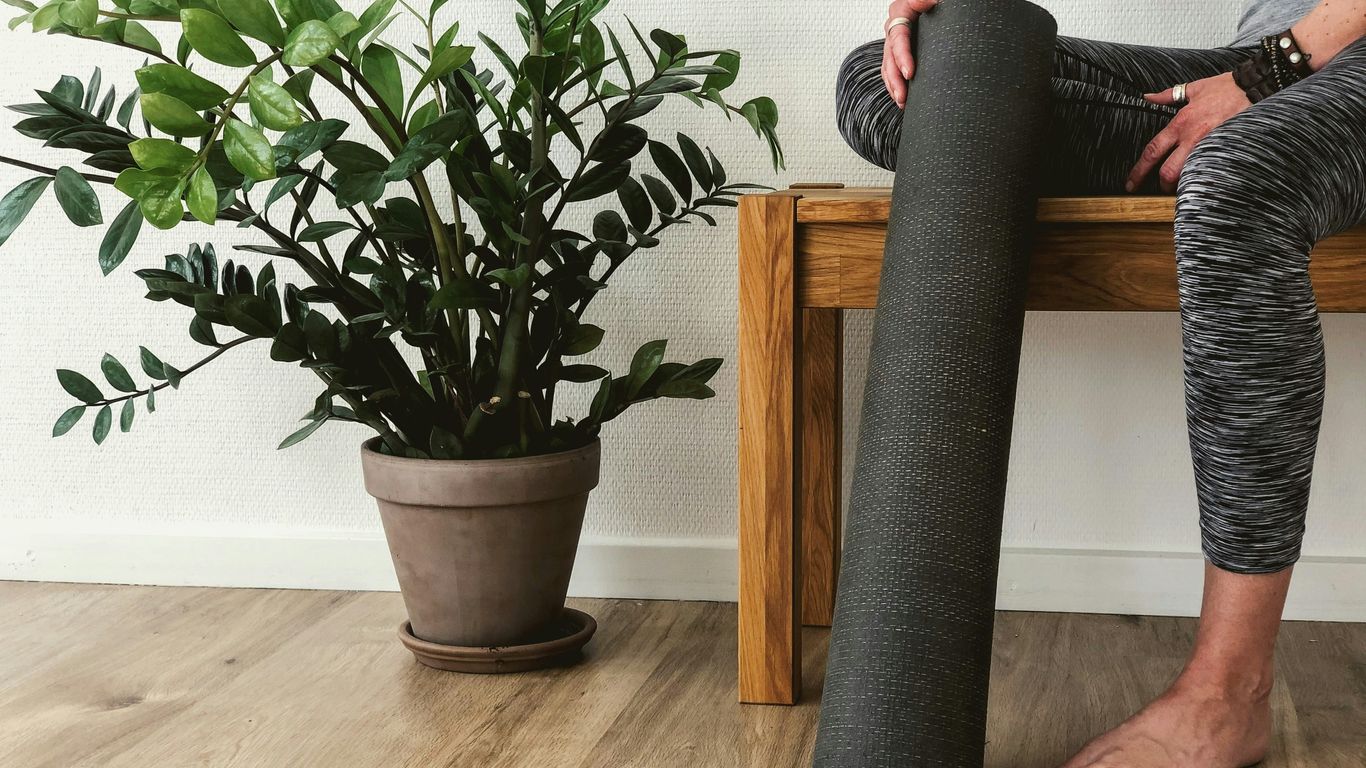
Thickness affects both comfort and stability. A very thin mat may offer grip but little relief on hard floors, while a thick, soft mat can feel unstable under a large or unsteady dog. Choose enough cushioning for the intended use without creating a surface that wobbles or catches paws.
For comparison, several Yune Yoga mats, including the Oshima Yoga Mat, are documented as 6mm thick with cushioning and stability for yoga practice. That information describes their intended use, so inspect any mat in person—or introduce it carefully—before giving it to your dog.
Comparing rubber, PVC, TPE, and foam materials
Rubber, PVC, TPE, and foam can all feel different underfoot. Rubber may have a distinctive smell, foam can compress more readily, and some plastics are easier to wipe clean than others. The material name alone does not tell you whether a mat will be safe or durable in your home; construction and the manufacturer’s care guidance matter too.
Consider allergies and household sensitivities as well as grip. If your dog already has recurring skin irritation, a useful starting point is this dog allergy guide, followed by advice from your veterinarian.
Checking for grip on both sides
Top-side traction helps paws stay planted, but the underside determines whether the mat stays put on tile, wood, or carpet. Press down on a corner and try to move it before your dog uses it. If it slides easily, add a compatible non-slip layer or choose a different surface.
A mat that curls at the edges is also a trip hazard. Unroll it fully, let it relax as directed, and do not place it beside stairs until it lies flat.
Avoiding toxic coatings, strong odors, and loose fragments
New-mat odor can be unpleasant for people and dogs, and loose flakes or peeling coatings can become a chewing temptation. Air out a mat according to its care instructions, inspect it in good light, and stop using it if it cracks, sheds, or causes redness. Clear labeling is preferable to vague assurances; a short greenwashing guide can help when marketing language makes environmental or safety claims sound stronger than the available details.
If the smell remains intense or your dog reacts to the surface, choose another option. Never let a dog chew a mat simply because it is marketed as natural, eco-friendly, or durable.
How to choose the right mat size
The right size is based on movement, not just body length. A dog may need room to step on, turn around, lie down, and step off without placing paws on a slippery edge. Measure the real space at home, then compare it with the mat’s usable dimensions.
Measuring your dog’s resting and movement area
Watch your dog move through the space you want to improve. Measure the route, the resting position, and the clearance around bowls or furniture. Add a little margin so the dog is not forced to balance on a narrow strip.
A useful test is to place temporary towels on the floor in the proposed footprint. If your dog consistently steps beyond them, the final mat probably needs to be wider or longer.
Selecting a mat for small, medium, and large dogs
Small dogs may manage with a compact mat near a bed or bowl, while medium and large dogs often need enough length for a full turn and a comfortable down position. Breed labels are less useful than your dog’s actual posture, stride, and confidence. A large dog that spreads out may need more room than a heavier but tightly curled sleeper.
Use the table below as a starting point, not a rigid sizing rule.
| Dog and use | Starting footprint | What to check |
|---|---|---|
| Small dog, resting spot | Compact area | Full body fits without curled edges |
| Medium dog, bowl or pathway | Medium strip | Dog can turn and step off safely |
| Large dog, rest and movement | Larger rectangle | Enough room for a natural stretch |
After measuring, place the chosen size in the room and observe normal movement. If paws frequently land beside the mat, increase coverage rather than expecting the dog to adapt.
Deciding whether one mat or multiple mats works best
One mat is convenient when the problem is limited to a single resting or feeding area. Multiple smaller mats can work better when a dog travels between rooms, although every extra edge needs checking. Keep the layout simple so the floor does not become a patchwork of curling or sliding pieces.
For example, one mat might sit beside the sofa and another near the stairs. Reassess after a few days; the most useful locations are the ones your dog actually uses.
Accounting for travel, crates, and compact storage
If the mat will travel, consider weight, rollability, and how quickly it can be cleaned after outdoor use. It should fit the crate or vehicle space without blocking ventilation or creating a raised edge. A thinner mat may pack more easily, but do not sacrifice essential grip for convenience.
The Howling Rock Yoga Mat is documented as lightweight, portable, and tear-resistant for yoga practice. Those product details make portability a sensible comparison point, not a guarantee that it will suit every dog or crate.
How to use a yoga mat safely with your dog
A mat is only helpful if your dog can use it calmly. Start when your dog is relaxed, keep the surface clear of food and clutter, and observe rather than directing every step. Safety also means knowing when the mat is the wrong surface for the moment.
Introducing the mat without forcing interaction
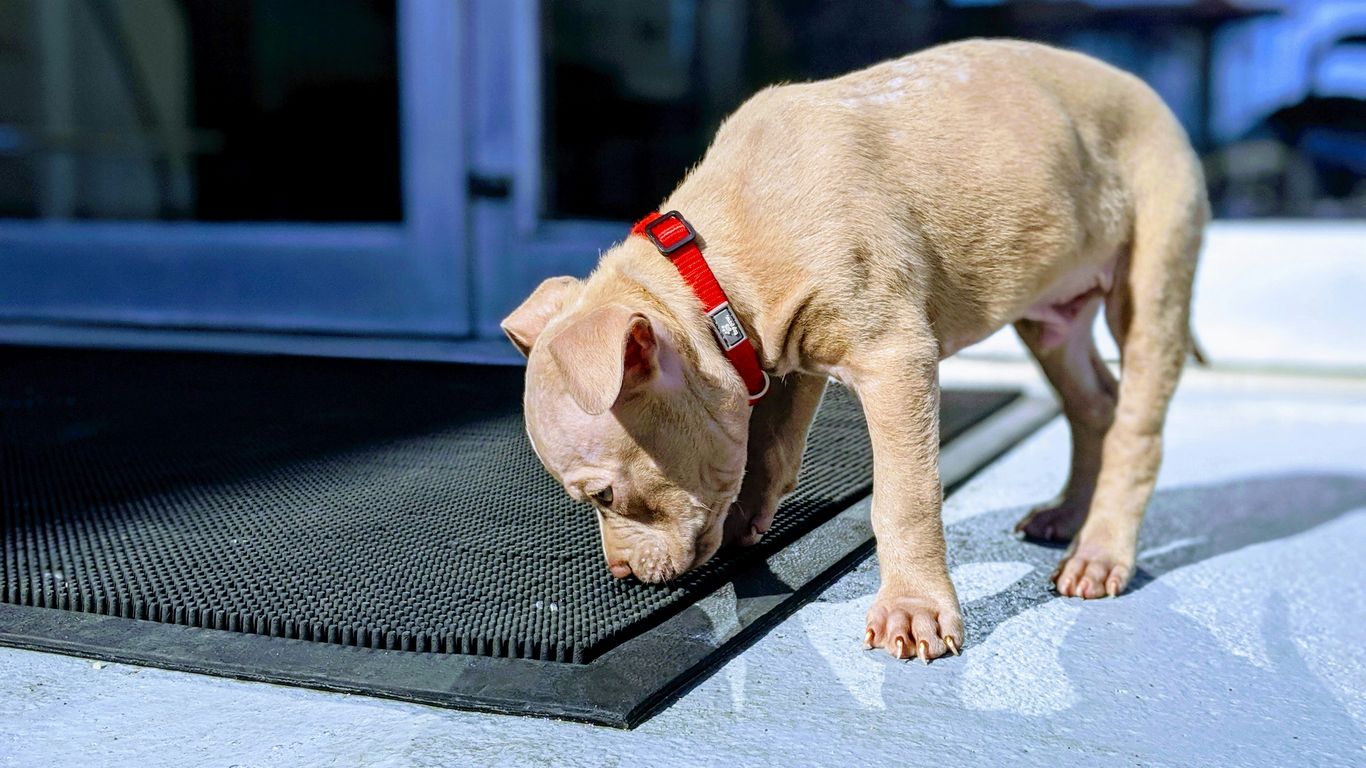
Lay the mat flat and let your dog investigate it at their own pace. Reward a glance, sniff, or relaxed step with praise or a treat, then allow the dog to leave. Avoid dragging the dog onto it or using it as a place for correction.
Short, low-pressure introductions are usually easier than a single long session. Once the dog chooses to stand or lie there, keep the experience quiet and predictable.
Securing the mat so it does not slide or curl
Test the mat yourself before inviting your dog onto it. Smooth the underside, place it on a clean floor, and use a safe non-slip layer if the manufacturer permits one. Keep corners away from doorways and make sure nearby furniture does not create a tight passage.
A curled edge can catch a toe even when the center has excellent grip. Inspect the perimeter each time you unroll the mat, especially after storage.
Supervising chewing, digging, and vigorous play
Never leave a dog unattended with a mat they are trying to chew or tear. Small fragments may be swallowed, and digging can quickly turn a traction surface into a ragged one. Redirect the behavior to an appropriate toy and remove the mat if the behavior continues.
For indoor exercise, keep sessions gentle and controlled. A mat can support footing, but it is not a substitute for a properly planned exercise surface or professional rehabilitation guidance.
Recognizing signs of discomfort, overheating, or irritation
Some dogs dislike the texture, odor, or warmth of a new mat. Watch for repeated licking of the paws, reluctance to stand, pacing, panting in a cool room, redness, or attempts to escape the surface. Move the dog to a comfortable area and discontinue use if symptoms persist.
The surface should be cool, dry, and free of cleaning residue. If irritation or mobility changes continue, contact your veterinarian rather than testing more mats at random.
How to clean and maintain a yoga mat for dogs
Dogs bring more onto a mat than a typical yoga session does, so routine care matters. Fur, wet paws, food residue, and outdoor dirt can build up in textured surfaces. Follow the manufacturer’s instructions first, then use the least aggressive cleaning method that removes the mess.
Removing fur, dirt, and muddy paw prints
Let mud dry enough to lift rather than rubbing it deeper into the texture. Shake the mat outdoors if practical, sweep or vacuum loose fur gently, and wipe paw marks with a damp cloth. Clean both sides when dirt has traveled underneath.
Do not fold a wet, dirty mat into a bag. That traps moisture and turns a small cleanup into a lingering odor problem.
Choosing pet-safe cleaning solutions
Use mild, unscented soap diluted with water when the care label allows it. Avoid bleach, harsh solvents, essential oils, and heavily perfumed sprays unless the manufacturer specifically approves them. Rinse away any residue that could irritate paws or invite licking.
Keep cleaning supplies separate from pet food and water bowls. For broader household safety research, even a guide to soldering materials illustrates the value of matching protective practices to the material being handled—though its subject is entirely different.
Drying the mat to prevent mildew and odors
After wiping, hang or lay the mat flat in a well-ventilated place. Let both sides dry fully before rolling it, and avoid prolonged direct sun if the care instructions warn against it. A damp mat can smell stale and may become less pleasant for your dog to use.
Rotate the mat occasionally so trapped moisture is easier to notice. If an odor remains after proper cleaning and drying, inspect the surface for damage rather than masking the smell.
Knowing when the mat should be replaced
Replace a mat when it no longer lies flat, loses its grip, develops deep cracks, or sheds pieces. Persistent odor, staining that cannot be cleaned, and visible damage around the edges are also reasons to retire it. A worn mat can create the very slipping risk it was meant to reduce.
Do not pass a damaged mat to another pet. Dispose of it according to local guidance and reassess whether a different material or purpose-built product would be safer.
When a yoga mat is not the best option
A yoga mat is a flexible household aid, not a universal dog-care product. Some dogs need more coverage, more cushioning, or a surface designed specifically for traction. The right choice depends on the dog’s health, habits, and environment rather than on the word “non-slip” alone.
Considering purpose-built dog traction mats
A purpose-built traction mat may be better when your dog needs dependable grip across smooth floors, stairs, or vehicle entry points. The Dog Traction Mats guide describes mats intended for those types of areas and emphasizes stability and easy cleaning. Compare the product’s dimensions and care instructions with your dog’s actual route.
This option is especially worth considering when a yoga mat bunches, shifts, or cannot cover enough of the floor. Ask your veterinarian for guidance if falls or weakness are increasing.
Choosing orthopedic beds for long-term sleeping
For overnight sleep or extended daytime rest, an orthopedic bed may provide more targeted support than a flat exercise mat. Look for a size that allows your dog to stretch out, a stable base, and a cover that can be washed. The bed should be easy to enter and exit without a high step.
A mat can sit beneath or near the bed to improve approach traction, but it does not automatically provide the same support as a properly designed resting surface.
Using washable rugs for larger floor areas
When a dog needs a safe route through a hallway or across a broad room, washable rugs may be more practical than several yoga mats. Choose low-pile styles that lie flat and have a secure backing, then wash them regularly. Avoid loose runners that slide or fold under paws.
Rugs also make it easier to cover a longer path without creating many separate seams. Check them often, since a damp or bunched rug is not safer simply because it is larger.
Matching the surface to your dog’s health and behavior needs
A confident adult dog, a nervous puppy, and a dog with arthritis may need very different surfaces. Consider paw sensitivity, nail length, chewing habits, balance, heat, and whether the dog can get on and off without help. If you are also planning travel or business logistics in another context, Dubai Konnect is a separate guide to setting up a company in Dubai—not a source of dog-care advice—so keep research tied to the question at hand.
Choose the simplest surface that solves the observed problem and monitor your dog after each change. Comfort, secure footing, and easy maintenance matter more than matching a particular yoga style.
Conclusion
A yoga mat can be a useful, inexpensive way to add traction and comfort around the home when it is correctly sized, secured, cleaned, and supervised. Start with your dog’s real movement needs, introduce the surface gently, and switch to a traction mat, washable rug, or supportive bed when that option offers a safer fit.
Frequently Asked Questions
Can a yoga mat help a dog on hardwood floors?
It can provide a more textured surface than smooth hardwood, especially along short routes or beside a bed. Make sure the underside does not slide and inspect the edges regularly.
What thickness is best for a dog yoga mat?
There is no single ideal thickness. Choose enough cushioning for the floor and your dog’s comfort while keeping the surface stable and easy to step onto.
Is a regular yoga mat safe for dogs?
It may be suitable if it is intact, low-odor, easy to clean, and securely placed. Supervise the first uses and remove it if your dog chews it or develops irritation.
Should a dog sleep on a yoga mat all night?
A yoga mat can be a temporary resting surface, but a supportive, appropriately sized bed is often better for long periods of sleep, particularly for senior dogs.
How do I stop a yoga mat from moving under my dog?
Use a clean, dry floor and choose a mat with a grippy underside. A compatible non-slip layer may help if the manufacturer allows it, but remove the mat if it still shifts.
How often should I clean a yoga mat used by a dog?
Wipe up dirt and muddy paw prints as they appear, then clean more thoroughly whenever the mat smells, feels sticky, or has visible residue. Always dry it fully before storage.
When should I replace a dog yoga mat?
Replace it when it curls, cracks, sheds fragments, loses traction, or retains an odor after cleaning. Damage that could catch a paw or be swallowed is a clear reason to stop using it.

