
How Yoga Can Help You Manage Anxiety Naturally
Yes, yoga can meaningfully reduce anxiety, and you can start right now. A 2020 randomized clinical trial published in JAMA Psychiatry found that Kundalini yoga produced a 54.2% short-term response rate in adults with generalized anxiety disorder (GAD), compared with 33.0% for a stress-education control. That is a real, measurable effect from movement and breath alone.
Three things you can do in the next five minutes:
- Sit or lie down and take six slow breaths: inhale for four counts, hold for four, exhale for eight. This activates your parasympathetic nervous system almost immediately.
- Move into Child’s Pose (Balasana): kneel, fold forward, rest your forehead on the floor or a folded blanket, and stay for two minutes. Let gravity do the work.
- Put your legs up the wall (Viparita Karani): lie on your back, swing your legs vertical against a wall, and breathe. Hold for three to five minutes.
One safety note before you go further: if your anxiety is severe, involves panic attacks, or is disrupting your daily life, yoga is a support tool, not a substitute for professional care. Use it alongside therapy or medication, not instead of it.
Key Takeaways
Yoga reliably reduces anxiety symptoms when practiced consistently, works best alongside professional care, and produces measurable effects through GABA elevation and autonomic nervous system regulation.
| Point | Details |
|---|---|
| Clinical evidence is real but bounded | Kundalini yoga produced a notable response rate for GAD compared to the control, but did not match the higher response rate observed with CBT. |
| Mechanism matters | Yoga elevates GABA and shifts the autonomic nervous system toward parasympathetic dominance, reducing baseline arousal. |
| Start with five minutes daily | Brief, consistent practice outperforms infrequent long sessions for mood regulation; two to four weeks shows measurable change. |
| Restorative poses first | Child’s Pose and Legs Up the Wall, held 1–10 minutes, are the most reliable immediate tools for calming anxiety. |
| Yuneyoga supports home practice | Natural-rubber mats, straps, and towels remove the physical friction that stops anxious beginners from practicing consistently. |
Table of Contents
- How does yoga actually change your brain and body?
- What does the clinical research actually show?
- 11 poses that calm the nervous system
- Breathing techniques and mindfulness that pair with yoga
- How to build a routine that actually sticks
- A 5–10 minute sequence for when anxiety spikes right now
- Safety, contraindications, and working with your care team
- What the research reliably shows, and a two-week action plan
- Diet and lifestyle habits that make yoga work better
- Common barriers to keeping up a yoga practice, and how to get past them
- Long-term benefits and the honest limits of yoga for anxiety
- An honest perspective on yoga and anxiety
- The right gear makes a consistent practice easier
- Sources
How does yoga actually change your brain and body?
Yoga works on anxiety through two distinct pathways, and understanding both explains why it feels different from a regular workout.
The first is top-down: your conscious mind sets an intention, focuses on breath, and directs attention away from anxious thought loops. This engages the prefrontal cortex and dials down the amygdala, the brain’s alarm center. The second is bottom-up: physical postures and slow breathing send signals from the body to the brain that say, essentially, “we are safe.” According to Stanford’s Lifestyle Medicine program, this combination helps people respond to stressors rather than react, which is the core behavioral shift that reduces chronic anxiety.
On the neurochemical side, regular yoga practice is associated with elevated levels of GABA (gamma-aminobutyric acid), the brain’s primary calming neurotransmitter. Low GABA activity is directly linked to anxiety disorders. Harvard Health reporting notes that yoga can also modulate heart-rate variability and HPA axis markers, both of which are measurable indicators of how well your stress-response system is regulated.
A simple example: when you hold Cat-Cow with a slow exhale, your diaphragm presses against the vagus nerve. That mechanical pressure sends a parasympathetic signal up to the brainstem. Your heart rate drops. Your shoulders drop. The nervous system gets the message before your mind even catches up.
Key mechanisms at a glance:
- ANS regulation: yoga shifts the balance from sympathetic (fight-or-flight) to parasympathetic (rest-and-digest) dominance.
- GABA elevation: linked to reduced anxiety, better mood, and improved sleep quality.
- HPA axis modulation: regular practice can lower cortisol and reduce the hair-trigger stress response.
- Breath-body feedback loop: slow, controlled breathing directly slows heart rate and signals safety to the brain.
What does the clinical research actually show?
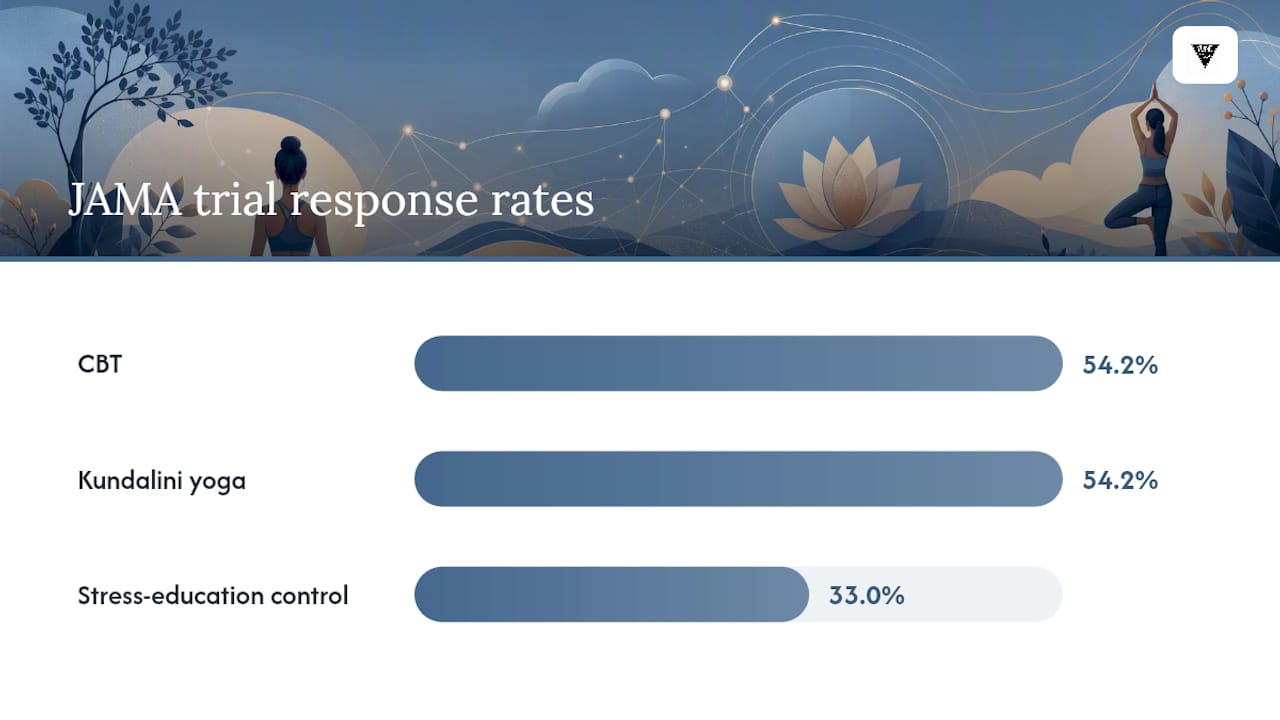
The strongest single piece of evidence is the 2020 JAMA Psychiatry randomized trial involving 226 adults diagnosed with GAD. Participants were assigned to Kundalini yoga, cognitive behavioral therapy (CBT), or a stress-education control. At short-term follow-up, response rates were:
| Treatment | Short-Term Response Rate |
|---|---|
| Cognitive behavioral therapy (CBT) | 54.2% |
| Kundalini yoga | 54.2% |
| Stress-education control | 33.0% |
Yoga beat the control by a meaningful margin. It did not, however, demonstrate noninferiority to CBT, meaning CBT remained the stronger clinical intervention. NYU Langone’s institutional summary of this research positions yoga as a promising complementary approach rather than a standalone first-line treatment.
Beyond this trial, broader reviews and meta-analyses point in the same direction. Harvard Health notes that yoga and music therapy tended to produce the most durable anxiety and depression reductions among older adults in relaxation-intervention reviews. PubMed indexes a growing but heterogeneous body of trials on yoga and mental health, which makes sweeping conclusions difficult.
Honest limitations worth knowing:
- Most trials use small samples and short follow-up periods.
- “Yoga” covers dozens of styles; Kundalini, Hatha, and Yin produce different physiological effects and are rarely compared head-to-head.
- Long-term follow-up data is thin, so how well gains hold after six to twelve months is still an open question.
- Blinding participants is impossible, which introduces expectation bias.
The bottom line: yoga reliably outperforms doing nothing for GAD, and it works best when paired with evidence-based care.
11 poses that calm the nervous system
These poses are drawn from Healthline’s clinically reviewed pose guide and are ordered from most grounding to slightly more active. Hold restorative poses for 1–10 minutes; active poses for 5–10 breaths.
Pro Tip: Use props freely. A natural-rubber mat prevents slipping, a folded blanket under your hips in seated poses removes strain, and a strap around your feet in forward bends lets you relax instead of strain. Props are not a shortcut; they are the point.
-
Child’s Pose (Balasana): Kneel with big toes touching, knees wide. Fold forward and extend arms or rest them alongside your body. Breathe into your back ribs. Breath cue: 4-count inhale, 6-count exhale. Modification: place a bolster or rolled blanket between thighs and chest.
-
Legs Up the Wall (Viparita Karani): Lie on your back, scoot hips close to a wall, and extend legs vertical. Rest hands on belly. Breath cue: natural, slow belly breathing. Modification: place a folded blanket under your hips for lumbar support.
-
Reclining Bound Angle (Supta Baddha Konasana): Lie on your back, soles of feet together, knees falling open. Support each knee with a folded blanket if they hover. Breath cue: slow exhale twice as long as inhale. Modification: keep feet farther from hips to reduce hip-flexor intensity.
-
Supported Bridge Pose: Lie on your back, knees bent, feet flat. Lift hips and slide a block or folded blanket under your sacrum. Release all muscular effort. Breath cue: breathe into the chest. Modification: lower the block height if the lower back feels compressed.
-
Seated Forward Bend (Paschimottanasana): Sit with legs extended. Loop a strap around your feet and hold the ends. Hinge from the hips, not the waist. Breath cue: exhale as you fold deeper. Modification: bend knees generously; the goal is a long spine, not straight legs.
-
Cat-Cow (Marjaryasana-Bitilasana): On hands and knees, alternate between arching and rounding the spine in sync with breath. Breath cue: inhale into Cow (belly drops), exhale into Cat (spine rounds). Modification: do this seated in a chair, hands on knees.
-
Supine Twist (Supta Matsyendrasana): Lie on your back, draw one knee to chest, then guide it across the body. Extend the same-side arm out. Breath cue: exhale into the twist. Modification: place a blanket under the lowered knee to reduce rotation depth.
-
Hero Pose (Virasana): Kneel with feet beside hips, sit between your heels. If this strains the knees, sit on a block. Breath cue: slow, even belly breathing. Modification: sit on a block or folded blanket to protect the knees.
-
Tree Pose (Vrksasana): Stand on one foot, place the other foot on the inner calf or thigh (never the knee). Hands at heart center. Breath cue: steady, even breath to maintain focus. Modification: keep toes of the raised foot lightly touching the floor.
-
Savasana (Corpse Pose): Lie flat, arms slightly away from the body, palms up. Stay completely still for 5–10 minutes. Breath cue: let the breath breathe itself. Modification: place a rolled blanket under the knees for lower-back relief.
-
Yoga Nidra (Yogic Sleep): A guided body-scan relaxation done lying in Savasana. Typically 20–45 minutes via audio guide. Breath cue: natural breath throughout. Modification: any comfortable lying position works; an eye pillow deepens the effect.
Caution: Intense backbends like Wheel or deep Camel can spike sympathetic arousal in anxiety-prone people. If a pose makes your heart race or your breath shorten, back off to a supported version or skip it entirely.
Breathing techniques and mindfulness that pair with yoga
Breath is the fastest lever you have for shifting your nervous system. These three practices take under five minutes each and pair directly with the poses above. For additional mindfulness activities that complement breathwork, pairing them with a short yoga session amplifies the calming effect.
Box breathing (4-4-4-4)
Inhale for four counts, hold for four, exhale for four, hold for four. Repeat six cycles. This technique is used in clinical stress-reduction programs because it equalizes the breath phases and interrupts the shallow, rapid breathing pattern that feeds anxiety. Use it before Child’s Pose or at the start of any session.
Diaphragmatic belly breathing
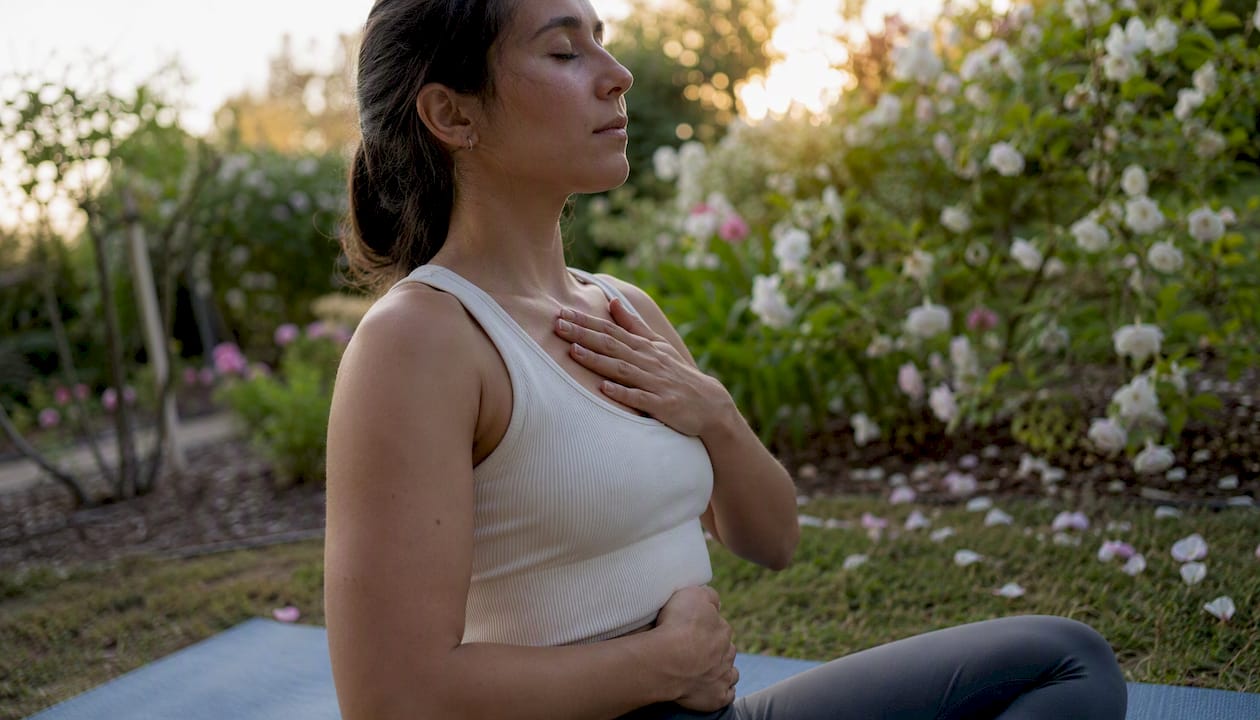
Place one hand on your chest, one on your belly. Breathe so only the belly hand rises. Aim for a 4-count inhale and 6-count exhale. The longer exhale activates the vagus nerve and slows heart rate. This is the breath to use during Legs Up the Wall or Reclining Bound Angle.
Simplified alternate nostril breathing (Nadi Shodhana)
Close the right nostril with your thumb, inhale left for four counts. Close both nostrils briefly. Release the right, exhale right for four counts. Inhale right. Switch. That is one cycle; do five. Research on pranayama suggests this balances left and right hemispheric activity and reduces perceived stress. Use it as a session opener.
60-second body scan for Savasana
Close your eyes. Notice the weight of your heels. Move attention slowly up: calves, knees, thighs, hips, belly, chest, hands, arms, shoulders, jaw, forehead. At each area, exhale and let it soften. No forcing, no judgment. If your mind wanders, return to wherever you left off. That is the entire practice.
Integration tip: Pick one breath technique and use it consistently for two weeks before adding another. Consistency builds the neural association between that breath pattern and calm faster than rotating through all three.
How to build a routine that actually sticks
The research signal is clear: brief, daily practice beats infrequent long sessions for mood regulation. Here are three ready-to-use routines. You can also explore yoga for stress relief and relaxation for additional pose sequences to rotate in.
5–10 minute morning grounding
- Box breathing, 6 cycles (2 minutes)
- Cat-Cow, 10 rounds (2 minutes)
- Child’s Pose (3 minutes)
- Seated belly breathing, 1 minute
20-minute midday reset
- Alternate nostril breathing, 5 cycles (2 minutes)
- Cat-Cow, 10 rounds (2 minutes)
- Seated Forward Bend (3 minutes)
- Supine Twist, both sides (4 minutes)
- Supported Bridge (4 minutes)
- Savasana (5 minutes)
40-minute evening restorative
- Diaphragmatic breathing, lying down (3 minutes)
- Reclining Bound Angle (5 minutes)
- Supported Bridge (5 minutes)
- Legs Up the Wall (10 minutes)
- Supine Twist, both sides (6 minutes)
- Yoga Nidra or Savasana (10 minutes)
Adherence tips that actually work:
- Anchor to a location: designate a specific corner of a room as your practice space. The visual cue alone begins to shift your nervous system before you even unroll your mat.
- Start with the shortest routine: five minutes done daily for two weeks builds more momentum than forty minutes done twice.
- Expect a two-to-four week lag: most people notice a measurable shift in baseline anxiety after two to four weeks of consistent practice, not after the first session.
- Consistency over duration: a ten-minute daily practice is more effective for anxiety management than a ninety-minute session once a week.
A 5–10 minute sequence for when anxiety spikes right now
This sequence is designed for acute anxiety relief. Do it in the order listed.
- Box breathing, seated (2 minutes): four counts in, four hold, four out, four hold. Do not skip this; it primes the nervous system for what follows.
- Child’s Pose (3 minutes): forehead down, arms extended or resting alongside the body. Focus only on the sensation of breath in your back ribs.
- Legs Up the Wall (4 minutes): hips close to the wall, legs vertical, hands on belly. Let gravity drain tension from the legs.
- Savasana with body scan (2 minutes): lie flat, run the 60-second body scan twice.
Total: approximately 11 minutes.
Safety notes: If your heart rate increases, your breathing becomes more labored, or you feel dizzy during any pose, come out slowly and sit quietly. Do not push through physical discomfort. If anxiety escalates into a panic attack during practice, stop, sit upright, and breathe normally. If panic attacks are frequent, discuss yoga practice with your therapist before continuing.
Safety, contraindications, and working with your care team
Yoga is low-risk for most people, but anxiety disorders come in different forms and some situations call for extra care.
Situations where you should consult a professional before starting:
- Active panic disorder with frequent, unpredictable attacks
- PTSD, where body-focused practices can sometimes trigger flashbacks
- Severe depression with low energy or suicidal ideation
- Recent surgery, injury, or unstable cardiovascular conditions
- Pregnancy (certain poses require modification or avoidance)
Questions to bring to your doctor or therapist:
- “Are there specific poses or breath practices I should avoid given my diagnosis?”
- “Can yoga complement my current medication or therapy plan?”
- “What symptoms should prompt me to stop practicing and contact you?”
On integration with therapy and medication: the JAMA Psychiatry trial is explicit that yoga did not match CBT’s effectiveness for GAD. Clinicians consistently recommend yoga as a complement to first-line treatments, not a replacement. If you are currently in CBT or on medication, yoga can reinforce the skills you are building in therapy and support medication by reducing baseline arousal. Tell your prescriber you are practicing; some people find they need to reassess dosing as their baseline anxiety shifts.
Mayo Clinic advises that when anxiety interferes with daily life, professional consultation is the appropriate first step, with complementary practices like yoga added into a broader plan.
What the research reliably shows, and a two-week action plan
What the evidence supports with reasonable confidence:
- Yoga produces measurable short-term anxiety reduction in adults with GAD.
- Restorative and breath-focused styles are better suited to anxiety than vigorous, heat-based styles.
- Regular practice modulates GABA, cortisol, and autonomic markers.
- Yoga works best alongside, not instead of, evidence-based clinical care.
What remains uncertain: long-term durability of gains, optimal session frequency and style, and how results generalize across different anxiety subtypes.
Your two-week action plan: For the next fourteen days, commit to the 5–10 minute morning grounding routine every day. Keep a simple one-line note after each session: “anxiety before” (1–10 scale) and “anxiety after” (1–10 scale). At the end of two weeks, look at the pattern. If you see a consistent downward trend, extend to the 20-minute midday reset three times per week. If you see no change after two weeks of daily practice, that is useful information too: bring it to your therapist and discuss whether a different style or a clinical adjustment makes sense.
Diet and lifestyle habits that make yoga work better
Yoga does not operate in isolation. What you eat, how you sleep, and how much you move the rest of the day all influence your baseline anxiety level, which in turn determines how much a yoga session can shift.
Sleep is the most direct lever. Anxiety and poor sleep are bidirectional: each worsens the other. A consistent sleep schedule, combined with an evening restorative yoga routine, tends to reduce sleep-onset anxiety more effectively than either alone. Aim for a fixed wake time even on weekends; it anchors your circadian rhythm and stabilizes cortisol patterns.
Caffeine and alcohol both raise baseline sympathetic arousal. Caffeine increases cortisol and can mimic anxiety symptoms; alcohol disrupts REM sleep and raises next-day anxiety. Neither needs to be eliminated entirely, but timing matters. Cutting caffeine after noon and limiting alcohol to two or fewer drinks on practice days is a practical starting point. For more on how nutrition supports your practice, eating well for yoga fitness covers the key dietary principles.
Magnesium is worth mentioning because deficiency is common and is associated with heightened stress reactivity. Leafy greens, pumpkin seeds, and dark chocolate are good dietary sources. This is not a supplement pitch; it is a gap many anxious people have without knowing it.
Aerobic movement outside of yoga also matters. Even a 20-minute brisk walk raises BDNF (brain-derived neurotrophic factor) and reduces cortisol. Think of yoga as the nervous-system regulator and aerobic exercise as the mood stabilizer; they work on overlapping but distinct pathways.
Social connection is underrated in anxiety management. Isolation amplifies anxious rumination. A group yoga class, even once a week, adds a social layer that solo home practice cannot replicate.
Common barriers to keeping up a yoga practice, and how to get past them
The most common reason people stop practicing is not lack of motivation. It is friction: the mat is in a closet, the routine takes too long, or one missed day becomes two weeks off.
“I don’t have time” is usually a scheduling problem, not a time problem. A five-minute practice before your morning coffee requires no commute, no class schedule, and no equipment beyond a mat on the floor. The 5-minute morning routine in this article was designed specifically for this objection.
“I’m not flexible enough” misunderstands what yoga is for. Flexibility is a byproduct, not a prerequisite. Every pose in this article has a modification that removes the flexibility requirement entirely. Straps and blankets exist precisely so you can get the nervous-system benefit without the physical demand.
“I tried it once and it didn’t help” reflects a realistic expectation gap. A single session produces a transient effect. The research on anxiety reduction is based on weeks of consistent practice, not one class. Two weeks of daily five-minute sessions will tell you more than one forty-minute class ever could.
“I lose focus and my mind wanders” is not a failure of meditation; it is the practice. Every time you notice your mind has wandered and return to the breath, you are strengthening the same neural circuit that reduces anxiety reactivity. The wandering is not the problem; staying lost in the thought is. Noticing and returning is the rep.
“I feel worse after some sessions” sometimes happens with intense backbends or fast-paced styles. Restorative yoga and breath-focused practices are consistently better tolerated by anxiety-prone people than vigorous or heated styles. If a class leaves you more wired than when you started, switch styles before you quit the practice entirely.
Long-term benefits and the honest limits of yoga for anxiety
Over months and years of consistent practice, the evidence suggests yoga produces changes that go beyond session-to-session relief. Harvard Health’s review of relaxation interventions found yoga among the approaches with the most durable anxiety and depression reductions, particularly in older adults. Structural brain changes, including increased gray matter in the hippocampus and prefrontal cortex, have been observed in long-term meditators, and yoga’s mindfulness component likely contributes to similar effects over time.
That said, the honest limits deserve equal space. Most yoga-and-anxiety trials run for eight to twelve weeks. What happens at six months or two years is largely unknown. The heterogeneity of yoga styles makes it difficult to say “yoga works” as a blanket statement; Kundalini yoga studied in a randomized trial is a very different intervention from a drop-in hot yoga class. And for people with severe GAD, OCD, or PTSD, yoga alone is unlikely to produce the kind of symptom reduction that structured psychotherapy achieves.
The practical takeaway: yoga is a durable, low-cost tool for managing anxiety naturally when used consistently and paired with appropriate clinical care. It is not a cure, and it does not need to be. A practice that reliably lowers your baseline arousal, improves sleep, and gives you a breath tool for acute moments is genuinely useful, even if it never replaces a therapist.
An honest perspective on yoga and anxiety
The gap between what yoga promises and what it delivers is smaller than skeptics claim and larger than wellness marketing suggests.
What gets undersold is the mechanism specificity. Most people think yoga helps anxiety because it is relaxing, the way a warm bath is relaxing. The actual mechanism is more interesting: you are training your nervous system to tolerate discomfort without escalating. Every time you hold a pose slightly past comfortable and breathe through it, you are practicing the same skill that CBT targets cognitively. The body learns it faster than the mind does, which is why some people notice a shift in anxiety reactivity before they can articulate why.
What gets oversold is the speed. Wellness content routinely implies that the right pose sequence will resolve anxiety. The JAMA trial’s 54.2% response rate is genuinely encouraging, but it also means nearly half of participants did not respond. Yoga is not universally effective, and pretending otherwise sets people up to blame themselves when it does not work immediately.
The most useful reframe: treat yoga as a nervous-system training program, not a relaxation technique. You are building capacity, not seeking relief. That shift in expectation changes how you practice and how you evaluate progress.
The right gear makes a consistent practice easier
A consistent home practice is easier when your setup removes friction rather than adding it. Yuneyoga’s natural-rubber mats provide the grip and cushioning that restorative poses require, so your attention stays on the breath instead of slipping hands. A quality yoga strap lets you hold seated forward bends without straining, which is exactly the modification that makes those poses accessible for anxious beginners. Folded yoga towels double as blankets for supported poses like Reclining Bound Angle and Savasana.
None of this requires a large investment. A mat, a strap, and a towel cover every pose and routine in this article. Browse Yuneyoga’s curated selection to find the combination that fits your practice and your space. Yoga is not a medical treatment, and the gear does not make it one, but the right setup makes showing up every day a little easier, and consistency is what actually moves the needle on anxiety.
Sources
- Efficacy of Yoga vs Cognitive Behavioral Therapy vs Stress Education for the Treatment of Generalized Anxiety Disorder | JAMA Psychiatry
- Yoga for better mental health - Harvard Health
- How Yoga Affects the Brain and Body to Reduce Stress – Lifestyle Medicine
- Herbal treatment for anxiety - Mayo Clinic
- Yoga Shown to Improve Anxiety, Study Finds


