
Sand-Resistant Yoga Mat: What It Is and How to Choose One
A sand-resistant yoga mat is built so that grit and moisture stay on the surface rather than embedding in the material. The key is construction: closed-cell surfaces block sand and water from entering the mat’s pores, while tightly woven or laminated top layers let you shake or brush particles off in seconds. If you practice on the beach or travel to coastal spots, this distinction matters more than thickness or brand name.
The fastest way to get this right: choose a closed-cell or microfiber-bonded surface. Everything else — weight, thickness, material — is a trade-off you can adjust once that baseline is met.
- What it is: A mat engineered with a sealed or tightly woven surface that resists sand and moisture absorption.
- Core materials: TPE (thermoplastic elastomer), high-density PVC blends, coated natural rubber, and microfiber-topped constructions.
- Why it matters: Open-cell foam absorbs grit like a sponge, abrading the material and creating unsanitary conditions over time.
- Yuneyoga’s focus: Eco-conscious, travel-ready mats built for exactly this kind of outdoor use.
Table of Contents
- What features make a mat truly sand-resistant?
- How sand-resistant mats are actually built
- Portability vs. cushioning: which trade-off fits your practice?
- Practical buying checklist and red flags to watch for
- How to clean and maintain your mat after beach sessions
- Grip, moisture management, and hygiene on wet surfaces
- Best use cases and accessories for outdoor practice
- Key Takeaways
- What beach practice has taught us about choosing the right mat
- Yuneyoga’s picks for beach and travel practice
- Useful sources
What features make a mat truly sand-resistant?
Not every mat labeled “beach-friendly” actually keeps sand out. Here is what to look for before you buy.
- Closed-cell or sealed surface: The single most important spec. No open pores means no place for sand to hide.
- Smooth or tightly woven top layer: Deep grooves trap grit that cannot be shaken out; a smooth or fine-weave surface lets particles slide off cleanly.
- Water resistance or quick-dry claim: Look for this explicitly in the product description, not just implied by the material name.
- Lightweight and packable: Thin travel mats (around 1–2mm) roll or fold small; dense studio mats (4–6mm) offer more cushioning but add bulk.
- Easy-clean surface: Machine-washable or wipe-clean construction saves time after salty sessions.
Pro Tip: If a mat’s spec sheet lists “open-cell foam” or shows deep geometric grooves in product photos, skip it for beach use — no coating will fully compensate for that base construction.
How sand-resistant mats are actually built
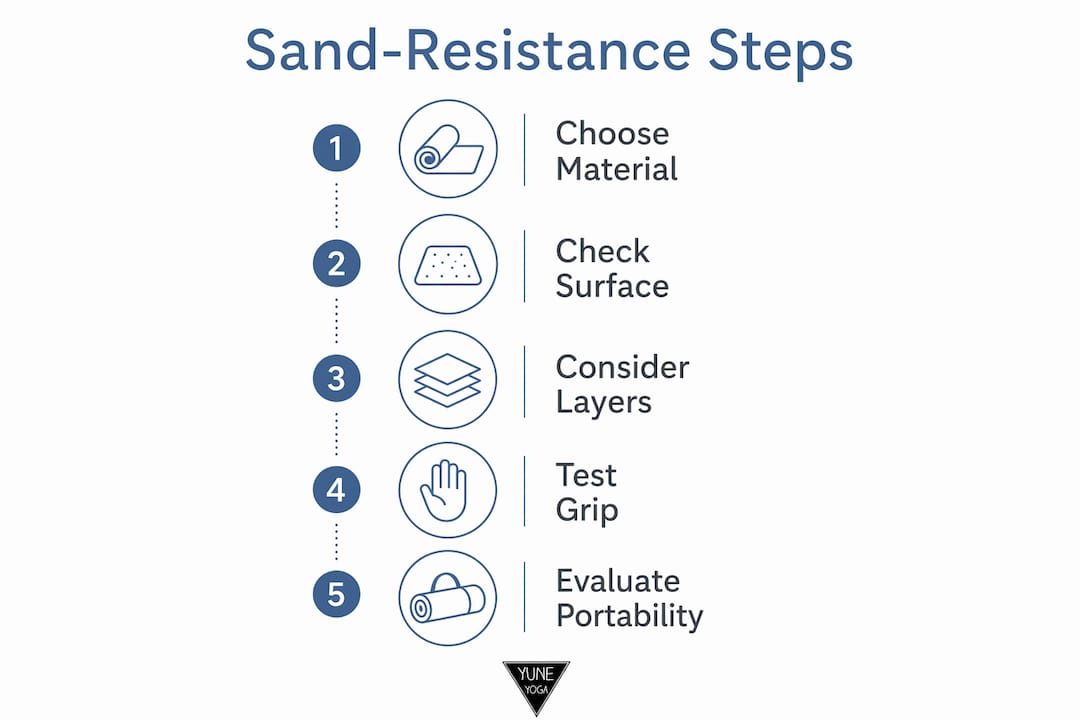
The difference between a mat that works on sand and one that doesn’t comes down to two things: what the surface is made of and how the layers are bonded together.
Closed-cell vs. open-cell construction
Open-cell mats act like sponges. Sand and moisture enter the pores, and once embedded, the particles abrade the material from the inside. Closed-cell mats seal those pores at the manufacturing stage, so water beads off and sand stays on the surface where you can brush it away.
Surface texture and coatings
Smooth or lightly textured tops shed sand naturally. Some mats use a laminated or coated top layer, which adds a thin sealed film over the base material. This works well until the coating wears through, so durability matters as much as the initial spec.
Microfiber-bonded layers
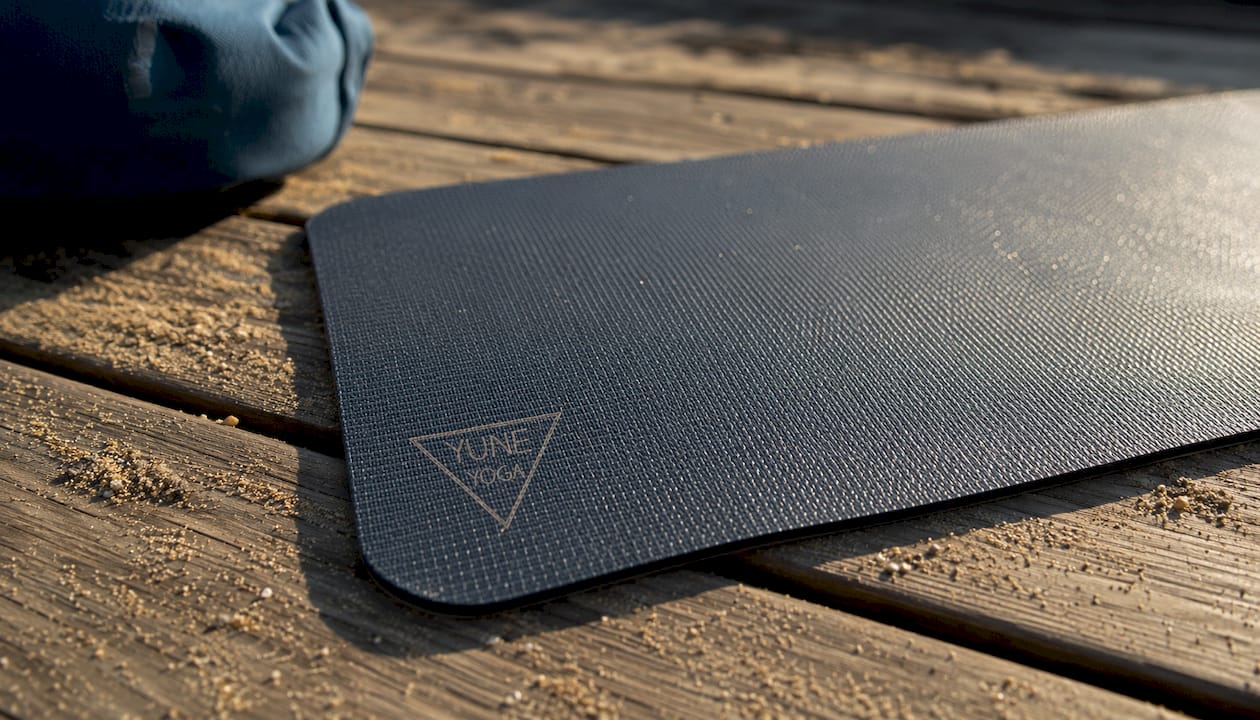
Microfiber-topped mats bond an absorbent towel layer directly to a rubber or TPE base. The microfiber manages sweat and grit simultaneously: moisture is absorbed into the fibers, and loose sand falls away rather than embedding. Grip actually improves as the surface gets damp, which is the opposite of what happens on a standard mat.
Dual-layer and mesh weave designs
Some outdoor mats use a staggered two-layer mesh system where sand passes through the top layer and collects beneath the mat rather than on the surface you practice on. These work well as perimeter or base mats under a thinner practice mat.
| Material | Sand Resistance | Grip | Weight | Best For |
|---|---|---|---|---|
| TPE (closed-cell) | High | Good | Light | Travel, all-around beach use |
| High-density PVC blend | High | Good | Moderate | Regular beach practice |
| Coated natural rubber | High | Excellent | Moderate–heavy | Grip-focused outdoor flows |
| Microfiber-topped rubber | High | Excellent when damp | Moderate | Hot, sweaty beach sessions |
| Vegan suede with silicone ribs | Moderate | Good when damp | Moderate | Dry-to-light-moisture conditions |
Portability vs. cushioning: which trade-off fits your practice?
Ultra-light, thin mats prioritize packability and often lack the high-density cushioning needed for uneven sand. That is the core tension every beach yogi faces.
- Thin travel mats (1–2mm): Easy to roll, strap to a bag, and shake clean. Knees and wrists feel the ground on rocky or shell-covered shores.
- Dense closed-cell mats (4–6mm): Smooth out uneven sand and protect joints, but they add weight and bulk that makes a beach walk less fun.
- The hybrid fix: Pair a thin foldable travel mat with a folded towel or thin foam pad under the knees. You get packability plus targeted cushioning without carrying a full studio mat.
Who needs what:
- Mobile travel yogis who move between locations: go thin, go light, add a towel layer.
- Beach regulars with a fixed spot: a denser closed-cell mat is worth the extra weight.
- Practitioners with joint sensitivities: prioritize thickness and pair with a ground pad rather than sacrificing cushioning for portability.
Pro Tip: Soft powder-sand beaches compress under a mat and provide some natural cushioning. Rocky or shell-covered shores do not — adjust your thickness choice based on the specific beach, not just the general category.
Practical buying checklist and red flags to watch for
Before you commit to a mat, run through these questions against the product listing.
- Does the description explicitly say “closed-cell” or “sealed surface”?
- Is the top layer smooth, lightly textured, or microfiber-bonded rather than deeply grooved?
- What material is listed? TPE, PVC blend, coated rubber, or microfiber-topped rubber all work; generic “foam” without further detail is a red flag.
- What is the weight and thickness? Does that match your portability needs?
- Does it claim water resistance, quick-dry, or easy-clean properties?
- Can you machine wash it, or is it wipe-clean only?
Red flags to avoid:
- “Open-cell foam” anywhere in the spec sheet.
- Deep geometric or grid texturing shown in product photos.
- No mention of water resistance or cleaning instructions.
- Vague claims like “beach-ready” with no material or construction details to back them up.
Marketing language like “sand-proof” is a description of intent, not a certified standard. Read the construction details, not just the headline claim. A mat with a sealed surface and quick-dry properties will tell you so in the specs.
How to clean and maintain your mat after beach sessions
Salt and sand are slow damage agents. A five-minute routine after each session prevents most long-term wear.
- Shake and dry-brush immediately after practice. Remove loose sand before it works into any surface texture.
- Rinse with fresh water after every salty session. Salt crystallization accelerates surface degradation if left to dry on the mat.
- Wash with mild biodegradable soap and a soft cloth weekly or after heavy use. Avoid abrasive sponges, which scratch sealed surfaces.
- Air dry in the shade. Direct sun degrades most mat materials over time, especially rubber and TPE.
- Store flat or loosely rolled. Avoid tight folds in heavy closed-cell mats for extended periods, which can cause creasing or delamination.
When to replace: Persistent odor that survives cleaning, visible micro-abrasion on the surface, or a coating that peels or flakes are all signs the mat’s sand resistance is compromised.
Pro Tip: Keep a small spray bottle of fresh water in your beach bag. A quick rinse on-site before the salt dries is faster and more effective than a full wash at home later.
Grip, moisture management, and hygiene on wet surfaces
Moisture is the variable most practitioners underestimate. Even a closed-cell mat loses traction when the surface is wet, unless it uses a microfiber layer that restores grip as it absorbs moisture.
- Microfiber-topped mats grip better as they get damp, making them the strongest choice for sweaty outdoor flows.
- Smooth TPE or PVC surfaces can get slippery when wet. A thin microfiber towel overlay solves this without replacing the mat.
- Tack-up sprays designed for yoga mats can restore surface grip temporarily, but check that the spray is safe for your mat’s material before applying.
- Repositioning: Move to a drier section of the mat between sequences if the surface becomes saturated.
On hygiene: wet mats that lack moisture management promote bacterial growth. Closed-cell construction limits microbial penetration, but rinsing and drying after every session is what actually keeps a mat sanitary. Test grip on a small area before starting any active sequence on a wet surface, and avoid sudden transitions that require stable footing on a saturated mat.
Best use cases and accessories for outdoor practice
Sand-resistant mats perform best in specific scenarios, and a few accessories make the difference between a frustrating session and a clean one.
- Windy powder-sand beaches: A heavier closed-cell mat stays put better than an ultra-light one. Use water bottles or bag weight at corners if wind is a factor.
- Compact travel sessions: Thin TPE or foldable mats with a travel strap pack into carry-on luggage without issue.
- Rocky or shell-covered shorelines: Prioritize thickness and pair with a ground pad for joint protection.
- Hot outdoor flows: Microfiber-topped mats handle sweat and heat better than smooth surfaces.
Useful accessories:
- Bonded microfiber towels laid over a smooth mat restore grip and add a washable hygiene layer.
- Sand-perimeter ground mats with multi-weave construction keep your practice zone sand-free by letting particles fall through to the bottom layer.
- Yoga straps or cargo bags make carrying a rolled mat to the beach straightforward.
- Quick-dry towels double as corner weights and post-session wipe-downs on multi-day trips.
For packing: roll rather than fold when possible, use a strap or bag to keep the mat clean in transit, and pair a thin mat with a quick-dry towel for a lightweight, complete beach kit.
Key Takeaways
A sand-resistant yoga mat’s closed-cell or tightly woven surface is the single feature that separates a mat that works on the beach from one that traps grit and degrades within a season.
| Point | Details |
|---|---|
| Closed-cell surface is non-negotiable | Sealed pores block sand and moisture from embedding, keeping the mat clean and intact. |
| Surface texture matters as much as material | Smooth or microfiber-bonded tops shed sand; deep grooves trap grit that cannot be shaken out. |
| Balance portability against cushioning | Match mat thickness to your shore type: thin for powder sand, thicker for rocky or shell-covered beaches. |
| Simple care preserves performance | Shake, rinse with fresh water, and air-dry in shade after every beach session to prevent salt damage. |
| Yuneyoga offers travel-ready options | Eco-conscious foldable mats, microfiber-topped options, and straps curated for beach and travel practice. |
What beach practice has taught us about choosing the right mat
There is a tendency in the yoga world to treat mat selection as a studio problem, something you solve once and forget. Beach practice exposes every flaw in that thinking fast.
The practitioners who struggle most on sand are not beginners. They are experienced yogis who brought a perfectly good studio mat to the beach and discovered that “good” is context-dependent. Open-cell foam that performs beautifully on a hardwood floor becomes a grit trap within one session on sand. A thick, cushioned mat that feels luxurious indoors turns into a heavy, slow-drying liability when you are rinsing salt out of it at a beach shower.
What actually matters outdoors is moisture management first, surface construction second, and portability third. Most buyers reverse that order, prioritizing thickness or brand recognition. The result is a mat that works once and then spends the rest of the trip damp and sandy in the corner of a rental.
At Yuneyoga, the focus on eco-conscious materials and travel-ready design is not a marketing angle. It reflects what outdoor and traveling practitioners actually need: mats that handle real conditions, pack without complaint, and clean up in minutes. The Yuneyoga blog covers these trade-offs in depth for readers who want to go further than a single guide.
Yuneyoga’s picks for beach and travel practice
If you have read this far, you know what to look for. Yuneyoga makes finding it straightforward.

The Yuneyoga collection includes foldable travel mats in TPE and natural rubber, microfiber-topped options for sweaty outdoor flows, and yoga straps designed for carrying a rolled mat to the beach without a bag. Every selection prioritizes the features this guide covers: closed-cell or sealed surfaces, quick-dry materials, and packable dimensions that fit a carry-on or a beach tote. Sustainable materials are standard, not an upgrade.
For practitioners who want a complete beach kit, Yuneyoga’s product bundles pair mats with towels and straps so you leave for the beach with everything already sorted. Browse the full range and find the combination that fits your shore.
Useful sources
- 6 Best Yoga Mats for Beach Yoga That Resist Sand — Swimmer Living
- 8 Sand-Resistant Yoga Essentials for Beach Stretching Sessions — Swimmer Living
- Best Beach Yoga Mat Guide: Find Your Zen on Sand! — It’s Yoga Puerto Rico
- Outdoor Exercise Mat — CGEAR Sand-Free
- How to choose a yoga mat — IPYM
- Yuneyoga Blog: Travel Yoga Mat Guides
Consult manufacturer cleaning instructions for your specific mat material before using any soap or spray, and always test grip on a small area before beginning an active sequence on a wet or unfamiliar surface.


