Article: Vegan Yoga Towels: What to Look for and What to Skip
Vegan Yoga Towels: What to Look for and What to Skip
Most yoga towels are vegan by default, because they are made from synthetic fibers like polyester and nylon or from plant fibers like cotton. The catch is that “vegan” is rarely printed on the label, and the materials that make a towel vegan are not always the ones that make it eco-friendly. Below, we explain what makes a towel animal-free, how to check the green claims on the tag, and how to choose one that grips your mat.
TL;DR
- A yoga towel is vegan when no part of it, including dyes, glues and trims, comes from animals. Microfiber (polyester/nylon blends) and cotton are normally animal-free. Wool or silk blends are not.
- Vegan does not mean sustainable. Recycled polyester cuts plastic waste but sheds microfibers in the wash. Organic cotton is plastic-free but takes more water and land.
- Ignore vague words like “eco-friendly.” Look for specific claims, such as a recycled-content percentage backed by a Global Recycled Standard (GRS) certificate.
- Grip matters more than the label. Most microfiber towels grip best when damp, so mist them before class.
- If a brand does not state the material and any vegan certification on the product page, ask before you buy.
Table of Contents
- What makes a yoga towel vegan?
- Vegan is not the same as eco-friendly
- How to read the green claims on a label
- Why a yoga towel matters in the first place
- How to choose a vegan yoga towel: a checklist
- Getting grip from a microfiber towel
- Caring for your towel so it keeps gripping
- Our perspective: what we would tell a friend
- Pairing a towel with the right mat
- Shop our yoga towels
- FAQ
- Sources
What makes a yoga towel vegan?
A vegan product contains no animal-derived materials. For a yoga towel, that rules out a short list of fibers and a few less obvious ingredients:
- Wool and wool blends. Rare in yoga towels, but they show up in some “natural” hand and meditation cloths.
- Silk. Sometimes used in luxury face or hand towels.
- Animal-derived finishes or adhesives. Rare, but the reason a certificate is more reliable than a guess.
The common yoga towel materials are all animal-free:
| Material | Typically vegan? | Main strength | Main drawback |
|---|---|---|---|
| Microfiber (polyester/nylon) | Yes | Wicks sweat, dries fast, grips when damp | Synthetic, sheds microfibers when washed |
| Recycled polyester (rPET) | Yes | Keeps plastic bottles out of landfill | Still sheds microfibers |
| Organic cotton | Yes | Biodegradable, plastic-free | Heavier, slower to dry, less grip when soaked |
| Bamboo-based fabrics | Usually | Soft feel | Processing varies, so ask how it is made |
The word “usually” in that table is deliberate. Fiber type tells you what the towel is mostly made of. It does not tell you about every dye, backing or silicone grip dot. When a brand wants to prove a product is animal-free, it can show a third-party mark. More than 1,000 companies use the PETA-Approved Vegan logo on clothing, accessories and home items, so it is a mark you may see on towels too. If you cannot find one, check the product page for a full material list.
Vegan is not the same as eco-friendly
Shoppers searching for vegan towels often care about animals and the planet together. The two do not always line up.
Sustainability writers covering yoga towels point to a built-in trade-off: recycled polyester reduces plastic waste but sheds microplastics in the laundry, while organic cotton is biodegradable and plastic-free but needs far more water and land to grow. Their conclusion is that no material is perfect. The right pick depends on how you practice and which impact matters most to you.
That is a useful way to decide:
- You practice hot yoga or sweat heavily. A microfiber or recycled-polyester towel will manage moisture better than cotton. You can reduce the downside by washing less often and using a laundry bag designed to catch microfibers.
- You practice gently, or in a cool room. Organic cotton may be all you need, and you avoid synthetic shedding entirely.
- You travel. Light, fast-drying synthetic fabric packs smaller and dries overnight in a hotel room.
How to read the green claims on a label
A tag that says “eco-friendly” tells you almost nothing. The U.S. Federal Trade Commission’s Green Guides say that marketers should not make broad, unqualified general environmental benefit claims like “green” or “eco-friendly,” because such claims are very hard to substantiate. A better label tells you exactly what is eco-friendly about the product and by how much.
Here is what specific looks like:
- A recycled-content percentage. “Made from 80% post-consumer recycled polyester” beats “made with recycled materials.”
- The type of recycled material. A “30% recycled” claim is not standardized, and it can combine pre-consumer scraps and industrial waste rather than post-consumer bottles.
- A certification you can look up. The Global Recycled Standard is a voluntary, full product standard for third-party certification of recycled content, chain of custody, and social and environmental practices. It applies to products with at least 20% recycled material and includes chemical restrictions, which speaks to the worry about hidden toxins in textile dyes. Textile Exchange publishes the standard itself, and a certified brand should be able to show you its certificate.
- A named material, not a mystery blend. “Microfiber” alone is vague. “Polyester and nylon, with a silicone dot backing” is useful.
If a product page makes none of these specifics, treat the green language as marketing and move on, or write to the brand and ask.
Why a yoga towel matters in the first place
A towel does a different job from the mat it sits on. Wirecutter’s reviewer describes it plainly: in hot, sweaty conditions a yoga towel is crucial because it wicks away perspiration and keeps you from slipping as much as you might on a slick mat. The same review found that top towels are mostly made of microfiber, a synthetic fabric valued for durability and moisture-wicking.
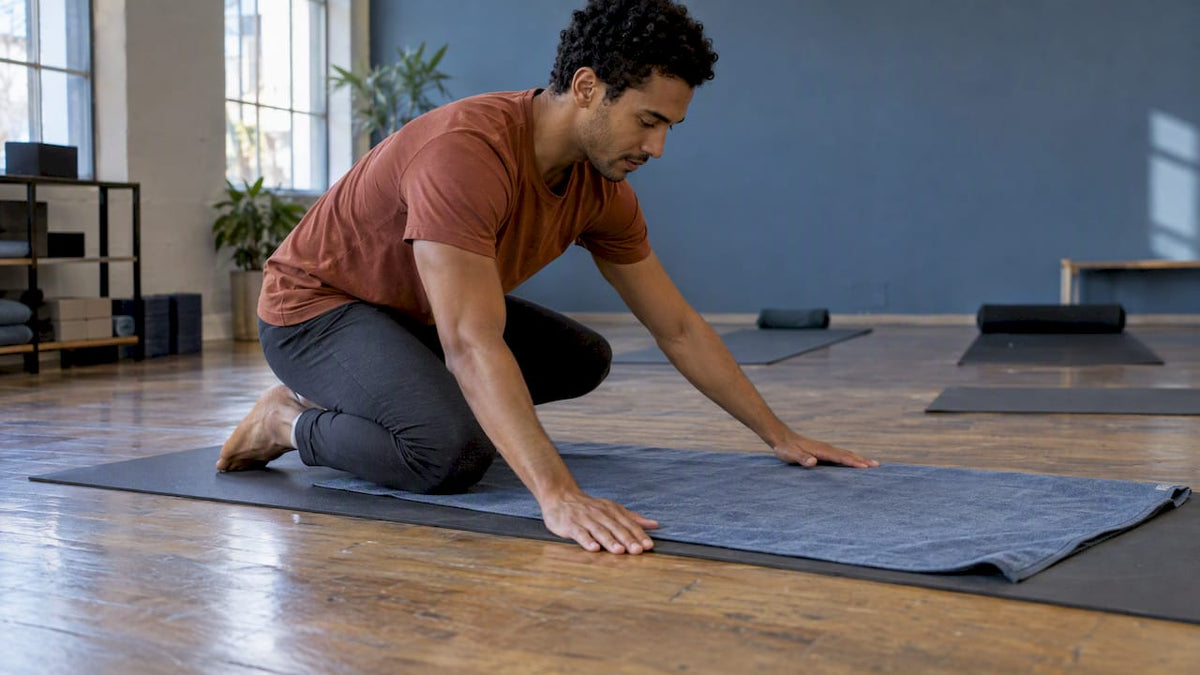
Instructors add a second point: stability. A good towel acts as an extension of the mat, and it should anchor to the mat rather than bunch during transitions and sun salutations. Bunching is what makes you adjust your towel mid-flow, and it is where wrists and ankles get caught.

If you want the longer case for using one, we cover it in our posts on the benefits of using a yoga mat towel and why a yoga mat towel is essential.
How to choose a vegan yoga towel: a checklist
Work through these in order. They take two minutes and save you a return.
- Confirm the material. Look for a stated fiber list. Skip any towel that mentions wool or silk.
- Look for a vegan mark or a clear statement. A third-party logo is strongest. A plain material list is the minimum.
- Check recycled claims. Want a number and a certification, not a slogan.
- Match size to your mat. Standard mats are about 68 to 72 inches long and 24 inches wide, so a towel around 24 by 70 inches covers most of them. Full coverage means no bare mat showing at the edges.
- Pick grip that suits your practice. Silicone dots or a textured underside keep the towel in place. For lighter practice, a smooth towel layered on a grippy mat is often enough.
- Think about care. Choose something you will actually wash after class. A towel you leave in a gym bag is a towel that smells.
For a deeper walk-through of fit and grip, see our guide on how to choose a yoga mat grip towel. If hot yoga is your main practice, our roundup of hot yoga mat towels for a slip-free practice goes through what to look for.
Getting grip from a microfiber towel
The most common complaint about a good microfiber towel is that it slides. Most of the time it is not defective. It is dry.
Microfiber towels behave differently dry and damp. Many high-performance towels need moisture, from sweat or a light water mist, to activate their grip. Practicing on a dry towel often leads to slipping, and people wrongly blame the towel.
A simple routine:
- Lay the towel flat on a clean mat and smooth out wrinkles from the center outward.
- Mist it lightly with water before you begin, especially in a cool or air-conditioned room.
- Keep sweat from pooling in one spot by shifting your weight evenly through the first few poses.
- If it creeps, stop and reset it rather than pushing through. A sliding towel at the top of a downward dog is how people strain a shoulder.
Caring for your towel so it keeps gripping
Care affects both grip and the environmental footprint of the towel.
- Wash microfiber separately. It acts like a magnet for lint, hair and dust, so it is standard practice to wash it apart from other laundry, which also protects the surface texture that provides grip.
- Wash only when needed. Rinse and hang to dry after light sessions, and run a full wash after sweaty ones. Fewer washes means less microfiber shedding.
- Skip fabric softener. It coats fibers and can dull grip. This is general laundry practice, so check the care tag on your own towel first.
- Air dry when you can. It is gentler on the fabric and uses no energy.
Our perspective: what we would tell a friend
We make yoga mats, towels and straps, and we think about this question a lot. Our view is that the useful question is not “is it vegan?” in isolation. It is “what is it made of, and can the brand show me?”

Some of the best-performing towels are synthetic, and that is fine for people who sweat. What matters is that the material list is honest and the claims are specific. We would rather you read a product page carefully than trust a leaf icon. That is also how we think about our own range, which is built around sustainable materials and designs meant to work at home and on the road. Before you buy any of our towels, read the product page for the material details, and if something is unclear, ask us.
We also think a towel should earn its place in your bag. It should anchor to the mat, dry quickly enough to pack, and hold up to repeated washing. If it does those three things, you will use it for years, and the most sustainable towel is the one you do not replace.
— Nicholas
Pairing a towel with the right mat
A towel works best on a mat that does its own part of the job. A natural rubber mat has a grippy surface that holds the towel in place, so it is less likely to bunch. If you want that setup, our natural rubber yoga mats are a good starting point. If you travel, a foldable mat such as the Fir Trekk travel mat packs small alongside a quick-drying towel.
Shop our yoga towels
If you are ready to compare options, browse our yoga towels collection. It includes designs such as the Tiger yoga towel and the Zebra stripe yoga towel, both sized for standard mats. Each product page lists the material details, so you can check them against the checklist above. If you want a full kit, the yoga mat, towel and strap set puts the three together.
FAQ
Are microfiber yoga towels vegan?
Usually, yes. Microfiber is typically made from polyester and nylon, which are synthetic and animal-free. The exceptions are rare, such as a blend that includes wool or a finish with an animal-derived ingredient. Look for a full material list or a third-party vegan mark to be sure.
Is a vegan yoga towel better for the environment?
Not automatically. Vegan describes the ingredients, not the footprint. A recycled-polyester towel reduces plastic waste but sheds microfibers, while an organic cotton towel is biodegradable but needs more water and land. Choose based on the specific claims and on how you practice.
How do I know a “recycled” yoga towel is really recycled?
Ask for the percentage and the certification. A Global Recycled Standard certificate means the recycled content has been verified through the supply chain. A bare “made with recycled materials” claim, with no number, is much harder to trust.
Why does my yoga towel slip?
It is probably dry. Many microfiber towels need sweat or a light mist of water to grip. Dampen it, smooth it flat on a clean mat and reset it if it creeps.
Can I use a regular cotton bath towel instead?
You can, but it will usually bunch and slide more than a towel made for yoga. Yoga towels are designed to absorb moisture and grip the mat beneath you. A bath towel works for a gentle session in a cool room, not for a sweaty one.
Sources
- Environmental Claims: Summary of the Green Guides, Federal Trade Commission
- Global Recycled Standard, Textile Exchange
- GRS Certified Polyester Fabric, Weaverine
- Sustainability Spotlight: Best Eco-Friendly Yoga Mat Towels for 2026, My Yoga Zone
- The 6 Best Yoga Mat Towels for Mopping Up Sweat Mid-Practice, How2Fit
- The 8 Best Yoga Towels, Shape
- Hot yoga towels review, Wirecutter
- PETA-Approved Vegan logo, PETA